Introduction
Most e-commerce teams are collecting more behavioral data than ever — clickstreams, cart events, purchase sequences, search queries — and using almost none of it to make decisions. That gap is where revenue leaks.
Machine learning converts dormant behavioral data into predictions: what to recommend, which customers are about to churn, where to set a price, and which transactions are fraudulent. The gap between teams that have shipped ML and those still evaluating it is widening fast.
Grand View Research estimates the global AI in retail market at $11.61 billion in 2024, growing to $40.74 billion by 2030. That's current infrastructure spending, not a future forecast.
Meanwhile, Baymard's 2025 analysis of 50 studies puts average cart abandonment at 70.22%. A significant share of that is recoverable — and ML addresses it through smarter personalization, better search, and targeted retention offers.
This article covers the six highest-impact ML use cases, how to implement them without stalling, and the pitfalls most teams hit along the way.
Key Takeaways
- Start with a specific revenue decision, not an algorithm — the use case defines the model
- Recommendations and search deliver the fastest ROI for most teams starting out
- Data quality and pipeline reliability matter more than model complexity
- Build in monitoring and retraining from day one — every model drifts without it
- Shopify, Salesforce, and Adobe Commerce all offer embedded ML tools — no full rebuild required
What Machine Learning Actually Does in E-Commerce
ML is not a single tool. It's a category of algorithms that learn patterns from historical data — purchases, browsing behavior, pricing events, inventory movements — and use those patterns to make predictions at a scale and speed no human team can replicate.
The practical difference from rules-based automation matters. A rules-based system fires a 10% discount when a cart sits idle for 24 hours — every time, regardless of who the customer is. An ML model looks at that customer's full history, their likelihood of converting without a discount, and their price sensitivity, then decides whether to send the offer, change the amount, or do nothing.
And it gets better as more data flows in.
Three Learning Approaches That Matter for E-Commerce
| Approach | What It Does | E-Commerce Applications |
|---|---|---|
| Supervised learning | Learns from labeled historical outcomes | Demand forecasting, fraud detection, churn prediction |
| Unsupervised learning | Finds hidden structure in unlabeled data | Customer segmentation, product clustering |
| Reinforcement learning | Optimizes decisions through trial and reward signals | Dynamic pricing, promotional optimization |
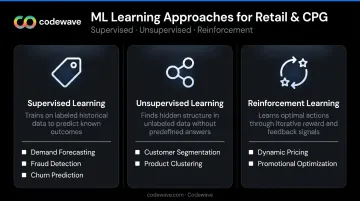
Different use cases genuinely require different model types. That's why starting with the business decision, not the algorithm, is the right place to begin any ML implementation.
Each of these approaches plugs into a specific layer of the e-commerce stack. ML sits between the data layer (transaction logs, CRM records, web analytics) and the customer-facing layer: storefront, email, chat. Its job is to turn raw signals into actions — surface a product, adjust a price, send a retention offer.
Top Machine Learning Use Cases in E-Commerce
Personalized Product Recommendations
Recommendation engines use two core techniques. Collaborative filtering matches a shopper to others with similar behavior and surfaces what those customers bought. Content-based filtering analyzes attributes of items a customer has already purchased and finds similar products. Production systems typically blend both, personalizing results per session rather than showing everyone the same bestseller list.
The numbers back this up. According to Salesforce Einstein data, sessions where shoppers clicked a recommendation represented just 7% of all visits but drove 24% of orders and 26% of revenue — with recommendation clickers generating 26% higher average order value. These figures are vendor-reported, but the directional logic is consistent with how personalization behaves across the industry.
McKinsey's personalization research puts revenue lift from personalization at 10–15% most commonly, with a range of 5–25% depending on execution quality. The same research found 71% of consumers expect personalized interactions and 76% are frustrated when they don't get them.
Smart Search and Discovery
ML-powered search goes well beyond keyword matching. Natural language processing lets the search layer understand intent, tolerate typos, recognize synonyms, and surface relevant substitutes — even when a query is vague or conversational. A shopper typing "cozy winter sweater women" should see cardigans and turtlenecks, not a literal keyword match against a product title field.
The conversion impact of better search is direct: shoppers who can't find what they want leave. Historical Econsultancy data (2013) showed site search users converting at 4.63% versus a 2.77% site average, and up to 30% of visitors used site search. That conversion premium has likely grown as search behavior has shifted toward longer, more conversational queries.
Bloomreach reports that its AI search implementation produces 25% more revenue per visitor and 15% higher conversion, though these are vendor-reported figures from their own product documentation.
For teams evaluating search as a starting point, the operational advantage is speed: most ML-powered search tools integrate with existing catalog infrastructure and don't require training a model from scratch.
Dynamic Pricing Optimization
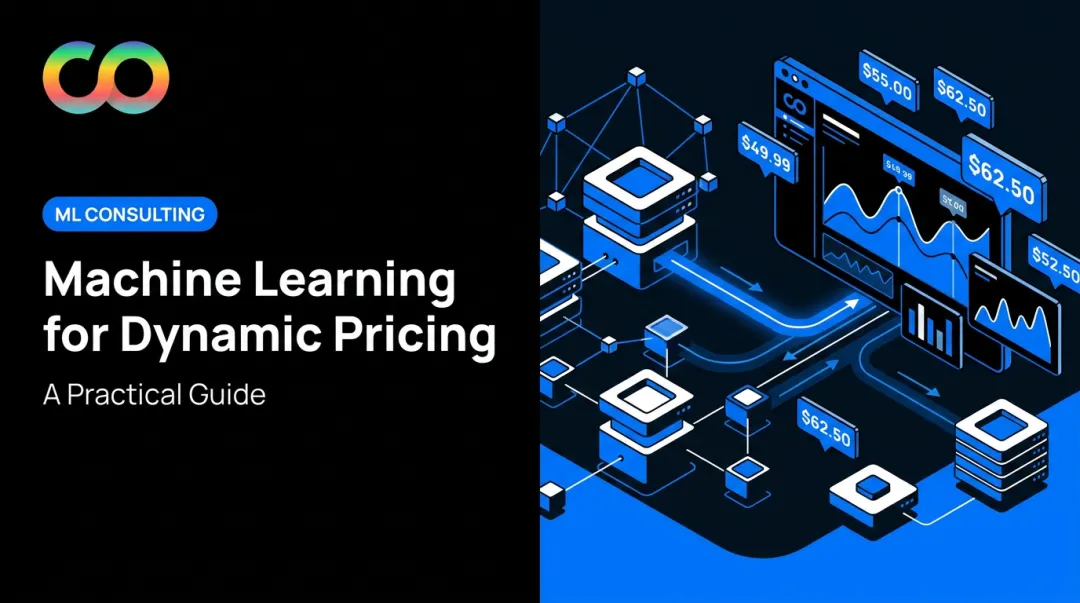
Dynamic pricing uses ML to adjust prices based on real-time demand signals, inventory levels, competitor pricing, and purchase history. The goal is margin protection: replacing blanket discounts with pricing decisions that reflect actual willingness to pay.
Amazon sets the benchmark here. Quartz/Profitero analysis reported Amazon changes prices more than 2.5 million times per day, though verified margin or profit impact data isn't available. What's clear is that Amazon has turned pricing into a continuous optimization problem, not a quarterly spreadsheet exercise.
Statista data from 2021 showed 17% of North American and European e-commerce companies planned to start using dynamic pricing — a figure that has almost certainly grown since, though a more recent benchmark wasn't verified at time of writing.
The practical starting point for most retailers isn't Amazon-scale real-time pricing. Good candidates for a first implementation include:
- Seasonal items with predictable demand spikes
- Perishables or time-sensitive SKUs
- Event-driven products where demand is short and concentrated
Demand Forecasting and Inventory Management
Poor inventory decisions cost money from both directions: stockouts lose sales, overstock ties up capital. IHL estimated worldwide inventory distortion — overstocks plus out-of-stocks — at $1.77 trillion in 2023. That figure is retail-wide, not e-commerce-only, but the problem is the same regardless of channel.
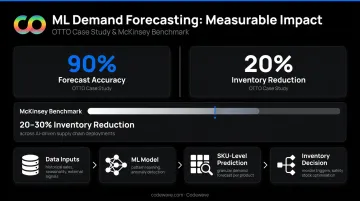
ML forecasting models (gradient-boosted trees and temporal neural networks are the most common production architectures) process variables like seasonality, regional trends, social signals, and point-of-sale history to produce SKU-level demand predictions.
The OTTO case study from HBS Digital Initiative illustrates the ceiling: the German online retailer used ML to predict 30-day item sales with 90% accuracy, which helped reduce inventory levels by 20%. McKinsey's distribution research points to 20–30% inventory reduction as achievable with AI-improved forecasting more broadly.
The operational payoff compounds around peak events. A model that's well-calibrated heading into Black Friday or Cyber Monday prevents the most expensive inventory mistakes: emergency restocks at peak freight rates, or excess holiday inventory marked down in January.
Fraud Detection and Transaction Security
ML fraud detection scores each transaction in milliseconds by comparing it against a customer's established behavioral pattern: purchase frequency, typical geolocation, device fingerprinting, and transaction velocity. When a transaction deviates from that pattern, a risk score triggers review. Unlike static rule-based systems, ML models adapt as fraud tactics evolve — a ruleset that can't update becomes exploitable.
Juniper Research forecasts global e-commerce fraud losses rising from $56.1 billion in 2025 to $131 billion by 2030, a 133% increase over five years.
The false-positive side matters just as much. Blocking legitimate transactions destroys customer trust and drives churn. Datos Insights estimated false-decline costs for U.S. e-commerce merchants at $11.1 billion in 2021. ML models reduce false positives by calibrating the security threshold to individual behavioral context rather than applying blunt category rules.
Churn Prediction and Customer Retention
Predictive retention models flag at-risk customers before they leave, based on signals like declining purchase frequency, shrinking basket size, or reduced site visits. That early warning gives marketing teams time to trigger a targeted retention workflow — a personalized discount, a re-engagement sequence, or a loyalty nudge timed to the customer's behavior.
The underlying economics justify this investment. Harvard Business Review research puts the cost of acquiring a new customer at 5 to 25 times more than retaining an existing one. RJMetrics data from 2015 found 68% of e-commerce customers never made a second purchase, which underscores why proactive retention matters more than acquisition in repeat-purchase categories.
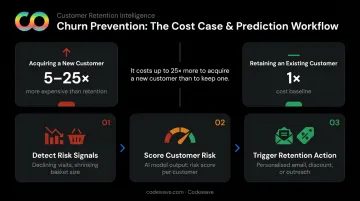
Churn prediction models work best when the output is already wired to an action. Before building the model, map the intervention: what fires when a customer hits the risk threshold, and who owns that workflow.
Key Benefits of Machine Learning for Online Retailers
Revenue per visitor is where ML's impact is most direct. By surfacing relevant products, reducing search friction, and recovering abandoned carts, ML generates lift from existing traffic without requiring additional ad spend. McKinsey's research establishes the 10–15% revenue lift benchmark from personalization — and companies that grow faster drive 40% more revenue from personalization than slower-growing peers.
Operational efficiency compounds that revenue impact. ML reduces manual overhead in pricing updates, inventory decisions, and customer segmentation. Merchandising teams stop repricing spreadsheets by hand. Demand planners retire their Excel-based forecasts. Fewer fulfillment errors also reduce inbound customer service volume — a cost benefit that rarely shows up in initial ROI projections but compounds over time.
Competitive compounding is the least visible benefit but the most durable. ML systems improve as they process more data. A team that deploys a recommendation engine today will have 12 months of additional training data by this time next year — producing a model demonstrably better than one deployed later. That gap between early movers and late adopters widens with every quarter of additional training.
Practical Tips for Implementing ML in Your E-Commerce Stack
Start With One Decision, Not a Roadmap
The most common failure mode is selecting a model before defining the decision it should automate. Pick one use case — recommendations or search are fastest to ROI for most teams — define the baseline metric before writing any code, and treat that metric as the north star for the pilot. Everything else is secondary until that pilot is in production and performing.
Get Data Infrastructure Right Before Modeling
Data quality and pipeline reliability are the actual cost drivers in ML projects, not model complexity. A sophisticated model fed poor data produces poor predictions. Being "data-ready" means:
- Clean, consistent event tracking across web and mobile
- A consolidated data source — data warehouse or feature store
- Labeled historical data adequate for the chosen use case
- Reliable pipelines that don't break when upstream systems change
Audit your data sources before a single model is trained. Projects that skip this step face repeated delays.
Evaluate Build vs. Extend
Not every e-commerce team needs a custom-built model. Most major platforms include embedded ML:
- Shopify: Shopify Magic and Search & Discovery for AI-assisted features
- Salesforce Commerce Cloud: Einstein Predictive Sort and Einstein Recommendations (supporting catalogs over 3 million SKUs)
- Adobe Commerce: Product Recommendations and Live Search powered by Adobe AI
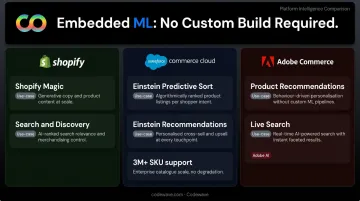
Custom ML makes sense when proprietary data is the differentiator — unique behavioral signals or catalog attributes that a platform's generic model can't use. The trade-off is speed and cost (platform-embedded ML) versus control and uniqueness (custom build). Most teams should start with platform-embedded ML and build custom only when they've outgrown it.
Plan for Monitoring and Retraining From Day One
Models drift. A recommendation engine trained on pre-holiday data performs differently in January. A pricing model calibrated before a catalog restructure may make poor decisions after. Without monitoring, degradation happens silently.
Good MLOps for e-commerce includes:
- Alerts that fire when model accuracy drops below a defined threshold
- Retraining cadences aligned to catalog change frequency and campaign cycles
- Version control (tools like MLflow) so rollbacks are fast when a new version underperforms
- A/B testing in production to confirm a retrained model actually improves on its predecessor
Monitoring structured this way is what separates a pilot from a production system. Codewave's ImpactIndex™ model builds this in from the start — drift detection, retraining cycles, and performance benchmarking are part of the engagement scope, not afterthoughts. Because clients pay for measurable outcomes rather than hours, keeping models healthy is a shared objective, not a client-side burden.
Integrate With the Systems That Take Action
A model that generates predictions but can't push them into the storefront, CRM, order management system, or email platform delivers no value. The integration layer — APIs connecting model outputs to the tools that act on them — is what turns an ML experiment into a revenue driver. Build it into the initial scope, not as an afterthought.
Common Pitfalls to Avoid When Adopting ML in E-Commerce
1. Starting With the Algorithm Instead of the Business Problem
Choosing a model before defining the decision it should automate produces technically interesting but commercially useless outputs. Define the metric first, measure your baseline, then select the model that moves that number.
2. Underestimating Data Preparation Time
Data cleaning, pipeline building, and feature engineering consistently consume more time and budget than the modeling itself. Projects that skip a proper data audit face repeated delays and scope changes. Run the audit before anything else.
3. Skipping Privacy and Compliance From the Start
E-commerce ML runs on behavioral and purchase data — and that triggers real regulatory obligations:
- GDPR: Individuals have the right not to be subject to decisions based solely on automated processing that significantly affects them.
- CCPA: Browsing history, purchase records, and behavioral inferences are personal information subject to consumer rights.
- PCI DSS: Scope applies if your ML system processes or transmits cardholder data.
Building consent mechanisms, data minimization practices, and audit logging retroactively costs far more than designing for compliance upfront.
Frequently Asked Questions
What is machine learning in e-commerce?
ML is a category of algorithms trained on historical e-commerce data (purchases, clicks, pricing events) to make predictions and automate decisions at scale. Practical applications include what to recommend, how to price, and which customers are at risk of churning.
What are the most common machine learning use cases in e-commerce?
The six highest-impact use cases are product recommendations, smart search and discovery, dynamic pricing, demand forecasting and inventory management, fraud detection, and churn prediction. For teams starting out, recommendations and search typically deliver the fastest ROI.
How does machine learning improve product recommendations?
Recommendation engines use two core techniques: collaborative filtering (matching a shopper to others with similar behavior) and content-based filtering (matching items to past purchases). Together, they personalize the product lineup per session, lifting average order value and conversion compared to static bestseller lists.
What data do you need to implement machine learning in e-commerce?
Core inputs include purchase and transaction history, product catalog attributes, clickstream and browsing behavior, search queries, and customer account data. Data quality and pipeline reliability matter more than data volume for most starting use cases.
How long does it take to implement a machine learning solution for e-commerce?
A single-use-case pilot — such as a recommendation engine — typically takes 8–16 weeks from data audit to production. Timeline is largely driven by data readiness and integration complexity, not model development.
What is the difference between AI and machine learning in e-commerce?
AI is the broader category of technologies designed to simulate intelligent decision-making; machine learning is a specific subset where algorithms learn patterns from data without being explicitly programmed. Most practical e-commerce applications — recommendations, pricing, fraud detection — run on ML models within that broader AI umbrella.