
Introduction
In 2019, a widely used health-risk algorithm was found to be systematically underserving Black patients. Because the model used healthcare cost as a proxy for health need, it reduced the share of Black patients identified for extra care by more than half — and correcting the proxy label would have raised that share from 17.7% to 46.5%. The algorithm wasn't malfunctioning. It was doing exactly what it was trained to do. That's what makes AI bias so difficult to catch and so damaging when left unchecked.
The healthcare case is far from exceptional. According to DataRobot's 2022 State of AI Bias report, 36% of organizations had already experienced direct business impact from AI bias — and 81% of technology leaders wanted government regulation of the problem.
For companies operating in healthcare, fintech, insurance, and other regulated sectors, unchecked bias carries regulatory exposure, legal liability, and real harm to the people AI systems are supposed to serve.
What follows is a practical breakdown of where bias enters AI systems, how to measure it, and which mitigation techniques apply at each stage of the model lifecycle — from data collection through deployment.
Key Takeaways
- AI bias stems from data, model design, and human decisions embedded throughout the development process — not random error
- Detection requires fairness metrics, subgroup evaluations, and open-source auditing tools applied both before and after deployment
- Mitigation operates across three stages: pre-processing (data), in-processing (training), and post-processing (outputs)
- Governance frameworks like NIST AI RMF and ISO 42001 structure sustainable, audit-ready bias management programs
- The EU AI Act, GDPR, and CCPA make bias testing a legal requirement for high-risk AI systems
What Is AI Bias and Why Does It Matter?
AI bias refers to systematic, skewed outputs from AI models that produce unfair or inaccurate results for specific groups. Unlike random prediction errors, bias is structural: it affects the same populations consistently, tracing back to training data or deliberate model design choices.
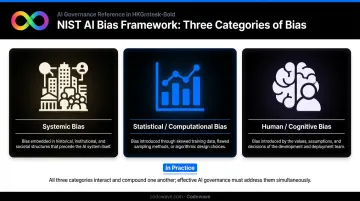
NIST's guidance on AI bias distinguishes three categories: systemic bias embedded in societal structures, statistical or computational bias introduced by data and algorithms, and human or cognitive bias introduced by the people building the system. In practice, all three often interact — which is why addressing bias requires looking beyond the model itself to the data pipelines and human decisions behind it.
The Business and Regulatory Stakes
Beyond ethics, bias creates concrete exposure across several dimensions:
- Regulatory risk: The EU AI Act (Article 10) requires high-risk AI datasets to be representative and examined for bias; Article 43 mandates conformity assessment before deployment
- Legal liability: GDPR Article 22 gives individuals the right to contest solely automated decisions with significant effects; CCPA's 2025 ADMT regulations add opt-out rights and risk assessments for automated decision-making
- Enforcement: The EEOC settled its first AI hiring discrimination case in 2023 for $365,000, after iTutorGroup's software automatically rejected female applicants over 55 and male applicants over 60
- Reputational damage: Bias incidents in consumer-facing AI systems erode trust quickly, especially in fintech, insurance, and healthcare — sectors where automated decisions carry direct financial or clinical consequences
Fairness Concepts Worth Knowing
Three fairness definitions appear most frequently in practice:
- Demographic parity: Selection rates should be independent of group membership — useful for access allocation like loan approvals or hiring screens
- Equalized odds: True-positive and false-positive rates should be equal across groups — relevant where error burden matters, such as medical diagnosis or fraud detection
- Individual fairness: Similar individuals should receive similar outcomes — useful for consistency reviews where similarity can be formally defined
These metrics can conflict mathematically: a system satisfying demographic parity will often violate equalized odds, and vice versa. Choosing the right definition is a deliberate design decision — one that should be made before model training, not after deployment reveals the gap.
Types and Sources of AI Bias
Bias can enter an AI system at nearly every stage of development, which is why treating it as a one-time data cleaning problem consistently falls short.
Three Primary Sources
Data bias occurs when training data over-represents certain groups or encodes historical inequalities. This is the most common entry point — if the data reflects a world where certain populations were systematically disadvantaged, the model will replicate those patterns.
Algorithmic bias emerges from model design choices: which features are selected, how the loss function is constructed, and which optimization objectives are prioritized. A model can be trained on balanced data and still produce skewed outputs if its architecture amplifies certain patterns.
Human and cognitive bias is introduced by the development team itself — through how problems are framed, which features are deemed relevant, how labels are assigned, and which edge cases are investigated. NIST classifies it as a distinct and significant source, one that's often underestimated precisely because it's invisible in the data.
Common Bias Types in Practice
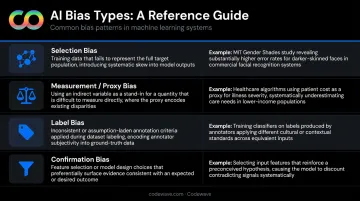
| Bias Type | What It Looks Like |
|---|---|
| Selection bias | MIT's Gender Shades study found error rates of 0.8% for light-skinned men vs. 34.7% for dark-skinned women — driven by non-representative training data |
| Measurement/proxy bias | A healthcare algorithm used cost as a proxy for illness severity; Black patients appeared lower-risk despite being sicker, due to historical gaps in care access |
| Label bias | Annotators applying inconsistent or culturally loaded criteria produce training labels that encode subjective assumptions |
| Confirmation bias | Teams frame problems around expected outcomes, then select features or datasets that confirm those expectations |
Bias mitigation must run continuously across the AI lifecycle — not as a pre-launch checkpoint, but as an embedded practice from data collection through deployment.
How to Detect Bias in AI Models
Detection requires both quantitative rigor and the right tooling. No single method catches all bias types.
Fairness Metrics to Apply
Select metrics based on the type of harm your use case could cause:
- Demographic parity: Measures whether selection rates differ across groups — apply when equal access is the goal
- Equalized odds: Checks whether true-positive and false-positive rates are equal across groups — use when unequal error burden is the primary concern
- Disparate impact ratio: The ratio of selection rates between unprivileged and privileged groups, often benchmarked against the four-fifths rule used in employment discrimination analysis
- Individual fairness scores: Verify that similar individuals receive similar predictions — most useful when a principled similarity metric can be defined
Data Analysis Techniques
Before training, apply these to your datasets:
- Distribution analysis — compare feature and label distributions across demographic subgroups
- Correlation checks — identify correlations between protected attributes and training labels
- Slice-based evaluation — measure model performance separately for each demographic subgroup, not just overall accuracy
Hidden stratification is a real risk: research has shown that subgroups in medical imaging datasets can suffer more than 20% relative performance differences even when overall accuracy looks strong.
Open-Source Auditing Tools
| Tool | Primary Use |
|---|---|
| IBM AI Fairness 360 (AIF360) | Bias metrics, disparate impact ratio, and mitigation algorithms |
| Microsoft Fairlearn | Group fairness dashboards and constrained optimization |
| Google What-If Tool | Visual probing, counterfactual testing, model debugging |
| SHAP | Feature attribution to explain which inputs drive predictions |
| LIME | Local surrogate explanations for individual case-level debugging |
Pre- and Post-Deployment Monitoring
Detection can't stop at launch. Model drift — caused by shifts in data distributions, user behavior, or business processes — can introduce new subgroup errors over time. Teams that lack a structured monitoring plan often discover fairness regressions only after real-world harm has occurred. Codewave's MLOps Readiness Assessment addresses this directly, reviewing drift detection triggers and retraining strategies so fairness monitoring continues as an active process, not a one-time check.
The NIST AI RMF reinforces this through its Measure and Manage functions, which treat both pre-deployment validation and post-deployment monitoring as ongoing obligations:
- Measure: Quantify bias risk before and after release using defined fairness metrics
- Manage: Establish retraining triggers, escalation paths, and subgroup performance thresholds
- Monitor continuously: Track performance across demographic slices, not just aggregate accuracy
AI Bias Mitigation Techniques That Work
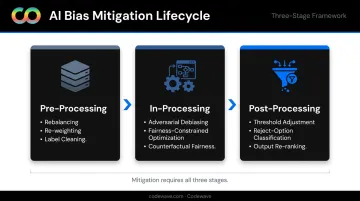
Mitigation operates at three distinct stages: pre-processing, in-processing, and post-processing. Knowing where each technique applies — and what tradeoffs it carries — determines which combination makes sense for a given system or deployment context.
Pre-Processing: Fixing Bias at the Data Level
Data-level interventions happen before model training begins.
Rebalancing approaches:
- SMOTE oversampling — generates synthetic examples of underrepresented groups; improves minority-class recall but can introduce noise if applied without validation
- Undersampling — removes examples from over-represented groups; simple to implement, though it discards data and can reduce overall accuracy
- Re-weighting — assigns higher weights to minority group samples during training without altering labels (IBM AIF360 includes a reweighing implementation)
Data quality and privacy methods:
- Clean datasets for labeling errors before training — mislabeled data amplifies bias even in well-balanced datasets
- Apply federated learning and differential privacy to expand data diversity across sources without exposing sensitive records, though non-IID data distributions and privacy noise can introduce their own fairness challenges
The core tradeoff: removing too much data to achieve balance can degrade overall model accuracy. These decisions require deliberate evaluation, not automated defaults.
In-Processing: Building Fairness Into Model Training
In-processing techniques modify the training process itself rather than the data or outputs.
Key algorithmic fairness approaches:
- Adversarial debiasing — trains a secondary network to predict protected attributes from model outputs; the primary model is penalized for making that possible, improving invariance across groups
- Counterfactual fairness — ensures predictions remain consistent when a sensitive attribute changes, along with everything causally downstream of it
- Fairness-constrained optimization — modifies the loss function to enforce demographic parity or equalized odds constraints alongside standard accuracy objectives (Microsoft Fairlearn's reductions approach implements this)
Requiring models to meet defined fairness thresholds before release — not just accuracy benchmarks — makes fairness an enforceable criterion rather than an afterthought. This is comparable to requiring security audits before launch: it shifts fairness from a post-hoc review to a production gate.
Post-Processing: Correcting Bias in Model Outputs
Post-processing is useful when retraining is not feasible — for example, when working with vendor models or legacy systems.
- Threshold adjustment — applies different decision thresholds for different subgroups to equalize outcomes; Fairlearn's ThresholdOptimizer implements this, though it may require randomized decisions as a tradeoff
- Reject-option classification — redirects uncertain predictions near the decision boundary toward unprivileged groups
- Output re-ranking — reorders ranked outputs (such as candidate shortlists) to meet representation constraints; relevance takes a measurable hit, so the tradeoff must be defined explicitly
Post-processing calibration doesn't fix the underlying model. Bias in the original predictions remains; it's corrected downstream. In high-stakes contexts — hiring, lending, clinical triage — that gap means the model can still generate biased outputs if the post-processing layer fails or is bypassed. Teams relying on this approach should document the limitation explicitly in their model cards and governance records.
Building a Sustainable AI Bias Mitigation Framework
Systems that pass fairness evaluations at launch can drift into biased behavior as data and user patterns change. That makes bias mitigation an ongoing operational commitment — not a one-time deployment checklist. Sustainable frameworks are built to catch and correct that drift continuously.
Core Program Pillars
- Regular bias impact assessments — scheduled reviews of model outputs across demographic subgroups, with defined thresholds for acceptable disparity
- Independent model audits — periodic third-party or cross-functional reviews that bring fresh perspective to subgroup performance gaps
- Retraining feedback loops — structured processes connecting audit findings back to data pipelines and model updates, so identified issues actually get fixed
Governance and Accountability Structures
Accountability requires clear ownership. Key questions every organization deploying high-risk AI should answer:
- Who owns model fairness oversight?
- How are fairness issues escalated, documented, and resolved?
- Which frameworks govern the program?
Two frameworks provide actionable structure:
- NIST AI RMF 1.0 — uses Govern, Map, Measure, and Manage functions to create a full lifecycle approach to AI risk, including bias and fairness
- ISO/IEC 42001:2023 — defines the AI management system standard for establishing, implementing, and continually improving AI governance programs, with defined audit cadence and documented responsibilities
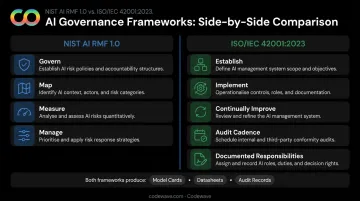
Both frameworks support the documentation artifacts that regulators expect: model cards, datasheets for datasets, SHAP-based explanation logs, and audit-ready records of preprocessing steps and fairness evaluation results.
Human-in-the-Loop Oversight
Diverse, cross-functional teams catch bias patterns that homogeneous teams miss. AI Now's Discriminating Systems report directly linked AI bias to diversity failures in development teams. Effective oversight isn't sequential review — it's parallel collaboration across roles:
- Data scientists and ML engineers
- Domain and subject-matter experts
- Legal and compliance advisors
- Representatives from affected user groups
Direct collaboration between builders and stakeholders matters here. When the people building an AI system work closely with those affected by its decisions, fairness issues surface earlier — before deployment, when fixes cost a fraction of what post-launch corrections require. Codewave's ZeroDX™ model is built on exactly this principle: removing middle layers so engineers engage directly with clients throughout development.
Transparency and Documentation
Audit readiness depends on documentation built throughout the development process, not assembled before a review:
- Record data sources, collection methods, and preprocessing decisions
- Document model configurations, training objectives, and fairness constraints applied
- Log fairness evaluation results at each validation checkpoint
- Integrate SHAP explanations into deliverables for regulated decisions — particularly in credit, healthcare, and insurance where regulators expect specific, human-interpretable explanations of individual outcomes
Frequently Asked Questions
What are effective AI bias mitigation strategies?
Combining techniques across the AI lifecycle is most effective: pre-processing fixes data-level gaps, in-processing builds fairness into training, and post-processing corrects outputs after predictions are made. Ongoing governance and auditing hold the entire program together.
What are the most common types of AI bias?
Selection bias, measurement bias, label bias, and confirmation bias appear most frequently in practice. All four can originate from data collection practices, human labeling decisions, or flawed problem framing by development teams — often in combination.
How do you detect bias in an AI model?
Detection involves applying fairness metrics (demographic parity, equalized odds, disparate impact ratio) and running slice-based evaluations across demographic subgroups. Auditing tools like IBM AIF360, Microsoft Fairlearn, and Google's What-If Tool support this process, and post-deployment monitoring for model drift is equally important.
What is the difference between pre-processing and post-processing bias mitigation?
Pre-processing modifies training data before a model is built (rebalancing, re-weighting, cleaning label errors). Post-processing adjusts model outputs after predictions are made (threshold adjustment, re-ranking). In-processing techniques modify the training process itself, making fairness part of the optimization objective.
What regulations require organizations to address AI bias?
The EU AI Act, GDPR, and CCPA's 2025 ADMT regulations all impose fairness, explainability, or risk assessment requirements on AI systems — with GDPR and the EU AI Act carrying the most direct enforcement weight. Non-compliance carries legal penalties and reputational consequences.
Can AI ever be completely free of bias?
No. Training data reflects real-world inequalities, and human decisions introduce assumptions at every stage of development. The realistic goal is continuous detection, reduction, and monitoring — keeping bias below harmful thresholds and maintaining fairness across the groups a system affects.