Introduction
Healthcare systems are under compounding pressure. The AHA projects a shortage of roughly 100,000 critical healthcare workers by 2028, while the CDC reports that chronic conditions account for 90% of annual U.S. healthcare expenditures — a system already spending $4.8 trillion per year.
Healthcare IoT directly targets the operational conditions that drive those costs and gaps: reactive care models, manual workflows, periodic assessments that miss deterioration windows, and clinical errors rooted in memory-dependent processes.
The real value of healthcare IoT shows up in specific, measurable places — fewer missed diagnoses, shorter hospital stays, faster responses to deteriorating patients, and lower per-episode costs. This article covers the highest-impact applications across care settings and the concrete operational benefits each one delivers.
Key Takeaways
- Healthcare IoT links devices, sensors, and software to capture and apply patient and operational data across every care setting
- Highest-impact applications: remote patient monitoring, chronic disease management, smart medication management, wearable surveillance, and hospital asset tracking
- Core measurable benefits: earlier clinical intervention, reduced operational costs, and fewer medication and documentation errors
- Organizations without IoT absorb avoidable readmission costs, preventable errors, and staff time lost to manual workflows
- The real value is in acting on data, not simply gathering it
What Is Healthcare IoT?
Healthcare IoT refers to the network of connected devices, sensors, and software platforms that continuously collect, transmit, and analyze health-related data — from wearables tracking a patient's oxygen saturation at home to hospital systems monitoring refrigeration temperatures in real time.
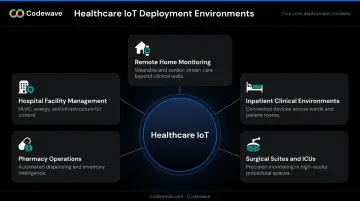
It applies across the entire care continuum:
- Remote home monitoring — wearables and connected devices transmitting vitals outside clinical settings
- Inpatient clinical environments — bedside sensors, smart infusion pumps, and continuous surveillance systems
- Surgical suites and ICUs — connected monitoring tools that feed data directly into clinical workflows
- Pharmacy operations — automated dispensing cabinets and medication management systems
- Hospital facility management — real-time location systems, environmental sensors, and building automation
Done well, healthcare IoT drives real clinical and operational outcomes: faster interventions, lower costs, fewer gaps in patient data. The goal is always the outcome, not the infrastructure behind it.
Key Applications of Healthcare IoT
Healthcare IoT spans multiple care settings and clinical workflows. The five applications below represent the highest-impact deployments seen across hospital systems today.
Remote Patient Monitoring (RPM)
RPM uses connected devices — pulse oximeters, blood pressure cuffs, ECG monitors, spirometers — to continuously track patient vitals outside clinical settings and transmit data to care teams in real time.
Adoption is growing but far from universal. Hospitals offering RPM increased from 33% in 2018 to 46.3% in 2022, a 40% relative increase. The evidence for clinical impact is condition-specific: COPD shows the strongest readmission benefit, while heart failure results are more mixed. Programs that target specific high-risk populations and pair data feeds with defined escalation protocols consistently outperform broad, undifferentiated deployments.
Chronic Disease Management
IoT-connected devices give patients and clinicians continuous visibility into chronic condition status — enabling intervention before acute episodes occur rather than after.
Key devices in this category:
- Continuous glucose monitors (CGMs) — ADA standards cite improved glucose control, reduced hypoglycemia, and better self-management across insulin regimens
- Connected inhalers — A 2023 meta-analysis found electronic inhaler monitors improved adherence in asthma and COPD patients
- Cardiac wearables — Optical heart-rate sensor wearables have shown approximately 93% accuracy for detecting life-threatening arrhythmias in systematic review evidence
Smart Medication Management
Connected medication dispensing cabinets (ADCs) and smart infusion pumps automate drug delivery, cross-reference doses against EHR records, and alert staff to deviations — catching errors at the point of care before they reach patients.
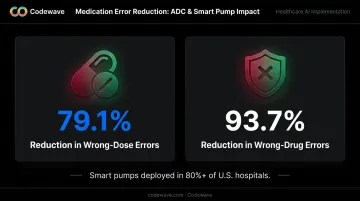
Smart pumps are now used in over 80% of U.S. hospitals. A 2025 peer-reviewed review found ADC implementation reduced wrong-dose and wrong-drug medication errors by 79.1% and 93.7% respectively in cited studies. That said, realizing those gains requires active governance: drug-library maintenance and override monitoring matter as much as the hardware itself.
Wearable Health Monitoring and Clinical Surveillance
ECG patches, fall-detection devices, and in-hospital sensor networks provide continuous patient surveillance without requiring manual check-ins. This applies directly to:
- Post-operative recovery monitoring
- Elderly patients at fall risk
- High-acuity ward patients where deterioration can develop rapidly between scheduled assessments
Continuous monitoring detects ward deterioration earlier than periodic vital-sign checks, giving care teams more time to act before ICU transfer becomes urgent.
Hospital Operations and Asset Management
Real-time location systems (RTLS), environmental IoT sensors, and building automation help hospitals operate more efficiently at the facility level. Applications include:
- Asset tracking — locating mobile equipment like infusion pumps and wheelchairs without manual searches
- Environmental monitoring — continuous temperature logging for vaccine and medication storage (a CDC-recommended practice for cold-chain integrity)
- OR environment management — monitoring sterile conditions and equipment readiness
- Predictive maintenance — flagging equipment performance changes before failure occurs
Systematic reviews document measurable workflow improvements from RTLS — primarily in equipment retrieval time and staff search burden. Specific time-savings figures vary by institution size and baseline processes, so local benchmarking is recommended before setting targets.
Key Benefits of Healthcare IoT
These benefits map directly to the operational KPIs healthcare executives and clinical leaders are accountable for — and they compound as IoT adoption scales across a health system.
Benefit 1: Real-Time Monitoring Enables Earlier Intervention
Periodic vital-sign checks create gaps. A patient can deteriorate significantly between a 6 a.m. and noon assessment. In sepsis, cardiac events, or respiratory decline, those hours matter.
Continuous IoT monitoring replaces snapshot-based assessment with a constant data stream. Devices generate alerts when vitals drift outside defined thresholds, triggering clinical response that would otherwise wait until the next scheduled check or in-person visit.
Adverse drug events alone cause nearly 700,000 emergency department visits and 100,000 hospitalizations annually in the U.S. Many of the deterioration events that precede those episodes are detectable before they escalate. Earlier intervention directly reduces ICU transfers, emergency readmissions, and adverse event frequency — all among the most expensive episodes in healthcare.
KPIs impacted:
- 30-day readmission rates
- ICU transfer rates
- Average length of stay
- Patient deterioration response time
- Adverse event frequency
When it matters most: Post-surgical patients, elderly patients with multiple comorbidities, and patients managing heart failure, COPD, or diabetes remotely. These are populations where the window between early warning and acute episode is short.
Benefit 2: Reduced Operational Costs and Resource Waste
Healthcare IoT reduces costs through two distinct mechanisms: preventing expensive clinical episodes, and automating workflows that consume staff time and create error risk.
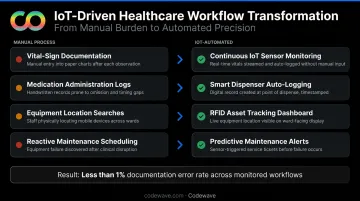
Labor is the single largest cost category in healthcare. AHA reported that hospital labor costs reached $890 billion — 56% of total hospital expenses — in 2024. IoT-enabled automation directly reduces the manual burden on nurses, pharmacists, and biomedical staff by eliminating tasks like:
- Manual vital-sign documentation and transcription
- Paper-based medication logs
- Manual equipment location searches
- Reactive maintenance triggered after equipment failure
Automated vital-sign upload into EHR systems has been shown to reduce documentation error rates to less than 1%, compared to manual transcription, which introduces both time costs and accuracy risks.
Additional cost reduction mechanisms:
- IoT-managed pharmacy inventory reduces drug waste from expired or improperly stored medications
- Temperature-monitored medication storage prevents cold-chain failures
- Predictive maintenance reduces emergency procurement and unplanned equipment downtime
- Continuous remote monitoring reduces unnecessary ED visits among high-risk outpatients
KPIs impacted:
- Cost per patient episode
- Staff hours spent on manual documentation
- Equipment downtime
- Medication waste rate
- Unplanned maintenance incidents
Highest-impact settings: Large hospital systems and health networks with high patient volumes and complex supply chains see the greatest gains. During constrained staffing periods, IoT extends workforce capacity without adding headcount.
Benefit 3: Higher Diagnostic Accuracy and Fewer Clinical Errors
Most clinical errors don't happen because of bad judgment. They happen because of bad conditions: manual documentation, memory-dependent workflows, and periodic spot-checks that create gaps in the data picture.
IoT reduces the conditions under which errors occur:
- Smart infusion pumps cross-reference programmed doses against patient records before delivery
- Connected diagnostic devices upload readings directly to EHR, eliminating manual transcription
- AI-assisted monitoring flags abnormal values before clinicians act on incorrect data
- Automated vital-sign capture removes the documentation error introduced by manual entry
The scale of the problem:
Measurable medical errors cost an estimated $17.1 billion annually, with IV infusions associated with 54% of adverse drug events and 61% of serious or life-threatening medication errors. IoT-enabled safeguards at the point of care, not just policy, are what actually move these numbers.
Fewer errors also affect a hospital's performance under value-based care models. Better treatment adherence, reduced adverse drug events, and higher patient satisfaction scores directly influence reimbursement rates.
KPIs impacted:
- Medication error rate
- Near-miss incidents
- Diagnostic turnaround time
- Patient satisfaction (HCAHPS) scores
- Value-based care performance metrics
Where you'll see the most impact: High-acuity environments (ICUs, ERs, surgical units) and settings managing high-risk medications like chemotherapy, anticoagulants, and insulin. RPM programs also benefit — manual transcription errors have long been a documented failure point in remote care workflows.
What Happens When Healthcare IoT Is Missing
Healthcare organizations that delay IoT adoption absorb real, avoidable costs every day they operate without it. The gaps aren't theoretical — they show up in patient outcomes, staff hours, and budget line items.
The operational consequences are specific:
- Clinicians rely on periodic check-ins that miss critical deterioration windows between assessments
- Medication errors remain elevated due to manual, memory-dependent workflows rather than automated cross-checks
- Equipment is misplaced or unavailable when needed — driving capital delays and clinical friction
- Chronic disease patients cycle through ER visits and readmissions that earlier intervention would have prevented
- **Staff spend hours on manual data collection** and reconciliation that IoT would automate, cutting directly into time available for patient care
These are the baseline operating conditions in health systems without connected monitoring or real-time asset visibility. Each gap compounds the others — and each one carries a measurable cost that IoT adoption is designed to eliminate.
How to Get the Most Value from Healthcare IoT
Deploying IoT devices is only the first step. The organizations that see the greatest return treat healthcare IoT as an ongoing operational practice, not a one-time infrastructure project.
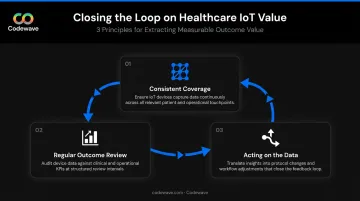
Three principles separate organizations that extract real value from those that don't:
Consistent coverage — Gaps across patient populations or departments create blind spots that undermine system-wide value. A hospital with RPM in one unit and manual check-ins in another doesn't benefit from either consistently.
Regular outcome review — IoT generates data continuously, but value requires comparing outcomes against baseline KPIs and adjusting clinical protocols when the data shows patterns.
Acting on the data — Stored data doesn't improve patient outcomes. The organizations seeing measurable returns use IoT data to change workflows, escalation procedures, and resource allocation, not merely to populate dashboards.
Executing these principles requires both technical precision and clinical alignment. Codewave's healthcare IoT work covers medical device-to-EHR integration using FHIR standards, real-time alerting pipelines built on Apache Kafka, and HIPAA-compliant architectures built in from the start. That technical foundation is what makes the ImpactIndex™ model work in healthcare contexts, where data quality, system integration, and execution speed directly affect patient and operational results.
Conclusion
Healthcare IoT's value is practical, not theoretical. It replaces reactive, manual, and fragmented workflows with real-time visibility, automated safeguards, and informed clinical decisions — spanning remote monitoring, chronic disease management, medication safety, clinical surveillance, and hospital operations.
The benefits compound. As more care settings and patient populations connect, system-wide data quality improves, early intervention becomes more reliable, and the cost of reactive care decreases. A health system operating with IoT coverage across multiple departments operates with measurably faster response times, fewer adverse events, and lower per-episode costs than one relying on periodic assessments and manual documentation.
Treat healthcare IoT as an ongoing operational discipline. The organizations that see lasting returns are the ones that close the loop — reviewing data consistently, refining clinical protocols based on what the data surfaces, and ensuring every sensor signal connects to a clear, accountable action.
Frequently Asked Questions
What are 5 examples of IoT used in healthcare?
Remote patient monitoring (continuous vitals tracking outside clinical settings), continuous glucose monitors (real-time blood sugar data for diabetes management), smart infusion pumps (automated dose cross-referencing against EHR records), wearable cardiac monitors (arrhythmia detection via ECG patches), and hospital RTLS systems (real-time location tracking for equipment and assets).
What is the Internet of Things for healthcare technology?
Healthcare IoT is the network of connected devices, sensors, and software that continuously collects and transmits patient and operational data across care settings. It enables real-time monitoring, automated clinical alerts, and data-driven decisions without relying on manual documentation or periodic check-ins.
What are the key benefits of IoT in healthcare?
The three core benefits are earlier clinical intervention through continuous monitoring, lower operational costs through workflow automation, and fewer clinical errors through connected, data-verified processes.
How does IoT in healthcare reduce costs?
IoT reduces costs by preventing expensive hospital readmissions through continuous monitoring, automating manual workflows that consume nursing and administrative time, reducing medication and equipment waste through connected inventory management, and enabling predictive maintenance of clinical assets rather than reactive repair after failure.
What are the biggest challenges of implementing IoT in healthcare?
The primary challenges are data security and HIPAA compliance, integration complexity with existing EHR systems, device interoperability across vendors, and inconsistent clinical adoption post-deployment. Realizing the full operational gains requires governance, staff training, and workflow alignment alongside the technology itself.