Introduction
Factory floors look different than they did a decade ago. Machines now communicate status without human prompts, sensors flag equipment stress before failure occurs, and inventory systems trigger procurement automatically. For manufacturers who've connected their production environments, this is already the operational baseline.
The scale of adoption reflects real urgency. According to MarketsandMarkets, the global Industrial IoT market was valued at $194.4 billion in 2024 and is projected to reach $286.3 billion by 2029.
Adoption is accelerating just as fast. Rockwell Automation's 2024 State of Smart Manufacturing report found that 95% of manufacturers were already using or evaluating smart manufacturing technology — up from 84% just one year earlier.
Manufacturers not moving in this direction face a compounding cost: unplanned downtime, scrap waste, quality failures, and supply chain blind spots — each one a measurable loss in hours and dollars.
This article covers the core IoT applications and use cases in manufacturing, the measurable benefits they deliver, real-world examples across industries, the challenges worth planning for, and how to start building a connected operation.
Key Takeaways
- IoT connects machines, sensors, and software to collect and act on real-time production data, enabling automated responses without manual intervention.
- Core use cases span predictive maintenance, quality control, digital twins, supply chain visibility, energy monitoring, and worker safety — each with measurable ROI.
- Manufacturers using smart manufacturing report 10–20% gains in production output and up to 70% reduction in equipment breakdowns.
- Cybersecurity, legacy integration, and data overload are the three most common adoption barriers — all manageable with the right approach.
- Start with a focused pilot on one line or use case — then scale once results are proven.
What Is IoT in Manufacturing?
IoT in manufacturing — more precisely called Industrial IoT (IIoT) — refers to a network of internet-connected sensors, devices, and software embedded in machines, products, and infrastructure that continuously collect and exchange operational data to improve production decisions.
Unlike consumer IoT (smart thermostats, wearables), IIoT operates under stricter requirements: real-time performance, high reliability, security, and integration with industrial systems like PLCs, SCADA platforms, and ERP software.
The IT/OT Convergence That Powers It All
The real engine behind IIoT is the convergence of two historically separate worlds:
- Operational Technology (OT): The physical machines, controllers, and systems running the shop floor
- Information Technology (IT): The software systems managing data, planning, and reporting
When these two connect, production data flows from a machine sensor directly into analytics dashboards, ERP systems, and executive reports in real time, without manual data collection. That closed loop between physical operations and digital intelligence is what defines Industry 4.0 in practice.
Top IoT Applications and Use Cases in Manufacturing
Manufacturers deploy IoT across the entire production ecosystem — from individual machines to enterprise-wide supply chains. Here are the six use cases delivering the most measurable impact.
Predictive Maintenance
Traditional maintenance operates on one of two models: fix it when it breaks, or fix it on a scheduled calendar. Both approaches waste money — reactive maintenance causes unplanned downtime, while scheduled maintenance replaces parts that didn't need replacing.
Predictive maintenance changes the model entirely. IoT sensors embedded in equipment track vibration, temperature, pressure, and electrical load continuously. Machine learning algorithms analyze that stream of data and flag early warning signs — an unusual vibration pattern in a motor bearing, a temperature trend in a compressor — before failure occurs.
The outcome is maintenance scheduled precisely when it's needed, not before or after.
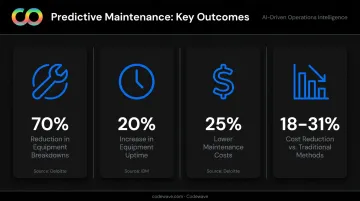
According to Deloitte, predictive maintenance reduces equipment breakdowns by 70%, increases uptime by up to 20%, and lowers maintenance costs by 25% on average. IBM puts maintenance cost reduction at 18–31% compared to traditional methods.
Quality Control and Defect Detection
Manual inspection catches defects after they've already been produced — often too late to prevent scrap or rework. IoT-enabled cameras, sensors, and AI systems monitor products throughout the production line in real time, detecting deviations in weight, dimensions, temperature, or surface condition the moment they occur.
According to the World Economic Forum, real-world results show what catching defects at the source looks like in practice:
- Beko reduced defect rates by 66% using decision-tree models in sheet-metal forming
- Midea Group achieved a 53% reduction in poor-quality outcomes through AI and digital technologies
- Jubilant Ingrevia cut process variability by 63% using Digital Performance Management
Supply Chain and Inventory Management
IoT gives manufacturers end-to-end visibility across the supply chain — from raw material receipt to finished goods shipment. RFID tags and sensors track inventory location and quantity in real time. Automated reorder triggers prevent stockouts. Integration with ERP systems enables demand-driven procurement rather than calendar-based ordering.
McKinsey's Supply Chain 4.0 research shows that connected supply chains can reduce operational costs by up to 30%, lower inventory levels by up to 75%, and reduce forecasting errors by 30–50%.
Digital Twins
A digital twin is a virtual replica of a physical machine, production line, or facility — continuously updated with live IoT data. Manufacturers use digital twins to simulate process changes, test new layouts, model equipment behavior under load, and validate decisions before touching the actual factory floor.
The practical value is iteration without consequence — teams can run dozens of simulations and implement only what works, with no production disruption and no capital spent on physical trials.
Siemens Electronics Works Amberg used digital twin simulations to optimize production and reduce target cycle times from 11 seconds to 8 seconds — a gain that compounds across millions of production cycles annually.
Energy Monitoring and Sustainability
Energy is often treated as a fixed production cost. IoT sensors on machinery, HVAC systems, and utilities prove that assumption wrong. Real-time energy data across production zones reveals idle machines consuming power, peak-demand spikes from poorly sequenced operations, and aging equipment running at degraded efficiency.
DOE's Better Plants program — which uses systematic energy monitoring and management practices across nearly 3,000 manufacturing facilities — documented cumulative energy cost savings of $4.2 billion. For most facilities, that visibility alone is enough to identify and eliminate 10–20% of wasted consumption without major capital investment.
Worker Safety Monitoring
Manufacturing carries a higher injury rate than most industries. The BLS reported a total recordable cases incidence rate of 3.4 per 100 full-time workers in manufacturing in 2024, versus a 2.3 private-industry baseline.
IoT changes the safety dynamic from reactive to preventive:
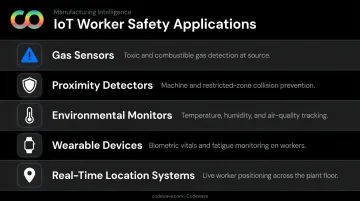
- Gas sensors detect toxic or flammable conditions before workers enter hazardous zones
- Proximity detectors trigger automatic equipment shutdowns when workers enter danger areas
- Environmental monitors track temperature, humidity, and air quality in real time
- Wearable devices monitor physiological strain and alert supervisors to fatigue or heat stress
- Real-time location systems improve emergency response when incidents do occur
NIOSH has specifically identified wearable IoT technologies as effective tools for monitoring air quality, carbon monoxide, hydrogen sulfide exposure, temperature, and physiological risk factors on industrial worksites.
Key Benefits of IoT in Manufacturing
Individually, each IoT use case solves a specific problem. Collectively, they shift the underlying cost structure of manufacturing operations — and the numbers back that up.
Operational Efficiency
Real-time production visibility eliminates the data blind spots that create delays, underutilization, and waste. Deloitte's 2025 Smart Manufacturing Survey found that manufacturers using smart manufacturing initiatives achieved 10–20% improvement in production output and 7–20% improvement in employee productivity.
Downtime Reduction
Unplanned equipment failure is expensive. Siemens estimated that the world's 500 largest companies lose $1.4 trillion annually to unplanned downtime — with automotive plants losing an average of $2.3 million per hour when lines go down. Predictive maintenance, powered by continuous IoT sensor monitoring, is the most direct solution.
Quality and Compliance
Automated, continuous quality monitoring throughout the production process reduces deviation rates and strengthens regulatory compliance — particularly in pharmaceuticals, food processing, and aerospace, where audit trails and process documentation are mandatory. McKinsey estimates Industry 4.0 quality levers can reduce suboptimal quality costs by 10–20%.
Cost Reduction
IoT's efficiency gains compound across every layer of operations — energy savings from smarter monitoring, lower maintenance costs from predictive scheduling, leaner inventory from real-time supply chain visibility, and fewer defects from early detection all reduce operational cost simultaneously.
McKinsey's Industry 4.0 analysis puts remote and predictive maintenance cost reduction at 10–40% depending on implementation depth.
Taken together, these gains represent a compounding ROI case — one that scales with the maturity of an organization's IoT implementation.
Benefits at a glance:
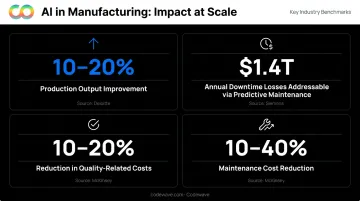
- 10–20% production output improvement (Deloitte, 2025)
- $1.4 trillion in annual downtime losses recoverable through predictive maintenance (Siemens)
- 10–20% reduction in quality-related costs (McKinsey)
- 10–40% maintenance cost reduction from predictive scheduling (McKinsey)
Real-World IoT in Manufacturing Examples
Automotive: BMW Group
BMW Group Plant Regensburg deployed an AI-supported maintenance system that monitors assembly conveyor technology by leveraging existing data streams — no additional sensors or hardware required. Early fault detection has eliminated more than 500 minutes of assembly disruption per year.
Food & Beverage: Coca-Cola
In filling systems where a thousandth-of-a-millimeter deviation can trigger a line stoppage, Coca-Cola deploys IO-Link sensors and digital twins to catch problems before they escalate. Vibration sensors flag can-sealing faults; valve sensors identify broken seals in bottle-washing systems before material loss occurs.
Pharmaceuticals: Pfizer Cold Chain
During COVID-19 vaccine distribution, Pfizer deployed GPS-enabled IoT sensors on vaccine shippers to track location and temperature continuously, maintaining -70°C (±10°C) for up to 10 days. Without IoT, that degree of real-time cold chain visibility across a global distribution network simply wasn't achievable.
Electronics: Siemens Amberg
At Siemens' Electronics Works Amberg — where 17 million SIMATIC products roll off a 75% automated value chain each year — AI applied to IoT sensor data delivered measurable results: PCB defects predicted earlier, X-ray testing effort cut by 30%, and a €500,000 capital equipment purchase avoided entirely.
Process Industry: BASF
BASF deployed wireless IoT sensors on pumps and motors at its Ludwigshafen chemical plant to monitor non-critical equipment remotely. Early degradation signals allow the team to shift from reactive repairs to scheduled interventions — cutting manual inspections in areas where worker exposure carries real risk.
Across industries and operating contexts, the pattern holds: IoT data, combined with analytics or AI, converts reactive operations into proactive ones — with measurable impact on uptime, cost, and safety.
Common Challenges of IoT Adoption in Manufacturing
Cybersecurity Risks
Every connected device expands the attack surface. Deloitte's 2025 Smart Manufacturing Survey found that 91% of manufacturers experienced at least one cybersecurity breach in the prior year, and 55% of executives strongly agreed that unauthorized OT access is a high concern.
Mitigation requires a layered approach:
- Encryption at the device level
- Network segmentation between OT and IT environments
- Regular security audits on industrial systems
- Strict access controls tied to user roles
Legacy System Integration
Most factories run machines and software built before IoT existed. Connecting legacy PLCs, SCADA systems, and older ERP platforms to modern IoT infrastructure requires adapters, middleware, or selective hardware upgrades.
McKinsey found that 44% of manufacturers cite high scaling costs and 45% cite lack of resources or knowledge as the primary barriers to Industry 4.0 rollout. A phased approach — starting with one machine type or production line — makes integration manageable without a full factory overhaul.
Data Overload and Analytics Readiness
IoT systems generate continuous, high-volume data streams. Without defined KPIs, data governance frameworks, and analytics infrastructure, that data creates noise instead of insight. Rockwell's 2023 Smart Manufacturing report documented a 40% year-over-year increase in manufacturers reporting they lacked the ability to use data to make competitive decisions.
The fix starts before data collection: define which decisions the data needs to support, then build KPIs and governance frameworks around those specific outcomes.
How to Get Started with IoT in Manufacturing
Step 1: Assess Infrastructure and Define Objectives
Audit existing equipment, connectivity, and data systems before selecting any technology. Define specific business goals — a target percentage reduction in downtime, a quality yield improvement, an energy cost reduction — so IoT investments are anchored to measurable outcomes from day one.
Step 2: Start with a Pilot, Then Scale
Choose one production line, machine type, or use case and run a controlled pilot. Predictive maintenance is typically the highest-ROI entry point. From there:
- Capture baseline metrics before and after deployment
- Refine the approach based on real operational data
- Expand to additional lines or use cases once results are validated
This sequence limits risk and builds internal confidence before committing to broader investment.
Step 3: Partner with Experienced IoT Solution Developers
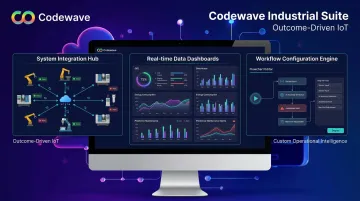
Successful IoT implementation requires expertise across sensor integration, cloud platforms, data engineering, and AI analytics — hardware is only the starting point. Codewave works with manufacturers and industrial businesses to design and build custom IoT and AI solutions that integrate with existing systems and deliver measurable operational outcomes.
With experience across 400+ businesses, Codewave's ImpactIndex™ framework ties delivery to outcome accountability — meaning solutions are built to perform in production, not just at launch.
Frequently Asked Questions
How is IoT used in manufacturing?
IoT is deployed through connected sensors on machines, equipment, and infrastructure to collect real-time data across the production process. Common applications include predictive maintenance, quality monitoring, supply chain tracking, energy management, and worker safety — no manual data collection required at each point.
What does IoT stand for in manufacturing?
IoT stands for Internet of Things. In manufacturing, it refers to the network of internet-connected sensors, devices, and machines that exchange data across a factory or supply chain. The industrial-specific subset is called IIoT (Industrial Internet of Things).
What is the difference between IoT and IIoT in manufacturing?
IoT is the broad concept of connected devices. IIoT specifically refers to its industrial application, with higher requirements for reliability, real-time performance, security, and integration with operational technology systems like PLCs, SCADA platforms, and ERP software.
What are the biggest challenges of implementing IoT in manufacturing?
The top three are cybersecurity risks from an expanded network attack surface, the complexity of integrating modern IoT platforms with legacy machines and software, and the challenge of structuring large volumes of sensor data into actionable decisions rather than noise.
How does IoT reduce downtime in manufacturing plants?
IoT sensors continuously monitor machine parameters — vibration, temperature, pressure — and detect anomalies before they cause failure. Maintenance teams can then schedule service during planned windows instead of responding to unexpected breakdowns.
What ROI can manufacturers expect from IoT implementation?
Benchmarks vary by use case. Deloitte reports predictive maintenance alone reduces breakdowns by 70% and lowers maintenance costs by 25%. Production output improvements of 10–20% are documented across smart manufacturing programs, with ROI depending on which use cases are prioritized and execution quality.