Introduction
Unplanned equipment downtime costs Fortune Global 500 industrial companies approximately $1.4 trillion annually—equivalent to 11% of total revenues—according to Siemens' 2024 True Cost of Downtime report. That figure has risen sharply from $864 billion just five years earlier, and the cost per lost hour has increased by at least 50% since 2019. For U.S. manufacturers alone, unplanned downtime drains an estimated $50 billion every year.
Those losses persist because most predictive tools stop at the warning. Traditional predictive AI tells you a machine is about to fail. Agentic AI goes several steps further: it diagnoses the failure mode, schedules the repair, orders the replacement part, and updates the production schedule—without waiting for a human to act.
This guide covers how manufacturing leaders can move from reactive maintenance to autonomous, agentic AI systems—what the technology involves, where it delivers proven ROI, and how to evaluate your readiness for implementation.
What Makes Agentic AI Different for Predictive Maintenance
Agentic AI refers to AI systems that can set sub-goals, take sequences of actions across tools and data sources, and adjust behavior in real time—without waiting for human instructions at each step. Gartner defines AI agents as "autonomous or semiautonomous software entities that use AI techniques to perceive, make decisions, take actions and achieve goals." In practice, this means multiple agents working together to execute complex, multi-step workflows with minimal human intervention—GenAI functioning less like a tool and more like an active participant in operations.
The critical distinction for maintenance teams: predictive AI is a warning light on the dashboard; agentic AI is the system that pulls the car over, calls the mechanic, and reroutes the trip. Traditional predictive AI generates alerts about likely failures. Agentic AI reasons about context, decides on the appropriate action, and autonomously executes the maintenance response—including work orders, parts procurement, and schedule adjustments. Closing this action loop is what delivers operational value.
Four Core Capabilities of Agentic AI for Predictive Maintenance
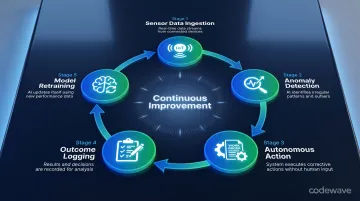
- Continuous perception: Ingests real-time streams from vibration sensors, temperature probes, pressure monitors, and acoustic devices across critical equipment.
- Autonomous reasoning: Trained classifiers compare live readings against historical baselines and OEM specifications, detecting anomalies with 95% accuracy.
- Goal-directed action: Generates prioritized work orders in your CMMS, recommends spare parts, identifies available technicians, and adjusts production timelines—without a human in the loop.
- Adaptive learning: After each maintenance event, the agent logs prediction accuracy and repair outcomes, then retrains to reduce false positives and refine Remaining Useful Life (RUL) estimates.
How Agentic AI Differs From Traditional Automation and Predictive AI
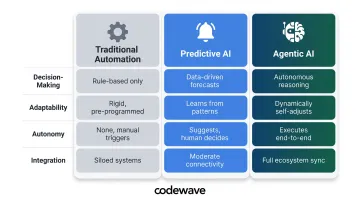
| Dimension | Traditional Automation | Predictive AI | Agentic AI |
|---|---|---|---|
| Decision-Making | Follows fixed, scripted rules | Generates alerts based on statistical models | Reasons about context and selects actions autonomously |
| Adaptability | Rigid; requires manual reprogramming | Limited; models improve with retraining | High; learns continuously from outcomes |
| Autonomy | Executes predefined tasks only | Flags issues but requires human action | Executes end-to-end workflows independently |
| Integration | Operates within single systems | Interfaces with dashboards and alerts | Orchestrates across ERP, CMMS, MES, and parts systems |
Gartner predicts that 40% of enterprise applications will feature task-specific AI agents by 2026, up from less than 5% in 2025.
Why Manufacturers Specifically Benefit From Agentic AI
Manufacturing environments involve too many interdependent variables for human teams to process and act on in real time: machine load fluctuations, shift patterns, parts availability, production schedules, environmental conditions, and more. International alarm management standards (EEMUA 191, IEC 62682, ISA-18.2) establish that operators can realistically manage approximately 6 alarms per hour—roughly 150 per day—before performance degrades. Many industrial teams currently receive hundreds of alerts weekly, leading to alert fatigue and missed critical warnings.
Agentic AI addresses this directly. By filtering noise and executing responses autonomously, it converts alert volume from an operational liability into a managed, prioritized queue—freeing technicians to focus on the interventions that actually matter.
How Agentic AI Works in a Manufacturing Predictive Maintenance System
Data Foundation: Real-Time Sensor Streams
Agentic AI systems are built in layers — each one handling a distinct job, from raw data ingestion to autonomous work order generation. At the base of that stack sits continuous time-series data from IoT-enabled equipment: vibration, temperature, pressure, and acoustic signals collected at the edge. These sensor readings are ingested using streaming platforms like Apache Kafka, which enables reliable, scalable, real-time data processing from factory-floor sensors to analytics systems.
At the edge, frameworks such as TensorFlow Lite run lightweight models directly on embedded systems, enabling real-time inference without cloud latency.
Anomaly Detection and Reasoning Layer
Trained ML models — Random Forest, LSTM (Long Short-Term Memory) networks, Isolation Forest — continuously compare live readings against historical baselines and OEM operating specifications.
When a deviation is detected, the system doesn't immediately flag it. Instead, it performs contextual reasoning: cross-referencing environmental conditions, recent load cycles, and maintenance history before concluding the anomaly is real.
For example, a peer-reviewed framework combining Random Forest, LSTM, and XGBoost achieved high accuracy by fusing feature selection and temporal pattern recognition. The approach substantially reduced false positives across multiple failure modes — a persistent challenge in industrial anomaly detection.
Autonomous Action Layer
Once an anomaly is confirmed, the agentic system doesn't stop at alerting. It:
- Generates a prioritized maintenance work order in the ERP/CMMS
- Recommends the appropriate spare part based on equipment history
- Identifies the right technician based on shift schedule and skill set
- Adjusts production timelines to minimize line impact
All of this executes autonomously, within operator-defined rules and approval thresholds.
Feedback and Learning Loop
After each maintenance event, the agent logs the outcome: whether its prediction was accurate, what repair was actually performed, how long the intervention took, and whether downtime was avoided. This outcome data feeds directly back into model retraining, improving Remaining Useful Life (RUL) predictions and reducing false positives with each cycle. RUL prediction is a formally recognized concept in industrial maintenance, referenced in NIST and IEEE standards as the primary prognostics metric.
Human Oversight in the System
Agentic AI in manufacturing is not fully unsupervised. Human operators set policies, approve high-stakes decisions, and receive explainable summaries of why the agent acted—including which sensor deviations triggered the alert and what historical patterns supported the recommendation. That transparency matters: operators can override, audit, and retrain the system based on real outcomes — keeping safety compliance intact without sacrificing the speed that makes autonomous action worthwhile.
High-Impact Use Cases: Where Agentic AI Creates Real Value
Predictive and Prescriptive Maintenance on Critical Assets
AI agents monitor motors, compressors, bearings, and hydraulic systems continuously. When early degradation signals appear—weeks before failure—the agent orchestrates the full maintenance response.
Real-world impact: Bosch implemented an AI solution integrating condition monitoring sensors across a facility managing over 2,000 assets and 35,000+ work orders per year. Results included a 29% reduction in recurring failures, a 17% increase in planned maintenance, and 100% of high-impact failures prioritized by AI.
Similarly, a consumer goods company deployed a gen AI troubleshooting copilot and achieved a 90% reduction in unscheduled downtime, a 33% reduction in maintenance labor costs, and a 40% increase in technician capacity.
Dynamic Scheduling and Production Coordination
Agentic AI integrates with Manufacturing Execution Systems (MES) and ERP platforms to automatically adjust production schedules when maintenance is triggered. The system coordinates when machines are serviced relative to production windows, minimizing line downtime.
By aligning maintenance with natural production gaps, agentic systems avoid costly mid-shift emergency repairs. Key scheduling advantages include:
- Syncs service windows with shift changes, batch transitions, and planned slowdowns
- Automatically reroutes production loads when a machine is pulled for service
- Reduces unplanned line stoppages by front-loading maintenance in low-utilization periods
Spare Parts and MRO Inventory Optimization
Agents predict which components will fail, when, and with what urgency—enabling just-in-time parts procurement rather than costly overstocking. The scale of the problem makes this valuable: the U.S. MRO spare parts market runs ~$89.5 billion annually, yet most of that inventory sits idle.
The inefficiency is striking:
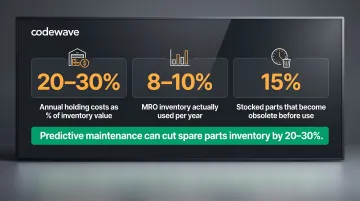
- Annual holding costs consume 20-30% of inventory value
- Most organizations use only 8-10% of MRO inventory in any given year
- Roughly 15% of stocked parts become obsolete before they're ever used
Predictive maintenance can cut spare parts inventory by 20-30% by accurately forecasting part consumption and eliminating precautionary overstocking.
Multi-Asset and Cross-Facility Coordination
Advanced agentic deployments move beyond individual machines to coordinate maintenance across entire production lines or multiple plants. Using federated or distributed AI models, systems share learned patterns across sites while maintaining data privacy. The result is compounding accuracy—each new site's data strengthens failure predictions across the entire network, turning a single-plant deployment into a continuously improving enterprise asset.
The Business Case: What Manufacturers Are Actually Gaining
Downtime Impact
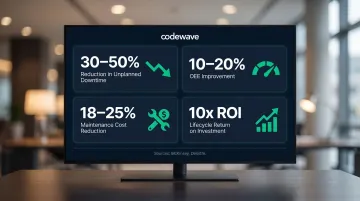
McKinsey and Deloitte both document that predictive maintenance delivers 30-50% reductions in unplanned downtime versus reactive strategies. Cross-sector average downtime costs approximately $260,000 per hour—over $2.3 million per hour in automotive manufacturing—so even a 30% reduction translates directly to millions in recovered revenue per facility.
The cost structure behind those incidents compounds the problem further:
- Major manufacturers average 20 unplanned downtime incidents per month per facility, with equipment failure causing 42% of them
- Proactive repairs cost 4–5x less than emergency repairs on the same asset
- Emergency parts procurement adds 30–40% cost premiums over planned purchases
OEE and Cost Improvements
Beyond preventing downtime, agentic AI drives measurable gains across all three Overall Equipment Effectiveness (OEE) dimensions:
- Availability: Fewer unplanned stops
- Performance: Optimized operating parameters reduce cycle time variability
- Quality: Early detection of process drift prevents scrap and rework
Deloitte benchmarks indicate predictive maintenance can deliver 10-20% OEE improvement and 20-50% reduction in time spent planning maintenance. Deloitte also benchmarks maintenance cost reductions of 18-25% as typical across industrial deployments.
ROI Timeline
Agentic AI predictive maintenance deployments typically have payback periods under two years when accounting for:
- Reduced emergency maintenance costs
- Energy savings from optimized equipment operation
- Extended asset lifespan
- Avoided production losses
95% of organizations implementing predictive maintenance report a positive ROI, with 27% achieving full payback within 12 months. Deloitte reports that predictive maintenance can deliver a 10x return on investment over the system's lifecycle.
Implementation Considerations: What You Need to Know Before Starting
Data and Infrastructure Readiness
Agentic AI requires clean, connected, continuous sensor data. Manufacturers need to audit:
- Map IoT sensor coverage across all critical assets, identifying gaps before deployment
- Assess OT/IT connectivity and whether existing data pipelines can handle real-time throughput
- Evaluate data quality and the completeness of historical failure logs needed to train models
Start with highest-impact, best-instrumented assets rather than attempting facility-wide rollout immediately. McKinsey notes that while many companies have launched isolated pilots, "few" have deployed predictive maintenance at scale, and asset-wide "PdM 4.0" systems are "rare today."
Legacy Systems and Integration Challenge
Most plants use a mix of older PLCs, disparate CMMS systems, and siloed data environments. Connecting these to an agentic AI layer requires API integration work and sometimes custom middleware.
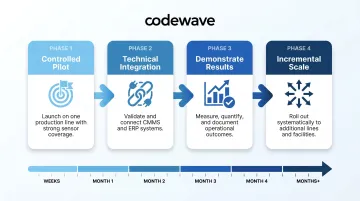
Recommended phased approach:
- Begin with a controlled pilot on one production line with strong sensor coverage
- Validate technical integration with existing CMMS/ERP systems
- Demonstrate measurable results before expanding scope
- Scale incrementally to additional lines and facilities
A partner with manufacturing AI experience can compress this timeline. Codewave, for example, works with pre-validated technology stacks—Apache Kafka for real-time streaming, TensorFlow for model deployment, and integration frameworks for IBM Maximo and Azure IoT Hub. Its QuantumAgile™ framework is designed to move teams from pilot to measurable outcomes in weeks, not months.
Getting the technology right is only half the challenge. How your team responds to the system's recommendations determines whether the investment delivers.
Workforce and Change Management
Operators and maintenance technicians need to trust the system's recommendations before they will act on them consistently. Explainable AI outputs—where the system shows why it flagged an anomaly and what evidence supports its recommendation—are critical for adoption.
Build in feedback mechanisms so technicians can annotate and correct predictions. This improves the system while building trust. McKinsey identifies weak change management as one of six primary barriers preventing pilot-to-scale deployment, emphasizing the need to redesign processes, build capabilities, and define new KPIs focused on unplanned-downtime reduction.
Frequently Asked Questions
What is the difference between predictive AI and agentic AI for predictive maintenance?
Predictive AI generates alerts about likely equipment failures based on sensor data and statistical models. Agentic AI goes further—it reasons about context, decides on the appropriate action, and autonomously executes the maintenance response, including generating work orders, ordering parts, and adjusting production schedules.
How much downtime reduction can manufacturers realistically expect from agentic AI?
Industry benchmarks from McKinsey and Deloitte indicate predictive maintenance delivers 30-50% reduction in unplanned downtime. Actual results depend on sensor coverage, data quality, and how well the system integrates with ERP/CMMS workflows. Mature implementations also tend to report 18-25% reductions in maintenance costs.
What data infrastructure is required before implementing agentic AI predictive maintenance?
Core requirements include:
- IoT sensor coverage on critical assets
- A real-time data pipeline for time-series streams (such as Apache Kafka)
- OT/IT system connectivity
- Sufficient historical failure data to train initial ML models
- Edge computing for low-latency inference, where needed
Can agentic AI for predictive maintenance work with older or legacy manufacturing equipment?
Yes. Legacy equipment can often be retrofitted with external IoT sensors without modifying the machine itself. Agentic AI systems connect to existing SCADA or CMMS platforms via APIs, though integration complexity varies — assess this before committing to a rollout. Middleware may be needed to bridge proprietary protocols.
How long does it typically take to implement an agentic AI predictive maintenance system?
A typical phased timeline looks like:
- IoT sensor deployment and data collection: 1–3 months
- AI model training and validation: 2–4 months
- ERP/MES integration and go-live: 1–2 months
McKinsey notes that with a structured approach, gen AI maintenance tools can begin delivering value in just a few weeks.
Is agentic AI predictive maintenance only viable for large manufacturers?
No. While large manufacturers have led early adoption, mid-sized manufacturers can achieve strong ROI by starting with a focused pilot on their highest-value or most failure-prone assets rather than facility-wide deployment from the start. Partnerships with experienced providers can reduce upfront investment and accelerate time-to-value.