IoT changes that equation. By connecting physical assets (vehicles, pallets, sensors, machinery) to a central data platform via the internet, IoT gives supply chain operators continuous visibility and control across every stage — from factory floor to final delivery.
The market reflects this urgency. IoT in warehouse management alone was valued at $11.3 billion in 2024 and is projected to reach $17.9 billion by 2030, according to Grand View Research.
This article covers how IoT works in the supply chain, the benefits it delivers, the use cases driving real results, the challenges to anticipate, and a practical roadmap for getting started.
Key Takeaways
- IoT connects physical supply chain assets to a central platform, enabling real-time tracking, monitoring, and automation
- Direct benefits span inventory accuracy, lower operational costs, fewer equipment failures, and faster fulfillment
- High-impact use cases include smart warehousing, cold chain monitoring, fleet management, and asset tracking
- Successful implementation follows a phased path — scoped pilot first, then scale what works
- Pairing IoT with AI/ML and edge computing turns raw sensor data into decisions that happen in real time
How IoT Works in the Supply Chain
The End-to-End Data Flow
IoT in the supply chain follows a simple but powerful sequence:
- Sense — Sensors and devices on shelves, trucks, packaging, and machinery collect data on location, condition, and movement
- Transmit — That data travels through a communication network (cellular, Wi-Fi, LPWAN) to a central platform
- Aggregate — Raw data streams are consolidated and structured
- Analyze — AI/ML layers process the data to surface patterns, anomalies, and predictions
- Act — Automated alerts, reorder triggers, maintenance schedules, or route adjustments are generated
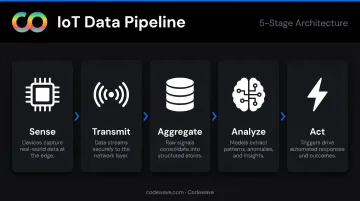
Each step depends on the one before it. Connectivity gaps kill sensor value; analytics gaps turn data into storage costs.
Key IoT Hardware in Supply Chains
- RFID tags and readers — Encode product data and capture it automatically via radio waves; UHF passive (RAIN RFID) is the most widely deployed type
- GPS trackers — Provide real-time shipment location, vehicle monitoring, and route management
- Environmental sensors — Monitor temperature, humidity, air composition; critical for pharmaceutical and food logistics
- Smart shelves — RFID readers at shelf level enable continuous inventory visibility and automate replenishment triggers
- Actuators — Enable automated physical responses, such as adjusting warehouse climate when temperature thresholds are breached
Connectivity and the Role of Private Networks
IoT effectiveness depends entirely on reliable connectivity. Private 4G/5G networks are gaining traction in manufacturing and logistics because they offer dedicated bandwidth under enterprise control — isolated from public network security risks. Ericsson's survey of manufacturing professionals at companies with $1B+ in annual revenue found that 30% were already incorporating private cellular networks.
For devices that travel across supply chain nodes — crossing carriers, borders, or coverage gaps — eSIM technology is a practical enabler. GSMA-standardized eSIM specifications allow remote provisioning of operator profiles, meaning devices can switch networks without physical SIM replacement. This matters when you're tracking containers across oceans or pallets across distribution centers.
The Analytics Layer
Raw sensor data only becomes valuable when connected to an analytics platform. IoT integrates with enterprise systems — ERP, WMS — and AI/ML layers on top to produce:
- Demand forecasts based on real-time inventory movement
- Predictive maintenance alerts before equipment fails
- Route optimization recommendations based on live conditions
Without this analytics layer, even a well-instrumented supply chain produces data that operations teams can't act on fast enough to matter. That's where implementation decisions — platform selection, integration depth, alerting logic — separate high-performing deployments from expensive pilots.
Key Benefits of IoT for Supply Chain Optimization
End-to-End Visibility and Real-Time Tracking
Traditional supply chain reporting relies on batch updates — data collected at intervals, reviewed after the fact. That lag creates blind spots. By the time a problem appears in a report, the shipment is already delayed, the temperature excursion has already happened, or the stockout has already cost a sale.
IoT replaces batch reporting with a continuous, accurate view: where goods are, what condition they're in, and whether operations are on schedule. Operators can intervene before problems escalate rather than discovering them after the damage is done.
Optimized Inventory Management
Overstocking ties up capital. Stockouts cost sales and damage customer relationships. Both problems stem from the same root cause: inaccurate, delayed inventory data.
IoT sensors provide real-time stock levels across warehouses and transit nodes, enabling automated reorder triggers that remove manual oversight. McKinsey's RFID analysis found inventory accuracy improvements of more than 25%, with inventory-related labor reduced by 10–15%. Lululemon achieved 98% inventory accuracy across nearly 500 stores with payback in under a year. Decathlon tripled labor productivity and saw 2.5% higher revenue after tagging more than 85% of items.
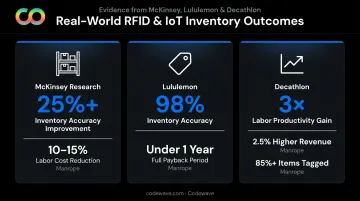
Those results share a common driver: replacing delayed manual counts with live sensor data that triggers action automatically.
Predictive Maintenance and Reduced Downtime
Equipment failure is one of the most expensive supply chain disruptions. Conveyor belts, forklifts, refrigeration units — when these go down unexpectedly, the cascading cost is significant. Siemens' 2024 downtime study estimated that an hour of unplanned downtime at a large automotive plant costs approximately $2.3 million.
IoT sensors on equipment monitor vibration, temperature, and cycle frequency continuously. When performance deviates from baseline, maintenance teams receive alerts before failure occurs. McKinsey documented an analytics-based maintenance case that reduced downtime, parts, and related costs by 30%. That 30% cost reduction comes directly from catching failures in advance rather than scrambling to recover from them.
Codewave's predictive maintenance implementations — using Azure IoT Hub and IBM Maximo — have delivered a 40% reduction in aircraft downtime with 95% forecast accuracy in aviation engagements. The same sensor-driven logic applies to warehouse conveyors, refrigerated transport, and logistics fleets, where unexpected failures carry comparable downstream costs.
Cost Reduction Through Compounding Efficiencies
The benefits above don't operate in isolation. They compound:
- Optimized routes reduce fuel spend
- Predictive maintenance reduces emergency repair bills
- Accurate inventory reduces carrying costs
- Automation reduces labor requirements for manual counting and reporting
Codewave's transportation and logistics clients have seen outcomes tied to real-time IoT telemetry processing: optimized delivery routes, reduced fuel consumption, and minimized equipment downtime through predictive analytics — lower operating costs driven by continuous data rather than periodic estimates.
Top IoT Use Cases Across Supply Chain Functions
Smart Warehousing
IoT-enabled robots and sensors automate picking, packing, sorting, and inventory counting — reducing human error and increasing throughput. Amazon operates more than 1 million robots across over 300 facilities. Its Sequoia system identifies and stores inventory 75% faster and can cut order-processing time by up to 25%.
Smart shelves take this further: embedded RFID readers detect when stock falls below a threshold and trigger automatic replenishment orders, removing manual monitoring entirely.
Cold Chain Monitoring
Temperature-sensitive goods — pharmaceuticals, fresh produce, frozen foods — require continuous environmental monitoring throughout transit and storage. IoT sensors track temperature, humidity, and air composition in real time, alerting operators to excursions before spoilage occurs.
Inadequate refrigeration causes the loss of 526 million tonnes of food annually — 12% of global food production, according to UNEP and FAO. The scale of IoT response matches that risk:
- Maersk's Captain Peter and Remote Container Management system delivers near-real-time reefer data — temperature, humidity, and air composition — while containers are at sea
- Walmart monitors refrigeration and HVAC systems across US stores, processing almost 1.5 billion IoT messages daily
Beyond spoilage prevention, cold chain IoT also supports regulatory compliance — critical in healthcare and food distribution.
Fleet and Transportation Management
GPS trackers and telematics sensors on vehicles provide real-time data on location, fuel consumption, engine health, speed, and driver behavior. This enables:
- Dynamic route optimization that reroutes around traffic delays and weather disruptions in real time
- Fuel savings through driver coaching: telematics data has moved average fleet fuel economy from 5.81 mpg to 6.10 mpg in documented studies
- Proactive maintenance by flagging engine health issues before they cause roadside breakdowns
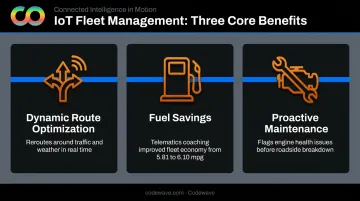
Maersk's container tracking system demonstrates what this looks like at global scale: near-real-time visibility across shipping lanes, with environmental condition monitoring for every reefer container in transit.
Asset and Inventory Tracking
RFID-based IoT systems eliminate manual barcode scans, providing a continuous view of every asset, pallet, or SKU across the supply chain. The practical outcomes:
- Reduced shrinkage and theft through continuous location data
- Improved stock accuracy without manual cycle counts
- Faster receiving and put-away processes
- Cleaner audit trails that support compliance and vendor reconciliation
When combined with AI-driven analytics, this shifts organizations away from reactive stock management. Instead of responding to stockouts after they happen, teams can position inventory ahead of demand shifts.
Industry-Specific Applications
Agriculture: IoT sensors monitor soil conditions, storage environments, and cold chain logistics for perishables. Codewave's precision agriculture work delivered an 80% reduction in crop diseases and a 55% increase in profitability for farmers through connected field diagnostics — combining IoT sensor data with ML-driven analysis.
Healthcare: IoT tracks medical devices, pharmaceutical cold chains, and hospital supply inventory in real time. Codewave's healthcare analytics framework integrates medical device data streams with patient records, enabling continuous monitoring with automated alerts for threshold deviations — built with HIPAA compliance embedded from the start.
Retail: Real-time RFID data connected to POS and e-commerce systems closes the gap between physical stock and digital inventory records — reducing shrink and improving omnichannel fulfillment accuracy.
Common Challenges of Implementing IoT in the Supply Chain
Data Security and Privacy Risks
IoT networks generate and transmit large volumes of sensitive operational data, making them attractive targets. Security must be designed in from the outset — not retrofitted after deployment.
Core requirements:
- End-to-end encryption for data at rest and in transit (SSL/TLS as a baseline)
- Role-based access controls limiting exposure to authorized users and devices
- Regular security audits, vulnerability assessments, and penetration testing
- Anomaly detection and audit logging for real-time transparency
Codewave structures IoT security architecture across every engagement phase, from threat modeling during discovery through post-launch monitoring. Compliance frameworks including GDPR and ISO 27001 are built into the design from day one.
Integration and Interoperability Complexity
IoT devices from different manufacturers often use different communication protocols (MQTT, CoAP, HTTP). Many existing ERP and WMS platforms were designed for batch processing, not continuous IoT data streams. Bridging these paradigms requires:
- Middleware and API gateway layers that translate between IoT data models and enterprise system structures
- Protocol selection (MQTT, CoAP, HTTP) matched to device constraints and latency requirements
- Event-driven pipelines using Apache Kafka or MQTT brokers to replace batch transfers with real-time flows
- Prebuilt connectors for SAP S/4HANA, Oracle, Dynamics 365, and similar ERP platforms
Data governance policies matter just as much. Without structured data management, high IoT data volumes generate noise rather than actionable signal.
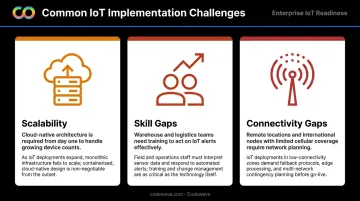
Scalability, Skill Gaps, and Connectivity Limitations
Three challenges that organizations frequently underestimate:
- Scalability: IoT architecture must handle growing device counts and data volumes without performance degradation. Cloud-native infrastructure is typically required from day one.
- Skill gaps: Warehouse and logistics teams need training to interpret IoT data and act on alerts. Technology alone doesn't change operations — the people using it do.
- Connectivity gaps: Remote locations and international supply chain nodes with limited cellular coverage remain practical barriers. 5G expansion is closing that gap, but network planning still needs to account for coverage dead zones.
How to Implement IoT in Your Supply Chain: A Practical Roadmap
Step 1: Identify the Core Problem and Assess Infrastructure
Resist deploying IoT everywhere at once. Start with one high-impact pain point:
- Inventory inaccuracy causing stockouts or excess carrying costs?
- Fleet fuel spend exceeding benchmarks?
- Cold chain excursions resulting in spoilage or compliance risk?
Then assess existing infrastructure: ERP systems, network architecture, data storage capacity, and API availability. Understanding these gaps before deployment prevents costly rework.
Common gaps Codewave surfaces during discovery: disconnected systems that can't communicate, batch-processing architectures incompatible with real-time IoT streams, and security configurations not designed for external device connectivity.
Step 2: Start with a Pilot, Then Scale
Deploy IoT in a single warehouse, fleet segment, or product category first. Define success metrics before the pilot launches — not after:
- Target stockout reduction percentage
- Fuel savings per mile
- Temperature excursion incidents per month
Use pilot results to calculate ROI, refine the approach, and build the business case for broader rollout. That ROI calculation is only useful if the pilot itself was structured to generate reliable signal — which is where methodology matters.
Codewave's QuantumAgile™ methodology simulates multiple solution paths simultaneously, shipping only what demonstrates measurable value. In logistics contexts, this extends to Digital Twin simulations using tools like Azure Digital Twins — testing alternate routing and warehouse load balancing scenarios virtually before committing to real-world deployment. Teams move from concept to validated outcomes in days, not months.
Step 3: Choose the Right Technology Partner and Analytics Layer
IoT implementation spans hardware selection, network infrastructure, software integration, and ongoing analytics — few organizations have all of this in-house. When evaluating partners, prioritize:
- Industry-specific experience in your vertical
- Ability to handle real-time data at scale
- Security capabilities built into the implementation (not bolted on)
- A proven analytics stack that connects IoT data to actionable insights
Codewave's IoT-to-analytics stack includes Azure IoT Hub, AWS IoT Core, IBM Maximo, TensorFlow, and Node-RED — designed for real-time data ingestion and predictive analytics across manufacturing, logistics, and transportation environments.
Frequently Asked Questions
How is IoT used in supply chain?
IoT connects physical supply chain assets — vehicles, pallets, shelves, machinery — via sensors and internet connectivity to a central platform. This enables real-time tracking, automated inventory management, predictive maintenance, cold chain monitoring, and route optimization across the entire operation.
What are the 4 types of IoT?
The four main categories are Consumer IoT (smart home devices, wearables), Commercial IoT (retail, healthcare), Industrial IoT or IIoT (manufacturing, logistics, supply chain), and Infrastructure IoT (smart cities, utilities). Supply chain optimization primarily relies on Industrial IoT.
How does IoT improve inventory management in supply chains?
IoT sensors provide continuous visibility into stock levels across warehouses and transit nodes — automating reorder triggers, reducing stockouts and overstock situations, and improving accuracy. McKinsey's research shows RFID implementations alone can improve inventory accuracy by more than 25% and reduce inventory-related labor by 10–15%.
What are the biggest challenges of implementing IoT in supply chains?
Key hurdles include data security (IoT networks require robust encryption, access controls, and ongoing audits), integration complexity (connecting devices from different manufacturers to existing ERP and WMS systems), and scalability (designing an architecture that grows without performance or cost issues).
What is the ROI of IoT in supply chain management?
ROI varies by use case and typically shows up as reduced fuel and maintenance costs in fleet management, lower inventory carrying costs in warehousing, and decreased spoilage losses in cold chain operations. Defining measurable success metrics before deployment is the most reliable way to capture and quantify those gains.
What future trends will shape IoT in supply chains?
5G, edge computing, and AI/ML are converging to amplify IoT's impact — enabling faster connectivity at scale, near-instant on-device decisions, and predictive insights from raw sensor data. Companies that build solid IoT foundations now will have a measurable head start when these capabilities hit mainstream adoption.