Introduction
AI is now embedded in hiring, lending, clinical decision support, fraud detection, and customer service — and the accountability gap is widening fast. According to IBM's 2025 Cost of a Data Breach Report, 63% of organizations lacked AI governance policies to manage AI or prevent shadow AI, and 97% of those reporting AI-related security incidents had no proper AI access controls in place.
The consequences are concrete. Rite Aid was banned from using facial recognition AI for five years after the FTC found it deployed the technology without reasonable safeguards. iTutorGroup paid $365,000 to settle EEOC claims that its hiring software automatically rejected older applicants. Both cases are early signals of what ungoverned AI looks like at scale — and regulators have taken notice.
The regulatory timeline has already closed for many organizations. The EU AI Act's general obligations took effect in August 2026. US state laws are multiplying. And US federal agencies issued 59 AI-related regulations in 2024 alone, more than double the prior year.
This guide covers:
- What AI governance solutions actually are
- Which regulations matter most in 2026
- What makes a governance framework effective
- How to evaluate and implement the right tooling
- The most common implementation failures and how to avoid them
Key Takeaways
- Organizations with mature AI governance programs are 41% more likely to realize measurable business benefits — making governance a competitive advantage, not an administrative burden
- Governance must span the full AI lifecycle — development, data handling, deployment, monitoring, and auditing
- The EU AI Act, NIST AI RMF, and US state laws impose real obligations in 2026 — non-compliance carries fines up to €35 million or 7% of global turnover
- Core components — ethics guidelines, accountability structures, explainability, and continuous monitoring — must be designed in from the start, not added after the fact
- Effective governance embeds oversight into existing workflows, enabling fast execution without accumulating compliance risk
What Are AI Governance Solutions?
AI governance refers to the policies, procedures, ethical guidelines, and technical controls that organizations use to oversee AI systems throughout their full lifecycle — ensuring they remain safe, fair, transparent, and compliant from initial development through ongoing operation.
In practice, most organizations discover that defining governance is far easier than enforcing it — especially once AI systems are already embedded in production workflows.
How AI Governance Differs from Adjacent Categories
Three categories are commonly confused with AI governance:
| Category | What It Does | What It Misses |
|---|---|---|
| MLOps platforms | Manage model deployment, versioning, and pipeline operations | No policy enforcement, no bias reporting, no regulatory documentation |
| Data governance tools | Handle data quality, access, and lineage | No AI-specific risk assessment, no model cards, no drift monitoring |
| GRC platforms | Manage enterprise risk and compliance broadly | Lack AI-specific audit artifacts — model cards, bias reports, AI bills of materials |
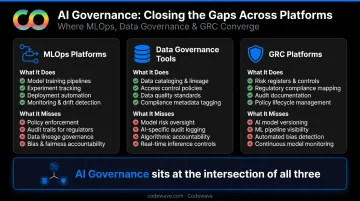
Effective AI governance sits at the intersection of all three. Industry analysts consistently note that AI governance requires enforceable technical controls, not policies alone — a distinction that most GRC platforms and MLOps tools simply weren't designed to address.
What AI Governance Solutions Actually Cover
A purpose-built AI governance solution provides:
- AI asset discovery — cataloging all AI systems in use, including unsanctioned ones
- Risk assessment — tiering systems by potential for harm and regulatory exposure
- Policy enforcement — technical controls that actually prevent unauthorized model use or deployment
- Continuous monitoring — real-time tracking of model performance, bias, and data drift
- Explainability — artifacts and interfaces that make AI decisions interpretable
- Regulator-ready documentation — model cards, AI bills of materials, bias reports, and audit trails
Codewave's AI governance practice covers this full scope. The approach embeds compliance architecture from day one, building governance into systems rather than retrofitting it after deployment — which is where most organizations run into regulatory trouble.
The 2026 AI Compliance Landscape: Regulations You Can't Ignore
Major Frameworks
| Framework | Scope | Key Obligation | Status / Penalty |
|---|---|---|---|
| EU AI Act (Reg. 2024/1689) | Any organization deploying AI affecting EU residents | Risk classification, documentation, human oversight for high-risk systems | General obligations from Aug 2026; Article 6(1) from Aug 2027. Fines up to €35M or 7% of global turnover |
| NIST AI RMF 1.0 | US federal agencies and their vendors | Govern, Map, Measure, Manage risk functions | Voluntary but required in federal procurement under OMB M-25-22 (April 2025) |
| ISO/IEC 42001:2023 | Any organization seeking governance certification | AI management system controls and continuous improvement | Signals governance maturity to regulators and enterprise buyers |
| Colorado SB26-189 | Employers and high-volume deployers in Colorado | Automated decision-making disclosures for consequential employment decisions | Enacted 2026; more US state laws pending |
Sector-Specific Obligations
- Healthcare: HIPAA requires protecting PHI used in AI training and inference. De-identification must meet Safe Harbor or Expert Determination standards — not all preprocessing qualifies
- Financial services: OCC Bulletin 2011-12 sets model risk management expectations for banks. The NAIC's 2023 model bulletin separately requires insurers to maintain written AI programs, model inventories, and third-party oversight
- EU personal data: GDPR Article 22 gives individuals the right to opt out of decisions made solely by automated processing that carry legal or significant effects
Regulations in this space are moving faster than annual assessments can track. What passes a compliance review today may fall short of an updated standard in six months — which is why ongoing governance programs outperform one-time audits.
Core Components of an AI Governance Framework
Ethical Guidelines and Fairness Standards
The foundation is a set of documented ethical principles — covering fairness, non-discrimination, privacy, and human oversight — that guide every stage of the AI lifecycle.
These must go beyond mission statements. Actionable technical controls include:
- Bias testing thresholds with defined remediation triggers
- Demographic parity and equalized odds metrics appropriate to each use case
- NIST SP 1270 guidance on context-specific fairness measurement (no single metric fits all systems)
Accountability Structures and Roles
Without clear ownership, governance decisions fall through the cracks. Organizations need:
- Defined roles: AI Ethics Officer, AI Compliance Manager, Data Protection Officer, AI Governance Committee
- A RACI matrix mapping who is responsible, accountable, consulted, and informed for each AI initiative
- Escalation protocols that activate human oversight when AI systems require intervention
In practice, these structures require more than org charts. Codewave builds these accountability layers directly into client engagements: audit trails for every AI decision, board-level reporting translated for non-technical executives, and escalation pathways that get tested before a real incident forces their use.
Transparency and Explainability Mechanisms
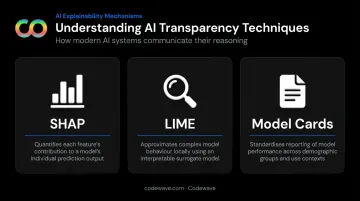
EU AI Act Article 13 requires high-risk AI systems to provide human-interpretable explanations of their outputs. Three techniques are most commonly used:
- SHAP (SHapley Additive exPlanations): Quantifies each input feature's contribution to a specific prediction, making it possible to trace why the model reached a particular output
- LIME (Local Interpretable Model-agnostic Explanations): Builds a simplified surrogate model around individual predictions, giving auditors a legible explanation without exposing the full model architecture
- Model cards: Standardized documentation that captures how a model performs across demographic and contextual subgroups — useful for both internal review and regulatory disclosure
Risk Management and Audit Processes
Once transparency mechanisms are in place, the next step is tying risk controls to the actual stakes involved. Risk-tier your AI systems by potential for harm, regulatory exposure, and business criticality. Apply governance controls proportionate to each tier — a predictive scheduling tool and a credit underwriting model should not carry the same compliance overhead.
Regular AI audits should review model accuracy, bias metrics, data lineage, and compliance status. These audits create the documented evidence trail that regulators increasingly require.
Continuous Monitoring and Feedback Loops
Audits catch problems at a point in time — but models drift and data distributions shift between review cycles. Governance frameworks should include:
- KPIs covering model performance, bias metrics, data quality, and security
- Automated alerting when thresholds are exceeded
- Regular post-deployment reviews that feed findings back into policy updates
- Version-controlled documentation so changes to models or thresholds are traceable over time
What to Look for in AI Governance Solutions
AI Asset Inventory and Shadow AI Detection
Microsoft and LinkedIn's 2024 Work Trend Index found that 78% of AI users bring their own AI tools to work, often through personal accounts outside IT visibility. IBM's 2025 breach data shows 63% of organizations lack governance policies to prevent shadow AI — meaning most enterprises are flying blind on a significant share of their AI exposure.
Effective solutions discover all AI in use by pulling from SSO logs, CASB signals, browser telemetry, and procurement systems, covering unsanctioned tools as well as officially approved ones.
Regulatory Mapping and Automated Compliance Documentation
Look for platforms with built-in templates aligned to the EU AI Act, NIST AI RMF, HIPAA, GDPR, and sector-specific frameworks. Auto-generating the following artifacts cuts the manual overhead that turns compliance teams into bottlenecks:
- Model cards
- AI bills of materials (AI-BOM)
- Risk assessments
- Audit-ready reports
Bias Detection, Drift Monitoring, and Explainability
Governance solutions must monitor deployed models continuously, not only during initial testing. Key capabilities:
- Performance degradation and data drift detection across demographic groups
- Real-time alerting tied to governance workflows (triggering re-approval or retraining)
- Explainability artifacts suitable for regulatory submission
Policy Enforcement and Access Controls
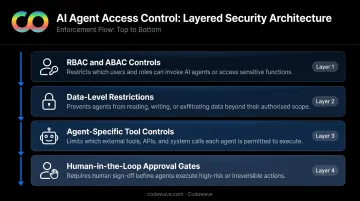
Monitoring tells you when something goes wrong; access controls determine whether it can happen in the first place. Effective tools provide:
- Fine-grained RBAC and ABAC controls over who can access, modify, or deploy AI models
- Data-level restrictions governing what information models can interact with
- Agent-specific controls that limit which tools autonomous agents can invoke
- Human-in-the-loop approval gates for high-risk agentic actions
Integration and Scalability
A governance tool that creates friction in developer workflows will be bypassed. Evaluate:
- Native connectors to your existing data warehouses, MLOps pipelines, and SIEM systems
- Embedding into CI/CD without adding deployment bottlenecks
- Pricing and architecture that scales to hundreds of models without becoming prohibitively complex
How to Implement AI Governance in Your Organization
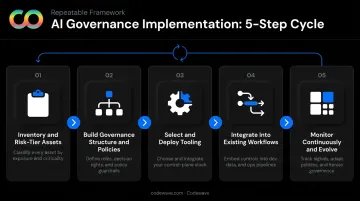
Effective AI governance doesn't happen in a single project sprint — it's a structured, ongoing process. These five steps give organizations a practical sequence for building governance that actually holds up under audit.
Step 1: Inventory and Risk-Tier Your AI Assets
Before selecting tools or writing policies, audit every AI system in use. Classify each by risk level — high, medium, or low — based on potential for harm, regulatory exposure, and business criticality. This inventory becomes the foundation of everything else.
Step 2: Build Your Governance Structure and Policies
Define roles and responsibilities, establish an AI Governance Committee, and draft a code of ethics that translates organizational values into actionable principles. Create intake and approval workflows that every new AI use case must pass through before deployment.
Step 3: Select and Deploy Governance Tooling
Match platform capabilities to your governance maturity:
- Foundational: Basic inventory, policy documentation, shadow AI discovery
- Developing: Automated compliance workflows, bias monitoring, drift alerting
- Advanced: Agentic AI oversight, cross-framework regulatory mapping, real-time audit readiness
Codewave works with organizations across all three maturity stages — from governance architecture through deployment — with a focus on measurable outcomes, not static policy documents.
Step 4: Integrate Governance Into Existing Workflows
With the right tooling in place, the next challenge is embedding governance into day-to-day development. Connecting governance to your CI/CD pipelines, data pipelines, and MLOps tooling means compliance runs alongside engineering — not as a separate gate at the end. Practical integration points include:
- Stage gates and automated policy checks in deployment pipelines
- Pre-approved AI tool catalogs that reduce shadow AI risk
- Governance hooks in MLOps tooling for model versioning and drift monitoring
Step 5: Monitor Continuously and Evolve
Set up dashboards and automated monitoring for your governance KPIs. Conduct regular audits and post-deployment reviews. Feed findings back into policy updates so your governance framework keeps pace with your AI portfolio and shifting regulations.
Common AI Governance Challenges — and How to Solve Them
Balancing Innovation Speed with Compliance Rigor
Many organizations treat governance as a speed bump — but it works better as an enabler. Fast-track approval workflows for low-risk use cases, pre-approved model libraries, and automated documentation generation all reduce friction without lowering the bar. Low-risk tools shouldn't face the same review cycle as a credit decisioning model.
Addressing Bias and Fairness at Scale
Bias presents a different challenge: it can enter through training data, model architecture, or post-deployment drift — and often doesn't surface until it causes measurable harm. The EEOC's iTutorGroup settlement and FTC's Rite Aid ban are reminders of what late detection costs.
The solution requires fairness testing across the full model lifecycle:
- Run context-appropriate fairness metrics at training, validation, and post-deployment stages
- Monitor for distributional drift that can reintroduce bias after launch
- Define clear remediation protocols before thresholds are exceeded, not after
Managing Multi-Jurisdictional Complexity
Complexity compounds further for organizations operating across the US, EU, and expansion markets like the UAE or Saudi Arabia. Requirements overlap, conflict, and multiply: Stanford HAI's 2025 AI Index documented a 21.3% rise in global AI legislative activity across 75 countries, and that pace isn't slowing.
The answer is governance frameworks built around flexible, jurisdiction-adaptable policy templates — so compliance teams configure for a new market rather than rebuilding from scratch.
Frequently Asked Questions
What is the difference between AI governance and data governance?
Data governance focuses on data quality, access controls, and lineage. AI governance specifically addresses how AI systems are developed, monitored for bias and drift, documented for regulators, and held accountable for their decisions. AI governance requires data governance as a foundational layer — but it addresses a distinct and broader set of obligations.
What are the most important AI regulations businesses need to comply with in 2026?
The EU AI Act (general obligations active from August 2026), NIST AI RMF (broadly referenced in US federal procurement), and ISO/IEC 42001 are the primary frameworks. Sector-specific obligations include HIPAA for healthcare AI, OCC and NAIC guidance for financial services, and Colorado SB26-189 for automated decision-making in employment and consumer contexts.
How is shadow AI a governance risk, and how can it be controlled?
Shadow AI — employees using unsanctioned AI tools through personal accounts — creates data exposure, compliance gaps, and audit liabilities. Governance tools detect unauthorized usage via SSO logs, CASB signals, and endpoint telemetry. Pairing detection with clear policies and fast-track approval paths gives employees sanctioned alternatives before problems compound.
Do small and mid-sized businesses need formal AI governance solutions?
Yes. SMBs using AI in decisions affecting customers — credit, hiring, healthcare, pricing — face the same regulatory obligations as large enterprises. A lightweight framework covering inventory, risk classification, and written policies costs far less than remediation after a compliance breach.
What is an AI governance framework, and how does it differ from AI governance tools?
A governance framework is the structured set of policies, principles, roles, and processes that define how an organization manages AI responsibly. Governance tools are the software platforms that automate, enforce, and document those policies. Both are necessary: the framework provides the strategy, and the tools put that strategy into practice across the organization.
How long does it typically take to implement an AI governance program?
Foundational steps — AI inventory, basic risk tiering, and written policies — can be completed in weeks. A fully operational program with automated monitoring, compliance mapping, and integrated tooling typically takes three to six months, with maturity building as the AI portfolio and regulatory requirements grow.