Introduction
By 2026, more than 80% of physicians were using AI in their professional work — roughly double the 2023 rate. Meanwhile, IBM's 2025 Cost of a Data Breach Report puts the average healthcare data breach at $7.42 million, the highest of any industry.
That gap between adoption speed and breach exposure is why HIPAA-compliant AI infrastructure is a budget decision with real consequences — not an afterthought.
Costs for HIPAA-compliant AI platforms vary widely: from around $500/month for off-the-shelf SaaS tools to $300,000+ for full custom enterprise builds. Misreading that range creates real risk. Underbudget and you expose PHI; overspend and you're paying for enterprise architecture a solo practice will never use.
This guide breaks down pricing tiers, the key factors that drive cost, a full component-by-component breakdown, and how to estimate the right budget for your organization in 2026.
Key Takeaways
- HIPAA-compliant AI platforms range from ~$500/month (SaaS) to $300,000+ (custom enterprise builds)
- Deployment model, PHI volume, EHR integrations, and certification requirements are the biggest cost drivers
- Matching your deployment tier to actual use case keeps costs from ballooning — small clinics and hospital networks have very different needs
- Building compliance architecture upfront costs significantly less than remediating a breach or retrofitting failed audits
- Proposed 2026 HIPAA Security Rule updates will likely require mandatory vulnerability scanning and annual penetration testing
How Much Does a HIPAA-Compliant AI Platform Cost?
There is no single fixed price. Costs range from a few hundred dollars a month for a pre-built SaaS tool to well over $300,000 for a fully custom AI environment with private hosting, multi-system EHR integration, and enterprise governance.
Three mistakes show up repeatedly in budget planning:
- Underbudgeting for compliance architecture, then failing a security audit
- Choosing the cheapest tool available, only to discover it can't support EHR integration or custom PHI workflows
- Being blindsided by integration fees and annual maintenance costs that weren't included in the original vendor quote
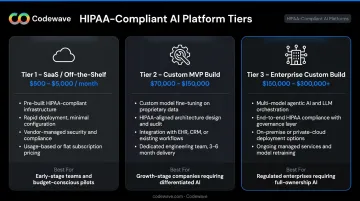
The three tiers below map the cost landscape by deployment model — which one fits depends on your PHI volume, workflow complexity, and compliance obligations.
Tier 1 — SaaS / Off-the-Shelf HIPAA-Compliant AI Tools
Typical range: ~$500–$5,000/month
These are pre-built tools — AI scribes, scheduling bots, patient communication platforms — that already hold BAAs and SOC 2 certification. The vendor manages the compliance infrastructure.
What's included:
- Vendor-managed HIPAA infrastructure
- Signed BAA
- Standard encryption and access controls
- Audit logs and customer support
What's excluded: Deep EHR customization, custom model training, private hosting, enterprise governance features
Best for: Solo practices, small clinics, and teams deploying a single focused use case (ambient note-taking, patient outreach) with no custom PHI workflows.
Tier 2 — Mid-Range / Custom MVP Platform
Typical range: $70,000–$150,000 one-time development investment
This tier involves building a compliant AI environment from scratch — with one or two clinical workflows, private model hosting, and core security architecture. It's a controlled first release: enough to validate the platform in production before committing to full-scale expansion.
What's included:
- PHI pipeline design, RBAC, encryption, and audit logging
- One EHR integration
- Basic compliance testing
What's excluded: HITRUST certification prep, multi-site deployment, advanced model governance
Best for: Mid-size healthcare groups, digital health startups, and organizations with proprietary workflows that off-the-shelf tools can't support. Codewave's M Square engagement illustrates what a focused Tier 2 build delivers: a GenAI-powered morbidity and mortality report generation tool that compressed a 20+ hour documentation process down to seconds.
Tier 3 — Enterprise / Full Custom Build
Typical range: $150,000–$300,000+
Full-scale builds covering multi-workflow automation, private or VPC-isolated model hosting, SIEM integration, and SOC 2 or HITRUST readiness preparation.
What's included:
- Complete PHI architecture and multi-system EHR/claims integration
- Immutable audit trails and zero-trust network controls
- Model governance and regulatory audit evidence collection
What's excluded from the base estimate: Annual maintenance (more on that below), staff training programs, and post-launch certification fees
Best for: Large hospital networks, healthcare SaaS companies, and any organization handling high PHI volumes across multiple departments, sites, or payer relationships.
Key Cost Factors That Drive HIPAA-Compliant AI Platform Pricing
Platform pricing reflects a mix of technical, regulatory, and operational factors. Understanding each one helps organizations avoid overspending in low-risk areas while correctly funding the high-stakes ones.
Deployment Model and Hosting Architecture
Where and how the AI model runs is the single largest cost variable. Options and their approximate cost implications:
| Deployment Model | Additional Cost |
|---|---|
| BAA-covered managed API (shared cloud) | $5,000–$20,000 |
| Private inference endpoints | $15,000–$45,000 |
| VPC-isolated / dedicated cloud tenancy | $20,000–$90,000 |
| On-premise LLM deployment | $60,000–$150,000 |
The right choice depends on PHI volume and data sovereignty requirements. A single-workflow clinical documentation tool can often run on a managed API with appropriate BAA coverage. A multi-payer claims platform almost certainly cannot.
PHI Volume and Workflow Complexity
Platforms processing high volumes of structured and unstructured PHI — EHR records, clinical notes, imaging metadata, call transcripts — require more complex ingestion pipelines, tokenization layers, and real-time de-identification. Single-workflow platforms cost significantly less than multi-workflow systems. The jump from one to three clinical workflows isn't linear; each added workflow compounds the engineering scope.
EHR and Healthcare System Integrations
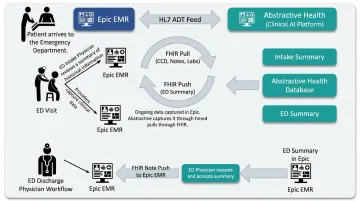
Connecting an AI platform to Epic, Oracle Health, or athenahealth via HL7/FHIR adds meaningful cost and complexity. Epic currently holds 43.9% of the U.S. inpatient EHR market, meaning most enterprise builds will require an Epic integration at some point.
Integration costs typically run $15,000–$40,000 per major EHR connection, covering bidirectional data flow, identity sync, and ongoing maintenance as the EHR updates.
Without deep integration, AI tools can't access the clinical data they need or write results back to the patient record. When scoping a build, EHR integration costs are among the most frequently underestimated line items — budget for them early and explicitly in any RFP.
Compliance Certification Requirements
Certification requirements directly shape budget:
- SOC 2 Type II readiness: $15,000–$35,000 (SOC 2 reports often start in the five figures, per Sensiba's audit cost guidance)
- HITRUST CSF preparation: HITRUST's MyCSF SaaS subscription starts at $18,100, with third-party assessor fees on top
Small practices can skip these. Enterprise healthcare buyers and hospital procurement teams increasingly require them before approving any new vendor.
2026 HIPAA Regulatory Developments
HHS published a proposed HIPAA Security Rule update in January 2025 that, if finalized, would require vulnerability scanning at least every six months and penetration testing at least every 12 months. These are proposed, not yet final, but organizations building platforms now should design their security programs to meet them.
Existing BAA rules add further obligations. Vendors must demonstrate they're not using PHI in ways unauthorized by the agreement, including for model training. HHS cloud guidance also requires BAAs to address PHI return or destruction at contract termination. For AI vendors and their buyers, this translates into concrete budget line items:
- Stricter vendor vetting processes before onboarding any AI tool
- Updated BAA legal review to reflect model training and data retention clauses
- Ongoing security testing costs if proposed scanning requirements are finalized
Full Cost Breakdown of a HIPAA-Compliant AI Platform
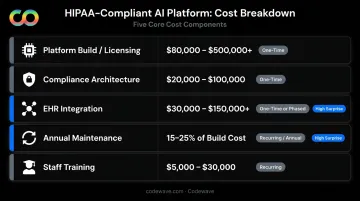
Total cost extends well beyond the platform license or initial build fee. Organizations that budget only for the headline number routinely exceed budget.
| Cost Component | One-Time or Recurring | What It Covers |
|---|---|---|
| Platform development or licensing | One-time (custom) or monthly (SaaS) | PHI architecture, security controls, AI model integration |
| Compliance and security architecture | One-time, with periodic updates | BAA negotiation, encryption, RBAC, PHI tokenization, audit logging |
| EHR and healthcare system integrations | One-time setup + ongoing maintenance | HL7/FHIR integration, claims/payer APIs, identity/SSO sync |
| Ongoing maintenance and compliance upkeep | Recurring (annual) | Vulnerability scanning, pen testing, model validation, access reviews |
| Staff training and change management | One-time with periodic refreshes | HIPAA AI training, incident response drills, workflow onboarding |
Key figures to budget for:
- Annual maintenance: Industry estimates run 15–25% of initial build cost per year. For a $150,000 build, that's $22,500–$37,500 annually — a recurring cost that frequently gets omitted from initial budget discussions.
- Staff training: Typically $5,000–$15,000 at launch, with smaller annual refresh costs. Frequently absent from vendor quotes.
- EHR integrations: Often the largest budget surprise in the first year post-launch. A Forrester TEI study of healthcare data integration found three-year costs reaching $828,000 for a composite organization, with ongoing management and maintenance costs far exceeding initial estimates.
Low-Cost vs. High-Cost HIPAA-Compliant AI Platforms — What's the Difference?
Budget and premium platforms can both meet baseline HIPAA requirements — but what separates them is what you get beyond the checkbox: control, auditability, scalability, and risk protection.
| Dimension | Lower-Cost SaaS Tools | Higher-Cost Custom Platforms |
|---|---|---|
| Compliance depth | Shared-infrastructure compliance; vendor manages controls | Dedicated, auditable environment; customer-controlled encryption keys and immutable audit logs |
| Integration capability | Limited pre-built connectors | Deep bidirectional EHR, claims, and payer integrations |
| Scalability | Suited to narrow, low-PHI-volume use cases | Built for complex multi-workflow and multi-site operations |
| Long-term risk profile | Relies on vendor compliance continuity | Direct organizational control over breach response, audit evidence, and model governance |
The right choice isn't always the more expensive one. A solo practice using an AI scribe doesn't need a zero-trust network architecture. A health system processing millions of clinical records across 12 sites does — and cutting corners there creates real regulatory and financial exposure.
How to Estimate the Right Budget for Your HIPAA-Compliant AI Platform
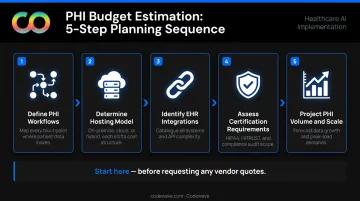
Budget estimation should start with use case clarity and compliance requirements — not with a vendor quote. Organizations that reverse that order either overpay for infrastructure they don't need or choose tools that fail procurement review.
Answer these questions before requesting any quotes:
- How many PHI workflows will the platform handle?
- Does the organization require private model hosting, or will a BAA-covered managed API suffice?
- Which EHR systems need integration, and is bidirectional write-back required?
- Are enterprise buyers requiring SOC 2 Type II or HITRUST certification?
- What is the expected PHI volume and user scale over the next 3–4 years?
For complex builds, compliance architecture decisions made late in development consistently drive up costs. Codewave scopes HIPAA requirements during the discovery phase itself, covering data protection, access controls, audit trails, and integration standards before model selection begins. This keeps rework costs off the table.
That architecture-first approach also informs how Codewave structures pricing. The ImpactIndex™ model ties project scope to measurable outcomes: reduced administrative burden, faster data processing, lower error rates. Rather than a flat fee for technical deliverables, the budget aligns to what the platform is actually expected to do.
What Most Organizations Miss When Budgeting for HIPAA-Compliant AI
Licensing and Build Fees Are Just the Start
Integration costs, certification prep, and annual maintenance routinely add more to three-year total cost of ownership than the initial platform fee. HITRUST's MyCSF alone starts at $18,100 before third-party assessor fees. EHR integration maintenance compounds annually. These line items deserve their own budget rows from day one.
Compliance Is Ongoing, Not a One-Time Checkbox
Compliance is an ongoing operational requirement. The proposed HIPAA Security Rule updates would require regular vulnerability scanning and penetration testing. Model outputs need monitoring for hallucinations that could expose PHI.
Organizations that treat compliance as a launch-only task end up paying for it later — through costly remediation when audits surface gaps, model updates break existing controls, or regulatory changes require architectural rework.
Shadow AI Carries Real Financial Risk
A 2026 Wolters Kluwer survey found that nearly 20% of healthcare professionals admitted using unsanctioned AI tools, and 1 in 10 reported using them for direct patient care. HIPAA civil monetary penalties for violations can reach:
- $73,011 per violation at Tier 4
- $2,190,294 per violation category annually under current 2026 inflation-adjusted figures
Providing staff with a sanctioned, compliant alternative is nearly always less expensive than that exposure.
Conclusion
HIPAA-compliant AI platform costs in 2026 range from a few hundred dollars a month for focused SaaS tools to over $300,000 for full custom enterprise builds. Where an organization lands depends on workflow complexity, PHI volume, hosting requirements, and certification scope.
The right cost is the one calibrated to the organization's actual compliance risk profile. Underspending on compliance architecture creates breach exposure and failed procurement audits; overspending on features a use case doesn't need diverts budget from direct care operations. Knowing which side of that line you're on requires an honest internal assessment of data sensitivity, integration scope, and regulatory obligations before any vendor conversation starts.
Frequently Asked Questions
What are the cost factors for a HIPAA-compliant AI platform in 2026?
The main drivers are deployment model (SaaS vs. custom build), PHI workflow complexity, EHR integration requirements, private hosting needs, and compliance certification targets (SOC 2, HITRUST). Proposed 2026 HIPAA Security Rule updates around mandatory vulnerability scanning and penetration testing are adding new operational cost line items that organizations need to plan for.
What are the new HIPAA changes for 2026?
HHS published a proposed HIPAA Security Rule update in January 2025 that would require vulnerability scanning at least every six months and penetration testing at least annually. This is a proposed rule, not yet finalized. Separately, existing BAA requirements already govern how AI vendors may use PHI, including restrictions on using patient data to train public models — a requirement that organizations should verify with every AI vendor they engage.
What is the typical cost range for a HIPAA-compliant AI platform?
Off-the-shelf SaaS tools run $500–$5,000/month. Custom MVP builds typically cost $70,000–$150,000 as a one-time development investment. Full enterprise custom platforms range from $150,000–$300,000+. Annual maintenance adds approximately 15–25% of the initial build cost each year, making the total cost of ownership significantly higher than the headline build number.
What certifications should a HIPAA-compliant AI vendor have?
SOC 2 Type II validates sustained security controls over time (vs. a point-in-time snapshot). HITRUST CSF is the healthcare industry standard combining HIPAA, NIST, and ISO requirements. A signed BAA is the required legal foundation — self-attestation alone is not sufficient, and hospital systems increasingly require third-party certification before approving new vendors.
Is it better to buy an off-the-shelf HIPAA AI tool or build a custom platform?
Buying works for standard, low-complexity workflows — note-taking, scheduling, patient FAQ bots — where vendor-managed compliance is sufficient. Building is necessary when the organization needs private model hosting, custom PHI pipelines, deep bidirectional EHR integration, or proprietary audit evidence required by hospital procurement teams. Start with the workflow; the build-vs-buy decision follows from there.
How much does annual maintenance cost for a HIPAA-compliant AI platform?
Ongoing maintenance typically runs 15–25% of the initial build cost per year, covering vulnerability scanning, penetration testing, model validation, access reviews, and compliance documentation updates. For a $150,000 build, that's $22,500–$37,500 annually — a recurring line item that must be budgeted from day one.