Introduction
AI agents are fundamentally reshaping how enterprises operate in 2026. IDC reports that global AI infrastructure spending reached $89.9 billion in Q4 2025 alone—a 62% year-over-year increase—with total 2026 spending projected to hit $487 billion. Yet spending alone doesn't equal results: McKinsey's 2025 State of AI survey found 62% of enterprises are experimenting with AI agents, but only 23% have successfully scaled agentic AI across even one business function.
This guide breaks down real AI agent development costs by type and complexity, key pricing factors, phase-by-phase budget allocation, and hidden ongoing expenses. Use it to plan your AI investment clearly and sidestep the budget traps that derail most enterprise AI projects.
Key Takeaways
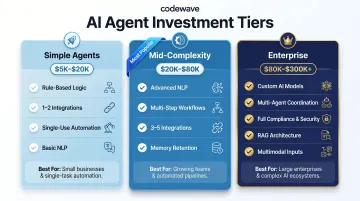
- Simple agents (rule-based, single-use): $5,000–$20,000 — proof-of-concept bots and single-process automation
- Mid-complexity agents (NLP, integrations, multi-step workflows): $20,000–$80,000 — CRM-connected systems and operational workflows
- Enterprise agents (custom models, multi-agent coordination, full compliance): $80,000–$300,000+ — regulated industries and autonomous decision-making
- What drives cost up: Complexity, system integrations, compliance requirements (HIPAA, GDPR), and autonomy level
- What keeps cost down: MVP-first approach, pre-trained models, RAG before fine-tuning, and monitored API usage
How Much Does It Cost to Develop an AI Agent?
AI agent development costs range from $5,000 for a simple rule-based bot to $300,000+ for an enterprise-grade autonomous system. The gap is real — and most businesses hit budget surprises not in the build phase, but when moving from prototype to production. Agent type, autonomy level, and integration depth drive the majority of that variance.
Here's how the tiers break down:
Simple AI Agents ($5,000–$20,000)
What's included:
- Rule-based logic with predefined response trees
- Limited integrations (typically 1–2 systems)
- Single-use case automation (FAQ bots, basic scheduling assistants, simple workflow triggers)
- Basic NLP for keyword matching and intent recognition
- Minimal security requirements
Best for:
- Startups validating a use case before committing to full builds
- Teams automating one repetitive process (lead capture, appointment booking)
- Businesses without complex data pipelines or compliance needs
- Proof-of-concept projects testing agent viability
Once a simple agent proves its value, most growing businesses find they need cross-system coordination and smarter decision logic — which is where mid-complexity builds come in.
Mid-Complexity AI Agents ($20,000–$80,000)
What's included:
- Advanced NLP with contextual understanding and entity extraction
- Multi-step workflows that chain actions across systems
- API integrations with 3–5 business systems (CRMs, ERPs, ticketing platforms)
- Basic learning capabilities (adapts responses based on historical interactions)
- Memory and context retention across sessions
- Common use cases: lead qualification agents, recommendation systems, internal knowledge assistants
Best for:
- Growing businesses automating customer-facing or operational workflows
- Teams requiring agents to connect with existing software ecosystems
- Organizations needing agents that handle moderately complex decision trees
- Companies with standard security requirements but no regulatory compliance obligations
For enterprises in regulated industries — or those with proprietary data, legacy infrastructure, and strict compliance mandates — mid-complexity agents typically fall short. That's when advanced builds become necessary.
Advanced / Enterprise AI Agents ($80,000–$300,000+)
What's included:
- Custom-trained or fine-tuned models on proprietary data
- Multi-agent coordination and orchestration across complex task pipelines
- Real-time decision-making with sub-second response requirements
- RAG (Retrieval-Augmented Generation) for dynamic knowledge base access
- Voice, vision, or multimodal inputs
- Full compliance and security layers (HIPAA, GDPR, SOC 2, PCI DSS)
- Enterprise system integration with legacy middleware
- Complete IP ownership and data sovereignty
Who should use this:
- Enterprises in regulated industries (healthcare, fintech, insurance)
- Organizations requiring autonomous multi-step reasoning
- Teams needing full IP ownership and data control
- Companies with complex security, audit, and compliance mandates
Important: These ranges are benchmarks, not fixed quotes. Final costs depend on vendor rates, geography, project scope, and whether teams build from scratch or use pre-trained models as a foundation.
Key Factors That Affect AI Agent Development Costs
AI agent costs don't follow a simple formula. What you pay depends on how much autonomy you need, what data you're working with, which systems the agent must connect to, and how heavily regulated your industry is. Getting clear on these variables upfront prevents expensive scope changes once development is underway.
Complexity and Autonomy Level
Agents range from simple reflex bots (rule-based, no memory) to fully autonomous multi-agent systems that plan, reason, and execute tasks independently.
Autonomy tiers and cost impact:
- Assistive agents — human-in-the-loop for every action; require minimal guardrails
- Semi-autonomous agents — handle routine tasks independently but escalate edge cases; need rollback logic and incident handling
- Fully autonomous agents — execute multi-step processes without supervision; require extensive safeguards, larger context windows, robust testing, and fail-safe mechanisms
Each step up in autonomy can add tens of thousands of dollars due to:
- Guardrail implementation (preventing harmful actions)
- Rollback and recovery logic
- Comprehensive edge case testing
- Human oversight monitoring dashboards
Data Requirements and Model Choice
The single largest cost variable in AI agent development is your model approach:
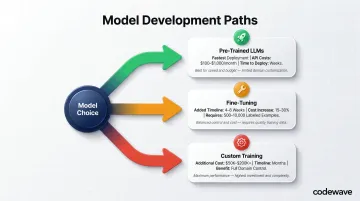
Three primary paths:
Pre-trained commercial LLMs (OpenAI, Anthropic, Google)
- Faster to deploy (weeks instead of months)
- OpenAI's GPT-4.5 costs $2.50 per 1M input tokens and $15.00 per 1M output tokens
- Anthropic's Claude Sonnet runs $3.00 per 1M input tokens and $15.00 per 1M output tokens
- Ongoing API costs scale with usage (typically $100–$1,000+/month for moderate-use agents)
Fine-tuning on proprietary data
- Balances customization with development speed
- Requires 500–10,000+ labeled examples
- Adds 4–8 weeks to project timeline
- Mid-range cost increase (15–30% over base build)
Training custom models from scratch
- Most expensive option (adds $50,000–$200,000+)
- Justified only for highly unique domain requirements
- Requires extensive data pipelines and ML engineering expertise
One cost that catches teams off guard: data preparation. Research cited by Cloudera shows data preparation and engineering consume over 80% of time in most AI/ML projects. Cleaning, labeling, PII redaction, and structuring datasets typically adds 20–40% to both timeline and budget.
System Integrations
Once your model approach is set, integrating the agent with your existing tech stack becomes the next major cost driver. Connecting to CRMs, ERPs, ticketing platforms, and legacy databases is often the most expensive phase of the build.
Integration complexity factors:
- Modern SaaS platforms with strong APIs and documentation integrate faster (1–2 weeks per system)
- Legacy enterprise systems often require middleware layers, custom connectors, and schema mapping (4–8 weeks per system)
- Real-time data sync requirements add complexity and cost
- Each additional integration typically adds 40–60 engineering hours
Compliance and Security Requirements
Integration complexity is often compounded in regulated industries. Healthcare, fintech, and insurance deployments must meet strict compliance standards — and those requirements add real cost:
Typical compliance requirements:
- Role-based access controls (RBAC)
- Comprehensive audit logging
- PII detection and redaction
- Prompt filtering and guardrails
- Penetration testing and vulnerability assessments
- Data encryption at rest and in transit
Cost benchmarks:
- SOC 2 compliance typically costs $30,000–$50,000 to achieve
- GDPR compliance ranges from €5,000–€30,000 for small businesses to €250,000–€1,000,000+ for large enterprises
Budget compliance from day one. Retrofitting security and regulatory controls after build completion typically doubles the implementation cost.
Developer Rates and Engagement Model
Hourly rates vary widely by region and skill level:
- U.S.-based AI engineers: $142,063 median total pay annually (translates to roughly $75–$110/hour for consulting work)
- Freelance marketplace rates: $35–$60/hour median on Upwork, with experienced specialists charging $100+/hour
- Agency rates: Typically 1.5–2.5× individual freelancer rates due to overhead and project management
Engagement model matters as much as rate. Fixed-price contracts work well for clearly scoped builds; time-and-materials gives you flexibility when requirements are likely to evolve — which is common in first-generation agent deployments.
AI Agent Development Cost Breakdown by Phase
AI agent costs accumulate across multiple development stages, and each phase carries its own complexity, timeline risks, and budget weight. Understanding where money goes helps you plan more accurately and avoid the overruns that catch most teams off guard.
Discovery and Planning (10–15% of total budget)
This phase covers:
- Defining the agent's purpose and success metrics
- Technical architecture decisions (model choice, orchestration layer)
- Data requirements assessment
- Integration scope mapping
- Compliance requirements identification
Typical cost: $5,000–$20,000 for standard projects; $20,000–$40,000 for complex enterprise builds.
A thorough discovery phase prevents scope creep and can save 30–50% on total build cost by identifying misaligned requirements early.
Development and Model Integration (35–45% of total budget)
The core engineering phase where most budget is spent:
- Model selection or fine-tuning
- Agent logic and reasoning framework
- Memory and context management
- Tool orchestration (connecting agent to external APIs and functions)
- Data pipeline construction
Cost drivers:
- Pre-trained vs. custom model decisions have the largest financial impact
- Complex reasoning chains require more engineering time
- Memory systems for context retention add complexity
Integration and Workflow Orchestration (15–20% of total budget)
This phase connects the agent to real business systems — transforming validated logic into something your teams can actually use:
- API development and middleware layers
- Schema mapping for legacy systems
- Real-time data synchronization
- Error handling and retry logic
Integration is the most frequently underestimated phase in AI builds. When integration planning is rushed or incomplete, the downstream cost is real: teams typically absorb 4–8 extra weeks and 20–40% budget overruns before the agent goes live.
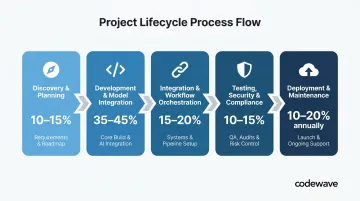
Testing, Security, and Compliance (10–15% of total budget)
AI-specific testing goes beyond traditional QA:
- Behavioral validation (does the agent respond appropriately?)
- Edge case handling (what happens when inputs are unexpected?)
- Hallucination mitigation testing
- Bias checks and fairness assessments
- Performance under load testing
- Security penetration testing
For regulated industries, formal compliance verification and audits add to this phase's cost.
Deployment and Ongoing Maintenance (10–20% annually)
Final build phase plus recurring costs:
- Cloud infrastructure setup (AWS Bedrock, GCP, Azure)
- CI/CD pipeline configuration
- Monitoring dashboards and alerting
- Annual maintenance: Typically 15–25% of initial build cost, covering model retraining, integration patches, and performance optimization
Hidden and Ongoing Costs of Running an AI Agent
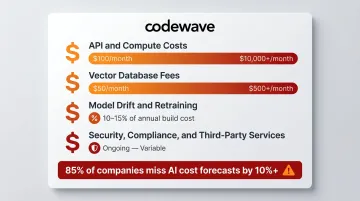
Building the agent is just the beginning. A survey reported by CFO Dive found that 85% of companies miss AI cost forecasts by at least 10%, with 24% missing by more than 50%.
API and Compute Costs
Commercial LLM API costs scale with usage:
- Moderate-use agents (10,000–50,000 requests/month) typically cost $100–$1,000/month in API fees
- High-use agents (200,000+ requests/month) can exceed $5,000–$10,000/month
- Batch processing offers 50% discounts on eligible workloads
Self-hosted open-source models eliminate per-call fees but require GPU-backed cloud instances — typically $1,000–$2,000/month for single-instance deployments. They only become cost-effective beyond roughly 100,000 requests/month.
Vector database costs add another layer:
- Pinecone Standard tier: $50/month minimum plus usage-based charges
- Qdrant offers a free tier with 1GB RAM and paid options for production workloads
- Storage and query costs scale with data volume
Model Drift and Retraining
AI agents degrade quietly. As business data shifts, user behavior changes, and product catalogs update, model accuracy erodes — often before anyone notices.
Ongoing obligations:
- Periodic retraining (typically quarterly to annually)
- Prompt updates and refinement
- Validation cycles to ensure accuracy
- Performance monitoring and drift detection
Typical cost: 10–15% of initial build cost annually for actively used agents.
Security, Compliance Monitoring, and Third-Party Integration Fees
Ongoing compliance is not a one-time setup task:
- Continuous compliance monitoring
- Regular security audits and vulnerability scans
- Encryption updates and access control reviews
- Real-time anomaly detection
Beyond security, third-party service fees accumulate steadily throughout the agent's lifecycle:
- NLP enhancement services
- Vector database subscriptions
- Voice API fees (ElevenLabs, Deepgram)
- Monitoring and observability platforms
Factor these line items into your budget before the first deployment — not after the first invoice.
How to Plan Your AI Agent Budget the Right Way
Budget planning should start with a clear definition of the problem the agent will solve and the measurable outcome it needs to deliver. A vague use case leads to scope creep and overspending.
Codewave's ImpactIndex™ model ties development to measurable business outcomes rather than engineering hours. For clients in healthcare, fintech, and retail, this means every feature traces back to a specific result — which keeps scope tight and budgets on track.
Build vs. Buy: Matching Approach to Budget
Off-the-shelf SaaS tools
- Upfront cost: $50–$500/user/month
- Time to deploy: Days to weeks
- Best for: Standard use cases (customer support bots, scheduling assistants)
- Trade-offs: Limited customization, vendor lock-in, recurring subscription fees
- Example: Microsoft Copilot Studio at $200/month per 25,000-message pack
Custom-built agents
- Upfront cost: $20,000–$300,000+
- Time to deploy: 3–6 months
- Best for: Regulated industries, unique workflows, full IP ownership requirements
- Trade-offs: Higher initial investment, longer development timeline
Hybrid approach
- Start with SaaS to validate use case and ROI
- Migrate to custom once value is proven
- Minimizes risk while preserving flexibility
Strategies to Reduce Costs Without Sacrificing Quality
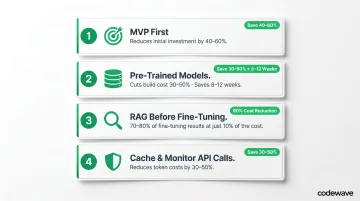
Start with an MVP focused on one core workflow
- Validate value before expanding scope
- Reduces initial investment by 40–60%
- Allows iterative refinement based on real feedback
Use pre-trained or open-source models instead of training from scratch
- Cuts development time by 8–12 weeks
- Reduces build cost by 30–50%
- Reserve custom training for truly unique requirements
Apply prompt engineering and RAG before investing in full fine-tuning
- RAG (Retrieval-Augmented Generation) provides dynamic knowledge access without retraining
- Prompt optimization typically delivers 70–80% of fine-tuning benefits at 10% of the cost
- Fine-tune only when prompt engineering hits performance ceilings
Monitor and cache API calls to reduce token costs
- Caching repeated queries can reduce API costs by 30–50%
- Batch processing (available on OpenAI, Anthropic, and Google APIs) cuts costs by up to 50%
- Set usage alerts to catch runaway costs early
What Most Businesses Get Wrong About AI Agent Costs
The most common budgeting mistake is treating AI agent development as a one-time expense rather than an ongoing investment. Underbudgeting for maintenance, retraining, and operational costs leads to degraded performance and hidden technical debt within months of launch.
Three more patterns consistently inflate costs or derail AI agent projects:
Chasing the lowest bid. Limited support, thin documentation, and vendor lock-in with inflexible platforms tend to follow. The "cheaper" option often triggers expensive rework or migration costs within 12–18 months.
Cutting the discovery phase to save time. Skipping requirements validation means misaligned specs and scope changes mid-build — which typically adds 30–50% to total project cost through rework alone.
Building too much in version one. Feature bloat delays launch and drives up development cost. Most over-specified features go unused. Starting lean and iterating based on real user feedback consistently delivers better ROI.
Conclusion
AI agent development costs vary widely—from a few thousand dollars for simple task bots to hundreds of thousands for enterprise-grade autonomous systems. Understanding the full cost picture (build + operate + maintain) leads to far better budgeting decisions.
The right investment matches the agent's complexity to the business outcome it needs to drive—nothing more, nothing less. Codewave has helped 400+ businesses across healthcare, fintech, retail, and beyond scope their AI agents realistically and build toward measurable results.
If you're still working out what your build should cost or where to start, that scoping conversation is usually the most valuable first step.
Frequently Asked Questions
How much does it cost to develop an AI agent?
Development costs range from $5,000 for simple rule-based bots to $300,000+ for enterprise-grade autonomous systems. Final cost depends on complexity (single-task vs. multi-agent coordination), integrations (number of connected systems), autonomy level (assistive vs. fully autonomous), and compliance requirements (HIPAA, GDPR, SOC 2).
How much do AI agencies or developers charge to build an AI agent?
Freelance AI engineers typically charge $35–$60/hour on platforms like Upwork, while experienced specialists command $100+/hour. U.S.-based AI engineers average $142,063 annually, translating to roughly $75–$110/hour for consulting work. Agencies typically charge 1.5–2.5× individual rates due to overhead and team coordination.
Is agentic AI free or paid?
Open-source frameworks like LangChain and Hugging Face are free to use, but production-ready systems still require paid engineering labor, cloud compute, LLM API calls, and ongoing maintenance. Total costs typically run $5,000–$300,000+ depending on complexity—even before factoring in retraining and monitoring.
What is the best platform to build agentic AI?
The right platform depends on your use case. LangGraph and LangChain suit orchestration-heavy workflows; OpenAI and Anthropic offer frontier model capabilities; AWS Bedrock, Google Vertex AI, and Azure AI Studio provide enterprise infrastructure with built-in compliance controls. Your choice directly affects both build time and ongoing API and compute costs.
What are the ongoing costs of running an AI agent?
Main recurring costs include LLM API fees ($100–$10,000+/month depending on usage), cloud hosting and compute ($500–$2,000+/month for self-hosted models), vector database storage ($50–$500+/month), model retraining and prompt updates (10–15% of build cost annually), and compliance monitoring (ongoing audit and security costs). Total ongoing costs typically represent 15–25% of the original build cost annually.
How can I reduce AI agent development costs without sacrificing quality?
- Start with an MVP on one core workflow before expanding scope
- Use pre-trained models (OpenAI, Anthropic) instead of training from scratch — saves 8–12 weeks
- Apply RAG before fine-tuning — delivers 70–80% of fine-tuning results at 10% of the cost
- Cache and monitor API calls to cut token costs by 30–50%