Introduction
The conversational AI market is growing fast. According to Grand View Research, it's expanding from $11.58 billion in 2024 to a projected $41.39 billion by 2030. What once demanded a $50,000+ custom build can now be deployed as a SaaS subscription for under $300 per user per month. Yet pricing remains wildly inconsistent: two companies building functionally similar solutions can end up with bills differing by 10x or more.
Pricing depends on deployment type, conversation volume, customization requirements, and integration complexity. These variables shift dramatically from one use case to the next.
A small e-commerce team using text-based chat with standard integrations pays a fraction of what a healthcare provider spends on HIPAA-compliant voice agents with custom LLM training.
This guide breaks down real cost ranges across tiers, explains what drives prices up or down, compares pricing models, and provides a practical framework to estimate the right budget for your use case — whether you're automating customer support, qualifying leads, or building enterprise-scale voice agents.
Key Takeaways
- Typical cost ranges: SaaS tools run $20–$150/user/month; enterprise custom builds range from $150–$300+/user/month or $5,000–$500,000+ for full development
- Voice vs. text pricing: Voice AI typically adds $0.10–$0.50/minute on top of base platform costs
- Key price drivers: Conversation volume, voice vs. text interaction, LLM model quality, integration depth, and compliance requirements
- Lower-cost deployments: Small teams using off-the-shelf SaaS tools with text-based chat and standard integrations
- Who pays more: Enterprises deploying voice AI, requiring custom-trained models, HIPAA/GDPR compliance, or deep CRM integration
- When to spend more: When automation at scale directly replaces measurable labor costs or drives clear revenue outcomes — the ROI case matters more than the sticker price
How Much Does Conversational AI Cost?
Conversational AI has no fixed price. What you pay depends entirely on deployment model, feature set, conversation volume, and whether you're buying off-the-shelf software or commissioning a custom build.
Misread the pricing model and you'll either underbudget into expensive overages, or overpay for enterprise features you don't need. Match your spend to your actual requirements, not the vendor's recommended tier.
Tier 1: Entry-Level SaaS Subscriptions
Price range: $0–$50/user/month or flat-rate plans starting at $24–$49/month
Entry-level platforms like Tidio and Freshchat provide pre-built chatbot templates, limited AI conversation credits per month, basic integrations, and standard analytics. Tidio's Starter plan costs $24.17/month and includes 100 billable conversations and 50 Lyro AI conversations. Freshchat offers a free plan for up to 10 agents with 500 Freddy AI Agent sessions included.
What's included:
- Pre-configured chatbot templates
- Limited monthly conversation volume (typically 50–250 interactions)
- Basic CRM and helpdesk integrations
- Standard analytics and reporting
Best for: Small businesses and startups testing AI-assisted support or lead capture at low conversation volumes.
Tier 2: Mid-Range / API-Integrated Platforms
Price range: $50–$150/user/month, or $0.10–$0.50/minute for voice
Mid-tier platforms combine subscription access with usage-based billing. Intercom charges $85/seat/month for the Advanced plan plus $0.99 per resolved outcome for its Fin AI Agent. Amazon Lex uses pure pay-per-request pricing: $0.00075 per text request and $0.004 per speech request.
What's included:
- Advanced natural language processing
- Workflow automation and routing
- CRM, helpdesk, and ticketing integrations
- AI analytics dashboards
- Custom conversation flows
Best for: Growing businesses that need AI connecting to existing tools and handling moderate-to-high conversation volumes.
Tier 3: Enterprise / Custom-Built Conversational AI
Price range: $150–$300+/user/month for enterprise SaaS, or $5,000–$500,000+ for custom builds
Salesforce Agentforce offers consumption-based pricing at $500 per 100,000 Flex Credits (standard actions cost ~$0.10 each). IBM watsonx Assistant Enterprise requires custom quotes and includes HIPAA readiness, data isolation, BYOK encryption, and 24/7 premium support.
Custom builds for regulated industries—healthcare, fintech, insurance—require domain-specific training, compliance configurations, and dedicated infrastructure.
What's included:
- Custom-trained LLMs fine-tuned for your domain
- On-premise or private cloud deployment
- HIPAA, GDPR, and financial compliance configurations
- Dedicated account management and support
- Full API access and white-label options
Best for: Large organizations in regulated industries where off-the-shelf tools fall short on accuracy, compliance, or workflow complexity.
Watch for hidden costs: Published pricing typically excludes:
- LLM API costs (almost always billed separately)
- Data migration and onboarding fees
- Premium support tier upgrades
- Overage charges on conversation minutes or interactions
Key Factors That Drive Conversational AI Pricing
Pricing reflects a combination of technical, operational, and business requirements—explaining why two vendor quotes for similar outcomes can differ by 10x.
Type of Interaction: Text vs. Voice
Voice-based conversational AI requires simultaneous speech-to-text processing, intent recognition, response generation, and text-to-speech synthesis. Amazon Lex pricing shows that speech requests cost $0.004 per request versus $0.00075 for text—making voice approximately 5.3x more expensive per interaction than text-based chatbots.
That gap compounds quickly at scale: voice deployments also demand more compute infrastructure, which pushes up costs for both usage-based billing and custom builds.
Conversation Volume and Scale
Monthly conversation volume is the most direct cost multiplier. Whether a platform bills per minute, per message, per resolution, or per user, more conversations mean higher costs.
Model your usage across low, medium, and high volume scenarios before signing any contract. Watch for "pricing cliffs" where costs jump sharply at usage thresholds—for example, IBM watsonx Assistant charges $14 per additional 100 MAUs beyond the 1,000 included in the Plus plan.
LLM Model Quality and Training Requirements
The underlying language model powering your conversational AI directly affects price. Generic models cost less to run but may underperform in specialized domains like healthcare intake, insurance claims, or financial services.
Cost differential by model tier:
- Generic models: $0.10/million tokens input (Google Gemini 2.5 Flash-Lite)
- Premium models: $5.00/million tokens input (OpenAI GPT-5.5, Anthropic Claude Opus)
- Fine-tuned models: OpenAI charges $25.00/million tokens for GPT-4o fine-tuning—a 10x premium over standard inference rates
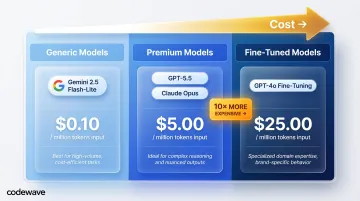
Fine-tuned or domain-specific models require training data, compute hours, and ongoing retraining as your use case evolves.
Customization and Integration Depth
Off-the-shelf tools with standard integrations (plug-and-play CRM connectors) are cheapest to deploy. Custom integrations into legacy systems, proprietary databases, or multi-tool stacks add substantial development cost.
Each additional integration point—helpdesk, inventory system, payment processor—typically requires premium API access billed separately. Add-on pricing stacks fast:
- Freshchat Freddy AI Copilot: $29/agent/month
- Intercom Pro AI Features: $99/month for 1,000 conversations
Deployment Model and Compliance Requirements
Cost by deployment type:
- Cloud SaaS: Lowest upfront cost, fastest deployment
- Hybrid: Moderate cost, partial control
- On-premise or private cloud: Highest cost, required for regulated industries
Compliance configurations for HIPAA, GDPR, or financial data regulations add setup cost and may require dedicated infrastructure, legal review, and ongoing audit logging. IBM watsonx Assistant Enterprise explicitly includes HIPAA readiness and data isolation, while entry-level plans offer neither—a distinction worth pricing carefully before committing.
Pricing Models Compared: Subscription, Pay-As-You-Go, and Custom Build
The pricing model you choose matters as much as the dollar amount. Getting this wrong means either paying for unused capacity or getting hit with unexpected usage bills.
Subscription vs. Pay-As-You-Go
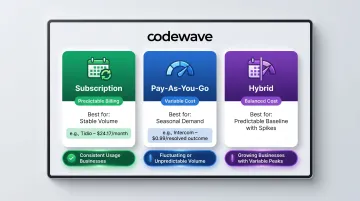
Subscription plans charge a fixed monthly cost per user or a flat-rate platform fee. Predictable billing makes this the right fit for teams with stable, ongoing conversation volume — though you pay full price even during slow periods. Tidio's Starter plan charges $24.17/month for 100 billable conversations and 50 Lyro AI conversations.
Pay-as-you-go pricing charges per minute, per message, or per resolved conversation. No minimum commitment means lower risk for variable demand, seasonal businesses, or pilots — but usage spikes can blow your budget fast. Intercom's Fin AI Agent charges $0.99 per resolved outcome with no per-seat fee. Amazon Connect bills $0.038/minute for voice with unlimited AI features.
Hybrid models combine a base platform fee covering a set interaction volume, with usage charges above the threshold. This works well for teams with a predictable baseline that occasionally spikes — such as seasonal retail surges.
Total Cost Breakdown: What You're Actually Paying For
Once you've chosen a model, the quoted price is rarely the final number. Costs fall into three buckets:
One-time costs:
- Initial platform or development cost
- Integration and setup work
- Compliance configuration and audit logging setup
Recurring monthly costs:
- Platform subscription or per-seat fees
- LLM API or usage fees (billed separately from platform)
- Ongoing maintenance, model retraining, and support
- Premium support tiers ($500–$2,000/month for dedicated account management)
Teams that only account for the subscription price consistently go over budget. Deloitte's 2025 Tech Value Survey found that almost 60% of organizations cited insufficient funding as a top barrier to digital transformation, suggesting systematic underestimation of AI costs.
Hidden costs rarely appearing in vendor quotes:
- Data migration fees
- Custom integration development charges
- Premium support tier upgrades
- Overage charges that can double per-unit costs once usage exceeds tier limits
Recommendation: Build a 15–20% contingency buffer into any usage estimate.
Budget vs. Premium Conversational AI: What You Actually Get
The real question isn't which tier is better. It's whether the performance gap is large enough to justify the price gap for your situation.
Performance and accuracy:
- Entry-level tools handle FAQs and simple routing using pre-trained models
- Premium and custom systems manage complex, multi-turn conversations with domain-specific knowledge — Gartner documented a retailer whose generative AI chatbot resolved 75% of customer interactions, nearly double the 40% resolution rate of their previous system
Customization and control:
- SaaS tools work within preset templates with limited room to adjust
- Custom builds support tailored conversation flows, persona design, and proprietary data integration
Long-term cost dynamics:
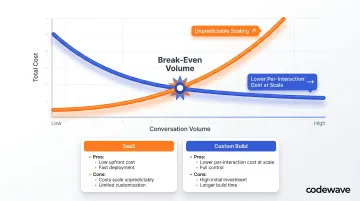
- SaaS costs start low but scale unpredictably — per-user or per-resolution fees add up fast
- Custom builds carry higher upfront investment but often deliver a lower per-interaction cost once volume picks up
Those cost dynamics point to a more useful framing than sticker-price comparisons. Codewave's ImpactIndex™ model evaluates cost per measurable business result — cost per resolved ticket, cost per qualified lead — rather than cost per platform seat. When the measure shifts to outcomes, feature lists matter less than actual performance.
Maintenance and reliability:
- Entry-level SaaS handles updates automatically, but feature changes and pricing adjustments can arrive without warning
- Custom and enterprise solutions offer more predictability, though they require dedicated maintenance — either in-house or through a vendor
Reliability and vendor stability are easy to overlook when comparing price points. A cheaper tool that breaks down or changes terms mid-contract often costs more than the premium option would have.
How to Estimate the Right Budget — and What Most People Get Wrong
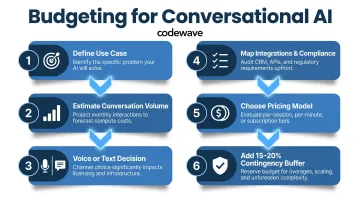
Practical Six-Step Budgeting Framework
- Define the use case precisely: Customer support bot, voice agent, sales qualification, etc.
- Estimate monthly conversation volume across low/medium/high growth scenarios
- Determine whether voice or text is required—this shifts cost significantly
- Map required integrations and compliance needs
- Choose a pricing model aligned with volume predictability
- Add a 15–20% contingency for overages, onboarding time, and support upgrades
Four Most Common Budget Mistakes
Subscription price isn't the full bill. Many platforms charge LLM inference separately. A $50/month plan can reach $500+ at volume if usage fees aren't factored in upfront.
Volume estimates are almost always low. AI conversations run longer initially as models learn. Applying current call center metrics to AI typically underestimates volume by 20–40%.
Phase one doesn't need every feature. Multilingual support, custom voice personas, and advanced analytics all add cost before they add value. Start with core requirements and expand later.
Cheap without accuracy is expensive. A bot deflecting 20% of queries saves little despite the low price; one deflecting 60% at moderate cost delivers real ROI. Gartner projects that by 2029, agentic AI will autonomously resolve 80% of common customer service issues—but only with properly trained, validated systems.
ROI Benchmarking for Finance Approval
Translate AI outcomes into operational terms:
- Ticket deflection rates: Gartner documented a 75% resolution rate in retail deployments
- Cost reduction: McKinsey found AI agents in contact centers achieve a 50% reduction in cost per call
- Handle-time reduction: IBM and Mizuho Bank reported a 6% reduction in average handle times
- Payback period: McKinsey research shows AI payback periods now run 6 to 12 months for both leading companies and those in the bottom 50 percent
Convert each metric into a labor cost equivalent — cost per ticket handled, fully-loaded agent hour, or calls avoided — so finance sees a direct dollar comparison against the AI investment.
Conclusion
Conversational AI pricing spans a wide range—from $20/month SaaS tools to $500,000+ custom builds. The right cost is determined by use case, volume, model requirements, and deployment complexity rather than any single line-item figure.
Understanding pricing components—subscription, usage, integration, compliance, support—leads to accurate budgets and avoids mid-project surprises that blow timelines and budgets. The vendors worth shortlisting are those whose pricing model aligns with your usage reality, not just their lowest published tier.
Before comparing vendor quotes, model your own usage scenario using the six-step framework in this guide. Calculate expected conversation volume, define integration requirements, and map AI outcomes to labor cost equivalents. That exercise reframes vendor conversations around the return you need to justify the spend—making ROI, not rate cards, the basis for every decision.
Frequently Asked Questions
How much does conversational AI cost per month?
SaaS tools start at $20–$50/month flat-rate or per user. Mid-range platforms run $50–$150/user/month. Enterprise or custom solutions cost $150–$300+/user/month or $5,000–$500,000+ as a one-time build. Usage-based components like voice minutes are typically billed on top of these base fees.
What is the difference between per-seat and per-resolution pricing?
Per-seat pricing charges a fixed monthly fee per team member regardless of conversation volume. Per-resolution pricing charges each time the AI successfully handles a customer inquiry. Hybrid models combine both, and per-resolution costs can compound quickly at high volumes.
Is it cheaper to build a custom conversational AI or buy a SaaS solution?
SaaS has a much lower upfront cost and faster deployment. Custom builds can deliver lower per-interaction cost at scale and offer control over data, compliance, and conversation design. The decision depends on volume, industry requirements, and long-term growth trajectory.
What hidden costs should I watch for when implementing conversational AI?
Watch for integration development fees, data migration costs, premium support tier charges, LLM API fees billed separately from platform subscriptions, and overage charges that apply when usage exceeds monthly limits. Build a 15–20% contingency into your budget.
Does conversational AI cost more for voice than for text-based chat?
Yes—voice AI requires continuous compute for speech-to-text, intent processing, and text-to-speech synthesis. Amazon Lex pricing shows voice is approximately 5.3x more expensive per interaction than text-based chat, a gap that appears in both usage-based billing and custom infrastructure costs.
How long does it take to see ROI from a conversational AI investment?
McKinsey research shows AI payback periods typically run 6 to 12 months. Measure ROI by converting handle-time reductions, ticket deflections, or conversion gains into a dollar equivalent, then compare against monthly AI spend. Some companies report 5x returns on digital projects within five years.