Introduction
Unplanned equipment downtime is one of manufacturing's most expensive problems — and it's getting worse. According to Siemens' True Cost of Downtime 2024 report, the world's 500 largest industrial companies lose an estimated $1.4 trillion annually — roughly 11% of revenue — to unplanned outages. In automotive alone, that figure reaches $695 million per plant per year.
Most of that loss traces back to the same root cause: equipment problems that went undetected until something broke. The Industrial Internet of Things (IIoT) addresses this directly by connecting sensors, machines, actuators, and control systems across factories and facilities — collecting real-time operational data, automating complex processes, and catching failures early enough to act on them.
This article covers what IIoT actually is, where it creates the most measurable impact, the technologies that make it work, and the challenges companies need to anticipate before they deploy.
Key Takeaways
- IIoT connects machines, sensors, and control systems to enable real-time monitoring, predictive maintenance, and automated decision-making at scale
- Core applications span predictive maintenance, smart manufacturing, remote monitoring, asset tracking, supply chain visibility, and worker safety
- Bosch reports connected manufacturing can increase productivity by up to 25%; Siemens data shows IIoT-driven predictive maintenance cuts unplanned downtime by 50%
- Edge computing, AI/ML, and 5G are the three enabling technologies amplifying IIoT impact across all industrial sectors
- Cybersecurity, legacy system integration, and data management are the primary implementation obstacles — each addressable with deliberate architecture choices from the start
What Is IoT in Industrial Automation?
Industrial IoT (IIoT) connects the physical machinery of factories, energy plants, and logistics facilities to digital systems — enabling automation, monitoring, and decision-making at a scale that manual oversight can't match.
IIoT vs. Consumer IoT
Consumer IoT adds convenience: smart thermostats, fitness trackers, connected appliances. IIoT operates in a different category. It connects machines, sensors, actuators, PLCs (Programmable Logic Controllers), and SCADA systems to automate complex industrial processes where failures carry real consequences — production halts, safety emergencies, or regulatory violations.
Unlike consumer devices, IIoT infrastructure requires redundant communication protocols, deterministic response times, and hardened security. The cost of a dropped connection in a factory is not a missed notification — it's an unplanned shutdown.
How IIoT Works
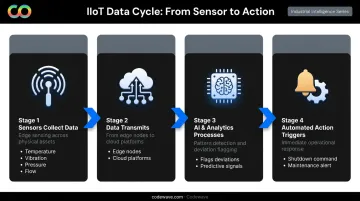
The core mechanism follows a consistent flow:
- Sensors collect data — temperature, vibration, pressure, flow rates — continuously from equipment and processes
- Data transmits to edge nodes or cloud platforms via industrial protocols
- AI and analytics software processes the data and flags deviations from normal operating ranges
- Automated actions or alerts trigger — a machine shuts down before overheating causes damage, or a maintenance alert reaches a technician before a bearing fails
A concrete example: an IoT vibration sensor on a motor detects frequency patterns that historically precede bearing failure. The system flags the anomaly, schedules maintenance during planned downtime, and the machine never stops unexpectedly.
That same logic applies across every layer of industrial automation — from rigid assembly lines to fully connected smart factories.
The Four Levels of Industrial Automation IIoT Touches
| Automation Type | IIoT Role |
|---|---|
| Fixed | Adds monitoring and remote visibility to rigid, high-volume lines |
| Programmable | Enables data-driven reprogramming and condition monitoring |
| Flexible | Supports rapid reconfiguration with real-time process feedback |
| Integrated (Smart Factory) | Full IIoT connectivity across all systems and processes |
Key Applications of IoT in Industrial Automation
IIoT creates measurable impact across manufacturing, energy, logistics, agriculture, healthcare, and automotive. These are the six applications with the clearest ROI.
Predictive Maintenance
Traditional time-based maintenance operates on fixed schedules: replacing parts whether they need it or not, or waiting for breakdowns to occur. IIoT changes this model.
Sensors monitor equipment health metrics (vibration, temperature, pressure, electrical current) continuously. AI models analyze the data stream and detect early warning patterns that predict failures days or weeks before they occur. Maintenance becomes scheduled around actual equipment condition rather than arbitrary intervals.
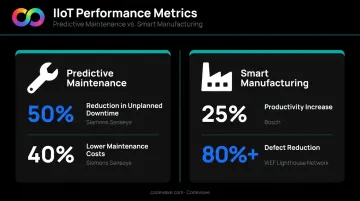
Siemens reports that live deployments of its Senseye Predictive Maintenance platform achieved a 50% reduction in unplanned machine downtime and 40% lower maintenance costs across customer sites.
Codewave's predictive maintenance implementations use Azure IoT Hub to analyze machine performance data. One example: monitoring conveyor belt wear and alerting operators before degradation exceeds safe operating thresholds, preventing catastrophic failures rather than reacting to them.
Smart Manufacturing and Quality Control
IoT-connected production lines use sensors, cameras, and robotics to monitor process parameters in real time. When a measurement deviates from acceptable range (a temperature spike, a dimensional variance, a pressure drop) the system flags or corrects it before a defective product completes the line.
Bosch reports that connected manufacturing solutions across its facilities can increase productivity by as much as 25%. The World Economic Forum's Global Lighthouse Network data shows average defect reductions exceeding 80% at sites deploying connected production systems alongside IoT and AI.
Remote Monitoring and Control
Plant managers and engineers can monitor and control equipment across multiple facilities from a single centralized dashboard, without physical presence. When an anomaly appears at a remote facility, alerts trigger, parameters adjust, and the right people are notified within seconds rather than hours.
This matters most in operations where on-site response is impractical:
- Energy utilities managing distributed grid infrastructure
- Oil and gas operators overseeing remote well sites
- Multi-site manufacturers coordinating production across facilities
Asset Tracking and Inventory Management
RFID tags, GPS sensors, UWB (ultra-wideband) beacons, and barcode systems provide continuous visibility into where assets are, what condition they're in, and how many are available. The result: no blind spots that cause stockouts, expensive equipment going missing, or maintenance teams spending hours searching for tools.
Codewave's asset tracking solutions integrate IoT sensors with Node-RED and TensorFlow to create real-time tracking systems, including live monitoring of forklifts and shipments with instant alerts when assets deviate from expected routes or locations.
Connected Supply Chain
IoT extends visibility beyond the factory floor into the entire supply chain. Sensors embedded in shipments track location, temperature, humidity, and handling conditions in real time. When a refrigerated shipment exceeds temperature thresholds, the system flags it immediately, before delivery, not after the damage is done.
Schneider Electric's El Paso facility demonstrated what integrated logistics IoT can achieve: on-time delivery improved from 61% to 97%, lead times dropped by up to 35%, and the site eliminated $43 million in backorders through integrated data engineering, industrial IoT, and AI, as published by the World Economic Forum.
Worker Safety Monitoring
Wearable IoT devices track employee vital signs (heart rate, body temperature, fatigue indicators) while environmental sensors monitor air quality, hazardous gas concentrations, and proximity to heavy equipment. When any metric crosses a threshold, supervisors receive an automatic alert.
No human supervisor can monitor every worker in every corner of a facility at once. IoT does it continuously and at scale, which is why facilities deploying wearable safety systems consistently report fewer lost-time incidents and faster emergency response.
Major Benefits of IoT in Industrial Automation
Enhanced Operational Efficiency
IIoT automates the monitoring and reporting tasks that previously required manual rounds, paperwork, and delayed analysis. Workers shift to higher-value functions while cycle times compress. Rockline Industries reported an immediate 5% OEE and throughput gain within weeks of deploying real-time production monitoring, growing to a 20%+ OEE improvement over two years.
Significant Cost Reduction
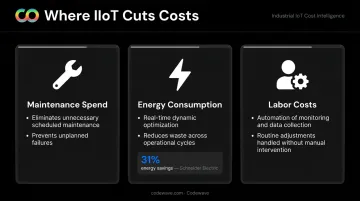
Cost savings from IIoT concentrate in three areas:
- Maintenance spend — predictive maintenance eliminates unnecessary scheduled maintenance while preventing costly unplanned failures
- Energy consumption — real-time monitoring enables dynamic energy optimization; Schneider Electric's digitized power management achieved 31% energy savings in paint-line ovens at one industrial plant
- Labor costs — automation of monitoring, data collection, and routine adjustments reduces manual labor requirements
Codewave's IIoT implementations across manufacturing and energy clients have produced measurable results in the same range — up to 25% cost reduction and 40% productivity gains within the first year of deployment.
Real-Time Decision-Making
Access to live operational data transforms management from reactive to proactive. Bottlenecks, quality deviations, and safety risks surface the moment they emerge — not hours later in a shift report. That speed matters: catching a temperature deviation mid-shift prevents scrap; catching it in a morning report means the batch is already lost.
Scalability and Business Agility
IoT-integrated automation allows manufacturers to scale production up or down without proportional increases in labor. Reconfiguring a line for a new product — or absorbing a sudden demand spike — means updating parameters in software, not rewiring equipment or retraining crews.
Core Technologies Enabling Industrial IoT
Smart Sensors and Connected Devices
Industrial-grade sensors — thermocouples, pressure transducers, RFID readers, vibration detectors — form the data collection layer. Built to withstand high temperatures, chemical exposure, and electromagnetic interference, they operate reliably in conditions that would disable consumer-grade hardware. The density and variety of sensors deployed directly determines how granular and accurate the operational picture becomes.
Edge Computing
Sending every sensor reading to the cloud creates latency and bandwidth problems that matter enormously in industrial settings where a safety shutdown might need to trigger in milliseconds. Edge computing processes data locally — at the machine or plant level — filtering noise, enabling real-time responses, and transmitting only meaningful events and aggregated metrics to cloud platforms.
AI, Machine Learning, and Advanced Analytics
Raw sensor data only becomes actionable when analytics can extract meaning from it. AI and ML models identify the patterns that precede equipment failures, detect quality deviations invisible to human operators, and dynamically optimize energy consumption based on real-time load conditions.
In practice, this requires an integrated data pipeline capable of handling the volume and velocity IIoT generates. Codewave's implementations typically combine Apache Kafka for live data streaming, Snowflake for data warehousing, Power BI for operational visualization, and TensorFlow for ML model deployment — each chosen based on the throughput and latency requirements of the specific industrial environment.
Challenges of Implementing IoT in Industrial Automation
These aren't reasons to avoid IIoT — they're known obstacles that successful implementations address upfront.
Cybersecurity and Data Privacy
Every connected device is a potential attack vector. Industrial systems are high-value targets because disrupting them causes operational harm, not just data exposure. Foundational security practices for IIoT include:
- Zero-trust architecture (never assume trust, always verify)
- Device authentication at every connection point
- Data encryption in transit and at rest
- Network segmentation to isolate OT from IT systems
Codewave builds zero-trust security principles into IIoT architectures from the start, using platforms including Zscaler, Illumio, and Cisco SecureX.
Legacy System Integration
Most industrial facilities run PLCs, SCADA systems, and equipment that was never designed to communicate with modern IoT platforms. A full rip-and-replace is rarely practical. The workable approach typically involves:
- IoT gateways and middleware layers to bridge OT and IT systems
- Phased integration strategies that avoid operational disruption
- Protocol translation tools that connect legacy equipment without replacement
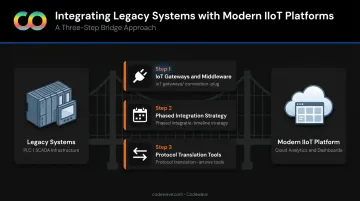
This preserves existing investments while extending them with modern connectivity.
Data Overload and Management Complexity
Large sensor networks generate enormous data volumes. The challenge isn't collection — it's making sense of what's collected. Three practices keep this manageable:
- Edge processing filters noise before data reaches the cloud
- Data governance frameworks define what to store, act on, and discard
- High-velocity analytics platforms turn raw sensor output into decisions that operators can act on in real time
Future Trends in Industrial IoT
Three technologies are reshaping how industrial IoT scales, performs, and aligns with broader business priorities.
5G Connectivity
Private 5G networks are approaching a projected $45 billion market by 2030, driven largely by industrial adoption. With 1ms latency targets and support for up to 1 million connected devices per square kilometer, 5G enables dense sensor networks, autonomous mobile robots, and real-time AR-assisted maintenance — at scales 4G simply cannot support.
Digital Twins
Virtual replicas of physical assets powered by live IoT data let manufacturers simulate failures, test process changes, and optimize performance without touching the physical system. McKinsey forecasts the digital twin market growing roughly 60% annually, reaching $73.5 billion by 2027.
That growth is backed by real results. Ferrero's Siemens digital twin deployment for an automated warehouse delivered 30% shorter commissioning time and 88% faster time to target availability.
Sustainable Manufacturing
IoT has become central to ESG commitments across industrial operations. World Economic Forum data from Global Lighthouse sites shows average reductions of 30% in material waste and 25% in energy and water consumption across digitally transformed facilities — though multiple technologies contribute to these outcomes.
Frequently Asked Questions
How is IoT used in industrial automation?
IoT connects sensors, machines, and control systems to enable real-time data collection, remote monitoring, predictive maintenance, and automated process control. The result is a factory that can detect problems, adjust parameters, and alert operators without waiting for human observation.
What is the difference between IoT and IIoT?
Consumer IoT covers connected devices in everyday life — smart homes, wearables, appliances. IIoT specifically refers to connected devices in industrial environments where reliability, safety, and operational continuity are mission-critical requirements.
What are the biggest challenges of implementing IoT in industrial automation?
Three challenges consistently surface in industrial IoT deployments:
- Cybersecurity exposure created by expanded network connectivity
- Integrating modern IoT platforms with legacy PLCs and SCADA systems
- Managing the data volume generated by large sensor networks at scale
How does IoT help reduce downtime in manufacturing?
IoT sensors monitor equipment health continuously, feeding data to predictive analytics systems that detect early warning signs of failure. Maintenance teams schedule repairs before breakdowns occur — rather than reacting after a line has already gone down.
What industries benefit most from IoT in industrial automation?
Manufacturing, energy and utilities, logistics and supply chain, agriculture, automotive, and healthcare see the greatest impact — sectors with high equipment dependency, large operational footprints, and significant cost exposure from inefficiency or downtime.
What is the future of IoT in industrial automation?
5G connectivity, digital twins, AI-driven autonomous systems, and sustainability-focused IoT applications are shaping the next phase of industrial operations. Facilities are moving toward self-optimizing systems that reduce energy consumption, cut response times, and operate with less manual intervention across every major sector.