Introduction
Picture this: a technician stands in front of a critical piece of equipment that just failed. The nearest expert is 800 miles away. The manual is three revisions out of date. Every minute offline is costing real money — and the clock is ticking.
This scenario plays out constantly across factories, oil fields, hospitals, and military bases. Traditional maintenance is under pressure from multiple sides:
- An aging workforce carrying decades of hands-on expertise — and no clear succession plan
- Equipment that grows more complex with every product cycle
- The punishing cost of unplanned stoppages that compounds by the hour
According to Siemens' 2024 True Cost of Downtime report, unplanned downtime costs the world's 500 largest companies $1.4 trillion annually — roughly 11% of revenue. For a large automotive plant, that translates to $2.3 million per hour offline.
Augmented reality (AR) is changing how maintenance actually happens — not by replacing technicians, but by giving them real-time information, remote expert access, and step-by-step guidance directly in their line of sight. What follows covers how AR works in practice, where it's already delivering measurable results, and what to evaluate before rolling it out.
Key Takeaways
- AR overlays digital instructions, schematics, and sensor data directly onto physical equipment, reducing lookup time and errors
- Remote expert collaboration via AR compresses hours-long repairs into minutes — no on-site travel required
- Manufacturing, energy, aerospace, healthcare, and field services are seeing the most active AR adoption
- Combining AR with AI and IoT creates a predictive maintenance layer, not just a reactive one
- AR rollouts succeed or stall based on hardware fit, connectivity, system integration, and how well teams are brought along
What Is Augmented Reality in Maintenance?
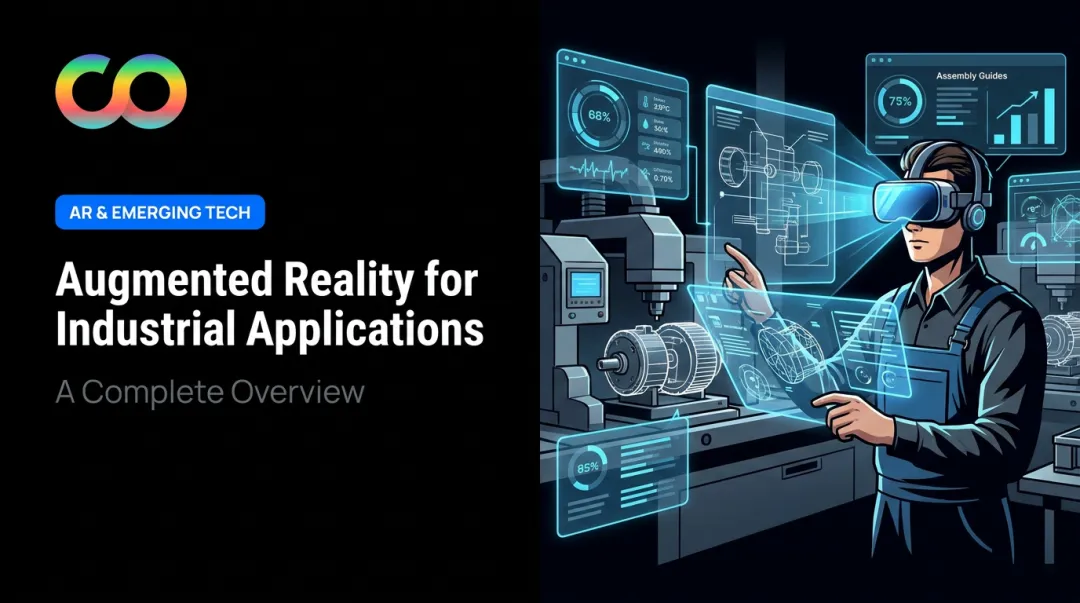
AR in maintenance means overlaying digital content — step-by-step instructions, 3D schematics, component labels, torque specifications, live sensor readings — directly onto a technician's view of real physical equipment. The display medium can be smart glasses (like Microsoft HoloLens), head-mounted displays, tablets, or smartphones.
AR vs. VR: Two Distinct Roles
These technologies are often conflated, but they serve different purposes:
| Technology | What It Does | Primary Use in Maintenance |
|---|---|---|
| AR | Adds digital content to the real environment | Live repairs, guided procedures, remote support |
| VR | Creates a fully virtual environment | Training, procedure rehearsal, hazard simulation |
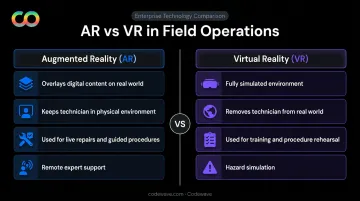
AR keeps the technician grounded in the real world with added context. VR removes them from it entirely. Many organizations use both: VR for training before a technician ever touches live equipment, AR for real-time guidance when they do.
Hardware Landscape
Devices range considerably in capability and form factor:
- Smart glasses (HoloLens, RealWear) — hands-free, purpose-built for field use
- Head-mounted displays — higher visual fidelity, typically heavier
- Tablets and smartphones — lower cost, wider availability, but require a hand to hold
Some AR systems are designed to function fully offline, storing content locally on the device. For remote field deployments where network connectivity is unreliable or unavailable, this capability is often the deciding factor in platform selection.
How AR Works During Maintenance and Repairs
Component Recognition and Contextual Overlay
When a technician points their AR device at a piece of equipment, the workflow begins immediately. The system identifies components through image recognition or marker-based tracking, then overlays relevant information — part IDs, warnings, replacement steps, torque values — precisely aligned to what the technician sees in front of them.
No manual lookup. No cross-referencing a PDF. The right information appears at the right moment.
Step-by-Step Guided Repair
Complex procedures get broken into sequenced visual steps that appear directly on or near the equipment. The technician works through each step in order, with the AR system confirming completion before advancing.
The result is a more reliable, standardized execution — regardless of who's doing the work:
- Eliminates cognitive load from memorizing multi-step procedures
- Reduces the chance of skipping a critical step under time pressure
- Standardizes execution across technicians with different experience levels
- Keeps both hands free for the actual work
Real-Time Remote Collaboration
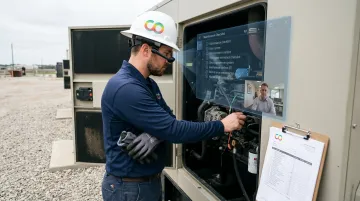
For organizations dealing with specialized expertise shortages, remote collaboration is where AR delivers its clearest operational advantage. An off-site expert can see exactly what the technician sees, annotate that view with markers and drawn instructions, and guide the repair verbally — in real time, without traveling to the site.
The U.S. Army's ARMS (Augmented Reality Maintenance System) demonstrates what this looks like in practice. At an April 2026 demonstration at Fort Bliss, a senior Army maintainer estimated that tasks which previously took roughly an hour "could now take 15 to 20 minutes" using ARMS combined with EMMA (Enhanced Multi-Sensory Maintenance Assistant).
The U.S. Navy separately confirmed ARMS was operational on five ships in 2025 for remote troubleshooting. These are real deployments, not pilots.
Data Capture and Offline Operation
AR-enabled devices can automatically log video, photos, and voice notes during a job, creating maintenance records without requiring technicians to stop and document separately. This data flows back to central systems, shifting maintenance from reactive part-swapping toward evidence-based diagnostics.
EMMA, the Army's on-device guidance system, is specifically designed to work without external connectivity — an essential design choice for any deployment in remote or field environments.
Key Benefits of AR in Maintenance Operations
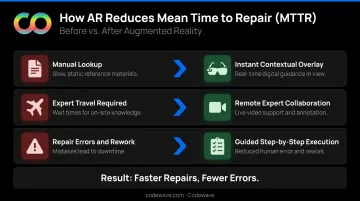
Faster Repairs and Reduced MTTR
AR compresses mean time to repair by eliminating the three biggest time sinks:
- Searching for and cross-referencing manuals
- Waiting for an expert to travel on-site
- Correcting mistakes made during the repair itself
A 2023 peer-reviewed review published in Augmented Reality in Maintenance — History and Perspectives found that controlled and field studies consistently show AR guidance reduces task completion time and errors compared to conventional instructions. The exact improvement varies by equipment type and task complexity, but the directional finding is consistent.
Fewer Errors and Greater Consistency
When every technician follows the same AR-guided sequence regardless of experience level, outcomes become more predictable. This matters most in:
- Safety-critical environments where a missed step carries serious consequences
- Complex multi-step procedures where experienced technicians may rely on habit rather than verified process
- High-turnover or mixed-skill teams where individual knowledge varies widely
Enhanced Technician Safety
AR delivers hazard awareness directly in the technician's field of view, before any contact with live equipment. Specific capabilities include:
- Surfacing hazard warnings and PPE requirements at the point of task
- Prompting lockout/tagout steps before contact with live systems
- Enabling practice of dangerous procedures in virtual environments — with no physical risk
This last capability is especially useful for high-voltage systems, pressurized vessels, and rotating machinery, where mistakes during training carry real consequences.
Accelerated Training and Faster Onboarding
The numbers tell the story: Deloitte and The Manufacturing Institute project that U.S. manufacturing may need 3.8 million new employees through 2033, with 1.9 million positions potentially going unfilled. The Bureau of Labor Statistics projects 13% employment growth for industrial machinery mechanics from 2024 to 2034.
AR helps close that gap. Newer technicians can work on real equipment with digital guidance from day one. They ramp up faster without requiring a senior technician to shadow them at every step.
Industry Applications: Where AR Is Making the Biggest Impact
Manufacturing and Industrial Maintenance
Factory floor technicians use AR glasses to service complex machinery — guided through calibration sequences, filter replacements, and fault diagnosis without leaving the equipment to consult documentation. The consistency benefit here is significant: every machine gets serviced the same way every time, regardless of which technician is on shift.
AR also feeds into predictive maintenance strategies by capturing real-time performance data during servicing and flagging patterns that indicate future failures.
Energy and Utilities
In oil and gas, power generation, and utilities, AR is used for inspecting turbines, pipelines, and electrical infrastructure in remote or hazardous environments. Shell has deployed RealWear head-mounted devices at its Pernis refinery and Scotford facility, allowing field workers to share their view with remote experts for troubleshooting and inspection — reducing travel, cost, and associated emissions.
Siemens Energy has similarly selected Librestream's Onsight platform for remote inspection, diagnosis, and equipment maintenance. Both cases reflect the same operational logic: AR lets scarce specialists support multiple field sites without traveling to each one.
Healthcare Equipment Servicing
Medical equipment maintenance requires precision and regulatory traceability. AR-guided servicing can reduce calibration errors and create automatic documentation trails that support compliance requirements.
Vendors like CareAR document AR-assisted troubleshooting and maintenance of medical devices, with visual verification and service documentation built to support compliance workflows.
Transportation and Aerospace
Airbus has used AR and VR tools for remote aircraft maintenance collaboration. Georgia Tech and PartWorks have developed RepAR, a launched MRO solution using AR overlays for aircraft structural repair workflows. The U.S. Air Force Research Laboratory's ARNE system overlays 3D instructions for eddy-current inspection of aircraft structures, with field demonstrations at Little Rock and Tinker AFB reporting greater technician confidence and less rework.
The Army's 2026 Fort Bliss demonstration applied EMMA and ARMS specifically to the Bradley Fighting Vehicle, Paladin, and M777 howitzer — real vehicles, real maintainers, operational environment.
Field Service and Infrastructure
Field technicians servicing HVAC systems, telecom equipment, or utilities infrastructure carry knowledge requirements that are difficult to address with traditional training. Mobile AR addresses this by giving technicians on-site access to schematics and live remote support — without physical manuals and in areas where connectivity may be unreliable.
Key capabilities that make this work in the field:
- Offline-capable architectures that function without consistent network access
- Remote expert video feeds for real-time guidance
- On-device schematic overlays tied to the specific equipment being serviced
AR Integration with AI, IoT, and Digital Twins
AR becomes significantly more powerful when connected to adjacent technologies.
AR + IoT for Predictive Maintenance
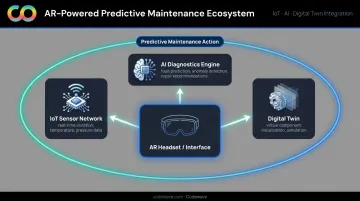
When AR headsets connect to IoT sensor networks, technicians can see real-time asset health data — vibration readings, temperature trends, pressure anomalies — overlaid directly onto the equipment they're inspecting. This shifts the decision point from "something just broke" to "these readings suggest something is about to break."
Siemens estimates that full predictive maintenance adoption by Fortune Global 500 industrial companies could save 2.1 million downtime hours and $233 billion through a 40% reduction in maintenance costs (these figures reflect predictive maintenance broadly, not AR specifically).
AR + AI for Intelligent Diagnostics
AI algorithms can analyze what an AR camera captures and suggest likely fault causes, recommend repair sequences, or flag anomalies the human eye might miss. Building this capability requires solid data pipelines, machine learning models, and real-time analytics infrastructure underneath the AR layer.
Codewave's AI and IoT practice covers anomaly detection, predictive fault diagnosis, and machine health monitoring — the diagnostic backbone an AR system surfaces to the technician. Their implementations on platforms like Azure IoT Hub, IBM Maximo, and Siemens MindSphere translate directly into the data infrastructure these systems depend on.
AR + Digital Twins
Digital twins allow technicians to interact with a live virtual model of equipment: visualizing internal components without disassembly, simulating what a repair will do before executing it, or comparing current asset state against the ideal baseline. PTC describes this as an "X-ray view" capability — effectively seeing inside a machine without ever opening it.
Challenges to Consider Before Implementing AR in Maintenance
Hardware and Connectivity Requirements
AR deployments aren't plug-and-play. Organizations need to assess:
- Device suitability: Smart glasses, tablets, and headsets each carry different ergonomic and environmental trade-offs
- Connectivity architecture: Cloud-based features require reliable network access; remote deployments may need offline-capable designs
- Hardware maturity: Gartner's 2024 research identifies cost, weight, field of view, and battery life as ongoing constraints — and projects frontline AR HMDs won't cross the adoption chasm until 2031
This doesn't mean AR isn't usable now — it means hardware selection needs to match the specific operational environment.
Change Management and Technician Adoption
Experienced technicians may be skeptical of technology-guided approaches. Introducing AR requires:
- Updating workflows and standard operating procedures
- Training staff on new tools without disrupting operations
- Addressing the perception that AR implies distrust of skilled judgment
Cultural adoption is as critical as technical implementation. Organizations that treat AR rollout as a pure technology project tend to underperform those that invest equally in the human side.
Integration Complexity and Custom Development
AR maintenance solutions rarely deploy without significant configuration. They require integration with existing CMMS, ERP, and IoT systems, plus custom content development: 3D models, digital work instructions, and asset-specific overlays for each equipment type in the fleet.
Organizations should evaluate whether off-the-shelf platforms meet their needs or whether a development partner is needed to build tailored solutions. The right answer depends on how standardized the maintenance workflows are, how complex the asset base is, and whether existing data infrastructure can support real-time AR diagnostics. For organizations where those gaps are wide, working with a firm experienced in IoT integration, AI diagnostics, and enterprise system connectivity — like Codewave — can bridge the distance between an AR platform and the operational context it needs to serve.
Frequently Asked Questions
What is augmented reality in maintenance and how does it work?
AR overlays digital information — instructions, schematics, sensor data, component labels — onto physical equipment via headsets, smart glasses, or mobile devices. As a technician looks at equipment, the AR system recognizes components and displays contextually relevant guidance precisely aligned to what they see.
How does AR reduce equipment repair times?
AR eliminates time spent searching manuals, enables remote expert guidance without travel delays, and walks technicians through step-by-step procedures in sequence. Each of these compresses mean time to repair — the Army's ARMS demonstration suggests tasks that took roughly an hour could potentially be completed in 15–20 minutes.
What industries benefit most from AR-assisted maintenance?
Manufacturing, energy and utilities, aerospace MRO, healthcare equipment servicing, transportation, and field services all see meaningful applications. The common thread is complexity: intricate equipment, skilled labor gaps, or geographically distributed operations.
Can AR maintenance tools work without internet connectivity?
Yes — many AR systems are designed for offline or disconnected operation, storing content locally on the device and syncing when connectivity is restored. The Army's EMMA system is specifically architected for this; it's a core requirement for field and remote deployments.
How does augmented reality improve technician training?
AR enables guided, hands-on training on real equipment — digital overlays show exactly what to do and in what order, reducing reliance on instructors and cutting time-to-competency for new technicians.
What is the difference between AR and VR for maintenance?
AR enhances the real-world environment with digital overlays and is used for live maintenance tasks. VR creates a fully simulated environment used primarily for training and procedure rehearsal before technicians work on actual equipment. Both serve distinct, complementary roles — and most mature maintenance programs deploy them in combination.