
Introduction
Pharmaceutical development is one of the most information-dense industries on earth. A single drug's mechanism of action involves molecular interactions that no 2D diagram adequately captures. A sales rep has 10 minutes with a cardiologist. A patient leaves the clinic with a prescription they don't fully understand.
Augmented reality is closing these gaps. Across pharma's entire value chain — from drug discovery to patient adherence — AR has moved from proof-of-concept to deployed infrastructure.
The scale of adoption reflects this shift. According to MarketsandMarkets, the extended reality (XR) market — which includes AR, VR, and mixed reality — is projected to grow from $24.43 billion in 2024 to $84.86 billion by 2029, at a 28.3% CAGR. Healthcare is among the fastest-growing enterprise segments driving that growth.
This article covers where AR is creating real impact in pharma right now — from HCP sales interactions and patient education to manufacturing quality control and drug discovery — along with where regulation stands, what's coming next, and what it takes to build a pharma AR solution that reaches production.
Key Takeaways
- AR bridges physical and digital environments — pharma teams are applying it across sales, training, patient education, and R&D
- Medication non-adherence costs the US healthcare system $100–$300 billion annually — AR-guided education directly targets this problem
- The FDA has authorized 69+ AR/VR medical products as of 2024, signaling regulatory maturation
- Successful implementation follows a phased path: validate content, clear compliance, then pilot before scaling
- Starting with one high-value use case beats trying to build everything at once
What Is Augmented Reality in the Pharmaceutical Industry?
AR vs. VR vs. XR: Why the Distinction Matters
The FDA defines augmented reality as a real-world experience where simulated digital imagery is overlaid or mixed with the physical environment through a camera or display. The user stays aware of their surroundings.
Virtual reality is different: it replaces the surrounding environment entirely with a simulated one, typically via headset.
Extended Reality (XR) is the umbrella term covering both, plus mixed reality — where digital objects interact dynamically with the physical environment.
This distinction matters in pharma because AR keeps the user grounded in reality. A surgeon using an AR overlay sees the patient and the digital guidance simultaneously. A sales rep using AR doesn't need a darkened room or a headset — they can pull up a 3D mechanism of action on a tablet during a clinic visit.
Why Pharma Is a Natural Fit for AR
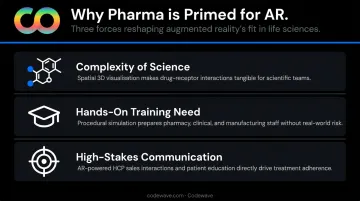
Pharma's structure makes it a natural fit for AR — for a few reasons:
- Molecular biology, drug-receptor interactions, and clinical data demand spatial, three-dimensional representation that 2D slides simply can't deliver
- Pharmacy students, clinical staff, and manufacturing operators all need hands-on, procedural training — AR simulates that without the risk
- HCP sales interactions and patient education directly shape prescribing decisions and medication adherence, making clarity a high-stakes requirement
Key Use Cases of AR in the Pharmaceutical Industry
Pharmaceutical Marketing and Sales
Static brochures and slide decks don't do justice to a drug's mechanism of action. AR gives pharma sales reps a tool to show — not just describe — how a molecule binds to a receptor, how a disease progresses, or how a therapy interrupts a biological pathway.
Novartis deployed InsideMS, an AR/WebGL education tool that walked healthcare professionals through multiple sclerosis progression across a 10-year patient timeline. Instead of explaining disease progression in the abstract, HCPs could see it rendered spatially in real time.
For medical devices and larger equipment, AR removes a significant logistical barrier. Rather than shipping physical samples or scheduling in-person demos, reps can walk a purchasing team through an interactive 3D model of the device, showing dimensions, components, and usage in the actual clinical environment. That compresses the decision cycle and cuts demo costs significantly.
Patient Education and Medication Adherence
Non-adherence is one of pharma's most expensive unsolved problems. According to the CDC, approximately 1 in 5 new prescriptions in the US are never filled, and about 50% of filled prescriptions are taken incorrectly — wrong timing, wrong dose, or abandoned early. The direct healthcare cost: $100 billion to $300 billion annually.
AR addresses the root cause: patients often don't understand their medications well enough to use them correctly.
AR apps allow patients to point a phone at a medication package and receive layered, visual information — dosage schedules, interaction warnings, what to expect in the first two weeks. For injectable therapies or inhaler devices, AR-guided demonstrations can walk a patient through proper technique step by step, in their home, at their own pace.
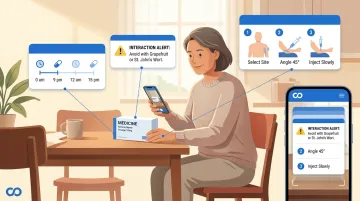
This matters most for complex therapies where technique errors are common: biologics, insulin pens, dry-powder inhalers, and auto-injectors all require precise patient behavior that a dense package insert rarely teaches effectively.
Medical Training and Workforce Development
AR has a clear advantage over traditional medical training: it lets learners practice on a simulated patient without any risk to a real one.
A randomized crossover study of ECMO cannulation training found that AR instructions led to a 66% reduction in knowledge-related errors compared to conventional instructions — a finding with direct implications for both clinical training programs and pharma-sponsored HCP education initiatives.
That same logic extends to pharma manufacturing floors. AR supports two distinct training scenarios:
- Pre-installation onboarding: Staff walk through assembly, calibration, and operating procedures via AR overlays on a tablet or headset before equipment physically arrives — so the first live run isn't a first exposure
- Ongoing procedure guidance: Operators follow visual AR instructions in real time rather than cross-referencing paper SOPs, reducing execution errors on complex tasks
Drug Discovery, R&D, and Manufacturing
Molecular visualization is one of the most compelling AR applications in R&D. Researchers who can rotate a 3D protein structure, simulate a drug binding event, or walk through a reaction pathway in spatial AR gain spatial understanding that flat screens can't replicate. A 2022 NIH/PMC review confirms AR's direct relevance to representing and manipulating 3D chemical structures in research contexts.
In manufacturing, AR supports quality control by overlaying step-by-step inspection and assembly instructions directly onto equipment. Operators follow visual guidance in real time rather than cross-referencing paper SOPs.
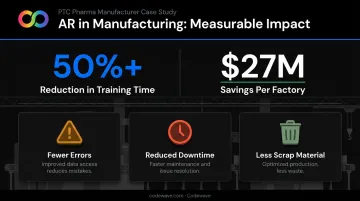
A PTC case study of a leading pharmaceutical manufacturer found that AR-enabled training and work instructions could reduce training time by 50% or more, with projected savings of $27 million per factory from reduced errors, downtime, and scrap material. For multi-site pharma operations, those gains compound — consistent procedure execution across facilities is one of the hardest problems in regulated manufacturing, and AR makes it tractable at scale.
Benefits of AR Adoption in the Pharmaceutical Industry
Improved Information Retention
The evidence for immersive learning is now substantial. A systematic review of 29 randomized controlled trials with 2,722 participants found that VR/AR/MR-based learning produced knowledge gains equal to traditional formats while delivering higher student satisfaction, self-efficacy, and engagement. A separate umbrella review reported that 57% of included studies showed increased skill acquisition and knowledge retention versus traditional methods.
In pharma, that holds across contexts — whether the learner is an HCP reviewing clinical data or a manufacturing operator mastering a sterile fill process.
Cost Reduction Across Multiple Functions
AR reduces costs in ways that compound:
- Eliminates physical sample shipping for device demonstrations
- Reduces printed marketing materials
- Cuts travel costs for in-person training sessions
- Decreases error-related downtime and scrap in manufacturing
- Compresses onboarding timelines for new equipment
The $27M per factory savings estimate from PTC's pharma manufacturing case study illustrates what's possible when AR is applied systematically to training and quality operations.
Better Patient Outcomes
When patients understand their therapy, they use it correctly. Better usage means better outcomes — fewer missed doses, fewer technique errors, fewer preventable hospitalizations. For pharma companies, this isn't just an ethical argument: adherence directly affects real-world efficacy data, post-market outcomes research, and long-term brand equity.
Competitive Differentiation
In therapeutic areas where two products have similar efficacy profiles, the quality of the HCP experience often influences prescribing behavior. An AR-powered sales interaction — where a rep can render a 3D mechanism of action on a tablet in 30 seconds — is more memorable than a leave-behind brochure. Repeated interactions like that build the kind of brand recall no printed leave-behind can replicate.
Challenges and Regulatory Considerations
Implementation Barriers
Pharma teams considering AR should plan for several real constraints:
- Content development costs: Medical-grade 3D models and animations require scientific accuracy review and significant production investment
- Regulatory validation: Content used in clinical or training contexts needs documented review and version control
- System integration: Connecting AR tools to EHR, LMS, or CRM platforms requires API planning and data governance work
- Hardware dependencies: Enterprise AR deployments may require device management across a field force
These aren't reasons to avoid AR — but they're reasons to pilot before scaling.
FDA Regulatory Landscape
The FDA's Digital Health Center of Excellence maintains an official AR/VR medical device list and actively regulates XR applications that meet the statutory definition of a medical device — meaning they diagnose, treat, mitigate, cure, or prevent disease.
Cleared devices include surgical navigation systems (xvision Spine System, ARVIS Surgical Navigation System, Medivis's Cranial Navigation platform), diagnostic imaging overlays, and therapeutic applications like AppliedVR's EaseVRx for chronic pain management.
AR tools used for pharma marketing, sales detailing, or unbranded HCP education generally do not require FDA clearance — they fall outside the medical device definition. The line can blur, though: a patient-facing AR app that provides dosage guidance or flags drug interactions warrants a compliance review. Engage legal and regulatory affairs early, not after development is complete.
Safety and User Experience Risks
Regulatory clearance is only part of the picture. Even compliant AR tools carry operational risks — and the FDA specifically flags these concerns for AR/VR in clinical settings:
- Cybersickness (nausea, dizziness, disorientation)
- Display errors affecting depth perception or anatomical overlay accuracy
- Distraction in time-sensitive clinical environments
- Cybersecurity and patient data privacy risks
Mitigating these requires thorough QA testing, phased rollout with monitored pilots, and clear protocols for when AR tools should and shouldn't be in use.
The Future of AR in the Pharmaceutical Industry
The FDA's authorization numbers tell the story directly. As of September 2024, the agency had cleared 69 medical products incorporating AR/VR technology. By February 2026, that list had grown to 104 entries — nearly tripling from 39 entries in late 2022. Almost 90% of cleared devices fall under radiology or neurology review panels, indicating where clinical AR is most mature today.
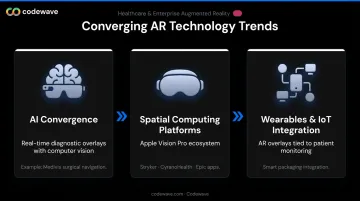
Three technology trends are accelerating what's possible:
- AI convergence: Real-time diagnostic overlays that combine AR with computer vision and machine learning — Medivis's FDA-cleared surgical navigation platform is an early example
- Spatial computing platforms: Apple Vision Pro has drawn healthcare apps from Stryker (surgical planning), CyranoHealth (clinical training), and Epic (health records), confirming that enterprise-grade AR has outgrown phones and tablets
- Wearables and IoT integration: AR overlays tied to real-time patient monitoring data, connected infusion pumps, or smart packaging create use cases that weren't technically feasible two years ago
For pharma companies, the window to build internal AR competency ahead of a maturing FDA framework is narrowing. Those who act now will set the compliance baseline — not scramble to meet it.
How Pharma Companies Can Start Building AR Solutions
Identify the Right Use Case First
Don't start with technology. Start with pain points.
Ask where in your organization there's a genuine communication gap, a training bottleneck, or a costly inefficiency that visual, spatial information could address:
- Sales teams struggling to explain complex MOAs in short HCP encounters
- Patient support programs with high early discontinuation rates
- Manufacturing operations with high error rates on complex SOPs
- Medical education programs that rely on passive content
The use case with the clearest business pain and the most measurable outcome is where to start.
Build the Right Solution Components
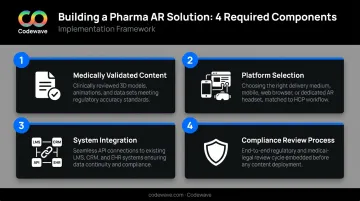
A successful pharma AR solution requires four things working together:
- Medically validated content — 3D models, scripts, and clinical data reviewed by medical affairs before they go into the experience
- Platform selection — mobile AR (ARKit/ARCore) for broad reach, web AR for zero-install deployment, headset-based AR for high-immersion training use cases
- System integration — connecting the AR experience to existing LMS, CRM, or EHR infrastructure so data flows and compliance logging work from day one
- Compliance review process — defined sign-off workflow for content updates, version tracking, and regulatory documentation
Pilot Before You Scale
Run a focused AR experience for a single drug, a single audience — oncology reps at a national sales meeting, patients in a specialty pharmacy program, operators at one manufacturing site. Define your measurement criteria upfront: HCP recall rate, training completion, SOP error frequency, time-on-content.
Use that pilot data to build the internal business case for broader rollout.
Working With Codewave
Codewave builds AR solutions across ARKit, ARCore, WebXR, Unity, and ViroReact — native mobile and browser-delivered — for pharma and healthcare organizations that need both technical depth and regulatory accountability.
Three delivery principles drive how engagements run:
- QuantumAgile™ — validates multiple prototype directions in parallel (device form factors, interaction models, content approaches) before committing to a build path, compressing decision cycles without sacrificing compliance rigor
- ZeroDX™ — the people scoping your solution are the ones building it, eliminating hand-off lag and translation errors between your compliance requirements and the team implementing them
- ImpactIndex™ — every sprint is accountable to defined business KPIs, not feature lists, so delivery stays tied to outcomes you can measure
A pharma AR pilot typically moves from validated concept to working product in 10–12 weeks — fast enough to generate meaningful data before committing to full-scale rollout.
Frequently Asked Questions
What is AR in pharma?
AR in pharma refers to the use of augmented reality to overlay digital content (3D drug models, procedural guidance, clinical data visualizations) onto real-world environments via smartphones, tablets, or headsets. It's used across sales enablement, patient education, clinical training, and manufacturing quality control.
How is augmented reality used in drug discovery and R&D?
AR enables researchers to visualize molecular structures and simulate chemical reactions in 3D, giving teams depth and spatial context that flat 2D screens cannot offer. This reduces reliance on costly physical trials and supports faster iteration in the early discovery pipeline.
What are the main challenges of implementing AR in the pharmaceutical industry?
The primary barriers are regulatory compliance requirements for clinical or patient-facing applications, high costs of producing medically validated 3D content, and the technical complexity of integrating AR tools with existing pharma IT infrastructure like EHR and LMS systems.
How does AR improve pharmaceutical sales rep effectiveness?
AR allows reps to present interactive 3D visualizations of drug mechanisms directly to HCPs during brief clinical encounters. This replaces static slides with dynamic, spatially engaging presentations that improve recall and make better use of limited face time.
What is the difference between AR and VR in healthcare?
AR overlays digital content onto the real world, so the user remains aware of their surroundings. VR immerses users in a fully simulated environment, replacing what they see. Both have healthcare applications, but AR is generally more practical for clinical and sales settings where environmental awareness matters.
Do AR applications in pharma require FDA approval?
It depends on intended use. AR tools for surgical guidance or diagnostics may require FDA clearance as medical devices. Marketing and sales enablement tools generally do not — but any patient-facing application that provides clinical guidance requires a regulatory review before launch.