Introduction
Industrial AR has crossed the threshold from pilot program to production reality. According to Grand View Research, the global AR and VR in manufacturing market was valued at $8.01 billion in 2022 and is projected to reach $62.71 billion by 2030 — a 29.3% CAGR that signals sustained, structural investment, not experimental curiosity.
For operations and digital transformation leaders, the question has shifted from "should we explore AR?" to "where do we start, and what does real ROI look like?"
This guide answers both. Here's what you'll find inside:
- What industrial AR is and how it works in practice
- Major use cases across assembly, maintenance, training, and logistics
- The business ROI driving adoption decisions
- How AR integrates with IoT and AI systems
- Implementation challenges worth planning for
- Where the technology is heading next
Key Takeaways
- Industrial AR overlays real-time digital information onto physical environments, keeping workers hands-free and contextually informed
- Documented outcomes include 34% productivity gains (GE), 25% warehouse efficiency improvement (DHL), and 50% downtime reduction (L'Oreal via Microsoft)
- AR delivers strongest ROI when integrated with IoT, digital twins, and AI — not as a standalone tool
- Main implementation barriers are hardware costs, connectivity requirements, and workforce change management
- AR is moving toward AI-driven proactive guidance and the industrial metaverse as its primary human interface
What Is Augmented Reality in an Industrial Context?
Industrial AR overlays digital information — step-by-step instructions, 3D models, live sensor readings, maintenance history — onto the physical world in real time. Workers access this through smart glasses, tablets, or purpose-built headsets, without breaking their workflow or putting down their tools.
Three related technologies often get conflated — each works differently:
- AR (Augmented Reality): Layers digital content over the real world, which stays fully visible
- VR (Virtual Reality): Replaces the real world entirely with an immersive digital environment
- MR (Mixed Reality): Blends both — digital objects anchor to and interact with physical surroundings
Industrial settings almost universally favor AR. Workers retain full situational awareness, stay hands-free, and never lose contact with the physical task. In environments where a single error carries real consequences, that continuity matters.
How It Works in Practice
An AR-enabled device scans the physical environment using cameras and sensors. It pulls relevant data from a connected cloud platform, ERP system, or digital twin, then superimposes that information directly into the worker's field of view. The result: a technician wiring a control panel sees the correct wiring sequence annotated on the actual panel in front of them, not on a paper manual across the room.
What separates industrial AR from consumer AR is the emphasis on precision, enterprise system integration (ERP, MES, IoT platforms), and operation in high-stakes environments where errors carry real consequences.
Key Industrial AR Use Cases
Assembly and Manufacturing Floor Operations
AR overlays step-by-step assembly instructions directly into a worker's line of sight, eliminating the need to cross-reference paper manuals or pause to consult documentation. The practical effect is faster task completion with fewer errors — particularly for complex, multi-step processes.
Lockheed Martin uses AR to support precision alignment and assembly in space technology manufacturing, with engineers reviewing 1:1 scale digital models of flight hardware to evaluate manufacturability before production begins. Academic research from Osman et al. confirms that AR-guided assembly consistently reduces errors and shortens task completion time compared to traditional manual-based methods.
Maintenance and Repair
AR enables technicians to work on complex equipment with real-time guidance surfaced directly in their field of view — maintenance history, sensor readings, step-by-step repair sequences — without stopping to consult a separate system.
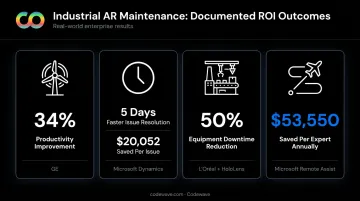
GE documented a 34% productivity improvement the first time a technician used AR wearables to wire a wind turbine control box versus the standard method. Microsoft's Dynamics 365 Remote Assist data shows manufacturers resolved throughput-impacting issues five days earlier on average, saving approximately $20,052 per issue. L'Oreal reduced equipment downtime by 50% using HoloLens 2 and Dynamics 365 Remote Assist.
Worker Training and Upskilling
Traditional training relies on senior staff shadowing junior workers — expensive, inconsistent, and hard to scale. AR training delivers interactive, repeatable guidance on the job, so new workers complete tasks correctly from day one without a dedicated mentor.
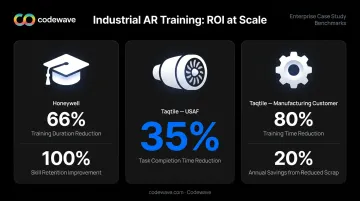
According to Taqtile's published data, USAF jet engine technicians using the Manifest AR platform completed assigned maintenance tasks in 35% less time compared to traditional methods. Honeywell reports its industrial AR/VR simulator improved skill retention by 100% and reduced training duration by up to 66%.
Logistics and Warehouse Operations
AR-guided picking directs warehouse workers to the correct shelf, item, and quantity in real time, with barcode scanning and order confirmation built into the workflow. The headset handles navigation; workers focus on accuracy.
DHL's AR vision-picking pilot in the Netherlands produced a 25% efficiency increase in the picking process. DHL Trend Research also notes that constant AR-guided picking validation can decrease errors by as much as 40% — a meaningful margin at the scale of a distribution center processing thousands of orders daily.
Remote Expert Collaboration
When equipment fails at a remote site, AR lets on-site workers share their live field of view with specialists anywhere in the world. Remote experts annotate, draw, and guide directly through the worker's headset — no travel required.
Microsoft data shows manufacturers saved an average of $3,500 per avoided expert trip. Across a year, one expert avoided 17 trips, saving $53,550 in travel costs and 384 hours of time. This model is particularly valuable in energy, aerospace, and heavy manufacturing, where specialized expertise is scarce and geographically concentrated.
Business Benefits and Measurable ROI
The ROI case for industrial AR rests on five measurable dimensions:
Productivity and Error Reduction
- GE: 34% productivity improvement in wind turbine assembly
- DHL: 25% efficiency gain in warehouse picking
- Taqtile: 35% reduction in maintenance task time for military aircraft technicians
Cost Savings Across the Lifecycle
- Remote assistance eliminates travel: $53,550 saved per expert annually (Microsoft data)
- Reduced downtime: manufacturers avoided 240–320 hours of lost throughput per year
- Design iteration: Lockheed Martin reviews 1:1 scale digital models before production, cutting physical prototype requirements
Improved Worker Safety AR surfaces hazard warnings, safety checklists, and real-time alerts directly in the worker's field of view. In energy plants and heavy manufacturing, delivering safety information in-context — rather than on a separate screen — meaningfully shortens the time between identifying a risk and responding to it.
Quality Control and Compliance AR-assisted inspection overlays tolerance specifications and IoT sensor data directly onto physical components, so technicians spot deviations without manual comparison. PTC's Vuforia Step Check uses AI-enhanced computer vision to deliver automated pass/fail alerts during quality control — replacing manual visual checks with a guided, auditable workflow.
Training ROI and Knowledge Transfer Honeywell's AR/VR training data shows up to 66% reduction in training duration. One Taqtile manufacturing customer reduced training time by 80% and reported 20% annual savings from reduced scrap and fewer production mistakes. Unlike classroom or shadowing-based programs, AR training scales without the cost of repetition — the same guided workflow reaches a new hire on day one the same way it reaches a veteran technician.
How AR Integrates with IoT, AI, and Digital Twins
AR's real industrial value emerges when it's connected to live data — not used as a standalone visualization layer, but integrated into the systems that already run the operation.
AR + IoT When AR headsets pull live data from IoT sensor networks, workers see actual equipment conditions — temperature, pressure, vibration, throughput — overlaid on the physical asset in real time. A maintenance technician approaching a machine doesn't just see its physical state; they see its operational state. Decisions shift from reactive to proactive.
AR + Digital Twins Digital twins are virtual replicas of physical assets, fed by continuous sensor data. When connected to AR, they allow workers to visualize a machine's current operational status, maintenance history, and predicted failure points without opening a separate monitoring dashboard. Honeywell's Immersive Field Simulator uses a digital twin of a physical facility: workers scan machinery through an AR interface and view internal components to train and troubleshoot without physical disassembly.
AR + AI and Machine Learning AI extends AR beyond information display into active guidance:
- Object recognition: Auto-identifies components so workers don't manually search for context
- Anomaly detection: Flags equipment deviations in real time before they become failures
- Adaptive instructions: Adjusts guidance based on worker skill level or task history
PTC's Vuforia platform demonstrates this in production: object and environment recognition delivers in-context instructions automatically, while AI-enhanced visual inspection identifies defects without manual review.
Why This Convergence Matters for Industrial Decision-Makers
An integrated AI + IoT + cloud stack delivers compound ROI that isolated AR tools cannot. Each layer makes the others more effective:
- IoT data becomes actionable when surfaced at the point of work through AR
- Digital twins become accessible without switching between dashboards
- AI guidance becomes context-aware when it draws on live operational state from sensors
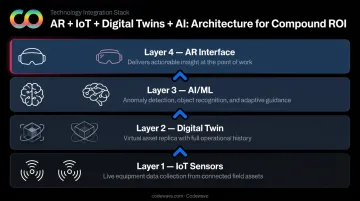
The architecture question is whether partners can design these layers to work together from the start, not retrofit integrations after deployment. Codewave builds AR + IoT solutions across energy, transportation, and manufacturing using platforms including Azure IoT Hub, Siemens MindSphere, and IBM Maximo — connecting live sensor data to AR interfaces so workers get the right information at the right moment, in the field.
Challenges and Implementation Considerations
Industrial AR implementations encounter three consistent categories of friction: connectivity and systems integration, hardware costs, and workforce adoption. Each is manageable — but none should be underestimated before committing to a deployment.
Infrastructure and Integration Complexity
AR solutions require reliable connectivity — Wi-Fi in controlled environments, 5G for mobile or outdoor operations. Qualcomm targets approximately 20ms round-trip latency as the threshold for acceptable XR user experience, which current 4G networks can't reliably achieve in all environments.
Beyond connectivity, integrating AR with existing ERP and MES systems requires significant data preparation. The Augmented Reality for Enterprise Alliance (AREA) identifies systems integration as one of the most commonly cited barriers to enterprise AR adoption.
Hardware Costs and Environment Constraints
Industrial-grade AR devices are not consumer electronics. Entry-level and specialized units from a single vendor can range from:
- RealWear Navigator 520: $3,150 per unit
- RealWear Navigator Z1 (hazardous-location rated): $6,250 per unit
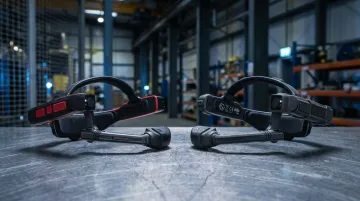
Neither figure includes software, integration, or deployment costs. Gartner cites unclear ROI as a primary adoption barrier — which is exactly why starting small matters. A targeted pilot in maintenance or training, where outcomes are measurable, builds the business case for broader expansion.
Change Management and Workforce Adoption
Technology adoption in industrial environments requires cultural buy-in, not just device training. Workers need to understand why the tool benefits them — not just how to use it.
AREA recommends involving end users in solution design rather than presenting a finished product. Phased rollouts — pilot, validate, expand — surface adoption issues early, before they scale into deployment-wide problems.
Future Trends Shaping Industrial AR
The Industrial Metaverse and Digital Twin Integration
Siemens defines the industrial metaverse as a persistent, physics-based digital environment that mirrors physical plants, factories, and infrastructure in real time. AR becomes the human-facing interface to this environment — the lens through which workers access simulation, remote collaboration, and predictive intelligence without leaving the physical workspace. As digital twins grow more sophisticated, AR overlays will shift monitoring from reactive dashboards to continuous, location-aware operational visibility.
Next-Generation AR Hardware
Current industrial devices like the RealWear Navigator 520 already achieve IP66 dust and water resistance, MIL-STD-810H durability certification, and a 270g form factor. The trajectory is lighter and more affordable. When paired with 5G's URLLC (Ultra-Reliable Low-Latency Communications) capabilities — which push AR latency below 20ms — previously unsuitable environments like outdoor energy infrastructure and large-scale logistics hubs become viable deployment targets.
AI-Driven Autonomous AR Guidance
The next generation of industrial AR won't simply display instructions — it will surface the right information at the right moment without requiring worker input. Two platforms already point toward this future:
- Taqtile's Manifest captures live performance data to inform AI-driven preventive maintenance, flagging issues before workers notice them
- PTC's Vuforia Step Check uses computer vision to automatically detect assembly defects mid-process
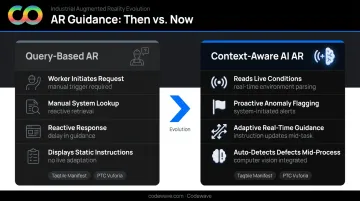
The broader shift is from query-based AR — where workers ask the system for help — to context-aware AR that reads operational conditions and acts on them proactively.
Frequently Asked Questions
What is the difference between AR, VR, and MR in industrial applications?
AR overlays digital information onto the real world while keeping it fully visible. VR replaces the real world with a fully digital environment. MR blends both, letting digital objects interact with physical surroundings. Industrial settings favor AR because workers retain situational awareness and hands-free capability, both critical in complex, high-stakes environments.
What hardware is typically used for industrial augmented reality?
The main categories are smart glasses and headsets (Microsoft HoloLens, RealWear Navigator, Vuzix M400), AR-enabled tablets for lighter-duty tasks, and intrinsically safe devices for hazardous environments like the RealWear Navigator Z1. Device choice depends on environment conditions, task complexity, connectivity, and budget.
Which industries benefit most from augmented reality?
Manufacturing, logistics, energy, aerospace, and healthcare are the most active adopters. Any industry with complex equipment, field service operations, or distributed workforces is a strong candidate — anywhere that getting the right information to the right person at the right moment has direct operational impact.
How does AR integrate with IoT and digital twin technology?
IoT sensors feed live equipment data — temperature, pressure, performance metrics — into AR overlays in real time. Digital twins provide a virtual replica of a physical asset, which AR uses to display current operational status, maintenance history, and predictive alerts. Together, they give workers a proactive operational picture without requiring separate monitoring systems.
What are the main challenges of implementing AR in industrial environments?
The three consistent barriers are upfront hardware and integration costs, connectivity requirements (reliable Wi-Fi or 5G with low latency), and workforce change management. Phased pilots in high-value use cases like maintenance and training let organizations validate ROI before committing to enterprise-wide rollout.
How long does it take to see ROI from industrial AR implementation?
Maintenance and training applications often show measurable results within months through reduced downtime and error rates. Larger deployments tied to quality control or logistics transformation typically take 6–18 months to fully quantify — though documented outcomes like DHL's 25% efficiency gain and L'Oreal's 50% downtime reduction suggest the underlying value arrives faster than the measurement timeline.