Introduction
Every billing claim, insurance reimbursement, and compliance audit in healthcare depends on one thing: accurate medical codes. Yet assigning those codes has traditionally been among the most labor-intensive steps in the revenue cycle — manual, slow, and hard to scale.
The administrative pressure is measurable:
- Hospitals spend nearly $18 billion annually overturning claims denials, according to the American Hospital Association
- The average hospital employs 64 administrative and billing staff for coding and collections alone
- The AMA reports a 30% shortage in qualified medical coders, even as outpatient visit volumes keep climbing
Healthcare organizations are responding with automation. An HFMA survey cited by Optum found 33% of health system executives planned to automate two or more RCM functions in 2024. Medical coding is increasingly central to those plans.
How that automation actually works — from reading a physician's note to submitting a clean claim — is what this guide breaks down, step by step.
Key Takeaways
- AI and NLP convert clinical documentation into ICD-10, CPT, and HCPCS codes without manual coder intervention on every chart
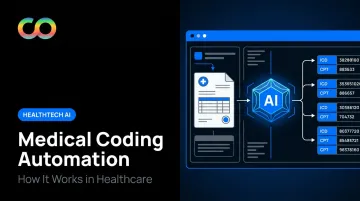
- The process runs in sequence: data ingestion → concept extraction → code mapping → validation → billing submission
- Modern systems use confidence scoring to route complex cases to human coders, not auto-approve everything
- Automation handles high-volume, routine encounters best; inpatient and surgical cases still need significant human judgment
- Coder roles shift toward exception handling, auditing, and CDI rather than disappearing
What Is Medical Coding Automation?
Medical coding automation uses AI and software to read clinical documentation and assign standardized diagnosis and procedure codes. It either replaces or augments the manual, chart-by-chart work that certified coders have traditionally performed.
The Problem It Solves
Manual coding has three structural weaknesses:
- Inconsistency: A peer-reviewed study in BMJ Health & Care Informatics found manual coding accuracy ranges from 50% to 98%, with a median of just 80%, depending on the coder, diagnosis type, and care setting
- Capacity limits: Coder shortages mean backlogs grow faster than teams can hire
- Scalability gaps: Outpatient volume surges (now representing 57% of hospital revenue, per AHA) require coding capacity that manual workflows can't match
What It Is Not
Modern coding automation is not a keyword-matching tool or a basic rules engine. It uses large language models (LLMs) and NLP to understand clinical context, distinguishing, for example, between a resolved condition in a patient's history and an active diagnosis that requires a billable code.
That distinction matters when comparing it to legacy computer-assisted coding (CAC) tools: those tools surfaced code suggestions but still required a coder to review every chart. Autonomous systems skip that review step entirely, finalizing codes for qualified encounters based on the model's own clinical interpretation.
How Does Medical Coding Automation Work?
The system operates through four sequential stages, each building on the last.
Stage 1: Data Ingestion from Clinical Sources
The process starts when the automation system connects to the EHR and pulls clinical documentation for a patient encounter. This typically includes:
- Physician progress notes and discharge summaries
- Lab results and diagnostic imaging reports
- Procedure records and operative notes
- Structured EHR fields (discrete diagnosis entries, medication lists)
Handling both structured data (discrete EHR fields) and unstructured data (free-text physician notes) is non-negotiable for complete code capture. Systems that only process structured inputs miss a significant portion of clinically relevant documentation—including the nuance buried in a provider's narrative notes.
Stage 2: NLP and AI-Driven Code Mapping
The AI applies Natural Language Processing to read clinical documentation the way a trained coder would, identifying:
- Active diagnoses and comorbidities
- Procedures performed and their modifiers
- Severity indicators and acuity markers
- Laterality, chronicity, and specificity required for accurate ICD-10 coding
The system then maps extracted clinical concepts to the correct standardized codes—ICD-10-CM for diagnoses, CPT for procedures, HCPCS for supplies and services—applying payer-specific logic and regulatory rules at the point of code assignment, not retroactively.
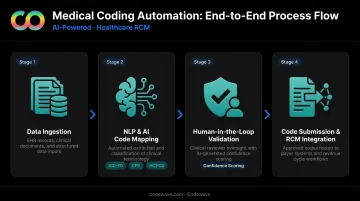
Stage 3: The Human-in-the-Loop Validation Layer
Production-grade systems use confidence scoring to determine what happens next:
| Confidence Level | Action |
|---|---|
| Above threshold (typically 97%+) | Code auto-approved, sent to billing |
| Below threshold | Case flagged for human coder review |
| Complex/ambiguous documentation | Routed directly to exception queue |
AHIMA's guidance on straight-to-bill automation sets 97% accuracy or higher as the threshold before eliminating human oversight. This stage is operationally critical: it keeps coders focused on genuinely difficult cases rather than routine chart reviews, and it protects organizations against audit exposure from over-automation.
Stage 4: Code Submission and Downstream Integration
Finalized codes flow directly into the organization's revenue cycle management (RCM) or claims management system, accompanied by audit trails that document the coding rationale.
Clean, first-pass-accurate codes produce measurable downstream results:
- Fewer claim rejections and payer denials
- Faster reimbursement and shorter AR cycles
- Stronger revenue integrity across the health system
Building these pipelines requires purpose-built ML models trained on large volumes of clinical data, integrated with HL7/FHIR-compliant infrastructure and HIPAA-aligned audit controls. Healthcare organizations evaluating custom automation workflows — or looking to recover from a failed implementation — can work with AI development partners like Codewave, which builds intelligent document processing and medical coding automation solutions for health system clients.
Types of Medical Coding Automation Systems
Medical coding automation spans two distinct generations of technology, each with different capabilities — and most healthcare organizations deploy both.
Computer-Assisted Coding (CAC)
CAC tools analyze documentation and flag relevant code suggestions for coder review. A coder still touches every chart—but the system speeds up their work by presenting options rather than requiring a manual search.
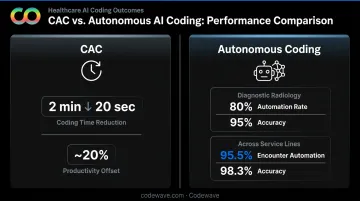
AHIMA research found that CAC can reduce ancillary encounter coding time from 2 minutes to 20 seconds and offset productivity loss by roughly 20%. Tools like Solventum 360 Encompass CAC and Optum Professional CAC are established examples in this category.
Autonomous (AI-Driven) Coding
The newer generation goes further. Autonomous systems process and finalize codes for straightforward encounters without any coder intervention, routing only low-confidence or complex cases for human review.
Real-world results from vendor case studies illustrate the potential:
- A Midwest health system reached up to 80% automation and 95% coding accuracy in diagnostic radiology using Solventum's autonomous coding system (vendor-published case study)
- Your Health achieved 95.5% encounter-level automation and 98.3% accuracy across service lines with Fathom (vendor-published case study)
KLAS Research characterizes autonomous coding as a promising early market. CodaMetrix, Fathom, and Nym received the strongest customer satisfaction scores in their analysis.
Hybrid Deployment
Neither approach works in isolation for most organizations. The practical reality is a hybrid model: autonomous coding handles high-volume, lower-complexity encounters — routine outpatient visits, professional fee coding, diagnostic radiology — while CAC or human coders manage inpatient, surgical, and specialty cases where documentation complexity is highest.
Where Medical Coding Automation Is Used
Workflow Position
Automation sits between clinical documentation completion and claim submission—downstream of clinical documentation improvement (CDI) and upstream of billing. It delivers the most value when embedded directly within the EHR workflow, where it can act on structured clinical data in real time rather than operating as a disconnected layer.
Settings Where It Delivers the Most Value
- High-volume outpatient settings: Primary care, urgent care, ambulatory surgery centers—where encounter volume is high and documentation patterns are relatively consistent
- Professional fee coding: Physician billing across specialties, where standardized CPT coding and payer rules benefit from automation
- Diagnostic radiology studies—MRIs, CT/PET scans, and screening mammography—have strong public evidence supporting autonomous coding performance in this setting
- Risk adjustment programs: Medicare Advantage and value-based care contracts, where HCC coding consistency directly affects capitation payments
Where Automation Plays a Support Role
Not every setting is equally suited for automation. Inpatient facility coding—particularly DRG assignment—involves greater regulatory complexity, higher documentation variability, and more significant financial risk per case. Autonomous inpatient coding is less mature; CAC and human coders remain central in this setting. Fully autonomous inpatient DRG coding remains in active development across the industry, with most vendors still relying on hybrid human-in-the-loop models for these encounters.
Benefits and Challenges of Medical Coding Automation
What Organizations Gain
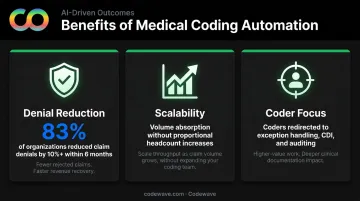
- Denial reduction: Black Book Market Research found 83% of healthcare organizations reported AI-driven automation reduced claim denials by at least 10% within six months
- Scalability: Volume surges—from seasonal demand, system growth, or post-merger integration—can be absorbed without proportional increases in coding headcount
- Coder focus: KLAS reported that autonomous coding users highlighted reduced strain on coding staff, with coders redirected to exception handling, CDI collaboration, and auditing—higher-value work than routine chart review
Key Implementation Challenges
EHR integration is the most common technical barrier. Legacy systems often lack the API infrastructure or data standardization that modern NLP pipelines require. This is where the AHIMA CAC toolkit's emphasis on interface planning, OCR/NLP readiness, and workflow governance becomes practically relevant—integration requires a structured implementation project, not a simple configuration step.
Change management is equally important. Coder resistance, often rooted in job displacement concerns, needs to be addressed directly. The evidence doesn't support those fears: the BLS projects 7% employment growth for medical records specialists through 2034, with approximately 14,200 openings per year.
HIPAA compliance shapes every vendor decision. Automated systems handle protected health information at scale, and HHS OCR requires covered entities and business associates to implement administrative, physical, and technical safeguards for electronic PHI.
Before deployment, evaluate vendors on:
- Data encryption standards
- Audit trail quality and completeness
- Business Associate Agreement terms
Coding accuracy metrics matter, but compliance readiness determines whether a system can be deployed at all.
Frequently Asked Questions
Will medical coding automation replace medical coders?
No. Automation handles high-volume, routine coding tasks, not the full scope of what coders do. Complex cases, exception handling, CDI collaboration, auditing, and compliance oversight still require human judgment. The BLS projects the profession to grow 7% through 2034, and AHIMA frames the coder role as evolving rather than disappearing.
What software do most medical coders use?
Coders typically work within EHR-integrated environments like Epic or Athenahealth alongside CAC platforms from vendors such as Solventum and Optum. Autonomous coding platforms, including Fathom, CodaMetrix, Nym, and Arintra, are increasingly deployed for high-volume outpatient and professional fee coding.
What is the difference between CAC and autonomous coding?
CAC suggests codes for every chart but requires a coder to review and approve each one. Autonomous coding finalizes codes for straightforward encounters without coder intervention, routing only low-confidence or complex cases for human review. The key difference is whether a human touches every chart or only the difficult ones.
What coding systems does medical coding automation work with?
Most platforms support ICD-10-CM (diagnoses), CPT (procedures), and HCPCS (supplies and services). Leading systems also handle HCC coding for risk adjustment programs used in Medicare Advantage and value-based care contracts, where coding accuracy directly affects payment rates.
How does automation handle complex or ambiguous documentation?
When AI confidence scores fall below a set threshold, due to incomplete documentation, rare diagnoses, or ambiguous provider language, the system flags the case for human coder review rather than auto-assigning a code. This keeps accuracy intact and audit exposure manageable.