Introduction
Healthcare organizations exist to treat patients. Yet a 2016 study published in Annals of Internal Medicine found physicians spend 49.2% of office time on EHR and desk work — nearly double the 27% spent in direct patient contact. A more recent JAMA Network Open study found 36.2 minutes of EHR work per visit, often exceeding the scheduled appointment itself.
The culprit isn't poor time management. It's document volume. Healthcare generates patient charts, insurance claims, lab reports, prior authorization requests, and dozens of other record types — spanning handwritten notes, scanned PDFs, faxes, and digital forms.
Legacy systems and basic OCR tools can't handle that variability accurately or at scale.
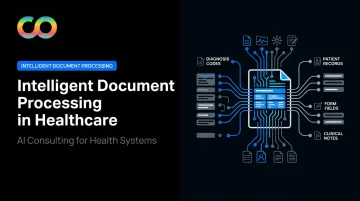
Intelligent Document Processing (IDP) addresses this directly. It combines AI, OCR, NLP, and machine learning to automatically extract, classify, validate, and route information from any document type — structured or not. This article covers how IDP works in healthcare, what it delivers, where it creates the most value, and how to implement it without overhauling existing systems.
Key Takeaways
- IDP automates end-to-end document handling — from digitization to routing — combining AI, OCR, NLP, and ML in one pipeline
- Prior authorization alone consumes 12 physician and staff hours weekly per practice, per AMA data — a fixable problem
- IDP integrates with existing EHR/EMR systems rather than replacing them, keeping adoption friction low
- High-value use cases include claims processing, medical coding, patient onboarding, and prescription handling
- Piloting one high-volume workflow first delivers measurable ROI before organization-wide rollout
Why Healthcare Is Buried in Documents
The Scale Is Staggering
The healthcare enterprise datasphere reached 717 exabytes in 2018, with IDC projecting 36% compound annual growth through 2025. That data doesn't arrive neatly structured — it comes as handwritten notes, faxed referrals, scanned admission forms, and multi-page insurance submissions.
Daily document types healthcare staff navigate include:
- Patient charts and clinical notes
- Insurance claims and explanation of benefits
- Lab results and pathology reports
- Discharge summaries and referral letters
- Prescription orders and pharmacy records
- Prior authorization requests
- Consent forms and billing invoices
Why Legacy Systems Break Down
Traditional rule-based systems and basic OCR tools fail for a simple reason: they require consistent formatting. Healthcare documents don't offer that. A handwritten prescription looks nothing like a typed discharge summary, and neither resembles a payer's claims template.
The consequences are concrete. CMS reported $31.70 billion in Medicare FFS improper payments for FY2024, with 79.11% of Medicaid improper payments linked to insufficient documentation. Meanwhile, the AHA found that one in three inpatient claims submitted to commercial insurers in Q1 2023 remained unpaid after 90 days.
The Human Cost
Those financial losses trace back to a workforce stretched thin by paperwork. A 2024 NIH review found documentation overload associated with diagnostic delays, lower patient satisfaction, and burnout odds 2.8 times higher among clinicians with insufficient documentation time. Every hour spent re-entering data manually is an hour pulled directly from patient care.
How Intelligent Document Processing Works in Healthcare
IDP vs. OCR vs. RPA
These three technologies are often conflated but do very different things:
| Technology | What It Does | What It Can't Do |
|---|---|---|
| OCR | Converts image text to machine-readable format | Classify, validate, or understand context |
| RPA | Automates rule-based repetitive tasks | Understand document content or handle variability |
| IDP | Understands context, classifies intelligently, learns over time | Replace human judgment on high-stakes decisions |
IDP is what makes AI useful for the unstructured, variable, high-stakes documents that define healthcare operations.
The IDP Pipeline: Healthcare-Specific Stages
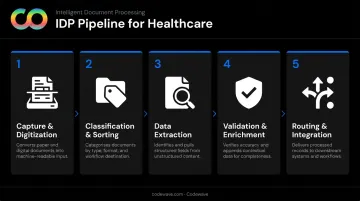
1. Capture & Digitization Paper forms, faxed referrals, and scanned records are ingested and converted into machine-readable formats using deep learning OCR — including CNN-based models tuned to handle noise, skewed pages, and poor print quality.
2. Classification & Sorting The system identifies document types — claim vs. lab report vs. prescription — and tags each with structured metadata. Documents that don't match known templates are flagged for review rather than silently misrouted.
3. Data Extraction AI models pull key fields: patient name, diagnosis codes (ICD), procedure codes (CPT), policy numbers, dates, drug names — even from handwritten clinical notes. Codewave's IDP approach uses transformer-based NLP (including BERT and RoBERTa) for semantic entity extraction and a hybrid CNN + LSTM architecture specifically for handwritten content.
4. Validation & Enrichment Extracted data is cross-checked against internal databases, payer rules, and regulatory standards. Gaps are flagged or auto-enriched before anything moves downstream.
5. Routing & Integration Verified data flows into EHR/EMR systems, billing platforms, or claims management systems automatically — no manual re-keying.
Continuous Learning and HIPAA Controls
Unlike rule-based systems that require manual updates when document formats change, IDP models improve with every processed document. Accuracy compounds over time. That adaptability matters — but in healthcare, performance alone isn't enough. Enterprise IDP deployments must also meet specific technical safeguard requirements, including:
- Role-based access control (per 45 CFR 164.312(a)(1))
- Audit logging that records all system activity involving ePHI (per 45 CFR 164.312(b))
- End-to-end encryption for data in transit and at rest
- Documentation retention meeting both HIPAA's six-year requirement and CMS's seven-year Medicare documentation standard
Human-in-the-loop review is a deliberate part of this architecture. Low-confidence extractions and high-stakes fields — medication dosages, billing codes, diagnoses — are routed for human review before entering downstream systems. Routine document work gets automated; decisions with patient safety or billing implications stay with trained reviewers.
Key Benefits of IDP for Healthcare Organizations
Faster Claims and Revenue Cycle Performance
Incomplete or miscoded claims drive denials. According to AHA-reported analysis from Premier, nearly 15% of private-payer claims were initially denied, and providers spent an estimated $19.7 billion appealing those denials. IDP validates data pre-submission against payer rules, catching errors before they generate denials and reducing the appeals backlog.
Reduced Administrative Transaction Costs
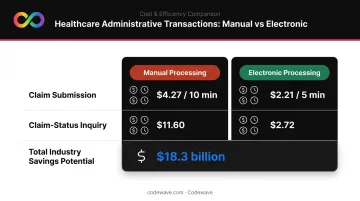
CAQH's 2023 Index measured the cost of manual claim submission at $4.27 and 10 minutes per transaction versus $2.21 and 5 minutes fully electronically. Claim-status inquiries run $11.60 manually versus $2.72 electronically. CAQH estimates $18.3 billion in annual savings from converting remaining manual administrative transactions to electronic. IDP accelerates that transition.
Accuracy and Error Reduction
Handwritten prescriptions, insurance codes, and billing data are where costly errors concentrate. AI models don't fatigue, misread context under time pressure, or skip validation steps. Codewave's implementations have achieved 90% reduction in data entry errors across document processing workflows, with confidence scoring and human review preserving accuracy on the highest-stakes fields.
Compliance and Audit Readiness
IDP automatically logs every document interaction with structured metadata, generating the complete audit trail that HIPAA requires. HHS has obtained $144.9 million in HIPAA settlements through October 2024. That includes a $4.75 million penalty against Montefiore Medical Center, tied in part to insufficient audit log review. Automated compliance tracking reduces that exposure without adding staff overhead.
Scalability Without Headcount Growth
Document volume spikes — open enrollment periods, merger-driven intake increases, seasonal admissions — don't require hiring. IDP scales to handle volume increases automatically, reallocating staff capacity to patient-facing work rather than temporary data entry.
Top Use Cases of IDP in Healthcare
Patient Record Digitization and Management
IDP converts paper charts, handwritten notes, and scanned admission/discharge documents into searchable digital records indexed by patient ID, date, and specialty. Clinicians retrieve exact data points in seconds before consultations instead of hunting through file systems or fax queues. Integration with EHR workflows means no separate login, no manual upload — records appear where staff already work.
Insurance Claims Processing and Adjudication
IDP automates the full claim lifecycle: ingesting submitted claims, extracting patient and procedure data, validating against payer rules, flagging discrepancies, and routing clean claims for adjudication. The CAQH baseline shows a $2.06 cost difference per transaction between fully manual and fully electronic submission. For hospitals where one in three inpatient claims sits unpaid past 90 days, faster clean-claim submission directly improves cash flow.
Medical Billing and Coding Automation
IDP reads clinical notes and discharge summaries, recognizes medical terminology, and maps procedures and diagnoses to correct ICD and CPT codes. Accurate automated coding reduces claim rejections, protects revenue, and limits the compliance exposure that comes from coding errors. Codewave builds medical coding automation that cuts rejection rates and removes physicians from downstream administrative coding tasks — keeping clinical staff focused on patient care.
Prior Authorization and Referral Management
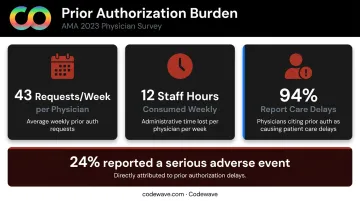
Prior authorization delays carry direct patient-care consequences. The AMA's 2023 survey of 1,000 physicians found:
- 43 prior authorization requests per physician per week, consuming 12 staff hours
- 94% said authorization delays sometimes or always delayed necessary care
- 24% reported a serious adverse event linked to prior authorization delay
CAQH measured manual prior-authorization transaction time at 22 minutes versus 11 minutes fully electronic. IDP automates extraction of patient demographics, clinical justification, and procedure details from order forms — and tracks submission status without manual follow-up.
Patient Onboarding and Pharmacy Prescription Processing
Two high-volume workflows that IDP handles well:
At admission, IDP auto-populates registration systems from ID documents, insurance cards, and consent forms — cutting intake errors and wait times without manual data entry.
For prescriptions, IDP applies CNN + LSTM hybrid models to recognize handwritten drug names, dosages, and prescribing physician details. Extracted data feeds automated refill processing and eligibility checks. The WHO estimates the global cost of medication errors at $42 billion annually — prescription misreads account for a preventable share of that figure.
How to Implement IDP in Healthcare: A Practical Approach
Start with One High-Pain Workflow
Pick one document type with high volume and measurable pain — insurance claims intake and patient onboarding are both strong starting points. Define KPIs before you build: processing time, error rate, throughput, and cost-per-document. Get that workflow stable and demonstrably performing before expanding.
Clinical decision workflows carry regulatory complexity that administrative workflows don't. Once the administrative layer is solid, you'll have the process maturity and confidence scores to tackle higher-stakes document types.
Integrate, Don't Replace
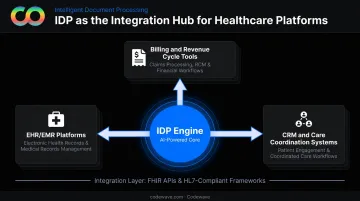
IDP should plug into existing systems — not displace them. Data extracted from documents flows into current workflows automatically, keeping staff adoption low-friction and avoiding costly infrastructure overhauls. Systems that typically need to connect include:
- EHR and EMR platforms
- Billing and revenue cycle tools
- CRM and care coordination systems
Codewave builds these integrations using FHIR-based APIs and HL7-compliant frameworks, so data meets healthcare standards as it moves between systems.
Validating performance before full deployment matters here. A pilot that works on paper but fails in a live clinical environment is expensive to unwind.
Establish Governance from Day One
Before processing a single document, define:
- HIPAA-compliant data handling protocols
- Confidence score thresholds that trigger human-in-the-loop review
- Reporting on exception rates, turnaround times, and cost-per-document
These metrics justify expanding to additional workflows and hold up under compliance audits. Building them in retroactively is much harder than establishing them from day one.
Frequently Asked Questions
What types of documents can IDP process in a healthcare setting?
IDP handles structured and semi-structured documents including patient records, insurance claims, lab reports, discharge summaries, referral letters, consent forms, prescriptions, prior authorization requests, and billing invoices — in formats ranging from scanned paper and handwritten notes to PDFs and digital forms.
How is IDP different from traditional OCR or RPA in healthcare?
OCR converts image text to machine-readable format. RPA automates rule-based repetitive tasks. IDP goes further: it understands document context, handles unstructured data, classifies intelligently, and continuously learns — which means it can manage the variability and volume that healthcare documentation demands across diverse workflows.
Is IDP compliant with HIPAA and other US healthcare regulations?
Enterprise IDP solutions incorporate role-based access controls, end-to-end encryption, complete audit trails, and confidence-scored human review for sensitive fields. Healthcare organizations should verify specific certifications and data processing agreements with their IDP vendor before deployment.
Can IDP integrate with existing EHR or EMR systems without replacing them?
Yes. IDP is designed to complement existing clinical systems by extracting and structuring data from documents and routing it into EHR/EMR workflows — improving data quality and speed without requiring costly system overhauls or retraining staff on new platforms.
What is the typical ROI of implementing IDP in a healthcare organization?
ROI varies by use case and document volume. Healthcare organizations commonly report reductions in processing time, claim denial rates, and administrative labor costs, alongside improvements in compliance posture and reimbursement speed. Benchmarking current manual processing costs and error rates before deployment gives the clearest picture of post-implementation gains.
How long does it take to implement an IDP solution in healthcare?
A focused pilot targeting one document type or workflow can be operational within weeks. Full-scale deployment across multiple workflows typically takes a few months, using a phased approach that validates performance at each stage before expanding.