Introduction
Most businesses assume their document extraction is "good enough" — until a misread invoice total triggers a payment dispute, an incorrect patient identifier creates compliance exposure, or a miscoded customs field holds up a shipment for days. The errors are rarely visible until they're expensive.
According to a 2024 Forrester report, more than one-quarter of global data and analytics professionals who cite poor data quality as a significant obstacle estimate losses exceeding $5M annually — and 7% report losses above $25M per year.
Traditional OCR and template-based tools read text. They don't understand it. When document formats shift — a vendor changes their invoice layout, a new insurer submits claims in a different structure — these tools produce silent misreads that propagate through downstream systems before anyone catches them.
Agentic document extraction takes a different approach. Rather than pattern-matching against fixed templates, it interprets layout, evaluates context, and validates output before data enters your systems. What follows breaks down how that process produces measurably higher accuracy — and which industries have the most to gain from it.
Key Takeaways
- Agentic extraction reasons, sees, and validates — OCR only transcribes
- Accuracy gains come from visual grounding, chain-of-thought reasoning, and tool-based validation working together
- Template-based systems break when formats change; agentic systems adapt without retraining
- The accuracy advantage is most consequential in healthcare, finance, insurance, and logistics
- Apply agentic extraction selectively — to high-value, error-sensitive workflows, not all document processing
What Is Agentic Document Extraction?
Agentic document extraction is an AI-driven approach where autonomous agents plan, interpret, and execute multi-step workflows to extract structured data from unstructured or semi-structured documents — PDFs, scanned forms, emails, invoices — with minimal human intervention.
The distinction from standard OCR goes beyond technique — it's a fundamentally different model of reasoning about documents.
Three Generations of Document Processing
| Generation | Approach | Core Limitation |
|---|---|---|
| Gen 1: OCR | Reads text characters | No understanding of meaning or context |
| Gen 2: Template/LLM Parsing | Extracts fields from known layouts | Breaks when document formats change |
| Gen 3: Agentic Extraction | Reasons through documents, adapts to variation, self-corrects | Slower and more compute-intensive |
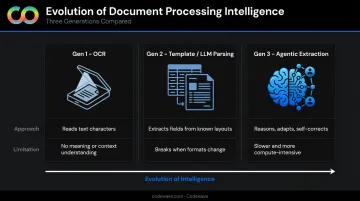
The generational leap matters because accuracy isn't just about reading characters correctly — it's about understanding which character belongs to which field, in which context, on which document type. OCR can misread a number. Template tools can assign a number to the wrong field. Agentic systems evaluate both problems before recording output.
Agentic systems don't follow a fixed script. Rather than pattern-matching against known templates, they evaluate context and handle ambiguity the way a trained analyst would when encountering an unfamiliar document format for the first time.
The 3 Core Mechanisms That Deliver Higher Accuracy
The accuracy advantage isn't incidental. It comes from three specific technical mechanisms working together. Understanding them helps you evaluate whether a solution will actually perform — or just claim to.
Visual Grounding — The Eyes of the System
Standard OCR and LLM-based tools process documents as plain text. They lose spatial context entirely. A number extracted from a header looks identical to the same number pulled from a table row — the tool has no way to distinguish them without additional configuration.
Agentic systems use Large Vision Models (LVMs) to visually inspect the document's actual layout. As Microsoft Research explains, layout-aware document models combine text, layout, and visual signals in one framework. This lets the system interpret checkboxes, table structures, field positions, and formatting cues in context.
A practical benefit: bounding box tracing. Each extracted data point is linked back to its exact position in the source document. Errors are traceable. Audits are straightforward. This matters in regulated industries where you need to prove where a value came from.
Chain-of-Thought Reasoning — The Brain
Rather than guessing field values, agentic systems follow a deliberate reasoning sequence:
- Identify what data is needed
- Locate candidate positions in the document
- Evaluate surrounding context
- Verify the interpretation before recording
Consider an invoice with multiple dates — a shipping date, a billing date, a due date. A template tool extracts whichever date appears in the configured field position. An agentic system reads the label adjacent to each date, checks what that date logically represents, and assigns the correct value.
This reasoning loop directly reduces hallucinations and field mismatches common in standard LLM-based extraction. The agent checks its own interpretation before finalizing output — not after.
Tool Use — The Hands for Validation
Passive parsing extracts and passes data forward. Agentic systems go further — they interact with external tools to validate before data ever leaves the extraction pipeline:
- A calculator tool sums line items to verify that invoice totals match
- A search tool cross-references vendor tax IDs against public registers
- A database integration validates extracted records against ERP or CRM systems before data exits the extraction pipeline
AWS documents this architecture explicitly — describing agents that access enterprise data via MCP servers to validate extracted content against business rules, with a troubleshooter agent reviewing errors against the source document before routing to human review.
Errors caught during extraction don't reach your ERP, CRM, or reporting layer. That prevents the cascading corrections — failed reconciliations, misposted invoices, compliance gaps — that make downstream cleanup far more expensive than the extraction itself.
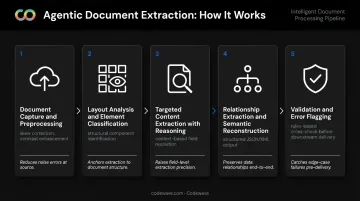
How Agentic Document Extraction Works: Step by Step
Each stage below is where accuracy improvements happen — not just at the end.
Step 1 – Document Capture and Preprocessing
Documents arrive from multiple sources: email attachments, API uploads, scanned PDFs, mobile camera images. Preprocessing applies skew correction, contrast enhancement, and font normalization.
Accuracy impact: Clean input prevents OCR misreads that cascade into downstream extraction errors. A misread character at this stage doesn't stay isolated — it propagates through every subsequent extraction decision.
Step 2 – Layout Analysis and Element Classification
A vision model identifies structural components — headings, tables, form fields, signatures, watermarks, side notes — and assigns semantic roles to each element.
Accuracy impact: A document ID in the header and a line-item amount in a table row may share the same numeric pattern. Context prevents misclassification. Without this step, both get treated identically.
Step 3 – Targeted Content Extraction with Reasoning
The agent focuses on specific fields of interest using its reasoning loop — evaluating multiple candidate locations, weighing surrounding context, ruling out false matches, and confirming the correct value.
Why it matters: Eliminates false positives that template-based systems produce when document layouts shift unexpectedly. The agent doesn't assume position; it infers from context.
Step 4 – Relationship Extraction and Semantic Reconstruction
The system identifies dependencies between document elements — a table belongs to the section heading above it; a chart illustrates figures in a specific paragraph — and outputs extracted data into structured formats (JSON, XML).
The precision gain: Captures hierarchical and relational data that flat OCR extraction misses entirely. Critical for multi-page contracts, structured reports, and complex regulatory filings.
Step 5 – Validation and Error Flagging
A validation agent cross-checks extracted data against rules, calculations, or external databases. The validation agent flags discrepancies for human review before data enters downstream systems.
Accuracy impact: Errors are caught at the source — not discovered after they've already affected reconciliation, clinical decisions, or compliance records.
Real-World Accuracy Gains Across Industries
Agentic extraction matters most where document volume is high, formats are inconsistent, and errors carry direct financial or compliance consequences. These four industries illustrate where the accuracy gap is most costly.
Healthcare Incorrect field extraction on patient intake forms or insurance documents can affect clinical decisions and trigger costly rework. HFMA reported in 2024 that reworking Medicare Advantage claim denials costs an average of $47.77 per claim, commercial denials average $63.76, and with roughly 3 billion claims submitted annually, total administrative rework costs have reached nearly $20 billion. Agentic reasoning handles variable form layouts and validates patient identifiers before data reaches billing systems.
Finance / Fintech Invoice exceptions run at 14% in 2024, according to Ardent Partners, with a cost of $9.40 per invoice to process. Mismatched totals and incorrect vendor IDs create reconciliation failures and regulatory exposure. Agentic systems validate line-item sums and cross-reference tax IDs in real time, catching errors before they reach the general ledger.
Insurance Claims forms and policy documents vary widely across providers and submission channels. Template tools require reconfiguration for each format variation. Agentic extraction adapts from context, maintaining accuracy across heterogeneous document types and reducing the manual review burden on claims teams.
Logistics Bills of lading and customs documents arrive in multiple languages, formats, and quality levels. McKinsey reports that manual bill-of-lading processing takes approximately six hours per document. Relationship extraction prevents shipment data errors — incorrect container numbers, mismatched port codes — that cause customs clearance delays and disputes.
The Speed Trade-Off: Where to Apply It
Agentic extraction is slower than standard OCR. In NVIDIA's benchmark, an OCR pipeline processed pages at 0.118 seconds per page, while a vision-language model step averaged 3.81 seconds per page. LandingAI separately reports a median ADE processing time of 8 seconds after optimization.
Apply agentic extraction to high-value, accuracy-sensitive document workflows. For bulk low-stakes processing where speed outweighs validation depth, simpler pipelines remain the right call.
How Codewave Can Help You Implement Agentic Document Extraction
Codewave works with organizations that have document-heavy operations where extraction errors are creating real operational costs — in reconciliation, compliance, manual rework, or delayed workflows.
Having partnered with 400+ businesses across 15+ industries, Codewave brings implementation experience across the specific document types and validation requirements that make agentic extraction either work or fall short in practice. Codewave's 95%+ data accuracy track record reflects what that precision means in practice: fewer reconciliation cycles, cleaner downstream data, and less manual intervention.
The approach is built around Codewave's ImpactIndex™ model: outcome-based engagements where the solution is calibrated to your specific document types, validation rules, and downstream systems — not a generic extraction tool dropped into your stack. Measurable outcomes clients have seen include:
- 90% fewer data errors through automated validation and error flagging
- 50% faster invoice processing via rule-based extraction and real-time cross-checks
- 40% reduction in reporting time through structured data output and direct system integration

Those results come from environments where the stakes are real — variable document formats, regulated data, or high-volume processing where a single extraction error compounds across systems. If that matches your operation, Codewave's team can assess your document environment and identify where the accuracy gains justify the implementation investment.
Frequently Asked Questions
How accurate is agentic document extraction compared to traditional OCR?
Agentic extraction outperforms OCR on complex, variable documents by adding reasoning, visual layout understanding, and active validation. On structured benchmarks, vendor-reported accuracy exceeds 99% — though real-world results depend on document complexity and implementation quality.
What types of documents benefit most from agentic extraction?
Agentic extraction adds the most value on complex, variable, or high-stakes documents: invoices with inconsistent layouts, multi-page contracts, handwritten or scanned forms, multilingual documents, and regulatory filings. The higher the format variation or the higher the cost of an extraction error, the stronger the case for agentic approaches.
Does agentic document extraction work on handwritten or scanned documents?
Yes. Agentic systems use Large Vision Models to interpret scanned images, often applying OCR as a preprocessing step. The agent then reasons over extracted text and visual layout together — handling noise, inconsistent handwriting, and poor scan quality more reliably than OCR alone.
What are the main limitations of agentic document extraction?
The two main trade-offs are processing speed — agentic systems take significantly longer per page than simple parsing because reasoning takes time — and computational cost, since iterative LLM calls are more expensive per page. This makes agentic extraction best suited for high-value workflows rather than bulk low-stakes processing.
How does agentic extraction handle documents when formats change unexpectedly?
This is one of its core advantages. Unlike template-based tools that break and require reconfiguration when formats shift, agentic systems use reasoning and visual layout analysis to infer field locations from context — adapting automatically without retraining or manual rule updates.
How long does it take to implement an agentic document extraction solution?
Simple workflows can be configured in weeks. Enterprise deployments with custom validation logic and multiple system integrations take longer — scope, document variety, and compliance requirements all affect the timeline. An experienced implementation partner shortens the path to production-ready accuracy.