Intelligent business processing (iBP) addresses this directly — by embedding AI, machine learning, and automation into the fabric of how work gets done, not just layering tools on top of broken processes.
According to Deloitte's 2022 global intelligent automation survey, 74% of organizations had already implemented RPA, and 46% planned to add AI capabilities within three years. The momentum is real. What separates organizations that realize lasting gains from those stuck in pilot purgatory is a clear understanding of what intelligent processing actually is — and how to implement it systematically.
This guide covers that ground: definitions, core components, measurable benefits, industry applications, and a practical implementation roadmap.
Key Takeaways
- Intelligent business processing combines RPA, AI/ML, and BPM to automate complex, decision-driven workflows, going well beyond simple task repetition.
- Unlike static automation, intelligent processing learns from data and self-optimizes over time.
- McKinsey research shows IPA can reduce straight-through process time by 50–60% and deliver 20–35% annual cost efficiencies.
- Successful implementation is phased — assess processes, pilot with defined KPIs, then scale with ongoing monitoring.
- Healthcare, fintech, retail, and logistics are documenting measurable gains by treating automation as an ongoing capability, not a one-time project.
What Is Intelligent Business Processing — And How Does It Differ from Traditional BPM?
Traditional BPM digitizes workflows. It maps processes, defines rules, and executes them consistently. That's useful — but it's not intelligent.
Intelligent Business Process Management (iBPM) integrates AI, machine learning, and RPA within a BPM framework, creating systems that don't just execute workflows but learn from them, adapt to exceptions, and continuously improve. Gartner's definition positions iBPMS (the software suite) as technology that coordinates people, machines, and things — with intelligence assessed across data timeliness, context granularity, predictive power, and actionability.
The Core Conceptual Difference
The clearest way to see this gap is through a concrete example: invoice processing.
Traditional BPM: Routes every invoice over $10,000 to the CFO. If a vendor changes their invoice layout, someone reconfigures the system manually. Exceptions get flagged and emailed to a human reviewer — who may or may not catch them before they post to the general ledger.
Intelligent BPM: Uses NLP and computer vision to extract data from any invoice format, regardless of layout. ML models detect anomalies — mismatched totals, duplicate entries, out-of-pattern amounts — before they reach approval. Routing decisions factor in vendor context, department rules, and historical approval patterns. Every processed document feeds a retraining loop, so the system becomes more accurate over time.
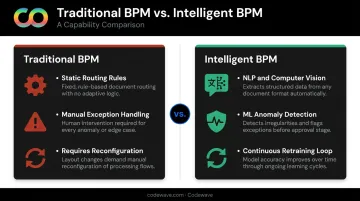
The difference isn't incremental — it's architectural. One system runs rules; the other refines them.
Navigating the Terminology
The terminology in this space is varied but largely refers to the same underlying concept. Here's a quick orientation:
| Term | What It Means |
|---|---|
| iBPMS | The software suite category (Gartner's classification) |
| IPA | Intelligent Process Automation — McKinsey's framing of RPA + ML + process redesign |
| IA | Intelligent Automation — broader umbrella covering BPM, RPA, document AI, low-code, and ML |
| DPA | Digital Process Automation — Forrester's preferred label replacing traditional BPM |
These terms overlap substantially. The underlying concept is consistent: rules-based automation extended with AI capabilities that handle unstructured data, adaptive decisions, and continuous learning.
That consistency in concept is precisely why the gaps in traditional BPM become so visible once you start applying these capabilities at scale.
Why Traditional BPM Falls Short Today
Rule-based systems were designed for structured, predictable inputs. Most enterprise data isn't. Emails, PDFs, voice notes, scanned forms, and contract documents flow through business processes daily — and static workflows break when those inputs deviate from expected formats.
The problem compounds when regulations change or business logic needs to evolve faster than IT can redeploy. Intelligent processing handles that variability by design, not as an afterthought.
Core Components That Power Intelligent Business Processing
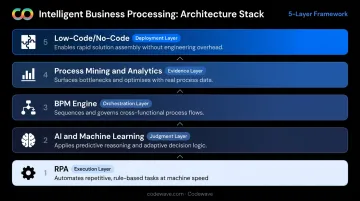
Intelligent business processing isn't one tool — it's several technologies working in sequence, each handling what the others can't do alone.
Robotic Process Automation (RPA)
RPA is the execution layer. Software bots replicate human interactions with applications: logging into systems, copying and pasting data, filling forms, processing transactions. They're fast, consistent, and don't make the errors that come with repetitive manual work.
The limitation: bots follow rules exactly as written. They don't interpret ambiguous inputs or handle exceptions without human intervention. RPA software revenue reached $3.2 billion in 2023, up 22.1% year-over-year — reflecting its role as a mature, foundational component inside broader intelligent automation stacks.
Artificial Intelligence and Machine Learning
AI is what gives automation its judgment. Three capabilities matter most in business process contexts:
- NLP — Reads and classifies unstructured text (emails, contracts, support tickets) without requiring structured input
- Computer vision — Extracts data from scanned documents, images, and forms regardless of format or layout
- Predictive analytics — Anticipates process outcomes (likely fraud, probable churn, expected approval delays) and routes work proactively
ML closes the feedback loop. Every process cycle produces training data that improves the model's next decision — something static rules cannot do.
Business Process Management (BPM) Engine
The BPM layer orchestrates everything: task sequencing, business rules enforcement, data routing between systems, and human task management. A Business Rules Management System (BRMS) handles policy compliance automatically — no manual checks required.
Without this layer, AI and RPA operate in silos. The BPM engine is what makes them a coherent, end-to-end system.
Process Analytics and Mining
Process mining software revenue crossed $1.1 billion in 2024, growing at 31.7% year-over-year — and the growth reflects a real need. Organizations deploying process mining discover that how work actually flows rarely matches how it was designed to flow.
Process mining ingests event log data from ERP, CRM, and other systems to reconstruct actual process paths, surface deviations, identify bottlenecks, and prioritize automation opportunities based on real throughput data rather than assumptions. It's the evidence layer that tells you where to focus.
Low-Code/No-Code Workflow Automation
Gartner forecasts the low-code development technologies market at $26.9 billion in 2023, with non-IT developers expected to comprise 80% of the low-code user base by 2026. Automation can't scale if every workflow change requires a developer ticket — and that's the gap low-code addresses.
iBPMS platforms offer drag-and-drop workflow builders, pre-built connectors, and visual rule editors that let operations teams build, test, and deploy process changes without queuing behind IT backlogs — cutting deployment timelines from months to weeks.
Measurable Benefits of Intelligent Business Processing
Efficiency and Cycle Time
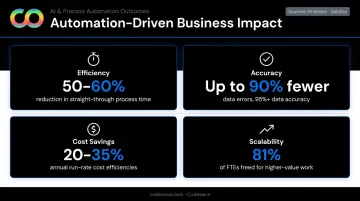
McKinsey's IPA research benchmarks straight-through process time reductions of 50–60% through intelligent process automation. In practice, this means approvals that took days happen in hours, and document processing that consumed entire FTE shifts completes in minutes.
The compounding effect is real: when processes run faster with fewer handoffs, employees redirect capacity toward decisions that require human judgment — not toward chasing down missing data or fixing upstream errors.
Accuracy and Error Reduction
Automated processes apply logic consistently, every time — eliminating transcription errors, missed validation checks, and duplicate records caused by manual copying between systems. Codewave's documented outcomes across intelligent document processing engagements include up to 90% fewer data errors and 95%+ data accuracy, figures consistent with what AI-driven validation delivers when it replaces manual review. Deloitte's automation research similarly found organizations widely reporting improved quality and accuracy as a primary benefit.
Cost Optimization
The cost case is direct: fewer labor-intensive manual steps, less rework from errors, and leaner staffing for routine transaction processing. McKinsey estimates 20–35% annual run-rate cost efficiencies from IPA deployments, while Deloitte's 2022 survey found organizations expected an average 31% cost reduction over three years.
Codewave's engagements have produced outcomes including a 25% reduction in operational costs and approximately 3 weeks saved per month in manual data work — reflecting what intelligent processing delivers when implemented against high-volume administrative workflows.
Scalability Without Proportional Headcount
Human capacity scales linearly. Intelligent workflows don't. One insurance cooperative documented by McKinsey automated excess queue procedures for 2,500 high-risk accounts daily, freeing 81% of FTEs for proactive relationship management — a volume no team could handle manually without significant hiring.
Seasonal spikes, geographic expansion, new product lines — intelligent processing absorbs these without proportional headcount increases. Organizations that build this elasticity into their operations gain flexibility that purely headcount-driven models simply can't match.
Compliance and Risk Management
Automated processes generate complete audit trails by design. Every decision, every data transformation, and every exception is logged with timestamp and context. Rules-based enforcement means compliance policies apply consistently — not selectively based on which employee is handling the file.
For regulated industries — fintech, insurance, healthcare — this matters because regulators expect demonstrable process controls, not retrospective explanations. Audit-ready records produced automatically remove the manual effort of reconstructing what happened and when.
Industry Applications: Where Intelligent Processing Delivers Results
Healthcare
Administrative burden consumes significant clinical resources. HIMSS estimates 10–20% of human work hours in healthcare organizations are spent on repetitive, low-level computer tasks. Intelligent processing addresses this across appointment scheduling, EMR data management, prior authorization workflows, and insurance claims intake. The operational gains redirect clinical staff toward patient care, where human judgment is irreplaceable.
Fintech and Insurance
Fraud detection and transaction monitoring were early adopters of ML-driven automation, and the results compound: systems that learn from confirmed fraud patterns identify new variants faster than rule updates can be written. ACFE's 2024 anti-fraud benchmarking data shows 83% of anti-fraud professionals expect to integrate generative AI into their strategies within two years.
For claims processing, intelligent routing reduces settlement times substantially. McKinsey documented a UK auto insurer that achieved a 22% increase in conversion rates and 330% ROI using cognitive technology — a result that demonstrates what decision intelligence delivers when embedded directly in customer-facing processes.
Retail and Supply Chain
Real-time inventory management and demand forecasting are high-frequency, high-stakes processes where AI-driven automation creates measurable separation from manual approaches. McKinsey's supply chain AI research found early adopters improved logistics costs by 15%, reduced inventory levels by 35%, and improved service levels by 65% compared to slower-moving competitors.
Codewave has documented 50% faster invoice processing and a 40% increase in productivity across automation-driven supply chain and retail engagements — consistent with what the industry evidence shows is achievable.
Transportation and Logistics
Route optimization, demand forecasting, and warehouse capacity management benefit directly from AI-driven processing because the variables are numerous, time-sensitive, and interdependent. McKinsey's distribution operations research documents one logistics provider using an AI digital twin to increase warehouse capacity by nearly 10% without adding real estate. That outcome requires process intelligence capable of modeling constraints and optimizing continuously across shifting conditions.
The Common Thread
Across all four sectors, the organizations realizing the largest gains share one characteristic: they treat intelligent processing as an ongoing operational capability, not a one-time deployment.

Pilots that plateau typically skip the follow-through — continuous monitoring, model retraining, and iterative process improvement. That follow-through is where durable performance compounds.
Codewave has worked with 400+ businesses across 15+ industries — including healthcare, fintech, insurance, retail, energy, agriculture, and education — applying this principle across engagements where outcome metrics like 3X faster data processing and 99% reduced fraud risk have been documented.
How to Implement Intelligent Business Processing: A Practical Roadmap
Step 1 — Assess and Map
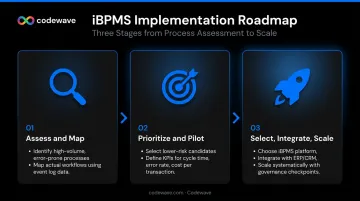
Start by identifying processes that are high-volume, error-prone, repetitive, or decision-heavy. Map the actual workflow — not the idealized version from a process document — using event log data where available.
Key questions at this stage:
- Where do handoffs create delays?
- Where do errors most commonly originate?
- What percentage of exceptions require genuine human judgment versus follow predictable patterns?
- Which systems hold the relevant data, and how clean is it?
Involve both operations and IT from the outset. Process owners understand the nuances; IT teams understand the integration constraints. Both are needed before a single automation is designed.
Step 2 — Prioritize and Pilot
Don't start with your most complex process. Start with one or two high-impact, lower-risk candidates — ideally with well-defined inputs, predictable exception patterns, and clear measurement points.
Set explicit KPIs before the pilot launches:
- Cycle time reduction target
- Error rate baseline and target
- Cost per transaction before and after
- FTE hours redirected
Pilot results serve two purposes: they validate the approach, and they build organizational buy-in for scaling. Deloitte found the average payback period for IA pilots runs to 22 months — a reminder that governance, process selection, and KPI discipline matter as much as technology choice.
Step 3 — Select, Integrate, and Scale
Choose an iBPMS platform based on your data volume, existing systems, and team capabilities. Integration with ERP, CRM, and data infrastructure is non-negotiable — isolated automation creates new silos rather than eliminating them.
When evaluating platforms, weigh these factors:
- Data volume and processing throughput requirements
- Native connectors for your existing ERP, CRM, and data stack
- Low-code configurability versus custom integration needs
- Vendor support for ongoing monitoring and model retraining
Scale systematically — add processes in sequence with continuous monitoring between rollouts. Deloitte's research points to process fragmentation, unclear vision, and IT readiness as the primary barriers at this stage. A phased approach with defined governance checkpoints addresses all three directly.
That gap between pilot success and production-ready deployment is where many programs stall. Codewave's QuantumAgile™ approach addresses it by simulating multiple implementation paths before committing resources — compressing the time from validated pilot to scaled rollout.
Frequently Asked Questions
What are the 5 steps of business process management (BPM)?
The standard BPM lifecycle runs: Design (model the process), Implement (configure and automate), Execute (run in production), Monitor (measure performance against KPIs), and Optimize (refine based on data). Each cycle feeds the next, making BPM iterative rather than linear.
What is the difference between IPA and RPA?
RPA automates rule-based, repetitive tasks — data entry, form filling, system navigation — without any judgment or adaptability. IPA layers AI and ML on top of RPA, enabling systems to handle unstructured inputs, make adaptive decisions, and improve performance over time. The core distinction: RPA follows fixed rules, while IPA continuously learns and adapts.
What are the 4 types of business processes?
The four types are operational (order fulfillment, claims processing), management (planning and governance), support (HR, IT, finance), and innovation (new products and business models). Intelligent automation delivers the fastest ROI when applied to high-volume operational and support processes first.
Is SAP a BPM tool?
SAP is an ERP platform with BPM capabilities built into SAP BTP and related modules. It's not a dedicated iBPMS. Organizations running SAP typically integrate it with purpose-built iBPMS or DPA platforms to handle end-to-end process orchestration, using SAP as the system of record rather than the automation engine.
What is the difference between iBPM and traditional BPM?
Traditional BPM executes static, pre-designed workflows and requires manual intervention when conditions fall outside defined rules. iBPM uses AI and ML to handle unstructured data, make context-aware decisions, and continuously self-optimize — without requiring manual reconfiguration each time conditions change.
How long does it take to implement intelligent business process management?
Targeted pilots can launch in weeks for well-defined processes with clean data. Enterprise-wide rollouts typically run three to twelve months depending on complexity and integration scope. Agile, phased deployments with clear KPIs at each stage compress time-to-value compared to waterfall approaches.