Introduction
Retailers wrestle with stockouts during peak seasons while warehouses overflow with unsold inventory. Manufacturers scramble to adjust production schedules as demand signals arrive too late to act. Healthcare systems face critical shortages of medical supplies during surges, and energy providers struggle to balance grids when consumption spikes unexpectedly.
These aren't isolated incidents—they're symptoms of a $1.77 trillion global problem. According to IHL Group's 2023 analysis, inventory distortion costs retailers alone this sum annually, with stockouts representing 68% ($1.2 trillion) and overstocks the remaining 32% ($562 billion).
The root cause? Traditional forecasting methods that rely on spreadsheets, historical averages, and quarterly planning cycles simply can't keep pace with today's fast-moving markets. McKinsey research reveals that close to 75% of supply-chain functions still depend on spreadsheets for planning—tools incapable of detecting complex patterns, processing real-time signals, or recovering quickly when markets shift.
This article covers the full picture of AI demand forecasting: what it is, which techniques power it, where it's delivering measurable value across industries, and how to implement it without common pitfalls.
Key Takeaways:
- AI demand forecasting cuts forecast errors by 20-50% by processing real-time data and detecting non-linear patterns traditional tools miss
- Machine learning models like LightGBM, LSTM, and ensemble methods continuously learn from new data rather than relying on static statistical assumptions
- Retail, manufacturing, healthcare, and energy sectors see measurable ROI through lower inventory costs, fewer stockouts, and faster decisions
- Successful implementation requires clean data infrastructure, model selection aligned to your use case, and continuous monitoring to prevent model drift
- Organizations like Codewave accelerate deployment by applying proven frameworks across 400+ business implementations
What Is AI Demand Forecasting — and How Does It Differ from Traditional Methods?
AI demand forecasting uses machine learning and predictive analytics to estimate future product or service demand — drawing on historical data, real-time signals, and external variables like weather, economic indicators, and social media trends. The key difference from traditional methods isn't just the technology. It's that AI-powered forecasting continuously adapts as new information flows in, rather than waiting for a human to update a spreadsheet.
Why Traditional Forecasting Falls Short
Traditional forecasting approaches suffer from fundamental limitations that make them increasingly inadequate for modern business environments:
- Static and slow to adapt — Most traditional models require manual updates and quarterly reviews, meaning they can't respond to sudden market shifts or disruptions
- Struggles with non-linear patterns — Statistical methods like simple moving averages assume linear relationships and fail to capture complex demand patterns driven by multiple interacting variables
- Cannot process unstructured data — Traditional tools can't incorporate external signals like social media sentiment, web traffic, or real-time IoT sensor data that increasingly drive demand
McKinsey found that applying AI-driven forecasting to supply chain management can reduce errors by between 20 and 50 percent, translating into a reduction in lost sales and product unavailability of up to 65%. This dramatic improvement stems from AI's ability to process far more variables simultaneously and detect patterns invisible to traditional statistical methods.
The Core Shift AI Introduces
Traditional forecasting is backward-looking by design — it tells you what happened and assumes it'll happen again. AI-powered forecasting works differently: models update automatically as new data arrives, adjusting in real time when consumer behavior shifts, a competitor launches a promotion, or external conditions change.
For example, while a traditional model might forecast next quarter's demand based solely on last year's sales during the same period, an AI model simultaneously considers:
- Historical sales patterns across multiple years
- Current inventory levels and sell-through rates
- Promotional calendars and pricing changes
- Competitor activity and market share shifts
- Weather forecasts and economic indicators
- Social media sentiment and web traffic trends
- Real-time point-of-sale data from all locations
The result: emerging demand signals surface days or weeks earlier than any spreadsheet-based model would catch them.
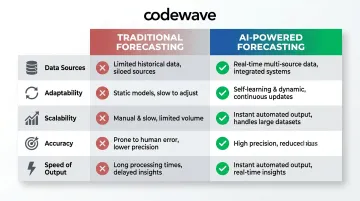
Traditional vs. AI-Powered Demand Forecasting
| Dimension | Traditional Forecasting | AI-Powered Forecasting |
|---|---|---|
| Data Sources | Historical sales data, manual inputs | Historical data + real-time signals (IoT, POS, social media, weather, economic indicators) |
| Adaptability | Static models requiring manual updates; quarterly planning cycles | Self-updating models that adapt continuously as new data arrives |
| Scalability | Limited by manual effort; difficult to scale across thousands of SKUs or locations | Automated scaling across unlimited SKUs, locations, and variables without proportional resource increase |
| Accuracy | Error rates of 20-50% common; struggles with volatility | 20-50% error reduction vs. traditional methods; handles complex patterns effectively |
| Speed of Output | Days to weeks for updated forecasts | Real-time or near-real-time forecast updates (minutes to hours) |
Core AI Techniques and Models Used in Demand Forecasting
Modern AI demand forecasting combines multiple techniques and models, each suited to different data types, forecasting horizons, and business contexts. The sections below break down which approach works best—and why.
Machine Learning Algorithms: The Foundation
Supervised learning algorithms form the foundation of most AI forecasting systems. These models identify mathematical relationships between input variables (historical sales, pricing, promotions, seasonality) and output targets (future demand) by learning patterns from labeled training data.
Gradient boosting models—particularly LightGBM and XGBoost—have emerged as the dominant choice for demand forecasting. The M5 Accuracy Competition, which analyzed 42,840 Walmart product time series, found that all of the top 50 performing teams used LightGBM. The winning team deployed an ensemble of 220 LightGBM models, achieving a 22.4% improvement over the best statistical benchmark.
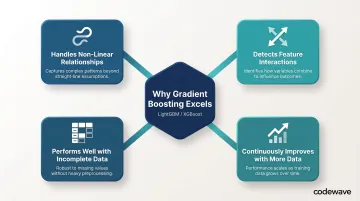
Why do gradient boosting models excel at demand forecasting?
- They handle non-linear relationships between variables effectively
- They automatically detect interactions between features (e.g., how promotions affect demand differently by season)
- They perform well even with incomplete data
- They continuously improve as more training data becomes available
Time-Series Forecasting Models
Traditional time-series models still play a role in AI-powered forecasting, particularly for stable demand patterns. Three are worth knowing:
- ARIMA works well for datasets with clear trends and minimal external disruption. It's most effective when demand follows predictable seasonal patterns—but it's univariate, meaning it cannot incorporate external variables like promotions or weather.
- ETS (Error, Trend, Seasonality) decomposes data into three components—random error, underlying trend, and seasonal patterns—making it particularly useful for retail sales forecasting where seasonal effects are strong.
- STL (Seasonal and Trend decomposition using Loess) excels when data exhibits strong, complex seasonal patterns that vary over time—commonly used in energy demand forecasting where consumption follows daily, weekly, and annual cycles.
The key limitation of these traditional statistical models is rigidity. The M5 competition demonstrated that incorporating external variables (prices, promotions, special events) improved accuracy dramatically—ARIMAX beat standard ARIMA by 13%—which is why pure ML approaches now dominate competitive forecasting.
Neural Networks and Deep Learning
Deep learning models detect complex, non-linear demand patterns across massive datasets, making them valuable when historical data is limited or when demand exhibits complex temporal dependencies.
LSTM (Long Short-Term Memory) networks are a type of recurrent neural network designed to remember patterns over long sequences. They excel at:
- New product launches with limited historical data
- Volatile product categories where demand patterns shift frequently
- Scenarios with long-term dependencies (e.g., how a promotion three months ago influences current demand)
Research comparing LSTM to ARIMA found LSTM achieved significantly higher accuracy (RMSE of 0.051828 vs. ARIMA's 0.144887) even on shorter datasets of just 36 data points. The third-place M5 competition team used 43 LSTM neural networks as part of their ensemble approach.
For most structured demand forecasting problems with tabular data, though, gradient-boosted trees deliver better accuracy with less computational overhead.
Predictive Analytics and Scenario Modeling
AI forecasting generates multiple demand scenarios simultaneously—not a single static prediction. Scenario modeling lets supply chain teams stress-test their assumptions before committing to procurement or inventory decisions:
- Best-case scenario: What happens if a competitor exits the market or a promotion drives higher-than-expected response?
- Worst-case scenario: What if supply chain disruptions delay inventory or economic conditions dampen demand?
- Baseline scenario: What's the most likely outcome given current conditions?
By running these parallel forecasts, supply chain leaders can establish contingency plans, set safety stock levels intelligently, and make risk-adjusted procurement decisions rather than relying on a single-point forecast that may prove wrong.
Real-Time Data Processing
Traditional forecasting ran on monthly or quarterly cycles—too slow to act on shifting demand. AI systems ingest real-time signals continuously, including:
- IoT sensor data from manufacturing equipment or logistics networks
- Point-of-sale data streaming from retail locations
- Social media sentiment indicating emerging trends or product buzz
- Web traffic and search patterns signaling shifting consumer interest
- Weather forecasts tied to demand spikes for seasonal or weather-sensitive products
- Economic indicators like employment data or consumer confidence
McKinsey research found that the market for external data APIs used to improve AI forecast accuracy has a predicted CAGR of 58%, reflecting how critical real-time data integration has become. When an AI model detects a sudden spike in social media mentions for a product category, it can adjust demand forecasts immediately—not weeks later when the opportunity has passed.
Industry Applications: Where AI Demand Forecasting Creates Real Business Value
AI demand forecasting applies across industries, but the signals, data sources, and decision outputs differ significantly by sector. The examples below show what's actually at stake—and what's measurable—when AI replaces traditional forecasting methods.
Retail and E-Commerce
Retailers face perhaps the most complex demand forecasting challenge: predicting sales across thousands of SKUs, multiple locations, and constantly shifting consumer preferences influenced by promotions, seasonality, and trends.
AI enables retailers to forecast demand at the SKU and store level, dynamically adjusting inventory allocation across locations. Real-time signals—browsing behavior, abandoned cart data, social media trends, local events, and weather—feed continuously into demand models.
More Retail, a grocery chain, partnered with AWS and Ganit to build a store-item-day level demand forecasting system using Amazon Forecast. The results: forecasting accuracy increased from 27% to 76%, wastage in the fresh produce category dropped by 20%, and stockouts fell to just 3%. The AI model outperformed traditional exponential smoothing by an additional 10% for volatile items.
At a different scale, The Very Group achieved a 9.9% improvement in SKU management with financial impact exceeding £110 million—the result of 70+ experiments and over 8 million forecasts generated through AWS AI/ML forecasting.
For retailers, the real leverage isn't just accuracy—it's what that accuracy unlocks: less capital trapped in slow-moving stock, fewer lost sales from empty shelves, and sharper promotional planning.
Healthcare and Pharmaceuticals
Healthcare organizations use AI demand forecasting to anticipate supply needs for medical equipment, medications, and even staffing levels. During demand surges—seasonal flu outbreaks, public health crises, or regional emergencies—AI models dynamically adjust procurement forecasts to prevent critical shortages.
According to industry analysis, AI-powered demand forecasting achieves 85% accuracy compared to 65% for traditional methods in medical supply chains. This translates to 30-40% reduction in medical supply waste while maintaining 99% product availability rates.
During COVID-19, AI models predicted shortages in PPE and ventilators by analyzing infection rate trends, hospital admission patterns, and regional outbreak data. Healthcare systems used those signals to reposition inventory and accelerate procurement weeks ahead of traditional planning timelines.
Energy and Utilities
Energy providers face a unique forecasting challenge: electricity demand fluctuates by hour, day, season, and weather condition, yet supply must match demand precisely to maintain grid stability and prevent outages.
AI forecasting for energy incorporates weather patterns (temperature, humidity, wind speed), industrial consumption cycles, economic indicators, and even special events that drive demand spikes. This enables utilities to balance supply and demand proactively, reduce reliance on expensive peaker plants, and integrate renewable energy sources more effectively.
National Grid ESO improved solar generation forecast accuracy by 33% using machine learning developed by Open Climate Fix. By using satellite imagery and AI for real-time "nowcasting," the grid operator reduced reliance on fossil fuel reserve power for balancing.
A Texas retail electric provider achieved $1 million in total savings through AI-driven demand forecasting, including a 40% increase in load forecasting accuracy, 35% reduction in annual overhead costs from reduced excess energy purchases, and 20% increase in revenue per customer.
Manufacturing and Supply Chain
Manufacturers use AI-powered demand signals to align production scheduling, raw material procurement, and supplier coordination with actual projected demand. The immediate target: the bullwhip effect, where small demand fluctuations get amplified into major supply chain disruptions upstream.
Harvard Business Review documented a global industrial manufacturer with 100,000+ SKUs and approximately $10 billion in revenue that deployed ML models across its supply chain. The results:
- 30-50% forecast error reduction compared to traditional ARIMA/ETS statistical methods
- 20% reduction in overall inventory levels while maintaining the same service levels
- 98% service level achievement with significantly less safety stock than traditional models required for 95% service levels
- Prevention of bullwhip effect costs, avoiding the 10-15% emergency shipping cost increases that plague traditional planning
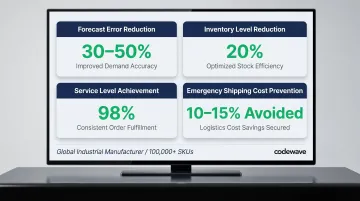
What's notable here is the compounding effect: better forecasts don't just cut inventory costs. They reduce expedited shipping, free up working capital, and give procurement teams lead time to negotiate—rather than react.
Key Business Benefits of AI Demand Forecasting
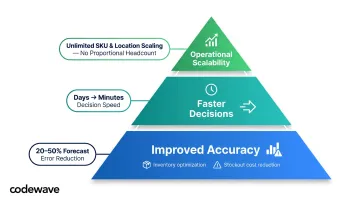
AI demand forecasting delivers measurable gains across three areas that matter most to business performance: cost control, decision speed, and operational scale.
Improved Accuracy and Reduced Costs
Higher forecast accuracy directly addresses the two most expensive inventory problems: overstocking (which ties up capital and incurs carrying costs) and understocking (which loses revenue and damages customer relationships).
The global cost of inventory distortion reached $1.77 trillion in 2023, driven by poor forecasting. Stockouts alone reduce annual revenue by 2-5%, while overstock absorbs 20-30% of working capital. The carrying cost of inventory runs 20-30% of inventory value annually.
By reducing forecast errors by 20-50%, AI-powered systems help organizations:
- Cut safety stock requirements without increasing stockout risk
- Reduce expedited shipping and emergency procurement costs
- Free up working capital for higher-ROI investments
- Minimize markdown losses from excess inventory
McKinsey research found that AI-driven demand forecasting enables:
- 20-30% reduction in inventory levels
- 5-10% reduction in warehousing costs
- 5-20% reduction in logistics costs
- 25-40% reduction in administration costs
Faster and Better Decision-Making
AI generates forecasts in near-real-time, allowing supply chain leaders, procurement teams, and finance managers to act on current signals rather than stale data from weeks-old reports.
Harvard Business Review found that AI-driven forecasting can cut decision-making time from days to minutes. When a retailer's AI model detects unexpected demand for a product category based on real-time POS data, inventory can be reallocated the same day—not after the next weekly planning meeting.
This speed advantage matters most during disruptions. When supply chain issues emerged during the pandemic, organizations with AI forecasting adapted procurement strategies in real time. Those relying on traditional methods faced weeks-long planning cycles, consistently trailing market conditions throughout the crisis.
Operational Efficiency and Scalability
Traditional forecasting requires proportional increases in headcount as product lines, geographies, or data complexity grow. AI models scale without these linear cost increases.
AWS case studies demonstrate this scalability: RetentionX scaled from 5 to more than 200 individual AI forecast models in less than one week. Adore Beauty built a functional AI forecasting prototype in just 4 days.
Once trained and integrated, AI models handle thousands of SKUs across hundreds of locations automatically—continuously refining predictions without manual intervention. This frees planning teams to focus on strategic decisions and exception management rather than spreadsheet maintenance.
Scalability also depends on planner trust. HBR research found that providing "feature importance" scores—explaining which variables most influenced a forecast—increased planner adoption of ML suggestions by over 60%.
Common Challenges in AI Demand Forecasting (and How to Address Them)
Despite clear benefits, organizations face predictable obstacles when implementing AI demand forecasting. Understanding these challenges and mitigation strategies improves implementation success rates.
Data Quality and Availability
AI models learn from data. Incomplete, inconsistent, or siloed data produces unreliable forecasts regardless of model sophistication.
Gartner research found that 85% of AI projects fail because of poor data quality or insufficient relevant data. A 2025 Qlik survey of 500 data professionals at companies with $500M+ revenue revealed that 81% still struggle with AI data quality, and 85% believe leadership isn't adequately addressing the issue.
How to address data quality challenges:
- Standardize formats, units, and definitions across all data sources before model training begins
- Unify data from ERP, CRM, point-of-sale, and external sources into a centralized data warehouse
- Implement validation rules that flag anomalies, missing values, and inconsistencies in real time
- Define data ownership, access controls, and quality standards to maintain integrity continuously
Target 95%+ data accuracy at the input stage — the threshold where AI forecasting models begin producing reliable, actionable outputs.
Implementation Complexity and Integration
Integrating AI forecasting with legacy systems, existing workflows, and cross-departmental processes requires planning and technical expertise.
Most organizations run on fragmented technology stacks — sales data in one system, inventory in another, financial data in a third. AI forecasting requires these systems to communicate, often through custom API integrations or data pipelines that existing IT teams don't have the capacity to build alongside ongoing operations.
How to address implementation complexity:
- Work with AI development teams that have domain experience — Codewave, for example, has delivered AI-powered data solutions across 400+ businesses in retail, healthcare, fintech, and beyond, applying proven frameworks that sidestep common integration pitfalls
- Begin with a defined pilot in one product category, region, or business unit to validate the approach before enterprise-wide rollout
- Secure executive sponsorship early — cross-functional implementation requires committed resources from IT, supply chain, finance, and operations simultaneously
McKinsey found that 60% of supply-chain-planning IT implementations take more time or money than expected or fail to achieve anticipated business outcomes — often because integration challenges were underestimated.
Model Drift and Ongoing Maintenance
Demand patterns change over time. Consumer behavior shifts, new competitors emerge, markets evolve, and economic conditions fluctuate. An AI model trained on 2022 data may perform poorly in 2024 if it hasn't been retrained to reflect new patterns.
This phenomenon, called model drift, means AI forecasting requires active management after deployment. Models must be continuously monitored, evaluated, and retrained to remain accurate.
How to address model drift:
- Adopt MLOps (Machine Learning Operations) practices — covering experiment tracking, model deployment, performance monitoring, and automated retraining as part of a managed lifecycle
- Track forecast accuracy continuously using metrics like Mean Absolute Percentage Error (MAPE) against actual outcomes to catch performance degradation early
- Define retraining triggers based on performance thresholds, elapsed time, or significant data volume changes — not just calendar schedules
- Maintain version history for all models so you can roll back quickly if a new version underperforms in production
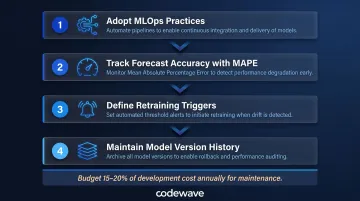
Budget for model maintenance from day one. In practice, MLOps overhead typically runs 15–20% of initial development cost annually — a figure that's far easier to absorb when planned for upfront than when it surfaces as an unexpected line item after launch.
How to Implement AI Demand Forecasting in Your Business
AI demand forecasting works best when introduced in phases — starting narrow, proving value, then scaling. The four steps below give you a repeatable path from objective-setting to production deployment.
Step 1 — Define Objectives and Identify Use Cases
Implementation starts with clarity about what business problem you're solving. Is it reducing stockouts in retail? Optimizing procurement in manufacturing? Forecasting patient supply needs in healthcare?
Setting a specific, measurable forecasting goal before selecting tools or models is essential. Vague objectives like "improve forecasting" lead to misaligned expectations and unclear success criteria.
Define clear objectives such as:
- Reduce forecast error (MAPE) from 35% to under 20% within six months
- Decrease stockouts by 40% while reducing inventory carrying costs by 15%
- Cut procurement lead time by 30% through better demand visibility
Identify the specific use case that will deliver the highest ROI with manageable complexity. Focus on one product category, one region, or one business process initially rather than attempting enterprise-wide transformation immediately.
Step 2 — Audit Data Infrastructure and Establish Quality Inputs
AI forecasting requires clean, comprehensive, accessible data. Before model development begins, assess what data exists, identify gaps, and build the infrastructure to deliver quality inputs.
Critical data audit questions:
- What historical demand data exists, and how far back does it go?
- Are sales, inventory, and procurement data stored in compatible formats across systems?
- What external variables (weather, economic indicators, competitor pricing) are available?
- How current is the data—is it updated daily, weekly, or monthly?
- What percentage of data records contain missing values or errors?
Research shows that poor data quality is the primary reason AI initiatives fail. Target 95%+ data accuracy at the input stage — this is the foundation everything else depends on.
Automated data pipelines handle extraction, validation, format standardization, and continuous loading into a centralized warehouse. Common infrastructure components include:
- Streaming: Apache Kafka or AWS Kinesis for real-time data ingestion
- Warehousing: Snowflake, BigQuery, or Redshift for centralized storage
- ETL automation: Fivetran or custom pipelines for ongoing data movement
Step 3 — Select the Right AI Models and Tech Stack
Model selection depends on data characteristics, forecasting horizon, and business domain. There is no universal "best" model—the right choice balances accuracy, interpretability, computational cost, and maintainability.
Model selection guidelines:
- For stable demand with clear seasonality: Start with time-series models (ARIMA, ETS) or gradient-boosted trees (LightGBM, XGBoost)
- For complex, non-linear patterns: Consider ensemble methods combining multiple model types or deep learning (LSTM) for temporal dependencies
- For new products with limited history: Deep learning or transfer learning approaches that leverage patterns from related products
- For maximum accuracy in competitions: Ensemble methods combining 50-200+ models (though rarely practical in production)
Enterprise-grade demand forecasting solutions often combine multiple approaches. For example, pairing time-series models for baseline forecasts with gradient-boosted trees that incorporate external variables (promotions, weather, economic indicators) delivers better results than either approach alone.
Tech stack considerations:
A production-ready forecasting system requires more than model training:
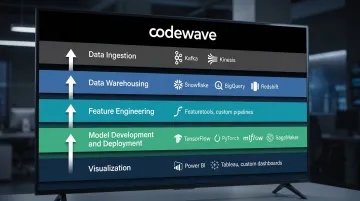
- Model development: TensorFlow, PyTorch, or scikit-learn for building and training models
- Data processing: Apache Kafka or AWS Kinesis for real-time streaming; Snowflake, BigQuery, or Redshift for data warehousing
- Feature engineering: Featuretools or custom pipelines for creating predictive variables
- Model deployment and monitoring: MLflow, Kubeflow, or AWS SageMaker for managing model lifecycles
- Visualization: Power BI, Tableau, or custom dashboards for forecast output and scenario comparison
Step 4 — Pilot, Monitor, and Iterate
AI forecasting should be introduced through a controlled pilot before enterprise-wide deployment. Choose one region, one product category, or one department to validate the approach, measure performance against baseline, and refine before scaling.
Pilot best practices:
- Define success metrics before launch — Track forecast accuracy using MAPE (Mean Absolute Percentage Error), comparing AI model performance to your previous forecasting method
- Run parallel forecasts initially — Generate AI forecasts alongside traditional forecasts, comparing both to actual outcomes to build confidence before switching fully
- Monitor continuously — Track forecast vs. actual results weekly to identify where models perform well and where they struggle
- Iterate based on results — Refine feature selection, adjust model parameters, or incorporate additional data sources based on pilot learnings
MAPE benchmarks by industry (for context):
- Consumer Packaged Goods: 15-25%
- Pharmaceuticals (stable demand): 10-20%
- Manufacturing: 20-40%
- Apparel and Retail: Over 30%
- High-predictability environments: Under 10% (excellent)
The pilot phase typically runs 2-4 months. Once the model demonstrates consistent accuracy improvement and integration issues are resolved, expand to additional product categories, regions, or business units incrementally.
Codewave has guided 400+ businesses across 15+ industries through this exact process — from data infrastructure audits to model deployment — cutting the typical implementation timeline by applying frameworks that are already proven in production.
Frequently Asked Questions
Can AI be used for forecasting?
Yes, AI is not only capable of forecasting but often significantly outperforms traditional statistical methods. AI processes larger datasets, detects non-linear patterns that statistical models miss, and updates predictions in real time as new data arrives rather than waiting for manual review cycles.
Which AI model is best for forecasting?
No single model fits every situation—the right choice depends on your data availability, forecasting horizon, and use case. ARIMA works for stable time-series with clear trends; LSTMs handle complex temporal patterns; ensemble approaches like LightGBM-based gradient-boosted trees typically deliver the highest accuracy in real-world demand forecasting.
What are the 4 types of forecasting?
The four common types are qualitative forecasting (expert judgment and market research), time-series forecasting (historical patterns and trends), causal/econometric forecasting (variable relationships like price and demand), and AI/ML-based forecasting (learned patterns from large, multi-variable datasets). Modern AI implementations increasingly blend all four approaches.
How accurate is AI demand forecasting compared to traditional methods?
AI-powered demand forecasting consistently outperforms traditional methods, particularly in volatile or complex environments. McKinsey research found AI reduces forecast errors by 20-50% compared to conventional statistical approaches, while Harvard Business Review documented 30-50% error reduction in a study of a manufacturer with 100,000+ SKUs.
What industries benefit most from AI demand forecasting?
Retail, healthcare, manufacturing, energy, and e-commerce see the most measurable impact. These sectors deal with high demand variability, significant cost penalties for forecasting errors (stockouts or overstock), and large volumes of usable historical and real-time data—conditions where AI's ability to detect complex patterns and adapt quickly delivers maximum value.