Introduction
B2B organizations face an efficiency paradox: despite investing heavily in AI tools, they're still drowning in manual processes, fragmented data, and slow decision-making. According to a 2024 Thomson Reuters analysis, more than 80% of AI projects fail — twice the rate of non-AI IT projects. The core problem: most off-the-shelf AI tools are built for mass adoption, not the operational complexity of B2B environments.
Generic platforms can't connect to proprietary ERPs or legacy databases without exposing sensitive data, and they lack the compliance controls and flexibility that B2B operations actually require.
This guide breaks down where generic AI breaks down for B2B, which use cases deliver real efficiency gains, how custom AI applies across industries, and what to prioritize when choosing a development partner.
Key Takeaways
- Custom AI fits your workflows, data, and compliance requirements out of the box—no forcing your operations to match a generic tool's limitations
- Top efficiency gains come from workflow automation, predictive analytics, document processing, and decision support
- Industry-specific AI delivers precision that off-the-shelf tools are architecturally built to avoid
- The build-vs-buy decision comes down to operational complexity, data sensitivity, and whether long-term ROI justifies the investment
- Prioritize partners who own outcomes and collaborate directly—technical capability alone is not enough
Why Off-the-Shelf AI Falls Short for Complex B2B Operations
The Structural Mismatch
Generic AI platforms are trained on broad, horizontal datasets for simple, common use cases. They can't learn from your proprietary systems without significant data exposure risk.
When you feed operational data into third-party models, you lose control. Deloitte's 2024 survey found that 40% of IT and business professionals rank data privacy as their #1 ethical concern with generative AI—75% place it in their top three concerns.
Off-the-shelf tools require you to export sensitive data, adapt your workflows to their limitations, and accept whatever features they offer. Custom AI, by contrast, is built around your existing infrastructure.
The Compliance and Governance Gap
Generic solutions lack industry-specific controls required in healthcare, financial services, and energy sectors. Retrofitting compliance after deployment creates audit vulnerabilities and regulatory exposure.
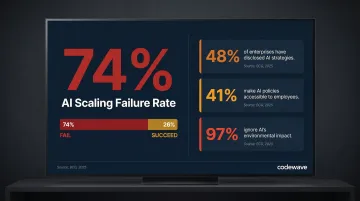
Thomson Reuters research puts the governance gap in sharp relief:
- Only 48% of companies have disclosed AI strategies or guidelines
- Just 41% make AI policies accessible to employees
- 97% fail to consider AI's environmental impact at all
BCG's 2025 analysis reveals that only 26% of organizations succeed in moving beyond proofs of concept — a 74% failure rate at scaling. That gap traces back to governance shortfalls, data quality problems, and infrastructure mismatches that generic tools aren't built to handle.
The Scalability Ceiling
Off-the-shelf tools cap at preset features. You can't adapt them as workflows, data sources, or compliance requirements evolve.
Custom AI is designed to integrate new data sources, add automation logic, and scale governance controls as your business grows — without requiring a platform replacement. When regulations tighten or data volumes spike, vendor roadmaps rarely move fast enough. Custom-built systems do.
Key Use Cases: How Custom AI Drives B2B Efficiency
Intelligent Workflow Automation
Custom AI automates end-to-end, multi-step B2B workflows—including conditional logic, role-based routing, and exception handling—far beyond what rule-based tools can handle.
Real-world applications:
- Contract review with clause extraction and risk flagging
- Procurement approvals with automated vendor validation
- Compliance monitoring pipelines that run autonomously
Economist Impact Research found that 75% of organizations reported AI-driven improvements in productivity and cost optimization, with 67% seeing strong performance in source-to-contract automation.
The key advantage: custom workflow AI handles exceptions. Generic tools break when they encounter edge cases outside their training data. Custom models learn from your specific scenarios and improve over time.
Predictive Analytics and Decision Support
AI models trained on your historical data consistently outperform generic forecasting tools for demand planning, sales pipeline projection, and risk prediction.
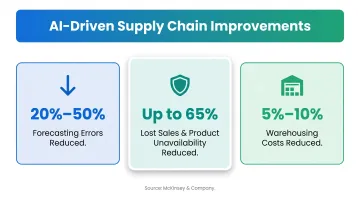
McKinsey research shows that AI-driven forecasting in supply chain management reduces errors by 20% to 50%, cuts lost sales and product unavailability by up to 65%, and reduces warehousing costs 5% to 10%.
Custom models improve continuously as they ingest new operational data. They learn your seasonal patterns, customer behavior shifts, and market dynamics that generic platforms simply don't have access to.
AI-Powered Document and Data Processing
NLP and OCR-based custom AI extracts, classifies, and acts on data from unstructured documents (invoices, compliance filings, technical reports), automatically populating downstream ERP and CRM systems.
Codewave's document AI implementations have delivered 50% faster invoice processing and 90% fewer data errors by building systems that understand specific document formats, validation rules, and integration requirements.
Gartner predicts that by 2025, 50% of B2B invoices worldwide will be processed without manual intervention.
Finance teams of 40 staff can save 25,000 hours annually through intelligent document processing, totaling roughly $878,000 in yearly savings.
Generative AI Copilots for Enterprise Teams
Enterprise LLM applications built on proprietary content enable teams to find and retrieve internal information faster, accelerate report generation, and respond to RFPs without switching tools.
The critical distinction: these copilots are trained on internal data but never expose it to external model training, which is a non-negotiable requirement in regulated B2B environments.
Custom copilots understand your terminology, reference your documentation, and maintain compliance requirements that generic ChatGPT wrappers cannot guarantee.
Sales and Revenue Intelligence
Custom AI embedded in B2B sales workflows enables lead scoring, behavioral campaign triggers, pipeline risk flagging, and personalized outreach at scale at a level of specificity that generic CRM AI add-ons aren't built to deliver.
Gartner research predicts that by 2029, sales organizations with AI-driven enablement functions will achieve 40% faster sales stage velocity than those using traditional methods.
Custom sales AI learns from your closed deals, lost opportunities, and customer interactions, providing insights specific to your market, product complexity, and sales motion.
Industry-Specific Custom AI Applications in B2B
Industry specificity matters because operational requirements, data governance, and regulatory constraints differ fundamentally across sectors. High-stakes B2B verticals need systems built around their specific data, workflows, and compliance requirements—not adapted from general-purpose platforms.
Manufacturing and Supply Chain
Custom AI trained on equipment sensor data predicts failures 24–48 hours in advance, optimizes production scheduling, and reduces unplanned downtime.
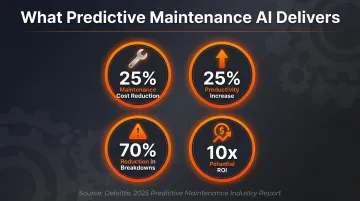
Deloitte's 2025 analysis documents measurable outcomes from predictive maintenance AI:
- Maintenance cost reduction of 25%
- Productivity increase of 25%
- Reduction in breakdowns of 70%
- Potential for 10x return on investment
These results come from models trained on specific equipment types, operational patterns, and failure modes—context generic platforms lack.
Healthcare and Life Sciences
Custom AI improves clinical workflows by surfacing relevant patient history, flagging documentation gaps, and automating administrative triage. Healthcare organizations need more than performance—they need provable controls. Custom AI embeds these requirements at the architecture level from day one:
- HIPAA-aligned role-based access controls and strict data isolation
- Encryption and compliance logging built into the system architecture
- Full audit trails and documentation for regulatory review
Financial Services and Fintech
Custom AI applications in fraud detection, credit risk modeling, automated compliance reporting, and intelligent document review deliver outcomes purpose-built for each organization's risk profile.
Codewave's fintech implementations have achieved 99% reduction in fraud risk and 40% less reporting time by building systems that understand specific transaction patterns, regulatory requirements, and risk thresholds.
Each system is built around deep integration with core banking infrastructure, using:
- ML models trained on proprietary transaction data
- NLP for automated document extraction and review
- Rule engines calibrated to specific compliance frameworks
Energy and Transportation
Real-time anomaly detection in pipeline and infrastructure operations, automated regulatory reporting, and predictive safety compliance monitoring all require accountability standards that off-the-shelf platforms are structurally unable to meet.
Custom systems integrate with SCADA platforms, IoT sensor networks, and operational databases to detect anomalies before they become incidents. Every action is logged with complete audit trails for regulators.
Retail and Agriculture
These sectors rely on data that's inherently local and proprietary—making custom models the only viable path to accuracy.
Demand forecasting models trained on a retailer's own sales history and seasonal patterns consistently outperform off-the-shelf alternatives on forecasting error. Precision agriculture applications—yield prediction, irrigation optimization, crop planning—depend on soil conditions, microclimate data, and crop-specific variables that no general-purpose model has ever seen.
Build vs. Buy: When Custom AI Development Makes Business Sense
The Decision Framework
Off-the-shelf AI is appropriate for early-stage testing and low-complexity standardized functions. Custom development becomes the right call when you face:
- Legacy system integration needs
- Strict regulatory environments
- Proprietary data sensitivity
- Processes requiring detailed audit trails
- Operational complexity that exceeds generic tool capabilities
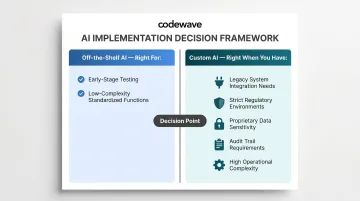
The right choice depends entirely on your operational reality — not a default preference for either approach.
Total Cost of Ownership
Custom AI carries higher upfront investment than licensing a generic tool. But recurring SaaS fees across multiple inadequate platforms—combined with unresolved compliance gaps and operational inefficiencies—often make the generic path more expensive over time.
Gartner forecasts that worldwide AI spending will reach $2.53 trillion in 2026, a 44% year-over-year increase. AI Services will account for $589 billion, and AI Software for $452 billion.
This rapid spending growth—coupled with the 74% failure rate at scaling generic AI—suggests that many organizations are paying repeatedly for tools that don't deliver. Custom AI built for your specific needs avoids this cycle.
The Governance Imperative
Responsible AI for B2B requires governance built in from the start, not bolted on later. That means:
- Transparency in decision-making and AI actions
- Role-based access controls and encrypted data handling
- Complete audit trails with automatic event logging
- Human oversight mechanisms and quality management systems
The EU AI Act makes this a legal requirement for high-risk AI systems, with obligations taking effect 24 months after the Act enters force.
FINRA's 2026 Annual Regulatory Oversight Report emphasizes written AI governance policies covering audit trails, data privacy, vendor due diligence, monitoring, and recordkeeping. Firms must archive AI-driven decisions and communications, with explainability for complex agent reasoning.
Generic platforms rarely provide the governance depth these standards demand — which is precisely where custom-built architecture earns its value.
What to Look for in a Custom AI Development Partner
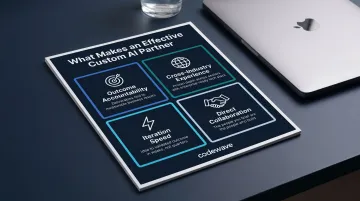
Before evaluating vendors, know the four qualities that separate an effective AI development partner from a generic one:
- Outcome accountability — deliverables tied to measurable business results, not project milestones
- Cross-industry experience — proven depth across sectors with an enterprise-ready tech stack
- Iteration speed — moving from idea to validated outcome in weeks, not quarters
- Direct collaboration — the people you brief are the people who build
Outcome Accountability
Outcome accountability means deliverables are tied to measurable business results — not just shipped code. A genuine AI partner tracks whether the solution actually improves operations after launch.
Codewave's ImpactIndex™ model represents this approach: an outcome-based engagement where clients pay for measurable results—not project milestones—ensuring the AI solution performs and drives real business value.
Cross-Industry Experience and Proprietary Data Capability
Look for proven experience across the industries they serve, with a technology stack capable of handling real-time data processing, analytics, and integration with existing enterprise systems.
Codewave has worked with 400+ businesses across 15+ industries, with an analytics tech stack including TensorFlow, Apache Kafka, Snowflake, and Power BI—demonstrating the breadth needed to handle diverse B2B requirements.
Iteration Speed and Collaborative Delivery
B2B AI development should move from idea to validated outcome in weeks—not quarters. Look for partners who simulate multiple scenarios rapidly and ship only what works.
Codewave's QuantumAgile™ framework does exactly this: testing multiple solution paths simultaneously and shipping only what validates, cutting time to outcomes by 60% compared to sequential development cycles.
Direct Collaboration Over Layered Project Management
The people you brief should be the people who build. Fragmented communication between stakeholders and engineering teams routinely keeps enterprise AI projects from reaching production.
Codewave's ZeroDX™ model removes those middle layers entirely — no account managers relaying requirements to a separate build team. Whoever you speak with owns the delivery.
Frequently Asked Questions
What is custom AI development for B2B businesses?
Custom AI development involves building AI systems specifically engineered around a company's own workflows, data, and operational requirements—as opposed to deploying off-the-shelf tools that require the business to adapt to preset capabilities.
How is custom AI different from off-the-shelf AI tools for B2B?
Custom AI integrates with proprietary data and legacy systems, is designed for specific compliance environments, and produces outcomes tailored to the business. Generic tools offer broad functionality that rarely fits complex B2B workflows precisely.
Which B2B processes benefit most from custom AI?
The highest-impact use cases span several core functions:
- Workflow automation — contract review, procurement approvals
- Document and data processing — invoice extraction, compliance filings
- Predictive analytics — demand forecasting, risk assessment
- Sales intelligence — lead scoring, pipeline management
- Industry-specific functions — compliance monitoring, regulatory reporting
How long does it take to build a custom AI solution for a B2B company?
Timelines vary by complexity. Simpler automation features can be validated in weeks, while enterprise-grade systems with deep integrations typically take several months. Iterative, outcome-focused delivery keeps timelines shorter than traditional waterfall approaches.
How do you measure ROI from custom AI development in B2B?
Tie AI outcomes to measurable business metrics—cost reduction, processing speed, error rate reduction, time saved per function. Pre-defining these KPIs before development begins is essential to demonstrating and sustaining ROI.
What should B2B companies look for when choosing a custom AI development partner?
Prioritize outcome accountability, cross-industry experience, data governance capability, and delivery speed. Look for partners who tie engagements to measurable results and ensure the people you speak with are the ones actually building the solution—not a layer removed from it.