Introduction
Most organizations have automated something. Scheduled reports, rule-based invoice routing, scripted data transfers — these work reliably until the process changes, the data gets messy, or a decision requires judgment. At that point, rule-based systems stall.
AI agent automation workflows are different. They're end-to-end systems in which autonomous software agents perceive inputs, reason through decisions, and execute multi-step tasks across systems — without constant human instruction at each step.
This guide is for operations leaders, IT decision-makers, and product teams in healthcare, fintech, insurance, and retail who need a functional understanding of agentic AI — how it works, where it fits, and where it doesn't. According to McKinsey's 2025 global survey, 23% of enterprises are already scaling an agentic AI system, yet most are still working out the implementation details.
What follows covers the mechanics, the real-world applications, the risks, and the honest limits.
Key Takeaways
- AI agent workflows go beyond RPA by enabling agents to reason, adapt, and make decisions across dynamic, multi-step processes
- The core loop runs perception → reasoning → execution → feedback — each stage feeding into the next
- Not every workflow suits an agent — task complexity, data variability, and latency requirements all determine fit
- Enterprise deployments require governance, clear escalation paths, and human-in-the-loop controls from day one
What Is an AI Agent Automation Workflow?
An AI agent automation workflow is an end-to-end process where one or more AI agents autonomously perceive inputs, make decisions, and execute tasks to reach a defined goal. Depending on the design, humans may intervene at specific checkpoints — or not at all.
How It Differs from Traditional Automation
RPA and rule-based bots follow static, predefined sequences. They perform well in stable environments, but a single unexpected input can derail the entire process. Agent workflows are goal-directed — the agent selects its execution path based on what it encounters, rather than following a fixed script.
Anthropic's engineering guidance draws a distinction here: workflows orchestrate LLMs and tools through predefined code paths, while agents dynamically direct their own process and tool use. That distinction matters operationally. When the process path is predictable, a workflow is the right choice. When it isn't, an agent handles the variance.
What Powers an Agent Workflow
Three components make this possible:
- Large language models — handle reasoning, interpretation, and decision-making at each step
- Tool-calling APIs — allow the agent to interact with external systems: databases, ERPs, RPA bots, code interpreters
- Memory mechanisms — maintain context across multi-step tasks, including short-term session memory and longer-term episodic or shared memory patterns
Single-Agent vs. Multi-Agent Systems
The right architecture depends on task scope and complexity:
| Single-Agent | Multi-Agent | |
|---|---|---|
| Best for | Focused, well-scoped processes | Complex workflows with distinct sub-tasks |
| Structure | One agent, end-to-end ownership | Specialized sub-agents coordinated by an orchestrator |
| Tradeoffs | Simpler to govern and debug | Higher capability, but more complexity and failure surface |
Multi-agent systems expand what's possible — but they also raise the stakes for governance and reliability.
Why Enterprises Are Adopting AI Agent Automation Workflows
The Gap Traditional Automation Can't Fill
RPA handles structured, repetitive, high-volume tasks well. It breaks on unstructured data, exception-heavy processes, and decisions that require contextual judgment. That's not a criticism — it's a design constraint. Agent workflows exist to fill the gap, not replace what already works.
The business pressure is real and quantifiable. In healthcare alone, CAQH's 2023 Index Report found that manual eligibility verification costs $11.16 per transaction versus $2.68 electronically — and the industry could save an additional $18.3 billion by fully automating administrative transactions. The broader point holds: administrative processes that run on human handoffs carry a compounding cost that scales poorly.
What Agent Workflows Unlock Operationally
The operational value is in end-to-end process completion. Processes like claims triage, financial reconciliation, and patient data intake have historically required human handoffs at decision points — not because humans add value at every step, but because the automation couldn't handle variability. Agentic systems can.
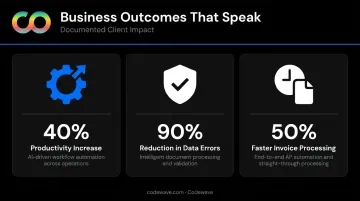
Codewave has deployed automation across 400+ businesses in healthcare, fintech, insurance, and retail. Across those engagements, the documented outcomes include:
- 40% increase in productivity across automated workflows
- 90% reduction in data errors in document-heavy processes
- 50% faster invoice processing in finance and operations
The Strategic Dimension
Gartner projects that 40% of enterprise applications will feature task-specific AI agents by end-2026, up from less than 5% in 2025. Organizations still running purely rule-based automation will find those gaps widening — in speed, scalability, and decision quality — as competitors deploy agentic systems. Getting ahead of that curve is an operational priority, not a future planning exercise.
How AI Agent Automation Workflows Work
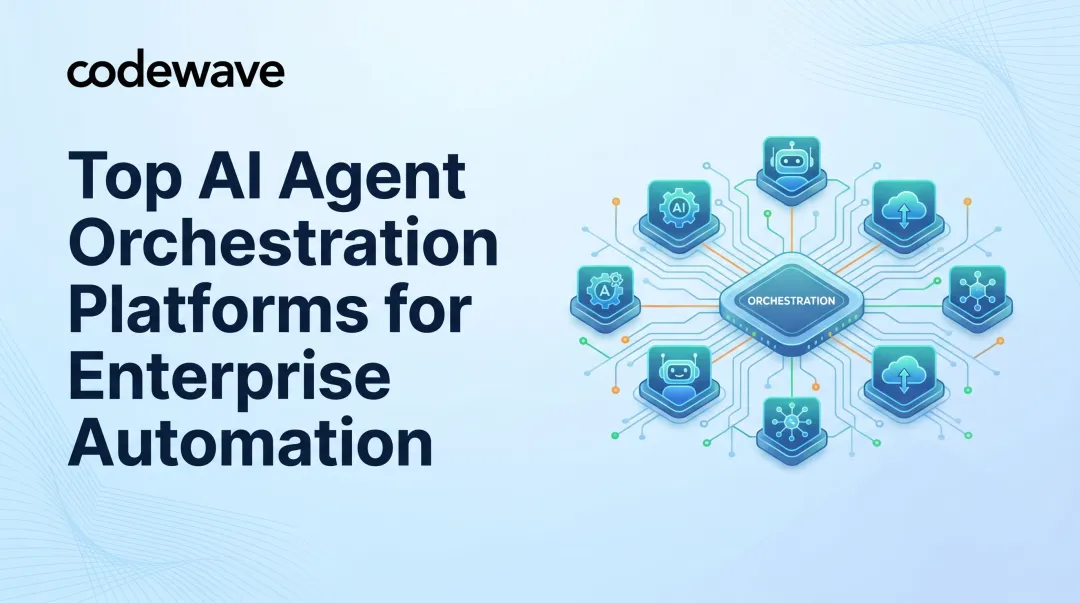
The basic loop: inputs flow into the agent, which reasons and plans, takes action via tools or APIs, evaluates outcomes, and feeds learnings back into future cycles. Each stage has distinct mechanics worth understanding.
Step 1: Perception and Input Collection
The agent collects data from its environment — user prompts, API responses, documents, database records, sensor feeds — and preprocesses it to form a structured understanding of the current state. NLP handles unstructured text; computer vision handles image or document inputs.
This stage determines everything downstream. An agent reasoning on clean, structured inputs performs measurably better than one working with inconsistent or siloed data.
Step 2: Reasoning, Planning, and Decision-Making
The agent uses an LLM to reason through the goal, evaluate possible action paths, and select an optimal sequence of steps. Two foundational frameworks inform how this works in practice:
- ReAct (Reasoning + Acting) — prompts the LLM to generate reasoning traces and task-specific actions in an interleaved manner, allowing the agent to think and act simultaneously
- Chain-of-Thought prompting — improves performance on complex, multi-step tasks by making the model's reasoning process explicit before it commits to an action
At this stage, the agent also decides when to call external tools, when to loop back, and when to escalate to a human. That last decision — escalation — is where governance design either works or fails.
Step 3: Execution and Feedback Loop
The agent calls tools (APIs, RPA bots, databases, code interpreters) to carry out each planned step. It monitors the outputs of those actions and either progresses toward the goal or adjusts its plan based on new information.
This is iterative by design. A well-built agent doesn't just execute — it evaluates. If a tool call returns unexpected results, or an intermediate output shifts the optimal path, the agent recalibrates. That feedback loop is what separates agentic execution from scripted automation.
This is also where implementation speed matters. Codewave's QuantumAgile™ methodology applies this same test-and-adapt logic to the build process itself — validating agentic workflows from concept to working system in days, not months. For enterprise teams under pressure to prove value before scaling, that compression makes a real difference.
Where AI Agent Automation Workflows Are Applied
High-Value Functional Areas
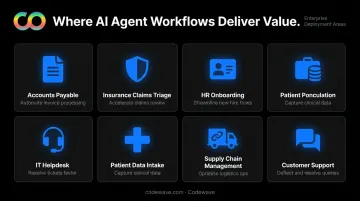
Agent workflows are deployed across a growing set of enterprise functions. Codewave has implemented automation across these areas for clients in healthcare, fintech, insurance, and retail:
- Accounts payable and financial reconciliation — automated invoice validation, PO matching, approval routing, and month-end close acceleration
- Insurance claims triage — accident report assessment, policy compliance checks, fraud flagging, and settlement routing
- HR onboarding — document capture, verification, HRIS integration, and compliance checks
- IT helpdesk escalation — automated request routing and resolution (ServiceNow has reported handling 90% of its own IT requests autonomously)
- Patient data intake — EHR integration, eligibility verification, scheduling, and clinical documentation
- Supply chain exception management — real-time inventory monitoring, demand forecasting, and exception routing
- Customer support resolution — query classification, automated resolution, and escalation handling
What Makes a Workflow Suitable
Not every process belongs here. The functional areas above share common characteristics:
- High data variability (inputs change frequently and unpredictably)
- Multi-system orchestration needs (CRM, ERP, and external APIs involved)
- Exception-heavy decision points that previously required skilled human judgment
- Sufficient volume to justify the overhead of agentic architecture
How Workflows Are Triggered
Agentic workflows are initiated by different conditions depending on the use case:
- Incoming document or query — a form submission, email, or support ticket kicks off the workflow immediately
- API event — a status change in an upstream system (payment processed, claim filed) fires the next step automatically
- Scheduled trigger — batch processes like nightly reconciliations or weekly compliance checks run on a fixed cadence
- Monitoring condition — continuous feeds detect anomalies or thresholds (inventory drop, fraud signal) and trigger exception handling
The trigger type directly shapes architecture decisions. Event-driven systems demand low-latency tooling and tight error handling; scheduled systems prioritize idempotency; continuously running agents require ongoing resource governance.
Key Factors That Affect AI Agent Workflow Performance
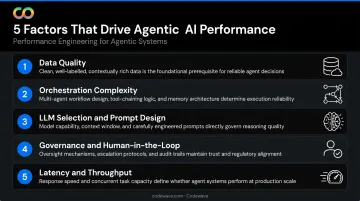
Performance in agentic systems is not just a function of model quality. These five factors account for most real-world deployment failures:
- Data quality and accessibility — unstructured, inconsistent, or siloed data directly degrades task completion rates; Gartner lists poor data quality among the top reasons agentic projects fail
- Orchestration and tool integration complexity — each additional system an agent coordinates (CRM, ERP, RPA bot, API) adds latency, failure points, and potential for compounding downstream failures
- LLM selection and prompt design — model-task mismatches and weak prompt design introduce reasoning errors that compound at scale, making this one of the earliest and most costly decisions in workflow design
- Governance and human-in-the-loop design — agents without defined escalation paths and audit trails create compliance exposure; NIST AI RMF and the EU AI Act both require accountability mechanisms for autonomous decision-making
- Latency and throughput requirements — multi-step workflows chain API calls and reasoning cycles, trading speed for flexibility; time-critical applications often need hybrid designs rather than fully autonomous agents (Anthropic's own documentation flags this tradeoff explicitly)
Common Misconceptions and When AI Agent Workflows May Not Be Appropriate
What Gets Misunderstood
Two misconceptions appear consistently in enterprise conversations about agentic AI.
The first is that AI agents will replace all existing automation. RPA and rule-based systems remain superior for structured, predictable, high-volume tasks where precision and speed matter more than adaptability. Forrester has explicitly warned automation builders not to repeat RPA's governance mistakes with agentic systems — overlapping functionality, unclear ownership, and agent sprawl.
The second is that any workflow can be handed to an agent. Autonomy without clear constraints produces brittle, ungovernable systems. Gartner predicts over 40% of agentic AI projects will be canceled by end-2027, with poor governance, unclear value, and data quality problems as the leading causes.
When Agent Workflows Are the Wrong Choice
Avoid agentic approaches for:
- Workflows with absolute predictability requirements — where deviation from a defined path is never acceptable
- Near real-time response mandates — multi-step reasoning cycles add latency that some applications can't absorb
- Heavily regulated outputs requiring deterministic audit trails — where every decision must be traceable and reproducible
- Processes with frequently shifting business rules — agents built on unstable logic foundations require constant retraining and reconfiguration
In these cases, traditional RPA or hybrid approaches — agents and RPA working in tandem — are more appropriate and easier to govern.
The Risk of Over-Automating by Default
Deploying agents into processes with unclear ownership, shifting business rules, or poorly understood edge cases doesn't accelerate operations. It shifts decisions to a system without the business context, exception-handling logic, or stakeholder judgment those processes actually require. The outcomes become harder to explain, harder to audit, and expensive to fix when something goes wrong.
Conclusion
AI agent automation workflows complement rule-based systems — not replace them. They handle the complex, judgment-intensive work that deterministic automation can't touch, while human oversight stays where it matters most.
The organizations that get the most out of agentic AI share three habits:
- Match autonomy levels to process type — not every workflow needs a fully autonomous agent
- Design governance in from the start, including escalation paths and audit trails
- Treat deployment as an iterative capability, validating in controlled environments before scaling
Organizations that follow this approach — with realistic expectations and a willingness to course-correct — outperform those chasing full automation as an end goal.
That iterative, governance-first approach is where an experienced implementation partner makes a concrete difference. Codewave has deployed agentic AI and automation systems across 400+ businesses in 15+ industries — with documented outcomes in healthcare, fintech, insurance, and retail. That applied breadth accelerates the path from concept to working system, reducing the trial-and-error that causes most AI automation projects to stall before they deliver value.
Frequently Asked Questions
What is agent automation?
Agent automation uses AI agents (software programs that perceive inputs, reason through decisions, and take autonomous action) to execute business processes without step-by-step human instruction. It goes beyond traditional rule-based automation by handling variable inputs and making contextual decisions at each step.
Will agents replace RPA?
No. Agents complement RPA rather than replace it. RPA handles structured, repetitive, high-volume tasks with superior speed and precision; agents handle the unstructured, judgment-intensive steps that RPA cannot. In most end-to-end enterprise workflows, both work together.
Is ChatGPT an agent or an LLM?
ChatGPT is primarily an LLM-based interface — it generates responses but doesn't autonomously pursue goals in the world. When connected to tools like code execution or web browsing, it begins exhibiting agentic behavior, but a true AI agent requires persistent goal pursuit, tool use, and independent multi-step execution.
What is the difference between AI agent automation and traditional automation?
Traditional automation follows fixed, predefined rules and breaks when conditions change. AI agent automation uses reasoning and adaptability to handle variable inputs, make contextual decisions, and adjust execution paths dynamically — purpose-built for complex, exception-heavy processes.
What industries benefit most from AI agent automation workflows?
Industries with high data variability, complex multi-system processes, and exception-heavy workflows benefit most — including healthcare (patient intake, prior authorizations), financial services (fraud detection, reconciliation), insurance (claims processing), and supply chain operations.
How do you know if a workflow is ready for AI agent automation?
Key readiness signals include:
- Inputs are variable or unstructured
- Decision-making is required at multiple steps
- Volume justifies the automation overhead
- Errors are recoverable if the agent missteps
If the process is purely rule-based and predictable, RPA is the better fit.