Introduction
Enterprises today operate fragmented networks of AI tools — LLMs, automation engines, data pipelines, and decision models — all running in isolation with no unified layer governing how they work together. Marketing deploys agents on one platform, finance runs workflows on another, and HR builds chatbots on a third. The result: duplicated integrations, inconsistent security postures, no cross-team visibility, and 88% of organizations unable to scale AI beyond functional silos.
AI agent orchestration platforms solve this by acting as connective tissue: coordinating multiple AI agents, models, data sources, and workflows across the enterprise with governance built in from day one.
Gartner predicts 40% of enterprise applications will embed task-specific AI agents by end of 2026 — up from less than 5% in 2025. That 8x jump means orchestration architecture decisions made now will define which enterprises lead and which spend the next two years untangling technical debt.
This guide breaks down the top AI agent orchestration platforms available today, the criteria that matter for enterprise evaluation, and how to match each platform to your operational context.
Key Takeaways
- AI agent orchestration platforms coordinate multiple AI agents, models, and workflows into unified, governed enterprise processes
- Key evaluation criteria include multi-agent coordination, integration depth, governance controls, model flexibility, and observability
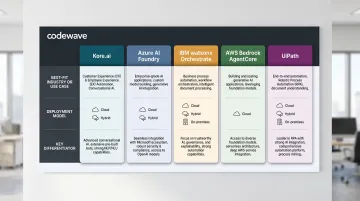
- Five platforms, five distinct fits: Kore.ai for CX/EX, Azure AI Foundry for Microsoft shops, IBM watsonx for regulated industries, AWS Bedrock for multi-model flexibility, UiPath for RPA migration
- Choosing the wrong platform creates fragmentation, compliance risk, and expensive re-platforming cycles
- The right platform depends on your cloud environment, compliance requirements, and automation maturity — this guide helps you match them
What Is AI Agent Orchestration (And Why Enterprises Can't Ignore It)
AI agent orchestration is the coordination layer that governs how AI agents work together. It routes tasks to the right models, manages context across multi-step workflows, enforces governance rules, and connects AI logic to enterprise systems. Unlike adjacent categories, it enables fundamentally different capabilities:
| Category | What It Does | What It Doesn't Do |
|----------|--------------|-------------------|
| RPA | Automates fixed, rule-based tasks with deterministic bots | Can't reason, adapt, or handle exceptions outside predefined rules |
| ETL | Moves and transforms data between systems on schedules | Doesn't make decisions or execute multi-step reasoning chains |
| MLOps | Manages model training, versioning, and deployment lifecycle | Doesn't orchestrate multiple agents collaborating on business workflows |
| Workflow Automation | Sequences predefined steps in a fixed order | Can't dynamically adjust paths based on intermediate results or context |
| AI Agent Orchestration | Coordinates autonomous agents that reason, delegate, and adapt across enterprise systems with governance | — |
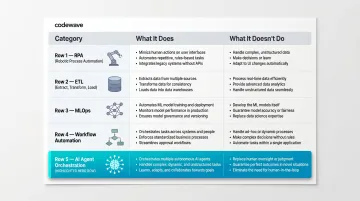
What this table makes visible is the fragmentation problem most enterprises are already living. Marketing, finance, HR, and customer service each build AI agents on separate platforms — no shared governance, duplicated data connections, inconsistent security, and no cross-team visibility. McKinsey's 2025 survey found that 62% of organizations are experimenting with AI agents, but only 23% are scaling them. In any given function, no more than 10% report scaling agents — a clear signal of siloed, fragmented deployments.
That fragmentation has a cost, and the market is responding. Gartner projects spending on AI governance will reach $492 million in 2026 and surpass $1 billion by 2030. Governance isn't an afterthought anymore — it's becoming a platform selection criterion.
Top AI Agent Orchestration Platforms for Enterprise Automation
These platforms were evaluated on multi-agent coordination capability, integration breadth with core enterprise systems, governance and compliance controls, deployment flexibility (cloud, hybrid, on-premises), model agnosticism, and proven enterprise adoption at scale.
Kore.ai
Founded as a conversational AI company, Kore.ai has evolved into a full-stack enterprise AI agent platform spanning customer experience, employee experience, and business process automation. The company is trusted by 400+ Fortune 2000 companies and was named a Leader in the 2025 Gartner Magic Quadrant for Conversational AI Platforms and the Forrester Wave Q2 2024. Enterprise use cases span customer experience (CX), employee experience (EX), and business process automation — with documented deployments in banking, healthcare, retail, IT, HR, and recruiting.
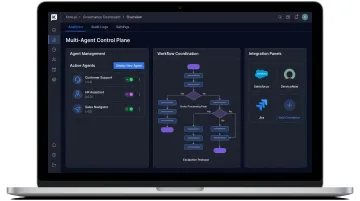
Kore.ai's core orchestration capability is its multi-agent engine — a control plane where specialized agents collaborate, share context, hand off tasks, and operate with varying levels of autonomy, from assistive copilots to fully autonomous executors.
The platform is model-agnostic and cloud-agnostic (bring-your-own model), with 200+ pre-built AI agent templates, 100+ enterprise application connectors, and a governance dashboard covering full audit trails and role-based access controls.
| Dimension | Details |
|---|---|
| Best For | Enterprises needing end-to-end orchestration across customer experience, employee experience, and business operations — especially in regulated industries requiring strong governance |
| Key Features | Multi-agent orchestration engine; 200+ pre-built agent templates; 100+ plug-and-play integrations (CRM, ERP, ITSM, HRIS); no-code + pro-code development; enterprise and agentic RAG; AI Security + Governance dashboard with audit logs and RBAC |
| Pricing Model | Custom/enterprise-quoted based on project scope; contact for tailored pricing |
Microsoft Azure AI Foundry
Microsoft Azure AI Foundry (previously Azure AI Studio, recently rebranded to Microsoft Foundry in November 2025) is Microsoft's unified platform for building, deploying, and orchestrating AI agents across the Azure ecosystem. The platform offers access to 11,000+ models with native integration across Microsoft 365, Teams, SharePoint, and Copilot Studio for agent creation and deployment. Orchestration is handled through Semantic Kernel and the Azure AI Agent Service.
Its primary differentiator: native, deep integration across the Microsoft technology stack makes it a natural fit for the majority of enterprises already running on Azure, Microsoft 365, and Dynamics — reducing integration overhead without new infrastructure layers. However, its orchestration value narrows considerably outside the Microsoft ecosystem, and model flexibility is more limited compared to model-agnostic platforms.
Azure holds 100+ compliance certifications including SOC 1/2/3, ISO 27001/27017/27018, HIPAA, FedRAMP, GDPR, and NIST 800-171.
| Dimension | Details |
|---|---|
| Best For | Large enterprises already heavily invested in the Microsoft ecosystem (Azure, Microsoft 365, Dynamics 365) that want to add AI agent orchestration without introducing new infrastructure layers |
| Key Features | Agent builder via Copilot Studio; Azure OpenAI Service integration; Semantic Kernel orchestration framework; access to 11,000+ models; enterprise RBAC; 100+ compliance certifications (SOC 2, ISO 27001, HIPAA, FedRAMP, GDPR) |
| Pricing Model | Free platform + consumption-based pricing; Agent Pre-purchase Plan with Agent Commit Units (ACUs): Tier 1 (5% discount), Tier 2 (10% discount), Tier 3 (15% discount); new accounts receive $200 credit for 30 days |
IBM watsonx Orchestrate
IBM watsonx Orchestrate is designed specifically for enterprise business process automation, allowing professionals in HR, finance, sales, and operations to create and deploy AI agents using natural language — without requiring deep technical expertise. Recognized as a Leader in the 2025 Gartner Magic Quadrant for AI Application Development Platforms, it serves heavily regulated industries including financial services, healthcare, and manufacturing.
The defining capability for enterprise orchestration is its hybrid cloud deployment model — on-premises, private cloud, or public cloud via IBM Cloud, AWS, or Red Hat OpenShift. This flexibility is essential for regulated industries handling sensitive data that can't move to public cloud environments. The platform also includes a pre-built skills library for common enterprise workflows and IBM's governance framework with policy enforcement and lifecycle control.
| Dimension | Details |
|---|---|
| Best For | Regulated enterprises (financial services, healthcare, manufacturing) needing hybrid cloud deployment of AI agents with enterprise-grade governance and auditability built in |
| Key Features | Multi-agent orchestration control plane; Agent Builder (no-code and pro-code); governed catalog of pre-built agents and tools; hybrid cloud deployment (IBM Cloud, AWS, on-premises via Red Hat OpenShift); policy enforcement and lifecycle control; RBAC and observability |
| Pricing Model | Three tiers: Free Trial, Essentials (for early teams), Standard (for scaling); available via IBM Cloud Catalog or AWS Marketplace; contact for enterprise licensing |
AWS Bedrock Agents (AgentCore)
AWS Bedrock Agents, now consolidated under the AgentCore infrastructure layer, provides enterprises running on AWS with a scalable, secure foundation for building and orchestrating AI agents that integrate natively across AWS services. Multi-agent orchestration reached general availability in March 2025, supporting Supervisor Mode (supervisor analyzes inputs, breaks down complex problems, invokes subagents serially or in parallel) and Supervisor with Routing Mode (routes simple requests directly, falls back to full orchestration for complex queries) — with up to three hierarchical agent team layers.
Its primary enterprise advantage: for organizations with significant AWS infrastructure investment, Bedrock Agents provides native access to 18+ foundation model providers (Amazon Titan, Anthropic Claude, Meta Llama, Mistral, Google, OpenAI, DeepSeek, and more) through a single API, combined with AWS-native security controls (IAM, VPC isolation, encryption). The key limitation: orchestration value is strongest within the AWS ecosystem, and portability to other environments is constrained.
| Dimension | Details |
|---|---|
| Best For | Enterprises with significant AWS infrastructure that want to build scalable, multi-model AI agent workflows without introducing new cloud platforms or security perimeters |
| Key Features | Access to 18+ foundation model providers via single API (Amazon, Anthropic, Meta, Mistral, Google, OpenAI, and more); agent memory and session management; AWS IAM integration; VPC isolation; Knowledge Bases for RAG; supervisor/worker multi-agent patterns with 3-layer hierarchy |
| Pricing Model | Pay-per-token pricing (Standard, Flex at 50% discount, Priority at 75% premium, Batch at 50% discount); Flows at $0.035 per 1,000 node transitions; Intelligent Prompt Routing at $1.00 per 1,000 requests; Knowledge Base queries $0.001-$2.00; cost escalation risk at high invocation volumes |
UiPath Agentic Automation Platform
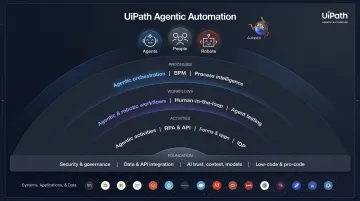
UiPath began as the dominant robotic process automation (RPA) platform and officially launched its agentic automation platform in April 2025 — uniquely positioned for enterprises that need to bridge existing rule-based RPA workflows with AI agent decision-making. This hybrid RPA + AI agent approach delivers the most value in process-heavy industries including finance, insurance, healthcare operations, and supply chain.
UiPath's orchestration differentiator is Maestro — a single control plane managing both traditional RPA bots and AI agents. Enterprises can incrementally layer AI agent capabilities onto existing automation investments rather than rebuilding from scratch, which lowers adoption risk and transition costs for organizations with established RPA deployments.
The AI Trust Layer handles governance across all generative AI activity, including an LLM gateway that serves as the central entry point for all LLM traffic with policy enforcement, access controls, and detailed audit logs.
| Dimension | Details |
|---|---|
| Best For | Process-heavy enterprises (insurance, financial services, healthcare operations) with existing RPA investments that want to augment automation with AI agent decision-making without a full platform migration |
| Key Features | UiPath Maestro for unified RPA + AI agent management; AI Trust Layer for governance with LLM gateway, policy enforcement, and audit logs; Document Understanding for unstructured data processing; integration with GPT family (Azure OpenAI) + BYOLLM; pre-built automation components library |
| Pricing Model | Basic starting at $25/month (personal automations); Standard and enterprise licensing contact sales; consumption-based options available |
How We Chose These Platforms
Platform selection for this list rested on four core criteria:
- Proven multi-agent orchestration capability (not just single-model automation)
- Enterprise-grade governance and compliance controls
- Depth of integration with core business systems
- Demonstrated adoption at scale among large enterprises in regulated industries
Selecting on feature checklists alone often leads to costly mismatches downstream. Enterprises should evaluate based on their specific deployment environment (cloud, hybrid, or on-premises), team composition, and regulatory context.
That context matters because every deployment is different. Codewave has worked with 400+ businesses across 15+ industries — including healthcare, fintech, insurance, and retail — helping them evaluate and implement AI orchestration approaches. The platforms included in this guide consistently surface as the most enterprise-ready based on implementation complexity, governance maturity, and scalability outcomes observed across those engagements.
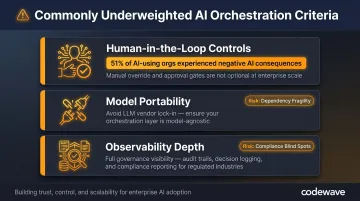
Three criteria enterprises most commonly underweight during evaluation:
- Human-in-the-loop controls — review, approval, and intervention workflows for high-risk decisions. With 51% of AI-using organizations experiencing at least one negative consequence from AI and 33% citing AI inaccuracy, this capability is essential for enterprise risk management
- Model portability — avoiding lock-in to a single LLM provider as the market evolves. Ecosystem-native platforms (Azure, AWS) offer fast integration within their stacks but limit portability
- Observability depth — full audit trails that compliance teams can actually use, not just developer-facing logs. Purpose-built orchestration platforms often provide more granular governance visibility
Conclusion
Choosing an AI agent orchestration platform comes down to fit, not feature count. Ecosystem-native platforms (Azure AI Foundry, AWS Bedrock) offer fast integration within their stacks but limit portability. Purpose-built orchestration platforms (Kore.ai, IBM watsonx, UiPath) cover more ground but require more deliberate integration planning. The right choice depends on your cloud environment, regulatory requirements, team capabilities, and growth trajectory.
Before selecting a platform, work through three steps:
- Audit your current AI landscape — map existing agents, the platforms they run on, and the data they access
- Identify two or three high-value use cases to pilot before committing to a full deployment
- Evaluate governance and model flexibility as primary criteria, not just ease of initial setup
Codewave has worked through these platform decisions with 400+ businesses across 15+ industries, from healthcare and fintech to retail and energy. If you're evaluating orchestration approaches for your organization, connect with the Codewave team to discuss the right strategy for your deployment environment, regulatory posture, and automation maturity.
Frequently Asked Questions
What is AI agent orchestration, and how is it different from workflow automation?
AI agent orchestration coordinates autonomous agents that reason, plan, and dynamically adapt their execution paths — sharing context, delegating tasks, and collaborating across enterprise systems with governance. Traditional workflow automation executes predefined, deterministic sequences with fixed rules and no adaptive reasoning.
What should enterprises prioritize when choosing an AI agent orchestration platform?
Prioritize multi-agent coordination, deep integration with core enterprise systems (CRM, ERP, ITSM), governance controls (RBAC, audit trails, human-in-the-loop), model flexibility, and scalability across cloud or hybrid environments. Feature checklists alone won't tell you what you need to know — evaluate against your actual workflows.
Which AI orchestration platforms work best for regulated industries like healthcare or finance?
Regulated industries should prioritize platforms with hybrid or on-premises deployment options, built-in compliance certifications (HIPAA, SOC 2, GDPR), detailed audit trails, and fine-grained access controls. IBM watsonx Orchestrate, Kore.ai, and UiPath are frequently adopted in these environments due to their governance depth and deployment flexibility.
What is multi-agent orchestration, and why does it matter for enterprise automation?
Multi-agent orchestration enables multiple specialized AI agents to collaborate on a single workflow — one extracting data, another validating it, a third routing exceptions. This division of labor allows enterprises to tackle complex, multi-step processes that a single AI model could not handle reliably or safely on its own.
Can AI agent orchestration platforms integrate with legacy enterprise systems?
Yes. Most enterprise orchestration platforms offer pre-built connectors for systems like SAP, Salesforce, ServiceNow, and Oracle, plus open APIs for custom integrations. That said, legacy integration depth varies significantly by platform and should be verified before you commit.
How much does an enterprise AI orchestration platform typically cost?
Pricing varies by model: consumption-based (AWS Bedrock, Azure AI Foundry), subscription or seat-based (IBM watsonx, UiPath), and usage-based (Kore.ai). Enterprise contracts are typically custom-quoted. Factor in integration, implementation, and governance overhead — not just license fees — when comparing total cost.