Introduction
The global AI orchestration market reached $11.02 billion in 2025 and is projected to hit $30.23 billion by 2030, growing at a 22.3% CAGR. This explosive growth reflects a fundamental shift: enterprises are moving beyond single-agent experiments to governed, multi-agent systems that automate entire operational workflows across customer service, finance, and IT operations.
Yet this rapid adoption carries real risk. More than 40% of agentic AI projects could be cancelled by 2027 due to poor governance, escalating costs, or unclear value. Choosing the wrong vendor — one that lacks enterprise governance controls, industry-specific expertise, or a credible deployment track record — is often what separates a failed pilot from a scaled system.
This guide covers the top AI orchestration companies in the US for 2026 (platform providers and implementation specialists), evaluated across governance maturity, multi-agent capability, industry specialization, and deployment complexity — so you can match vendors to your actual requirements.
Key Takeaways
- AI orchestration coordinates multi-agent workflows, state, memory, and tool use across enterprise AI systems
- US demand is concentrated in regulated industries — healthcare, fintech, and insurance — where audit-ready deployments are non-negotiable
- Top providers include IBM, Microsoft, AWS, UiPath, and specialized implementation partners like Codewave
- Selection hinges on governance depth, deployment flexibility, integration breadth, and measurable outcomes
- Compliance-heavy enterprises and fast-moving ops teams need very different partners — fit matters as much as capability
What Is AI Orchestration and Why Does It Matter in 2026?
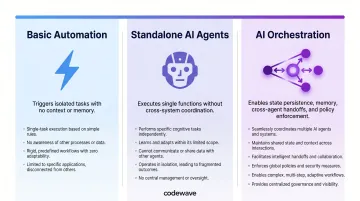
AI orchestration is the coordination layer that connects multiple AI agents, data pipelines, and tools into governed workflows capable of planning, acting, and producing audit-grade outcomes. It goes beyond what simpler approaches can handle:
- Basic automation triggers isolated tasks but can't manage context or state
- Standalone AI agents perform single functions without cross-system coordination
- AI orchestration manages state persistence, cross-agent handoffs, memory, and policy enforcement across complex, multi-step processes
The market reflects this shift. The AI orchestration market reached $11.02 billion in 2025, with North America leading adoption. Enterprise priorities have moved well past chatbots — today's demand centers on write-back systems with policy portability, role-aware approvals, and telemetry tied directly to KPIs. MarketsandMarkets describes this as "governed, outcome-linked automation that executes system actions with approvals and audit trails."
Regulated industries are leading this charge. Banking, financial services, and insurance (BFSI) hold the largest market share, with 70% of agentic AI proofs of concept originating from BFSI, retail, or manufacturing — sectors where audit trails and governance aren't optional extras.
The companies below were selected for proven market presence, technical capability, deployment flexibility, and measurable business outcomes delivered to US enterprises—not just brand recognition.
Top AI Orchestration Companies in the US for 2026
These companies were evaluated on enterprise readiness, governance depth, multi-agent coordination capability, US market presence, and verifiable client outcomes.
IBM watsonx Orchestrate
IBM positions AI orchestration through watsonx Orchestrate, combining it with watsonx.ai, watsonx.data, and watsonx.governance for a unified, hybrid-cloud suite. The platform serves regulated industries including finance, healthcare, and the public sector with pre-built skills libraries and deep connector coverage across SAP, Salesforce, and ServiceNow.
IBM differentiates through typed action catalogs, policy-portable governance, and audit-grade observability—making it the go-to for enterprises requiring traceable, rollback-capable AI workflows. Single-tenant and customer-managed deployment options address strict data sovereignty requirements.
Analyst recognition validates this approach: IBM earned Leader status in seven AI-related Gartner Magic Quadrant reports in 2025-2026, including AI Application Development Platforms, plus IDC MarketScape Leader for AI Governance 2025-2026—the broadest coverage among orchestration vendors.
Verified outcomes include IBM's internal AskHR achieving 94% containment of HR questions with a 75% reduction in support tickets, and MyLUA Health reaching 90%+ accuracy in early risk detection.
| Feature | Details |
|---|---|
| Key Platform | watsonx Orchestrate (with watsonx.ai, watsonx.data, watsonx.governance) |
| Deployment Model | Multi-tenant SaaS, single-tenant SaaS, customer-managed/on-premises |
| Best For | Regulated enterprises in finance, healthcare, and public sector needing hybrid deployment and audit-ready governance |
Microsoft (Azure AI Foundry Agent Service)
Microsoft delivers AI orchestration through Azure AI Foundry Agent Service and Copilot Studio, embedding orchestration across Microsoft 365, Dynamics 365, and Power Platform. The architecture supports pro-code and low-code development with enterprise CI/CD integration and a layered design spanning orchestration, storage, networking, and identity.
Microsoft's differentiation lies in ecosystem penetration—organizations already running on Microsoft infrastructure gain orchestration natively across productivity, CRM, and ERP tools, with Copilot integration reducing adoption friction. A standout capability: Copilot Studio's "Computer Use" feature enables AI agents to interact with any application with a graphical user interface, extending orchestration to legacy systems without API access.
Pricing removes barriers: no additional charge for creating or running Foundry-native agents using prompts and workflows—Microsoft monetizes through model token consumption and integration connectors instead.
| Feature | Details |
|---|---|
| Key Platform | Azure AI Foundry Agent Service, Copilot Studio, Power Platform |
| Deployment Model | Cloud-native (Azure), hybrid deployment options |
| Best For | Microsoft-ecosystem enterprises seeking embedded AI orchestration across M365, Dynamics, and ERP workflows |
AWS (Amazon Bedrock Agents)
AWS delivers managed AI orchestration through Amazon Bedrock Agents, supporting autonomous multi-agent collaboration, built-in knowledge bases, and session management. The AgentCore architecture—covering Gateway, Memory, Runtime, and Identity—provides enterprise-grade orchestration at scale.
AWS differentiates through infrastructure depth: teams access foundation models from 18+ providers including Anthropic, Meta, Mistral, Amazon, Google, and OpenAI, with native integration across the AWS ecosystem (S3, Lambda, SageMaker). Usage-based pricing lowers entry barriers for POC-to-production deployments.
Multi-agent collaboration reached general availability in March 2025, using a supervisor agent to coordinate specialized agents across complex workflows. Amazon Bedrock now powers generative AI for more than 100,000 organizations worldwide.
| Feature | Details |
|---|---|
| Key Platform | Amazon Bedrock Agents, AgentCore (Gateway, Memory, Runtime, Identity) |
| Deployment Model | Fully managed SaaS (AWS cloud), multi-region |
| Best For | AWS-centric organizations scaling AI agents with managed foundation model access and enterprise-grade security |
UiPath (Agentic Automation Platform)
UiPath combines established RPA leadership with the Maestro orchestration engine to coordinate autonomous AI agents, human reviewers, and RPA bots within BPMN-modeled workflows. This hybrid approach serves financial services, government, and healthcare where blended human-AI process management is essential.
UiPath differentiates through process intelligence and ROI tracking built directly into the orchestration layer—Maestro allows organizations with existing RPA investments to extend into agentic AI without replacing automation infrastructure, reducing migration risk and accelerating time to value.
Real-world impact: UiPath's agentic AI for financial crime and lending cut manual research from 20 minutes to under 2 minutes. Survey data shows 90% of US IT executives believe business processes would be improved by agentic AI, with 87% citing interoperability between AI technologies as essential.
| Feature | Details |
|---|---|
| Key Platform | Maestro Orchestration Engine, UiPath Agentic Automation Platform |
| Deployment Model | Cloud and on-premises; automation-volume-based pricing |
| Best For | Organizations with existing RPA programs expanding into governed, multi-agent AI automation |
Codewave
Codewave has delivered AI orchestration solutions across 400+ businesses in 15+ industries—healthcare, fintech, retail, insurance, and transportation among them. Unlike platform vendors, Codewave designs and builds custom AI orchestration architectures tailored to client-specific workflows and compliance requirements.
The tech stack spans TensorFlow, Apache Kafka, Snowflake, and modern agent frameworks, selected based on each client's data environment rather than a one-size-fits-all toolchain.
Three delivery principles separate Codewave from conventional implementation partners:
- ImpactIndex™: Clients pay for measurable results, not hours or deliverables
- QuantumAgile™: Moves from idea to validated AI outcome in days by running parallel scenarios and shipping what works
- ZeroDX™: Removes middle layers so the engineers you talk to are the ones building the solution
Verified outcomes include 3X faster data processing, 40% productivity gains, and 90% fewer data errors across client implementations—each tied to defined KPIs before a project begins.
For enterprises that need orchestration built around their processes—not the other way around—Codewave functions as the architect, builder, and outcome owner in one engagement.
| Feature | Details |
|---|---|
| Key Approach | Custom AI orchestration design and implementation using client-specific agent frameworks and data stacks |
| Engagement Model | Outcome-based (ImpactIndex™); QuantumAgile™ delivery; ZeroDX™ direct team collaboration |
| Best For | Mid-to-large enterprises in healthcare, fintech, retail, and insurance needing bespoke, ROI-linked AI orchestration with a proven implementation partner |
How We Chose the Best AI Orchestration Companies
The most common mistake buyers make is selecting vendors based on brand name or feature checklists alone. Without evaluating governance depth, deployment fit, or whether the vendor has documented results in your industry, you risk ending up with orchestration systems that are brittle, ungoverned, or impossible to audit when regulators require traceability.
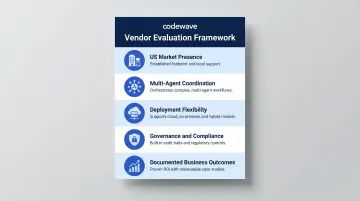
To avoid that, each company on this list was assessed against criteria that reflect what enterprise deployments actually demand:
- US market presence and enterprise client base — verified through public case studies
- Multi-agent coordination capability — state management, memory, and cross-agent handoffs
- Deployment model flexibility — SaaS, hybrid, and on-premises options for data sovereignty
- Governance and compliance tooling — audit trails, role-aware approvals, policy portability
- Documented business outcomes — KPIs like cycle time reduction, error rates, and cost savings
Conclusion
Choosing an AI orchestration partner in 2026 comes down to fit, not brand recognition. The right architecture should align with your operational goals: governance requirements, deployment constraints, industry compliance needs, and the workflows you need to automate at scale.
Before finalizing any decision, evaluate how each vendor handles state persistence, agent failure recovery, and telemetry linking AI actions to business KPIs. Scalability and cost-per-outcome matter more than feature count.
If you're looking for a partner that designs AI orchestration around your specific business outcomes from the ground up, Codewave's ImpactIndex™ model ties every engagement to measurable results — you pay for outcomes, not hours. Explore how Codewave can architect your AI orchestration strategy.
Frequently Asked Questions
What is the difference between AI orchestration and AI automation?
AI automation handles individual task execution (e.g., triggering a workflow when an email arrives), while AI orchestration coordinates multiple AI agents, models, and tools across complex, multi-step processes—managing state, memory, handoffs, and governance to achieve consistent outcomes across the enterprise.
What should I look for when choosing an AI orchestration company?
Focus on governance and audit capabilities, deployment flexibility (cloud vs. on-prem), integration breadth, multi-agent coordination with state management, and verified ROI in your industry. 75% of tech leaders cite governance as their primary deployment challenge.
How much does it typically cost to implement AI orchestration?
Costs vary widely—cloud platforms use usage-based pricing (pay-per-token/compute), while custom implementations range from project-based to outcome-based models. Native agent creation on major platforms may be free, but compute, storage, and execution costs accumulate quickly.
Which industries benefit most from AI orchestration in the US?
Healthcare (patient workflows, claims processing), fintech (fraud detection, compliance reporting), insurance (underwriting, claims automation), retail (supply chain, personalization), and IT operations (ITSM, incident management) show the highest impact. BFSI holds the largest market share in AI orchestration adoption.
What is the difference between an AI orchestration platform and an AI orchestration service provider?
Platforms (IBM, AWS, Microsoft, UiPath) provide the software infrastructure for orchestration, while service providers (like Codewave) design and implement custom orchestration architectures on top of those platforms—tailored to a client's specific workflows, compliance needs, and tech stack.
How long does it take to implement AI orchestration in an enterprise?
POCs on managed platforms can go live in weeks; full enterprise deployments with custom workflows and governance layers typically take 2–6 months. Data readiness is the primary timeline driver, with poor searchability and reusability being the most common bottlenecks.