Introduction
Enterprise AI has shifted from single-model experiments to complex ecosystems of agents, LLMs, and automation tools operating simultaneously. Organizations now run multiple specialized models, autonomous agents, and data pipelines across departments. Without a proper orchestration layer, that infrastructure fragments fast — and governance becomes an afterthought.
Gartner predicts 40% of enterprise applications will feature task-specific AI agents by 2026, up from less than 5% in 2025. Yet McKinsey finds that while 62% of organizations experiment with AI agents, fewer than 10% are scaling in any given business function. The gap between pilot and production isn't technical capability — it's infrastructure coordination.
Choosing the wrong orchestration platform in 2026 means slow deployment cycles, redundant infrastructure, and outputs that never connect. This guide evaluates the top AI orchestration and automation platforms on what actually determines production success: integration depth, governance controls, scalability, and measurable business impact.
Key Takeaways
- AI orchestration platforms coordinate AI models, agents, and tools into governed workflows
- Leading platforms range from developer-first frameworks and no-code builders to cloud-native services and enterprise suites
- Selection depends on technical depth, governance needs, and whether you require prebuilt agents or custom pipelines
- Top picks: LangGraph, Zapier, AWS Bedrock Agents, UiPath, IBM watsonx Orchestrate
- Evaluate each platform on integration breadth, multi-agent support, observability, and how quickly your team can ship
What Is AI Orchestration and Why It Matters in 2026
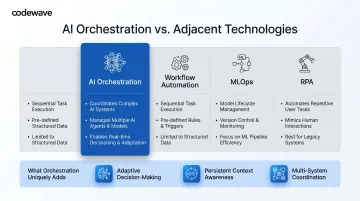
AI orchestration is the coordination layer that connects AI models, agents, data sources, and automation tools into end-to-end workflows with centralized governance. It's distinct from adjacent technologies that often get conflated with it:
- Workflow automation executes static, rule-based sequences with no adaptive logic
- MLOps manages model lifecycles (training, versioning, deployment) but not cross-system coordination
- RPA tools handle repetitive task automation without context management across sessions
Orchestration adds what these tools lack: adaptive decision-making, persistent context across interactions, and the ability to coordinate multiple AI systems simultaneously.
Enterprise AI environments in 2026 typically run multiple LLMs, specialized agents, and automation pipelines side by side. Without a coordination layer, that stack produces fragmented outputs and duplicated effort rather than coherent results. DataRobot reports that 25% of teams struggle with AI tool implementation, with nearly 30% citing integration and workflow inefficiencies as their primary frustration.
The consequences are significant. MIT research documents a 95% failure rate for enterprise generative AI pilots, with governance gaps and poor observability among the leading causes. Orchestration directly addresses both.
With demand for governed, scalable AI infrastructure rising across healthcare, fintech, and retail, the platforms below represent the most capable options available in 2026 — evaluated on governance controls, multi-agent support, integration depth, and enterprise readiness.
Top AI Orchestration and Automation Platforms for 2026
These platforms were selected based on orchestration capabilities, integration ecosystem, multi-agent support, governance controls, and fit across different team profiles— spanning developers, business operators, and enterprise IT teams.
LangGraph (LangChain Ecosystem)
LangGraph is a stateful orchestration framework from the LangChain team, built for developers who need graph-based agent workflows with cycles, branching, checkpointing, and multi-agent coordination that LangChain's linear DAG model cannot support. It handles long-running, stateful agents at the infrastructure level.
Its pluggable persistence layer supports Redis, Postgres, and custom backends — agents resume from exactly where they left off. It covers five core orchestration patterns: sequential, concurrent, handoff, group chat, and plan-first. A strong open-source community with 1,000+ tool integrations and 30,600 GitHub stars under an MIT license make it a production-ready default for engineering teams building agentic applications.
| Attribute | Details |
|---|---|
| Best For | Developer teams building custom LLM pipelines and multi-agent systems |
| Key Features | Stateful graph execution, pluggable checkpointers, built-in human-in-the-loop support, LangSmith observability hub |
| Pricing | Open-source (free); LangSmith Plus starts at $39/seat/month; Enterprise pricing available |
Zapier
Zapier is a no-code AI orchestration platform connecting 9,000+ apps into multi-step automated workflows, extended with AI Agents, Copilot for natural language workflow building, and built-in tools including Canvas, Tables, Forms, and Chatbots.
The integration breadth is unmatched. Non-technical teams can build AI-powered, human-in-the-loop workflows in minutes — no code required. SOC 2 Type II and GDPR compliance handles enterprise security requirements, while SAML SSO and SCIM provisioning support team-scale deployments. For ops teams orchestrating AI across existing business applications, it's the most accessible entry point available.
| Attribute | Details |
|---|---|
| Best For | Business and ops teams orchestrating AI across existing apps without code |
| Key Features | 9,000+ app integrations, AI Copilot, Zapier Agents, Canvas workflow builder, MCP connector, SSO/SCIM support |
| Pricing | Free plan available; Professional from $19.99/month; Team from $69/month; Enterprise custom pricing |
AWS Bedrock Agents
Amazon Bedrock Agents is a fully managed cloud-native service for building and deploying autonomous AI agents within the AWS ecosystem. It supports multi-agent collaboration through supervisor architectures, RAG knowledge bases, and code interpretation — with access to 18 model providers including Anthropic, OpenAI, Meta, and Google.
Deep AWS service integration is the core differentiator here. KMS handles encryption key management, CloudWatch covers monitoring and audit logging, and IAM enforces least-privilege access — all native, no third-party wiring required. Batch inference runs at 50% lower cost than on-demand, making it cost-effective at scale for teams already inside the AWS ecosystem.
| Attribute | Details |
|---|---|
| Best For | Cloud-native teams building scalable AI agents within the AWS ecosystem |
| Key Features | 18+ model providers, multi-agent collaboration, RAG knowledge bases, Bedrock Guardrails, KMS/CloudWatch/IAM integration |
| Pricing | Usage-based pricing (pay per token/API call); no upfront cost |
UiPath Agentic Automation Platform
UiPath combines traditional RPA bots with AI agents through its Maestro orchestration layer, enabling BPMN-based workflows that coordinate AI agents, RPA processes, and human reviewers in a single governed environment. Maestro is a cloud-native platform that unifies automation, AI tools, and human interactions into cohesive end-to-end business processes.
The key differentiator is hybrid execution: structured RPA handles rule-based tasks, while agentic AI reasoning covers edge cases and decisions — both managed from one platform. Additional capabilities include built-in Process Mining and Task Mining for process intelligence, a prebuilt automation library through Automation Hub, and live supervision with pause, resume, and retry controls. Recognized as a Leader in the 2025 Gartner Magic Quadrant for RPA, UiPath is a strong fit for enterprises modernizing legacy automation with AI.
| Attribute | Details |
|---|---|
| Best For | Enterprise teams blending RPA automation with AI agent decision-making |
| Key Features | Maestro BPMN orchestration, AI + RPA hybrid workflows, process intelligence, prebuilt automation library, governance dashboards |
| Pricing | Subscription-based; Basic starts at $25/month; contact UiPath for Standard and Enterprise pricing |
IBM watsonx Orchestrate
IBM watsonx Orchestrate is an AI orchestration platform built for business users in HR, finance, sales, and operations — letting teams create and deploy AI agents through natural language prompts without developer involvement. A framework-agnostic Agent Catalog provides prebuilt agents from IBM and partners out of the box.
Three capabilities separate it from competitors: hybrid cloud deployment (SaaS on IBM Cloud, AWS, or on-premises via Red Hat OpenShift), centralized governance with full visibility into what's running and who owns it, and a curated skill library connecting LLMs to enterprise apps like SAP, Salesforce, Workday, and ServiceNow through 80+ connectors. IBM reports that finance agents can cut uncollectible balances by 43% by automating invoicing and payment workflows — a meaningful benchmark for regulated industries evaluating ROI.
| Attribute | Details |
|---|---|
| Best For | Enterprise business teams in regulated industries needing governed, low-code AI automation |
| Key Features | Natural language agent creation, hybrid cloud deployment, prebuilt skill library, centralized governance, enterprise app integrations (SAP, Salesforce) |
| Pricing | Subscription-based; Essentials starts at $530/month; contact IBM for Standard tier |
How We Chose the Best AI Orchestration Platforms
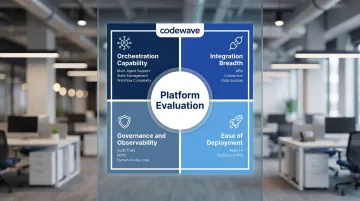
Platforms were assessed across four dimensions:
| Dimension | What We Evaluated |
|---|---|
| Orchestration Capability | Multi-agent support, state management, workflow complexity |
| Integration Breadth | APIs, connectors, data source support |
| Governance & Observability | Audit trails, RBAC, monitoring dashboards, human-in-the-loop controls |
| Ease of Deployment | Fit relative to the team's technical profile |
The most common mistake teams make: selecting a platform based on brand name or LLM compatibility alone, without considering whether it fits their team's technical profile or governance requirements. IDC identifies fragmentation as the primary barrier to enterprise AI progress—orchestration is the strategic response, but only when matched to actual workflows.
Each dimension ties directly to business outcomes. The practical questions worth asking before committing to any platform:
- Does it consolidate design, deployment, and monitoring in one environment, or does it add to tool sprawl?
- Does it handle retries and error-routing to reduce workflow failures at scale?
- Does it provide the audit logs, RBAC, and approval gates required for healthcare, fintech, or retail compliance?
Platform selection matched to actual workflows — rather than prioritizing feature breadth over workflow fit — is where most time-to-value gains come from. Codewave has seen this directly: across 400+ implementations, teams that aligned platform choice to their workflow context achieved 40% productivity gains and 3X faster data processing compared to those that selected on capability lists alone.
No single platform is universally best. The right choice depends on your team's profile:
- Developer-led teams: LangGraph
- Operations-led teams: Zapier
- Cloud-native environments: AWS Bedrock
- Automation-heavy workflows: UiPath
- Enterprise/compliance-focused organizations: IBM watsonx Orchestrate
Conclusion
In 2026, AI orchestration is the infrastructure layer that determines whether your AI investments produce measurable results or stall as isolated pilots. McKinsey projects IT infrastructure costs will increase 2-3X by 2030 while budgets remain flat — making platform selection a direct lever on both operational efficiency and AI ROI.
That context makes the evaluation criteria matter more than the vendor marketing. Assess platforms against your team's technical depth, existing infrastructure, governance requirements, and the specific workflows you need to automate — not integration counts or feature checklists.
Codewave has helped 400+ businesses across 15+ industries work through exactly this decision — matching orchestration platforms to real operational constraints and getting them into production. If you're in the evaluation stage and want a clearer path to the right stack, reach out to the Codewave team.
Frequently Asked Questions
What are AI orchestration platforms?
AI orchestration platforms are software systems that coordinate the deployment, integration, and management of multiple AI models, agents, and automation tools into unified, governed workflows. They act as the connective layer that turns fragmented AI capabilities into coherent end-to-end systems.
What is the best AI orchestration platform?
No single platform fits every team. LangGraph suits developers building custom agents, Zapier handles no-code automation, AWS Bedrock fits cloud-native deployments, and UiPath bridges RPA with AI. The right choice comes down to your team's technical profile and the complexity of your workflows.
How do AI orchestration platforms differ from workflow automation tools?
Traditional workflow automation follows static, rule-based sequences. AI orchestration layers on adaptive decision-making, multi-agent coordination, session-level context management, and governance controls. The result is workflows that handle edge cases and coordinate multiple AI models in ways rule-based tools simply cannot.
What features should I look for in an AI orchestration platform?
Prioritize these four areas:
- Integration depth: APIs, pre-built connectors, and hybrid cloud support
- Agent & state management: Multi-agent coordination with persistent context
- Governance controls: RBAC, audit logs, and human-in-the-loop approvals
- Observability: Dashboards that surface errors and performance in real time
What is the difference between AI agents and AI orchestration?
AI agents are autonomous models that execute specific tasks independently. AI orchestration is the infrastructure layer that coordinates multiple agents, models, and tools into coherent workflows with shared context, governance, and reliability controls.
Can small businesses benefit from AI orchestration platforms?
Yes. Zapier's no-code interface lets small teams automate cross-functional workflows without dedicated engineering resources. AWS Bedrock's pay-per-use pricing removes upfront infrastructure costs, making it viable for teams without enterprise budgets.