Introduction
Picture a mid-sized insurance company that built a promising AI model to automate claims triage. It worked beautifully in the pilot — cutting review time by 60%. Six months later, the model sits largely unused. It can't connect to the claims management system. The data team uses a different schema. Nobody owns the governance. The pilot never had a path to production.
This scenario is far more common than most organizations admit. Gartner predicted in 2024 that at least 30% of GenAI projects would be abandoned after proof of concept by end of 2025 — primarily due to poor data quality, inadequate risk controls, and unclear business value. Separate research suggests 95% of organizations are seeing zero return on enterprise GenAI investment despite industry-wide spending of $30–40B.
In most cases, the root cause is the same: AI deployed without a shared architectural foundation connecting data, systems, and governance.
This guide covers what enterprise AI architecture actually is, its seven functional layers, the core components every implementation needs, a phased roadmap for building it, and the governance principles that keep it trustworthy at scale.
Key Takeaways
- Most AI pilot failures stem from missing architecture, not missing technology
- Enterprise AI requires seven distinct layers — from raw infrastructure to user experience
- 60% of AI projects lacking AI-ready data are predicted to fail — data readiness is the critical risk
- Governance must be embedded from day one, not retrofitted after deployment
- A phased approach — foundation first, autonomy later — reduces risk while delivering real business value
What Is Enterprise AI Architecture?
Enterprise AI architecture is the end-to-end structural blueprint governing how AI systems are designed, deployed, integrated, governed, and scaled across an organization. It covers the full stack that keeps AI running reliably at enterprise scale:
- Data pipelines — ingestion, transformation, and routing
- AI/ML models — training, versioning, and serving
- Integration layers — APIs, event buses, and orchestration
- Security and governance controls — access, compliance, and auditability
- Monitoring and observability — performance, drift detection, and alerting
How It Differs from Traditional IT Architecture
Traditional IT architecture was built for deterministic, human-driven workflows. A user submits a form; a system processes it; a record is created. The logic is fixed and predictable.
Enterprise AI architecture must support a different class of system entirely: non-deterministic, continuously learning models that sense context, reason through ambiguity, and act autonomously. That demands architectural layers absent from legacy designs:
- Agentic runtimes that manage multi-step reasoning and tool use
- Semantic understanding layers for context-aware data processing
- Real-time model governance for monitoring decisions as they happen
Grafting AI onto a legacy IT foundation doesn't fail at the model level — it fails at the infrastructure level. The data pipelines weren't built for high-volume inference. The governance controls weren't designed for probabilistic outputs. The integration layer wasn't made for autonomous agents making decisions at runtime.
The Business Case
A deliberate AI architecture foundation pays off in concrete, measurable ways. Codewave clients have documented 3x faster data processing, 40% productivity gains, and 90% fewer data errors — outcomes that depend on data pipelines, model governance, and integration infrastructure working together, not a capable model sitting in isolation.
McKinsey estimates generative AI could add $2.6T–$4.4T in annual economic value. Capturing that value requires architecture, not just experimentation.
The 7 Layers of Enterprise AI Architecture
Enterprise AI is organized into discrete, interconnected layers — each handling specific functions, from raw compute to end-user experience. This layered view helps architects make deliberate decisions about where to invest and how components interact, rather than treating AI as a single monolithic system.
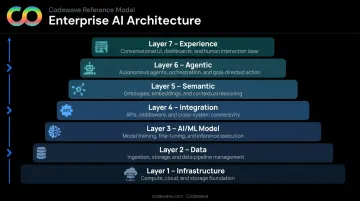
Infrastructure Layer
The foundation: GPU/CPU compute clusters, storage systems, networking, and cloud environments — multi-cloud, hybrid, and edge. This layer must elastically scale to meet AI workload demands, which vary dramatically between model training (compute-intensive, bursty) and inference (latency-sensitive, continuous).
Key considerations:
- Specialized hardware for training versus inference workloads
- Cost controls for GPU utilization
- Network throughput for real-time data pipelines
- Edge deployment for latency-constrained applications
Codewave's architecture-drives-technology principle applies here: cloud provider and configuration choices follow the client's specific requirements — not vendor preferences.
Data Layer
This layer manages ingestion, transformation, quality, and governance of enterprise data — structured, semi-structured, and unstructured.
Gartner predicts that through 2026, organizations will abandon 60% of AI projects unsupported by AI-ready data. The data layer is not a prerequisite to check off — it's a continuous operational discipline.
Critical components:
- Data lakehouses as a unified source of truth for AI systems
- Real-time streaming pipelines alongside batch processing
- Vector databases for RAG-based retrieval (Databricks reported 377% year-over-year growth in vector DB adoption across 10,000+ organizations)
- Data quality monitoring and lineage tracking
AI/ML Model Layer
This layer covers the full model lifecycle: training, fine-tuning, versioning, deployment, and retirement. Two architectural decisions matter most here.
Foundation models vs. domain-specific models: Large foundation models handle complex reasoning tasks. Smaller, domain-specific models are better suited for latency-sensitive or regulated workloads — healthcare, fintech, and insurance often favor them for privacy and compliance reasons.
MLOps/LLMOps pipelines: These keep models governed and performant over time. Codewave's documented toolchain spans TFX and PyTorch for training, MLflow and DVC for versioning, Kubeflow and Kubernetes for deployment, and IBM Watson OpenScale for monitoring.
Integration Layer
AI delivers value only when embedded into real business workflows — not as a standalone system. The integration layer connects AI to existing enterprise platforms (CRM, ERP, data warehouses) through APIs, event-driven architectures, and emerging agent communication protocols like Anthropic's Model Context Protocol (MCP) and Google's Agent2Agent (A2A) protocol.
When this layer is absent, AI outputs remain isolated — visible in reporting tools but disconnected from the systems where decisions actually get made and acted on.
Semantic Layer
This emerging layer provides shared context and meaning across the enterprise. Using knowledge graphs, ontologies, and business glossaries, the semantic layer ensures AI agents can interpret data from different domains consistently.
Without it, an agent pulling from the sales CRM and the finance ERP may interpret "customer" two different ways — producing reasoning errors that are difficult to trace. The semantic layer is the reason cross-functional AI actually works at scale.
Key functions it enables:
- Unified definitions across business domains (sales, finance, operations)
- Consistent data interpretation for multi-agent workflows
- Traceable reasoning when AI outputs span multiple source systems
Agentic Layer
The agentic layer is the runtime for AI agents: it handles goal decomposition, tool use, memory, planning, and agent-to-agent coordination. Where rule-based automation follows fixed if/then logic, agents dynamically plan, adapt, and delegate based on context.
Gartner predicts 40% of enterprise applications will include task-specific AI agents by 2026 — up from less than 5% in 2025.
Codewave architects this layer using LangGraph for state management, CrewAI for multi-agent coordination, Pinecone/Weaviate for long-term memory, and Pydantic with human override flows for safety.
Experience Layer
The user-facing layer translates AI reasoning into actionable, transparent outputs — spanning conversational interfaces, multimodal inputs (text, voice, visual), and omnichannel delivery across apps, websites, and messaging platforms.
Explainability is non-negotiable here. Users who can't understand why an AI recommended something won't trust it — and in regulated industries, they can't legally act on it without an audit trail. Codewave builds analytics dashboards and compliance monitoring directly into this layer for healthcare, fintech, and insurance deployments.
Core Components Every Enterprise AI Architecture Needs
Four cross-cutting capabilities span the entire architecture. Each one is a structural requirement — not a configuration choice — and each must be designed in from the start.
Data Foundation and Quality Management
Poor data quality costs organizations an average of $12.9M per year, according to Gartner — and 59% of organizations don't even measure it. In AI systems, bad data doesn't just produce bad reports; it produces confidently wrong decisions at scale.
A sound data foundation requires:
- Centralized data catalogs for discoverability
- Master data management for consistency across systems
- Data contracts between producers and consumers
- Lineage tracking to trace AI outputs back to source data
- Adaptive quality monitoring that catches drift in incoming data before it reaches models
Model Management and MLOps/LLMOps
The operational discipline for AI models has evolved in three stages:
| Discipline | Scope | Key Concerns |
|---|---|---|
| MLOps | Classical ML models | Training pipelines, versioning, CI/CD deployment |
| LLMOps | Large language models | Prompt management, hallucination evaluation, fine-tuning |
| AgentOps | Networks of agents | Orchestration, tool-use monitoring, inter-agent behavior |
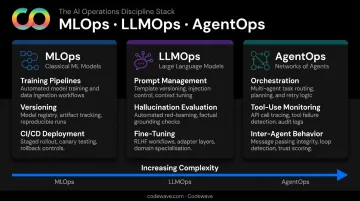
Each requires distinct tooling. Conflating them (treating an LLM deployment like a classical model) is one of the most common operational mistakes in enterprise AI.
Getting MLOps right is a prerequisite for everything that follows — particularly the orchestration layer, where process complexity compounds quickly.
Orchestration and Workflow Control
Enterprise orchestration manages end-to-end business processes spanning AI agents, humans, and deterministic systems. Two models exist:
- Centralized orchestration: Top-down governance, policy enforcement, KPI tracking — strong for compliance-sensitive workflows
- Decentralized choreography: Local agent autonomy, faster execution — strong for complex, dynamic tasks
Codewave uses a blended model: LangChain and API orchestration provide the centralized coordination backbone, while multi-agent systems introduce distributed autonomy for complex problem-solving. The architecture embeds human oversight as a structural component, not an afterthought.
Orchestration determines what gets done. Observability determines whether it's working — and that's where the feedback loop closes.
Observability and Grounding with RAG
Observability in AI means monitoring model accuracy, latency, drift, agent behavior, and cost over time — not just infrastructure uptime. The goal is a closed feedback loop where observability telemetry feeds automatically back into retraining pipelines.
RAG (Retrieval-Augmented Generation) is the primary technique for grounding AI outputs in accurate, enterprise-specific data rather than relying solely on pre-trained knowledge. Menlo Ventures reported RAG adoption at 51% of enterprise GenAI implementations in 2024, up from 31% in 2023. Vector search, knowledge graphs, and semantic query engines work together to give agents accurate, current context for reasoning.
Building Enterprise AI Architecture: A Phased Roadmap
Enterprise AI architecture is not built in a single sprint. Most organizations progress through four maturity stages, each one building on the last.
Phase 1 — Foundation
Goal: Augment human workers with accurate, explainable information retrieval.
This phase focuses on getting the infrastructure right before expanding AI autonomy:
- Stand up core data infrastructure (VectorDB, data lakehouse)
- Deploy a governed model gateway and RAG pipelines
- Implement basic observability and zero-trust security controls
The governing principle: build organizational trust in AI outputs before granting AI broader action.
Phase 2 — Automation (Single-Domain Agentic Workflows)
Goal: Shift from read-only AI to AI that takes actions.
This means modularizing application services into APIs that agents can call, implementing agent lifecycle management, deploying guardrails, and monitoring agent behavior in production. A healthcare organization might automate patient scheduling; an insurer might automate claims intake and initial triage, with human review built in for risk-sensitive decisions.
Codewave's documented insurance capabilities include automated claims workflows designed to accelerate processing, improve accuracy, and maintain full audit trails.
Phase 3 — Orchestration (Cross-Domain and Multi-Agent Systems)
Goal: Deliver systemic business value across the enterprise — not just task-level efficiency.
This phase introduces three interconnected capabilities:
- Enterprise Knowledge Graph for shared semantic context across systems
- Hybrid workflow execution engine to govern complex cross-system processes
- Event-driven integration for asynchronous communication across platforms
Multiple agents coordinate across finance, operations, and customer service rather than operating in departmental silos. The result is enterprise-wide outcomes — reduced cycle times, fewer handoff errors, unified customer data — that isolated department tools can't produce.
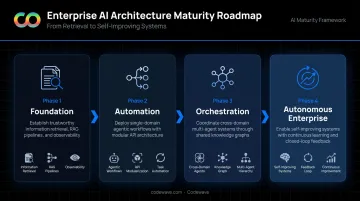
Phase 4 — Autonomous Enterprise
Goal: Self-improving systems operating within designed guardrails.
The most mature state: agents with self-reflection capabilities, closed learning feedback loops, digital twin process modeling for simulation, and dynamic agent-to-agent collaboration. Human oversight remains essential. Autonomy at this level succeeds only within clear accountability structures — governance frameworks that define who owns each decision and what triggers human escalation.
Governance, Security, and Compliance in Enterprise AI Architecture
Governance embedded from day one costs a fraction of governance retrofitted after a breach or regulatory finding. The key pillars:
- Policy-as-code for automated rule enforcement across all layers
- Role-based and intent-based access controls at every data and model touchpoint
- Audit trails with explainable outputs for regulated decision-making
- Continuous red-teaming to surface model vulnerabilities before adversaries do
Regulatory Compliance as an Architectural Input
The EU AI Act entered into force on August 1, 2024 and becomes fully applicable on August 2, 2026. High-risk AI systems must address risk management, data quality, technical documentation, transparency, human oversight, accuracy, and cybersecurity — requirements that cannot be addressed after deployment.
For healthcare and fintech organizations, HIPAA, NIST AI RMF, and sector-specific mandates impose similar constraints. Organizations that build compliance into architecture from the start move faster through approvals, produce more auditable outputs, and spend less on remediation — converting regulatory requirements into measurable operational advantages.
Only 18% of organizations have an enterprise-wide council overseeing responsible AI governance, according to McKinsey. That gap represents both significant risk and significant opportunity for organizations that move first.
AI Assurance
Compliance frameworks define the rules — AI assurance enforces them continuously. Automated monitoring for bias, drift, hallucination, and misuse keeps trust measurable long after a model goes live, not just at the point of launch. For organizations handling sensitive data, techniques like federated learning and differential privacy protect model integrity without sacrificing predictive performance:
- Federated learning trains models across distributed data sources without centralizing raw data
- Differential privacy adds statistical noise to outputs, preventing individual data points from being reverse-engineered
- Continuous bias auditing detects performance degradation across demographic or operational segments before it affects decisions
Common Mistakes to Avoid When Designing Enterprise AI Architecture
Most enterprise AI failures are predictable. Here are the five that show up most often:
Treating AI as a collection of point tools — Deploying AI in departmental silos produces fragmented data, duplicated infrastructure, and no path to enterprise-wide value. Architecture requires a unified blueprint.
Bolting governance on after deployment — Security controls and compliance frameworks added retroactively are expensive, incomplete, and often too late. Build them in from day one or accept the downstream cost.
Designing for pilot scale, not production scale — Many architectures work beautifully for 50 users and collapse under 5,000. If scalability wasn't a design input, it can't be an afterthought.
Neglecting the semantic layer — Agents that can't interpret data consistently across domains will fail on cross-functional tasks in ways that are hard to diagnose. The knowledge layer isn't optional; it's what makes enterprise-wide AI coherent.
Assuming autonomy means absence of control — The organizations that extract the most value from agentic AI are the ones that invest most heavily in guardrails, oversight flows, and audit mechanisms. Autonomy without accountability is a liability.
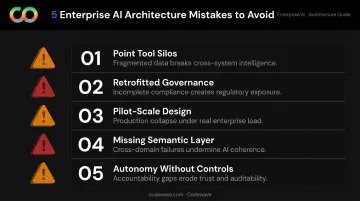
Organizations that treat these five areas as design requirements — not corrections — end up with architecture that scales without breaking and adapts without starting over. Codewave works with enterprises to build that foundation from the start, with governance and modularity built into the architecture rather than layered on after the fact.
Frequently Asked Questions
What is the role of an AI architect in enterprise?
An AI architect designs and governs the end-to-end blueprint for how AI systems are built, integrated, secured, and scaled across the organization. The role bridges technical infrastructure with business strategy, ensuring models, data pipelines, and governance frameworks operate as a unified system rather than disconnected silos.
What are the 4 domains of enterprise architecture?
The traditional four domains are Business Architecture, Data Architecture, Application Architecture, and Technology/Infrastructure Architecture. Enterprise AI architecture extends all four by adding AI-specific layers (agentic, semantic, and AI/ML) on top of these foundations.
What are the 7 layers of AI architecture?
The seven layers are: Infrastructure, Data, AI/ML Model, Integration, Semantic, Agentic, and Experience. Each handles a distinct function from raw compute to user-facing intelligent interfaces. Skipping deliberate design at any layer creates gaps that compound into reliability, security, or scalability failures downstream.
What is the difference between enterprise AI architecture and traditional IT architecture?
Traditional IT architecture was designed for deterministic, human-driven workflows. Enterprise AI architecture must support non-deterministic, continuously learning systems — which means adding layers for agentic reasoning, semantic understanding, and model governance that legacy architectures were never built to handle.
How do organizations govern AI systems across the enterprise?
Effective AI governance embeds policy-as-code, model approval workflows, bias and drift monitoring, audit trails, and role-based access controls directly into the architecture. This turns governance into a continuous, automated process rather than a reactive audit triggered by an incident.
What is the first step in building enterprise AI architecture?
Start by establishing a governed data foundation — data lakehouse, quality management, access controls — and a model gateway for secure AI access. Layer in observability and security before expanding to agentic or cross-domain use cases. A solid foundation here directly determines whether your models return reliable outputs or produce results no one can audit or explain.