

Introduction
When a single team's deployment blocks 50 others, something has gone fundamentally wrong with the architecture. That's the reality for large organizations running monolithic applications — deployment cycles slow to a crawl, every change carries system-wide risk, and teams spend more time coordinating than shipping.
Architecture decisions at this scale carry direct business consequences. A poorly timed deployment freeze during peak traffic isn't just a technical inconvenience — it's lost revenue, degraded customer experience, and engineering talent burned on coordination overhead instead of product work.
This guide is for architects and technical leaders navigating that inflection point. It covers the core components of enterprise microservices architecture, the design patterns that make distributed systems reliable, the trade-offs organizations routinely underestimate, and a practical migration framework built around what actually works at scale.
Key Takeaways:
- Domain-aligned service boundaries are critical — technical-layer splits are the leading cause of microservices failure
- API gateways, service meshes, and observability are non-negotiable infrastructure
- Saga and CQRS patterns solve distributed-systems problems that ACID transactions cannot span across services
- The Strangler Fig migration approach consistently outperforms big-bang rewrites
- Microservices overhead only justifies itself at sufficient team and product scale
What Is Enterprise Microservices Architecture and Why Scale Changes Everything
Defining the Enterprise Dimension
Martin Fowler's canonical definition describes microservices as a suite of small services, each running in its own process, communicating via lightweight mechanisms, organized around business capabilities, and independently deployable. That definition holds at any scale.
The enterprise dimension adds four layers on top: governance across dozens of teams, team topology decisions that affect architectural outcomes, cross-service reliability requirements with contractual SLAs, and compliance obligations that shape how services handle and isolate data.
A startup running five microservices and an enterprise running 200 are solving fundamentally different problems.
Monolith vs. Microservices at Enterprise Scale
In a monolith, one team's change can block everyone else. Before organizations like Amazon completed their services migration, engineers coordinated large-scale binary releases — weekly merge processes that became increasingly painful as the codebase grew. The problem wasn't the developers; it was the architecture forcing serialized coordination at scale.
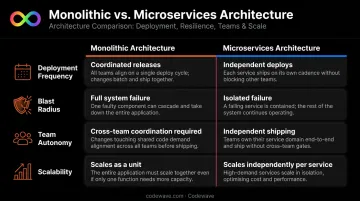
The DORA State of DevOps research documents the downstream effect: elite-performing organizations deploy far more frequently than low performers, and architectural constraints are among the primary differentiators. The operational contrast is stark:
- Deployment frequency: Monoliths force coordinated releases; microservices enable independent deploys per team
- Blast radius: A monolith failure can take down the entire system; microservices fail in isolation
- Team autonomy: Monolith changes require cross-team coordination; microservices let teams ship on their own schedule
- Scalability: Monoliths scale as a unit; individual microservices scale independently based on demand
Domain-Driven Design as the Boundary-Setting Framework
Microservices fail most often at the boundaries. Services organized around technical layers — database team, API team, frontend team — create dependencies that undermine independent deployment. Business capability boundaries are what make autonomous operation possible.
Domain-Driven Design (DDD) provides the framework. Bounded contexts map naturally to service boundaries:
| Domain | Bounded Context | Owns |
|---|---|---|
| E-commerce | Order Management | Order lifecycle, fulfillment status |
| E-commerce | Inventory | Stock levels, warehouse data |
| E-commerce | Payment | Transaction processing, refunds |
When services share a database across these boundaries, schema changes in one domain cascade into failures in others — undermining the independence that microservices are supposed to provide.
Conway's Law and Team Structure
Conway's Law states that systems reflect the communication structures of the organizations that build them. Organizations that want loosely coupled services need loosely coupled teams — intentionally structured that way, not as a byproduct.
Successful enterprise microservices adoption requires restructuring teams around service ownership, not just splitting the codebase. Small, autonomous, cross-functional teams — each owning a service end-to-end — are the organizational foundation, not the follow-on.
Core Building Blocks of an Enterprise Microservices System
API Gateway Layer
The API gateway is the single entry point for all client requests. It handles:
- Authentication and authorization enforcement
- Rate limiting and traffic management
- Request routing to downstream services
- Response aggregation from multiple services
Without a dedicated gateway, clients must know the location of every service, and security enforcement becomes inconsistent across the system. At enterprise scale, where services number in the dozens or hundreds, that inconsistency is not a theoretical risk — it's an active vulnerability. AWS API Gateway and Kong are among the commonly deployed options.
Service Mesh
Where the API gateway handles north-south traffic (client to service), the service mesh handles east-west traffic (service to service). Tools like Istio and Linkerd provide:
- Load balancing across service instances
- Mutual TLS (mTLS) for zero-trust service-to-service security
- Circuit breaking at the network layer
- Observability without requiring application code changes
Istio's security model and Linkerd's automatic mTLS implement these as infrastructure concerns. Application code stays focused on business logic, not network reliability.
Service Discovery
In containerized environments, service instances start, stop, and relocate dynamically. Hardcoded addresses fail immediately. Two discovery patterns address this:
- Client-side discovery: The calling service queries a registry (Consul, Eureka) and selects an instance directly
- Server-side discovery: A load balancer queries the registry and routes the call, keeping discovery logic out of the client
HashiCorp Consul is widely used for server-side discovery in enterprise environments. Either pattern must be in place before deploying any services; without it, dynamic scaling becomes a liability.
Database-per-Service Pattern
Each microservice must own its data store — no shared databases. This is the architectural rule that most directly enables independent deployment.
Shared databases create hidden coupling: a schema change for one service breaks another, making "independent" deployment a fiction. The practical upside of data isolation is technology flexibility — different services can use different database types suited to their workload:
- Relational (PostgreSQL) for transactional data like orders
- Key-value (Redis) for sessions and caching
- Document (MongoDB) for product catalogs
Codewave's microservices stack includes PostgreSQL, MongoDB, and Redis — deployed selectively based on each service's data access patterns rather than forcing a single model across all services.
Observability Stack
Distributed systems cannot be debugged the way monoliths can. When a request spans eight services, a stack trace from one tells you almost nothing. Data isolation across services compounds this: failures are harder to correlate without a shared view of the system. Three observability pillars must be built in from the start:
- Centralized logging (ELK Stack): Use correlation IDs to trace a request across service boundaries using a shared identifier
- Metrics collection (Prometheus + Grafana): Monitor service health, latency, and error rates in real time
- Distributed tracing (Jaeger, Zipkin): Visualize the full path of a request through the service graph
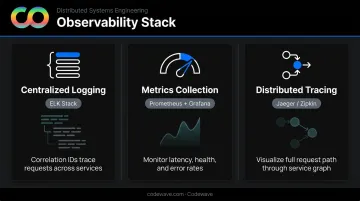
Codewave's production infrastructure uses Prometheus and the ELK Stack as core monitoring components, integrated with blue-green deployments to support zero-downtime releases.
Essential Design Patterns for Large-Scale Microservices
Event-Driven Architecture and Asynchronous Communication
Synchronous REST calls between many services create latency chains. If Service A calls B, which calls C, which calls D, the total response time accumulates — and a slow or failed D brings down the entire chain.
Event-driven architecture breaks this coupling. Services publish events to a message broker (Apache Kafka, RabbitMQ); downstream services consume those events independently. Producers don't know or care who's listening.
When to use asynchronous messaging:
- Order processing and fulfillment workflows
- Notification systems
- Data synchronization across services
- Any process where immediate response isn't required
When to use synchronous communication (REST/gRPC):
- Real-time user-facing queries requiring immediate response
- Read operations where the client needs data before proceeding
Enterprises need both. The choice for each interaction should be deliberate, not defaulted — defaulting to REST across all service boundaries is one of the most common scalability mistakes in early microservices migrations.
Saga Pattern for Distributed Transactions
ACID transactions across multiple services are not possible when each service owns its own database. The Saga pattern solves this by breaking a distributed transaction into a sequence of local transactions, each triggering the next step.
Two implementation variants:
- Choreography-based: Services react to events published by other services — no central coordinator, simpler for smaller flows
- Orchestration-based: A central coordinator directs the transaction sequence — easier to reason about for complex, long-running processes
Every saga requires compensating transactions — the rollback logic that executes when a step fails. Designing these upfront is non-negotiable; retrofitting them into a live system is significantly harder.
CQRS (Command Query Responsibility Segregation)
CQRS separates write models from read models, allowing each to be optimized independently:
- Write side: Prioritizes consistency and transactional integrity
- Read side: Uses denormalized, fast-query models optimized for the specific query patterns
For high-read-volume systems — product catalogs, dashboards, reporting services — this separation can improve query performance and maintainability. The trade-off is added complexity: two models to maintain instead of one.
Circuit Breaker Pattern
When a downstream service slows, callers back up — and if enough requests pile up, the failure cascades system-wide. The circuit breaker pattern, popularized by Netflix via Hystrix, monitors failure rates and stops calls to a degraded service once a threshold is breached, returning a configured fallback instead.
The pattern operates across three states:
- Closed: Normal operation — requests flow through
- Open: Threshold breached — calls blocked, fallback returned immediately
- Half-open: Recovery check — test calls allowed to assess if the service has recovered
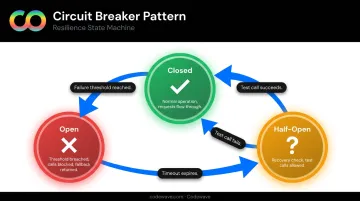
This ensures one degraded dependency stays isolated rather than cascading into a full application failure.
Real Business Benefits and Honest Trade-offs
What Enterprises Actually Gain
The business case for enterprise microservices rests on outcomes, not architectural theory:
- Deployment frequency: DORA research shows elite performers deploying on demand; lower performers are stuck at monthly or quarterly releases. Service-based architectures are the structural difference.
- Fault isolation: A failed service degrades a specific capability rather than taking down the entire application — a meaningful difference during peak traffic periods.
- Independent scaling: Services with high load (payment processing on Black Friday) can scale independently without over-provisioning everything else.
- Team autonomy: Teams ship without waiting for cross-team coordination cycles.
The Trade-offs Organizations Underestimate
Microservices solve coordination problems and introduce operational ones. The honest accounting:
- Operational complexity: Managing 50 services requires automation, observability, and DevOps maturity that many organizations don't have at the start
- Distributed system latency: Every inter-service call adds network overhead; synchronous call chains amplify this
- Testing complexity: Unit testing individual services is straightforward; integration testing across services requires significant investment in test infrastructure
- Data consistency: Eventual consistency is the dominant model — teams used to strong consistency from relational monoliths find this shift demanding
Organizations that succeed treat these as known, solvable engineering problems. Those that fail treat them as surprises — and that distinction often determines whether the migration delivers value or stalls. Knowing the trade-offs upfront is also what informs the most critical decision: whether microservices are the right choice at all.
When Microservices Are the Wrong Choice
A modular monolith often delivers better ROI than microservices for:
| Scenario | Better Choice |
|---|---|
| Small team (< 8–10 engineers) | Modular monolith |
| Early-stage product, uncertain domain | Modular monolith |
| Low deployment frequency requirements | Modular monolith |
| Single domain, low complexity | Modular monolith |
| Large team, multiple domains, high scale | Microservices |
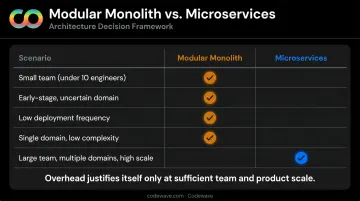
The overhead microservices introduce — infrastructure, observability, distributed systems complexity — only pays off when team size and product complexity make coordination overhead the bigger constraint.
From Monolith to Microservices: A Strategic Migration Approach
The Strangler Fig Pattern
Big-bang rewrites — stopping all development, rebuilding the system from scratch, then switching over — fail at a high rate. The effort expands, requirements drift, and the organization is left maintaining two systems simultaneously with no clear migration endpoint.
The Strangler Fig pattern takes the opposite approach: incrementally wrap and replace monolithic functionality with microservices, keeping the system operational throughout. The practical sequence:
- Identify a bounded domain with clear interfaces and minimal data entanglement in the monolith
- Extract it as a microservice — implement the capability independently
- Route traffic to the new service while the monolith remains as fallback
- Validate, then retire the monolith component
- Repeat with the next domain
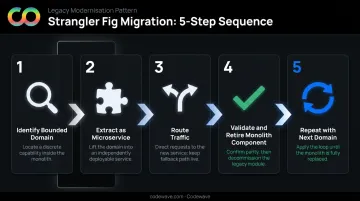
This approach lets organizations validate architectural decisions with real traffic before committing fully.
Prioritizing Which Services to Extract First
Not all services are equal candidates for early extraction. Prioritize using two axes:
- Business impact: Does this service need to scale independently? Is it a deployment bottleneck for multiple teams?
- Decoupling ease: Is it already loosely coupled from the monolith? Does it own clear, bounded data?
High-impact, easily decoupled services go first. Services with deep data entanglement — shared tables, complex cross-domain transactions — go last, after organizational capability and tooling are mature.
Avoid extracting a service that requires significant shared database refactoring early in the migration. The technical debt from premature extraction is harder to unwind than the coordination cost of leaving it in the monolith temporarily.
Running the Migration Without Stalling Delivery
One failure mode that derails otherwise sound migration plans: months of upfront decomposition planning before a single service ships. Codewave's QuantumAgile™ methodology counters this by letting teams pursue the highest-impact extractions in parallel rather than waiting for a theoretically perfect sequence.
The result is faster organizational confidence — early wins validate the approach before the full migration commitment is made, not after.
Frequently Asked Questions
Is microservice architecture still relevant?
Microservices remain highly relevant, particularly for large-scale applications. Cloud-native adoption, Kubernetes in production at roughly 80% of surveyed enterprises, and the rise of AI-driven workloads have reinforced the value of independently scalable services. The tooling has matured considerably since the early adoption years, lowering the operational barrier.
Is a REST API a microservice?
A REST API is a communication interface, not a microservice. A microservice is an independently deployable unit of business functionality that exposes its capabilities through an API — which could be REST, gRPC, or event-based. Having a REST API does not make something a microservice.
What are the 3 C's of microservices?
The three C's are Culture (teams must embrace DevOps ownership and service autonomy), Containers (the standard deployment unit enabling independent packaging and scaling), and Continuous Delivery (automated CI/CD pipelines that make frequent, safe deployments possible).
What are the three types of microservices?
Three common classifications:
- Functional — implement specific business capabilities like payments or user management
- Infrastructure — handle cross-cutting concerns like authentication or notifications
- Aggregator — collect data from multiple services and return a unified response to the client
How does microservices architecture differ from SOA?
Both decompose applications into services, but SOA typically relies on a heavyweight Enterprise Service Bus (ESB) for communication and allows broader data sharing. Microservices favor lightweight protocols (REST, messaging), strict database-per-service isolation, and independent deployment — a more granular, decentralized evolution of SOA principles.
How long does it take to migrate from a monolith to microservices?
A focused initial service extraction can be completed in weeks. Full migration of a large enterprise monolith typically takes 12–36 months using an incremental approach. Big-bang rewrites consistently take longer and carry a much higher risk of failure.