
Introduction
Most enterprises today run on dozens of disconnected tools — CRMs, ERPs, cloud apps, legacy databases — and the friction between them quietly drains productivity and delays decisions. According to MuleSoft's 2025 Connectivity Benchmark Report, the average enterprise manages 897 applications, yet only 28% of those are integrated. That gap is where operational pain lives.
A connected enterprise is one where systems exchange data without human intervention, departments share a consistent view of the truth, and decisions are based on current information rather than yesterday's exports. Integration is what makes that possible — and without it, even well-staffed organizations operate with a lag that compounds over time.
This guide breaks down the essentials: what digital integration is, what disconnected systems actually cost, the core integration types enterprises use, how to build a strategy that delivers, and where integration creates the most impact across industries.
Key Takeaways
- Only 28% of enterprise applications are integrated — leaving the vast majority creating operational drag
- Poor data quality costs organizations an average of $12.9 million annually, according to Gartner research
- API-led connectivity, data centralization, and iPaaS platforms are the leading integration approaches for modern enterprises
- Effective integration is a prerequisite for AI adoption, not a secondary concern
- Phased, outcome-validated delivery reduces risk and accelerates time-to-value
What Is Digital Integration? Building the Foundation of a Connected Enterprise
Digital integration is the discipline of connecting applications, data sources, APIs, and business processes — across cloud and on-premise environments — so they function as a single, unified system rather than a collection of isolated tools.
Point-to-Point vs. Platform-Based Integration
Early integration approaches relied on point-to-point connections: custom code linking System A directly to System B. It worked when enterprises had five or six systems. With hundreds of applications, it becomes a maintenance nightmare — every new system requires new connections, and a change in one breaks several others.
Modern integration flips this model:
- Standardized, reusable interfaces replace brittle custom code between systems
- Centralized governance and monitoring replace fragmented oversight
- Event-driven designs let systems react to real-time changes across the enterprise
What a Connected Enterprise Looks Like in Practice
- Real-time data flows between operational systems without manual export/import
- Automated handoffs between departments (sales to operations, finance to fulfillment)
- A single source of truth that every team — from the boardroom to the warehouse — trusts
- Consistent experiences for customers and employees regardless of which system they're touching
Digital integration is not the same as buying more software, migrating to the cloud, or running isolated automation scripts. Those are valuable investments — but without integration, each one operates as a separate island. The missing piece is what determines whether your technology stack multiplies its value or just adds to its complexity.
The Hidden Cost of Disconnected Systems
Siloed systems create three compounding failure modes that most organizations underestimate until the damage is visible.
The Three Failure Modes
1. Data inconsistency — When CRM, ERP, and financial systems hold different versions of the same customer or transaction record, teams spend hours reconciling instead of acting. Forrester research found that only 18% of organizations can reliably identify the most up-to-date customer information across their systems.
2. Operational drag — Manual data re-entry, approval bottlenecks, and redundant workflows consume resources that should be driving growth. MuleSoft reports IT developers spend 39% of their time on custom integrations — time pulled directly from strategic work.
3. Decision lag — Leaders act on stale or incomplete information when data sits in departmental silos. According to Gartner, poor data quality costs organizations at least $12.9 million per year on average, a figure that understates the strategic cost of slow decisions.
Why Disconnected Systems Block AI Adoption
This is the piece many enterprises miss: AI models require clean, unified, real-time data to function accurately. MuleSoft's 2025 report found 95% of IT leaders cite integration gaps as a top barrier to AI implementation. You cannot build reliable AI on fragmented data foundations.
Integration Debt: The Compounding Risk
Every new SaaS tool added without proper integration creates integration debt. With an average of 897 enterprise applications in a typical enterprise and only 28% connected, most organizations are already carrying a significant load.
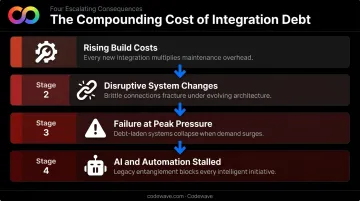
As the application estate grows, that debt compounds in measurable ways:
- Future integrations become more expensive to build and maintain
- System changes grow more disruptive and harder to coordinate
- Failures concentrate at the moments of highest operational pressure
- AI and automation initiatives stall waiting on data readiness that never arrives
Core Types of Digital Integration Solutions
Application and System Integration
Application integration connects business software — CRM, ERP, HRM, marketing platforms — so they exchange data and trigger actions across departments without manual workarounds. When a sales rep closes a deal in Salesforce and the ERP automatically creates the customer record, that's application integration working correctly.
System integration goes deeper, connecting foundational infrastructure: core databases, middleware, and enterprise platforms that underpin multiple business functions. Together, they eliminate the data inconsistency that causes operational drag.
API-Led Integration
APIs act as standardized contracts between systems — defining how they communicate, what data they exchange, and under what security conditions. Postman's 2025 State of the API Report found 82% of organizations have adopted some level of API-first approach, with 65% now generating direct revenue from their API programs.
API-led integration is particularly relevant for:
- Open banking — enabling consumer-permissioned financial data access across institutions
- Healthcare interoperability — connecting EHR systems via HL7/FHIR standards (supported by ONC's HTI-1 Final Rule)
- Partner ecosystems — creating secure, scalable connections with third-party platforms and marketplaces
Codewave builds API-led integrations with HL7/FHIR compliance for healthcare platforms and PCI-DSS-compliant API connections for fintech environments — embedding security and regulatory alignment into the architecture rather than adding it later.
Data Integration and Centralization
Data integration consolidates information from disparate sources — operational databases, cloud warehouses, streaming systems — into a unified, governed layer that the entire organization can trust.
A modern data integration stack typically includes:
- Apache Kafka for real-time event streaming and data pipeline orchestration (used by more than 80% of Fortune 100 companies)
- Snowflake for centralized cloud data warehousing and analytical processing
- ETL tools like Fivetran, Airbyte, or Talend for structured data movement between sources
McKinsey research shows that high-performing data organizations are 3x more likely to report that analytics contributed at least 20% to EBIT — a direct return on unified data infrastructure.
Codewave builds automated data pipelines that connect CRMs, accounting systems, operations databases, and legacy spreadsheets into a single, continuously refreshed data destination — with working dashboards delivered within weeks.
Workflow and Process Automation Integration
Workflow integration moves beyond connecting data — it automates handoffs between systems so events in one platform trigger actions in another without human intervention.
In practice: a new customer order updates inventory, triggers fulfillment, notifies the finance system, and sends a confirmation to the customer — all within seconds, with no manual steps. Codewave connects CRM, ERP, CDP, and billing platforms via secure APIs to eliminate approval bottlenecks and repeated data entry across departments.
iPaaS and Cloud-Native Integration Platforms
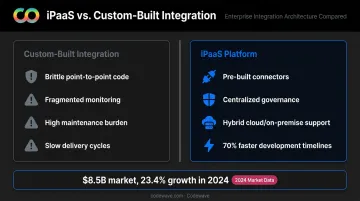
iPaaS (Integration Platform as a Service) provides pre-built connectors, centralized governance, and scalable cloud infrastructure — reducing the time and cost of building integrations. Gartner reported the iPaaS market grew 23.4% to $8.5 billion in 2024, reflecting how widely enterprises have adopted this approach.
Key advantages over custom-built integration:
- Pre-built connectors for hundreds of enterprise applications
- Centralized monitoring and governance across all integration flows
- Hybrid support for both on-premise and cloud environments
- A Forrester TEI study for one iPaaS provider documented up to 70% reduction in development timelines
How to Build a Digital Integration Strategy That Delivers Results
Step 1: Define Measurable Goals Before Selecting Tools
Start with business outcomes, not technology. Identify which disconnected systems create the most operational pain and quantify what success looks like:
- Reduce invoice processing time by 50%
- Eliminate manual data re-entry in the order management workflow
- Cut reporting cycle time from five days to one day
Goals tied to specific metrics keep integration projects accountable and prevent scope drift.
Step 2: Map Your Integration Landscape
Before recommending any architecture, Codewave conducts a current-state assessment covering:
- All existing applications and how they interact
- Current data flows and where they break down
- Integration inventory (including legacy systems and shadow integrations)
- Dependencies, bottlenecks, and compliance constraints
No architecture is recommended until this landscape is fully understood. Every decision is grounded in reality, not assumptions.
Step 3: Choose the Right Architecture for Your Context
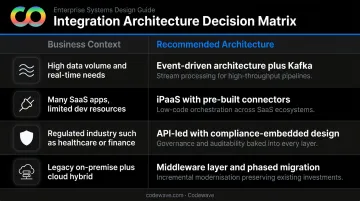
Not every enterprise needs the same approach. Selection criteria include:
| Context | Recommended Approach |
|---|---|
| High data volume, real-time requirements | Event-driven + Kafka streaming |
| Many SaaS applications, limited dev resources | iPaaS with pre-built connectors |
| Regulated industry (healthcare, finance) | API-led with compliance-embedded design |
| Legacy on-premise + cloud hybrid | Middleware layer + phased cloud migration |
Step 4: Build Governance, Security, and Data Quality In From Day One
Integration increases data movement across system boundaries — which amplifies security risk if not governed properly. Non-negotiable elements include:
- Role-based access controls (RBAC) limiting system access by function
- Audit trails capturing every data interaction for compliance verification
- Data validation at ingestion points to prevent garbage-in-garbage-out propagation
- Encryption at rest and in transit across all integration touchpoints
Codewave embeds AES-256 encryption, RBAC, and audit logging as standard components — not optional add-ons — across all integration architectures.
Step 5: Deliver in Phases, Not Big Bangs
Large, single-release integration projects fail at a high rate. Phased delivery reduces risk and accelerates time-to-value by validating outcomes at each milestone before the next phase begins. Codewave structures this through two proprietary frameworks:
- QuantumAgile™ — moves integration work from system mapping to live connections within weeks, using outcome-validated sprints rather than months-long delivery cycles
- ImpactIndex™ — ties payment to measurable results, not just completed deliverables
Real-World Impact: Digital Integration Across Industries
Healthcare and Fintech
In healthcare, integration directly affects patient safety. A 2022 systematic review found interoperability failures accounted for 18.1% of EHR-related safety events. ONC data shows U.S. hospital engagement in full interoperability grew from 46% in 2018 to 70% in 2023, driven by regulatory mandates and measurable clinical outcomes.
Fintech tells a similar story. Real-time fraud detection pipelines, core banking connections, and compliance reporting automation have shifted from differentiators to baseline expectations — firms that lack them are simply uncompetitive. Codewave has helped close that gap across 400+ businesses in 15+ industries, delivering outcomes including 90% fewer data errors and 50% faster invoice processing.
Retail and Supply Chain
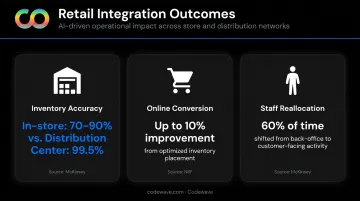
Disconnected retail systems create inventory blind spots that directly cost revenue. McKinsey found in-store inventory accuracy typically ranges from 70% to 90%, compared with 99.5% in distribution centers , a gap that leads to stockouts, lost sales, and poor customer experiences.
Integration closes that gap by connecting inventory management, order systems, fulfillment platforms, and customer data in real time. The downstream effects go beyond accuracy:
- McKinsey found that optimizing inventory placement through integrated data can improve online conversion rates by nearly 10%
- NRF reported that RFID-enabled integration shifted store associates from spending 60% of time on back-office tasks to 60% on customer-facing activity
Energy, Agriculture, and Transportation
In operationally complex sectors, integration connects IoT sensor data, operational systems, and analytics platforms to enable decisions that previously required days of manual data collection.
- Energy: Predictive maintenance through integrated sensor data can reduce machine downtime by 30–50% (McKinsey), while Deloitte estimates unplanned downtime costs industrial manufacturers $50 billion annually
- Agriculture: Deloitte projected 300 million IoT endpoints in precision farming by end of 2024; integrated precision irrigation reduces water usage by 30–50% versus traditional methods
- Transportation: USDOT's FLOW initiative connected 53 member companies exchanging real-time container volume and logistics asset data, demonstrating how integration scales across entire supply chain networks
Frequently Asked Questions
What is an example of a digital integration?
A hospital's EHR system automatically syncing patient records with the billing platform and patient portal is a clear example. When a provider updates a diagnosis, the billing code updates and the patient sees current information — no manual re-entry, no data lag, no reconciliation errors.
What are integrated digital solutions?
Integrated digital solutions are software systems, platforms, or services designed to connect and unify multiple business applications, data sources, and workflows — so they function as a coordinated ecosystem rather than independent tools operating in parallel.
What are the main types of digital integration in an enterprise?
The five core types are application integration, API-led integration, data integration, workflow automation integration, and iPaaS — each serving different connectivity needs depending on data volume, system complexity, and compliance requirements.
What is the difference between digital integration and digital transformation?
Digital transformation is the broader strategic journey of modernizing how a business operates. Digital integration is the technical foundation that makes transformation possible — connecting the tools, data, and processes that transformation depends on.
How do I know if my business needs digital integration?
Clear signals include employees copying data between systems manually, reports that disagree across departments, customer experiences that break at system handoffs, or AI and analytics investments that underperform. Each of these points to integration gaps.
How long does it take to implement digital integration solutions?
Timelines depend on the number of systems, data complexity, and architecture chosen. Phased delivery models, like Codewave's QuantumAgile™ approach, begin delivering measurable results within weeks, while a full enterprise integration program typically completes across several months in validated milestones.