The shift from reactive to proactive care is the most consequential change in modern healthcare delivery. AI predictive analytics makes it possible by analyzing historical patient data, real-time clinical signals, and statistical models to forecast health events before they occur. The result: earlier interventions, fewer preventable complications, and smarter use of stretched resources.
This article covers how predictive analytics works technically, where it delivers the most clinical and operational value, the real benefits and honest challenges organizations face, and where the technology is heading next.
Key Takeaways
- 66% of non-federal acute care hospitals used predictive AI integrated with EHRs in 2023, rising to 71% in 2024, according to ASTP/ONC Data Brief No. 80
- Key applications: early disease detection, readmission prevention, staffing optimization, fraud detection, and population health management
- Johns Hopkins' TREWS system made sepsis patients 20% less likely to die — one of the strongest published outcome benchmarks available
- Challenges include data silos, algorithmic bias, and evolving FDA/ONC compliance requirements
- Successful deployment hinges on clean data pipelines, bias audits, and governance frameworks — not the AI model alone
How AI Predictive Analytics Works in Healthcare
AI predictive analytics in healthcare applies machine learning algorithms and statistical models to historical and real-time data — EHRs, lab results, wearables, claims, imaging — to generate probabilistic predictions about future health events or operational needs.
Prediction accuracy hinges on data quality and preparation. What goes in determines what comes out — and in clinical settings, that dependency has real consequences.
Core Data Inputs
Predictive models typically draw from multiple source types:
- Electronic health records — diagnoses, medications, procedures, and visit history
- Lab and imaging results — trends in biomarkers, radiology, and pathology
- Genomic data — genetic risk factors for disease onset and drug response
- IoT and wearable streams — continuous biometric signals from monitors and sensors
- Insurance claims — utilization patterns and care gaps
- Clinical notes — unstructured physician documentation, often the richest signal of all
Data quality and integration are the limiting factors. A 2025 study on healthcare ML found 48.7% missing values for serum insulin in a standard diabetes dataset — the kind of gap that quietly degrades model performance without obvious warning signs.
Algorithms That Power Predictive Models
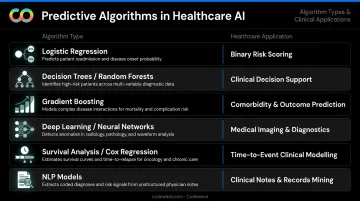
No single algorithm type covers all clinical use cases. The right choice depends on the prediction target and available data:
| Algorithm Type | Healthcare Application |
|---|---|
| Logistic regression | Binary risk scoring (readmission, sepsis onset) |
| Decision trees & random forests | Multi-variable risk stratification |
| Gradient boosting | High-accuracy classification across complex features |
| Deep learning / neural networks | Medical imaging analysis, deterioration prediction |
| Survival analysis (Cox regression) | Time-to-event predictions — disease onset, mortality |
| NLP models | Extracting structured insights from clinical notes |
A JAMIA study found that combining unstructured clinical text with structured EHR fields improved model AUC significantly compared to structured data alone (p < .001) — because physician notes contain diagnostic reasoning that structured fields don't capture.
The Infrastructure Behind the Models
Models don't run in isolation — they require data pipelines that feed them continuously and infrastructure that delivers predictions when they're clinically useful.
A production-grade stack typically includes:
- Apache Kafka — real-time data pipeline ingestion
- Snowflake — cloud data warehousing and query performance
- TensorFlow — model development and training
- Power BI / Tableau — clinical dashboards surfacing predictions at the point of care
- AWS SageMaker — automated model retraining as new patient data flows in
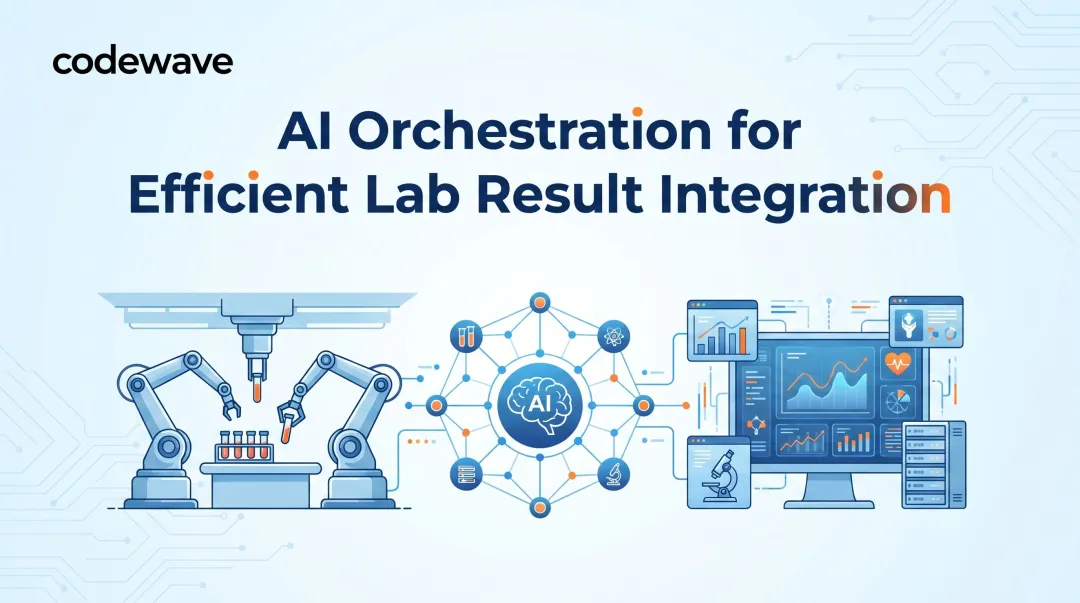
Putting these components together for healthcare requires more than tool selection. Codewave connects EHR platforms like Epic and Cerner, laboratory systems, PACS, and IoT devices through FHIR-based APIs and HL7-compliant pipelines — building unified patient profiles where every prediction draws from every relevant data point, not just what one system happens to store.
Data silos remain the most common barrier. Fragmented records across departments, incompatible formats between systems, and inconsistent data quality standards all degrade prediction accuracy before a model even runs.
Key Use Cases of AI Predictive Analytics in Healthcare
Predictive analytics spans both clinical and operational domains — which is what makes it one of the most versatile tools available to health systems today. The same underlying infrastructure can reduce sepsis mortality and optimize nurse staffing ratios.
Early Disease Detection and Risk Stratification
Predictive models analyze EHR data, lab trends, and demographic risk factors to flag patients at elevated risk for chronic diseases before symptoms become severe.
The strongest published benchmark comes from a 2025 Nature Medicine PRAIM study across 463,094 women in German population-based mammography screening. AI-supported double reading detected breast cancer at 6.7 per 1,000 women versus 5.7 per 1,000 with standard double reading — a 17.6% higher detection rate without a higher recall rate. The AI safety net contributed to 204 cancer diagnoses that would otherwise have been missed by human readers entirely.
For diabetes, deep learning models applied to retinal fundus photographs have demonstrated 90.3% sensitivity and 98.1% specificity for diabetic retinopathy detection — enabling intervention before vision loss occurs.
Hospital Readmission Prevention
CMS's Hospital Readmissions Reduction Program applies payment reductions of up to 3% of Medicare fee-for-service base operating DRG payments for excess readmissions across six conditions: AMI, COPD, heart failure, pneumonia, CABG, and elective THA/TKA. That financial exposure motivates the investment in predictive tools.
Kaiser Permanente Northern California's Transitions Program deployed a logistic regression risk model across 21 hospitals and over 1.5 million eligible index admissions, targeting patients at medium or high 30-day readmission or mortality risk for enhanced follow-up. The model integrates prior admissions, comorbidities, and social determinants of health — factors that discharge paperwork alone rarely captures.
Operational Efficiency: Staffing and Bed Management
Johns Hopkins' Capacity Command Center uses predictive analytics drawing on Epic data to forecast patient volumes across shifts, days, and weeks. The results after five years of operation:
- Bed utilization improved from 85% to approximately 94%
- Effectively opened 16 additional beds daily without new construction
- Contributed an estimated $16M in annual revenue
- ED-admitted patients received beds 38% faster
- OR transfer delays fell 83%
- Complex transfer patient acceptance improved 46%
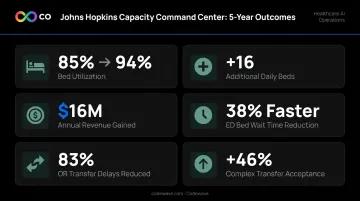
These gains translated directly to patient throughput and revenue — without adding physical infrastructure.
Fraud Detection and Claims Processing
Healthcare fraud costs tens of billions annually, according to the FBI. CMS deployed predictive algorithms to analyze billing patterns against every Medicare fee-for-service claim in real time. The result: its Fraud Prevention System identified or prevented $820M in improper Medicare payments in its first three years, including $454M in CY2014, at a 10:1 return on investment. Flagging anomalous billing before payment is processed — rather than catching it through retrospective audit — is what gives predictive fraud detection its edge.
Population Health and Outbreak Prediction
The CDC's Center for Forecasting and Outbreak Analytics applies predictive modeling to support public health responses at scale.
During COVID-19, a federated learning study (EXAM) demonstrated what distributed AI can do. Trained across 20 institutes on 16,148 cases, the models forecasted patient oxygen requirements at 24 and 72 hours — achieving AUC greater than 0.92 while keeping patient data local at each institution. It's a blueprint for privacy-preserving AI in global health emergencies.
Benefits of AI Predictive Analytics for Healthcare Organizations
The impact of predictive analytics spans clinical quality, financial performance, and operational efficiency at once. Health systems that treat it as a single-use tool tend to capture only a fraction of what it can actually deliver.
Improved Patient Outcomes Through Proactive Care
The most direct evidence comes from sepsis. Johns Hopkins' TREWS early warning system detects sepsis hours earlier than traditional methods. The published multi-site prospective study in Nature Medicine (2022) found patients were 20% less likely to die of sepsis after TREWS implementation. Earlier detection of deterioration translates directly to earlier intervention — and in time-sensitive conditions like sepsis, hours matter.
Codewave's healthcare analytics implementations report 3X faster data processing and approximately 3 weeks saved per month in manual data work, giving clinicians faster access to the patient information that drives those earlier decisions.
Significant Cost Reduction Across the Care Continuum
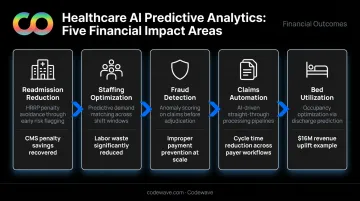
The cost levers stack up quickly:
- Fewer readmissions reduce HRRP penalties and direct re-hospitalization costs
- Staffing models aligned to predicted census, not historical averages, cut labor waste
- Fraud flagging catches improper payments before they're processed
- Automated claims processing reduces errors and shortens cycle time
- Better bed utilization — Johns Hopkins documented a $16M annual revenue gain from this alone
NBER estimates broader AI adoption could save $200B to $360B in US healthcare spending annually — though that figure spans AI broadly, not predictive analytics alone. The narrower, verified case studies above make the financial case without requiring that number.
Shift to Proactive, Personalized Medicine
When predictive models incorporate genomic, lifestyle, and behavioral data alongside clinical records, treatment plans can reflect individual patient profiles rather than population averages. This reduces the trial-and-error cycle in chronic disease management, oncology treatment selection, and medication dosing decisions.
In practice, clinicians spend less time adjusting treatments reactively and more time executing plans built around that specific patient's risk profile from the start.
Operational Agility Through Real-Time Decision Support
Predictive dashboards showing projected admission surges, staffing needs, and supply demands allow administrators to act ahead of bottlenecks. Codewave's outcome-based ImpactIndex™ model reflects this directly: healthcare AI deployments are measured against operational results, not just whether the system went live on schedule.
Challenges and Ethical Considerations in Healthcare AI
Data Quality and Integration
Predictive models are only as reliable as the data they're trained on. Fragmented EHR systems, inconsistent data standards, and siloed records mean many organizations deploy models before their data infrastructure can actually support them.
Investment in data governance and integration — FHIR-compliant APIs, unified patient data pipelines, quality monitoring — must precede model deployment, not follow it.
Codewave's approach addresses this directly through HL7 FHIR-based integration frameworks connecting EHR platforms, LIS, PACS, billing, and IoT devices into a single reliable data layer before analytics layers are built on top.
Bias and Fairness
A landmark 2019 Science study by Obermeyer et al. found a widely deployed health management algorithm assigned Black patients the same risk scores as substantially sicker White patients — because it used healthcare cost as a proxy for health need, encoding existing access disparities directly into the risk model.
According to ASTP/ONC Data Brief No. 80, 74% of hospitals using predictive AI evaluated their models for bias in 2024 — meaning roughly one in four deployed systems may never have undergone that review. Organizations must implement local validation protocols across demographic subgroups, not just rely on vendor-reported aggregate accuracy metrics.
Codewave applies tools including Fairlearn and Aequitas in model validation to identify and address demographic disparities in predictions before deployment.
Regulatory and Compliance Landscape
Healthcare AI operates under layered oversight:
- FDA — Predictive tools meeting Software as a Medical Device (SaMD) criteria fall under the 2021 AI/ML action plan, requiring transparency and real-world performance monitoring
- ONC HTI-1 Final Rule — Establishes first-of-its-kind transparency requirements for AI and predictive algorithms in certified health IT
- HIPAA — Governs PHI use in model training; de-identification through Safe Harbor or Expert Determination, limited data sets with data-use agreements, or IRB-approved research protocols are the primary paths
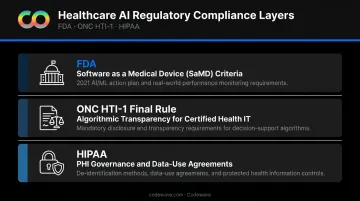
Organizations deploying third-party vendor models carry compliance obligations they often don't fully audit. Auditing those obligations before deployment — not scrambling after an incident — is what separates organizations with manageable compliance exposure from those facing enforcement action.
Future Trends in AI Predictive Analytics for Healthcare
IoT and Continuous Biometric Monitoring
IoT wearables are shifting prediction from periodic check-ins to continuous risk assessment. A 2025 Northwell study developed a recurrent neural network using chest-worn wearable data from 888 adult non-ICU patients, achieving AUROC of 0.89 and predicting adverse clinical outcomes up to 17 hours in advance with 81.8% accuracy. As device adoption grows, patient risk scores will update throughout the day rather than at point-of-care visits alone.
Federated Learning and Privacy-Preserving AI
Federated learning addresses healthcare's core data privacy constraint. Rather than centralizing sensitive patient records, federated models train across multiple hospital datasets while data stays at each local institution. The EXAM study demonstrated this at scale: 20 institutes across 4 continents, 16,148 COVID-19 cases, AUC above 0.92, with a reported 38% improvement in generalizability versus single-site models. For health systems navigating HIPAA while trying to build stronger models, federated approaches remove the trade-off between data protection and model performance.
Generative AI as a Complement to Predictive Models
Generative AI is finding a practical role alongside predictive models in two distinct ways:
- Synthetic data generation: GANs create realistic training records for rare conditions where real patient data is too scarce to build reliable models
- Explainable decision support: Large language models translate predictive model outputs into plain clinical language, helping clinicians understand what a model is flagging and why
Together, generative and predictive AI are moving from parallel experiments to integrated clinical workflows.
Frequently Asked Questions
What are predictive AI tools in healthcare?
Predictive AI tools in healthcare are software systems that use machine learning and statistical algorithms to analyze patient and operational data and forecast future events. These include clinical risk scores, readmission flags, early warning systems, and scheduling optimization tools — typically embedded in or connected to EHR platforms.
What is an example of predictive analytics in healthcare?
Hospital readmission prediction is the most common example. A model analyzes discharge data, comorbidities, and social risk factors to flag patients likely to return within 30 days, enabling targeted follow-up and reducing costly preventable readmissions that trigger Medicare HRRP payment penalties.
What types of algorithms are used for predictive modelling?
Common algorithm types include:
- Logistic regression — binary outcomes such as readmission risk
- Decision trees and random forests — multi-variable risk stratification
- Gradient boosting — high-accuracy classification tasks
- Deep learning — imaging-based predictions
Algorithm choice depends on the clinical use case and volume of available training data.
Is ChatGPT generative or predictive AI?
ChatGPT is generative AI — it creates new text outputs rather than forecasting a specific future event. Predictive AI in healthcare focuses on forecasting outcomes (disease risk, patient deterioration) based on historical patterns. Both types increasingly appear together in clinical decision support tools, with generative AI surfacing plain-language explanations of what predictive models detect.
What are the biggest challenges of using AI predictive analytics in healthcare?
Three challenges consistently stand out:
- Data quality and silos — fragmented EHR systems limit model accuracy and generalizability
- Algorithmic bias — models trained on skewed data can produce inequitable care recommendations across demographic groups
- Regulatory complexity — validating models for safety, fairness, and HIPAA compliance across diverse populations is time-intensive and ongoing
How does AI predictive analytics improve patient outcomes?
By identifying high-risk patients earlier, predictive analytics enables preventive interventions before conditions worsen — reducing complications, hospital admissions, and mortality. The Johns Hopkins TREWS system reduced sepsis mortality by 20%. Earlier detection combined with real-time clinical decision support gives care teams both the warning and the information needed to act.