Introduction
Sales teams are caught in a familiar bind: revenue targets climb every quarter, B2B buying groups grow more complex, and the enablement team supporting hundreds of reps is still just three people. Something has to give.
According to McKinsey's analysis of nearly 500 B2B companies, non-selling activities consume two-thirds of the average sales team's time. Meanwhile, Forrester's 2026 State of Business Buying reports that the typical B2B purchase now involves 13 internal stakeholders and 9 external influencers — making every deal harder to navigate and easier to lose.
AI is changing the equation — not by replacing human judgment, but by cutting the manual drag that keeps reps from selling and leaves enablement teams constantly behind. This guide covers what AI sales enablement actually is, which use cases move the needle fastest, how to run a structured rollout, and how to measure results.
Key Takeaways
- AI sales enablement shifts from a pull model (reps search when they remember) to a push model (the right asset surfaces automatically at the right moment)
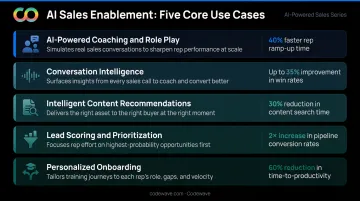
- Highest-impact use cases: AI coaching, conversation intelligence, intelligent content recommendations, lead scoring, and personalized onboarding
- Start with one bottleneck: pilot with a small team, prove ROI, then scale
- Build vs. buy decisions hinge on your tech stack complexity, data maturity, and whether AI is a core differentiator for your business
What Is AI Sales Enablement?
Most sales teams don't have a content problem — they have a delivery problem. AI sales enablement solves it by using machine learning, NLP, predictive analytics, and generative AI to put the right resource, coaching tip, or buyer insight in front of reps at the exact moment they need it.
Traditional enablement relies on static content libraries and periodic training programs that reps access reactively — when they remember to, or when a manager nudges them. AI-powered enablement works differently.
The Push vs. Pull Shift
In a pull model, reps search for the right battlecard, case study, or objection-handling guide when they think of it — which often means the best resources go unused at the exact moment they're needed most.
In a push model, AI analyzes the deal context in real time and surfaces the right asset, coaching tip, or buyer insight proactively. A rep preparing for a call with a CFO at a healthcare company doesn't search for relevant content — it appears in their workflow automatically, triggered by the account profile and deal stage.
The result isn't just faster access to resources — it's better decisions made earlier in the deal.
The Technology Behind It
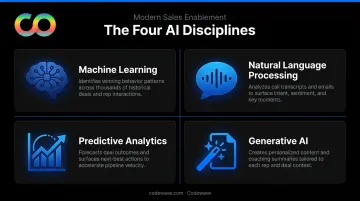
Four AI disciplines power modern sales enablement:
- Machine learning — identifies patterns in successful interactions and predicts which behaviors drive wins
- Natural language processing (NLP) — understands context in call transcripts and email threads, not just keywords
- Predictive analytics — forecasts deal outcomes and recommends next-best actions based on historical data
- Generative AI — creates personalized content, coaching summaries, and outreach drafts on demand
None of these require a data science background to benefit from. They operate beneath the surface of the tools reps already use — CRM, email, dialers — without adding friction to daily workflows.
Why Modern Sales Teams Are Turning to AI Sales Enablement
Sales teams today are operating under compounding pressure: tighter cycles, heavier scrutiny on B2B spend, and buyer expectations for personalized engagement — all while enablement teams are expected to support larger rep populations without adding headcount.
Salesforce's 2026 State of Sales survey of 4,050 sales professionals found that 87% of sales organizations now use AI for tasks including prospecting, lead scoring, forecasting, and email drafting. This is no longer experimental territory — it's the baseline.
What the Data Shows on Revenue Impact
The business case is direct. Salesforce's 2024 State of Sales data shows 83% of teams using AI saw revenue growth, compared to 66% of teams without it. That's a meaningful gap — and it maps to several concrete mechanisms:
- Smaller enablement teams can support more reps without proportional headcount growth
- Reps receive personalized coaching without waiting on manager availability
- Content reaches buyers at the right stage, rather than sitting unused in a library
- Coaching shifts from intuition-based to data-driven, using actual call and deal data
The Counterintuitive Benefit
AI also surfaces something enablement leaders often lack: visibility into what's actually working. Conversation intelligence tools analyze thousands of recorded calls to identify the specific behaviors that separate top performers — question patterns, talk ratios, objection responses. Those behaviors can then be systematically taught across the whole team.
The result is an enablement program that improves with every deal cycle, not just the reps it trains.
Top AI Sales Enablement Use Cases to Implement Now
AI-Powered Coaching and Role Play
Sales managers face a structural impossibility: they cannot realistically review every rep's calls, score every pitch, or provide individualized feedback at scale. AI coaching tools solve this by letting reps practice pitches, objection handling, and discovery calls in a low-stakes environment — with instant, objective feedback.
That scale matters. Mindtickle reports that Cisco saved 6,000 manager hours in an AI role-play pitch contest involving 7,200 sellers, with reps practicing an average of 4-6 times before submission. That volume of deliberate practice would be impossible through traditional 1:1 coaching alone.
Conversation Intelligence
Conversation intelligence tools record, transcribe, and analyze sales calls to surface behavioral patterns and coaching opportunities. The analysis goes beyond sentiment — flagging competitor mentions, objection patterns, talk-to-listen ratios, and buying signals in context.
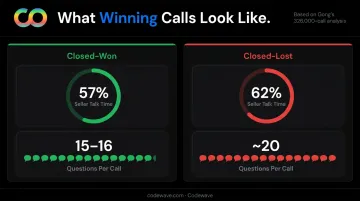
Gong's analysis of 326,000 sales calls found that closed-won deals averaged 57% seller talk time, while lost deals averaged 62%. Winning sellers also asked 15-16 questions per call, compared to roughly 20 for losing sellers. These aren't intuitions — they're measurable behaviors that AI can track, benchmark, and coach toward at scale.
Two groups benefit directly: reps get post-call self-coaching prompts, and managers gain visibility into exactly which behaviors separate top performers from the rest.
Intelligent Content Recommendations
Most sales content goes unused — not because it's poor quality, but because reps can't find the right asset at the right moment. Forrester research finds that 65% of content marketing assets go unused because they're irrelevant to the context in which they're delivered. At the same time, 75% of technology buyers say it's important for reps to provide only relevant, personalized content.
AI closes this gap by analyzing deal stage, buyer persona, and conversation context to surface the most relevant piece of content before the rep thinks to search for it.
Lead Scoring, Prioritization, and Segmentation
Without AI scoring, reps prioritize leads based on gut feel, recency bias, or whoever emailed last. AI tracks lead signals across multiple dimensions and surfaces a ranked priority list:
- Conversation sentiment and objection frequency
- Touchpoint cadence and content consumption patterns
- Historical conversion data by segment and deal size
Speed matters here. XANT's study of 55 million sales activities found conversion rates are 8x greater when leads are engaged within the first five minutes versus later attempts. AI scoring identifies which leads deserve that urgency — and which ones don't.
Personalized Onboarding and Training Paths
Traditional onboarding is one-size-fits-all, which means reps who struggle with discovery calls get the same curriculum as reps who struggle with closing. AI changes this by analyzing new rep behavior and performance data to adjust upcoming sessions in real time.
The result is more practice on objection handling for one rep, more product training for another — and a measurably shorter path to first closed deal. Every week shaved off ramp time is a week of revenue contribution that would otherwise be lost.
Predictive Sales Forecasting
Clari's 2024 research found 71% of respondents said forecast and pipeline details are hidden or incorrect in their organizations. That's not a minor reporting gap — it means leadership is making staffing and budget decisions on bad data.
AI analyzes activity signals across the pipeline to provide deal health indicators, at-risk opportunity flags, and next-best-action recommendations. Salesforce's 2026 State of Sales data shows **98% of sales leaders expect AI to improve forecast accuracy** — and that expectation is driving adoption across the enterprise.
How to Implement AI Sales Enablement: A Step-by-Step Roadmap
Step 1 — Audit Workflows and Identify the Biggest Bottleneck
Before evaluating any vendor, map where friction is highest in your current enablement process:
- Is it content discoverability — reps can't find the right asset at the right time?
- Is it coaching bandwidth — managers can't review enough calls?
- Is it rep ramp time — new hires take too long to reach quota?
- Is it lead quality — reps waste time on low-probability opportunities?
That answer should define your first AI use case. Let the bottleneck drive the decision, not a vendor's feature list.
Step 2 — Select the Right Tool for the Use Case
When evaluating platforms, focus on these criteria:
- Verify CRM integration depth: native connectors outperform third-party ones on data quality and adoption
- Confirm data refresh frequency — recommendations built on stale data produce bad results
- Check workflow fit: tools requiring a separate login see lower rep adoption
- Demand outcome accountability: can the vendor tie features to revenue metrics, not just activity counts?
Two tool types matter here: generative AI tools draft content or coaching on request; agentic AI tools act on signals without being prompted. For high-volume teams, agentic systems tend to deliver more consistent value because they don't depend on reps remembering to ask.
Step 3 — Run a Structured Pilot Before Full Rollout
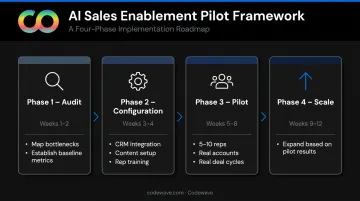
A practical pilot framework:
| Phase | Timeline | Activity |
|---|---|---|
| Audit | Weeks 1-2 | Map bottlenecks, establish baseline metrics |
| Configuration | Weeks 3-4 | CRM integration, content setup, rep training |
| Pilot | Weeks 5-8 | 5-10 reps, real accounts, real deal cycles |
| Scale | Weeks 9-12 | Expand based on pilot results |
Track four metrics during the pilot: time saved per rep, content adoption rate, response rate, and pipeline created. If none of these move, the tool isn't solving the right problem.
Step 4 — Address Adoption with Change Management
The best AI tool fails without rep adoption. Three concerns come up consistently:
- Reframe job displacement fear early: AI automates admin tasks, not relationships. Reps who use it spend more time selling.
- Eliminate complexity at the point of access: if it requires a separate login and 30 minutes of training, adoption will stall.
- Build trust in AI outputs gradually: coach reps to treat call scoring and recommendations as a starting point, not a final verdict.
Once trust is established, small daily habits compound faster than a full workflow overhaul imposed from day one.
Step 5 — Scale and Layer in Additional Capabilities
The most successful AI sales enablement programs start narrow. Once the first use case delivers measurable results, add a second capability — for example, layering conversation intelligence onto a working content recommendation system.
Buying five platforms before proving value from any of them is among the most common reasons these rollouts stall. Prove one, then expand.
How to Measure the ROI of AI Sales Enablement
The Metrics That Matter
Distinguish between activity metrics (easy to track, low business impact) and outcome metrics (what leadership actually cares about):
| Metric Type | Examples |
|---|---|
| Activity | Logins, content views, training completions |
| Outcome | Rep ramp time, win rate, average deal cycle, quota attainment |
Core outcome metrics to track:
- Time saved per rep per week
- Content adoption rate (assets used in active deals)
- Rep ramp time (days to first closed deal)
- Win rate and average deal cycle length
- Quota attainment rates across the team
Building the Internal Business Case
Use pilot data to construct a simple ROI model:
- Time saved per rep per week from the pilot (e.g., 3 hours)
- Multiply across the full team (e.g., 50 reps × 3 hours = 150 hours/week)
- Assign a dollar value per selling hour based on OTE and quota
- Calculate annualized productivity gain
Pair this with pipeline data from the pilot — deals created, response rates, content engagement — to cover both sides of the case: efficiency gains and revenue impact.
Common Measurement Mistakes
- Counting AI coaching sessions completed ≠ measuring win rate improvement. Track outcome metrics, not feature usage.
- Pilots under two weeks reveal integration issues but miss deal cycle impact entirely — extend the timeline.
- Without a pre-AI baseline, the business case is assertion, not evidence. Capture before/after data from day one.
Build vs. Buy: Choosing the Right AI Sales Enablement Approach
Off-the-Shelf vs. Custom: What Each Approach Actually Costs You
Off-the-shelf AI sales enablement platforms offer faster deployment, proven features, and predictable pricing. The trade-off is limited customization — generic models trained on aggregate data, not your specific deal history, buyer personas, or product context.
Custom-built solutions are tailored to your workflows, CRM architecture, and industry context. You're trading speed for fit, and that trade-off requires a build partner with genuine AI and data expertise — not just a development shop.
For enterprise teams in regulated industries — healthcare, fintech, insurance — the customization case is often stronger than it looks. Generic platforms frequently don't account for compliance requirements, data structures, or the nuance of highly specialized sales processes.
Harvard Business Review notes that even with outsourced AI, enterprises still own operational and governance risk — prompts, workflows, and model behavior become embedded in application logic. That's a meaningful consideration when choosing a platform versus building something your team controls. That's a meaningful consideration when choosing a platform versus building something your team controls. For organizations where that governance exposure is material, custom development isn't just a preference — it's a risk management decision.
When Custom Makes More Sense
Custom AI development is worth evaluating when:
- The sales process is highly differentiated from standard B2B workflows
- Proprietary data — call transcripts, CRM history, product usage — should power the recommendations, not generic models
- Existing tech stack integration is complex enough that off-the-shelf connectors won't hold
- Compliance requirements in regulated industries create constraints generic platforms don't address
- The organization needs AI that compounds value over time, not a static feature set
Codewave, for example, approaches custom AI builds with a discovery-first process — mapping existing workflows and data infrastructure before recommending a path forward. Their ImpactIndex™ framework structures engagements around measurable business outcomes, which keeps the focus on results rather than feature lists.
A Practical Decision Framework
| Situation | Recommendation |
|---|---|
| Standard use cases, clean CRM data, straightforward integrations | Off-the-shelf platform |
| Complex tech stack, proprietary data, regulated industry | Custom build or hybrid |
| Mix of standard and differentiated needs | Platform for common capabilities + custom for differentiating ones |
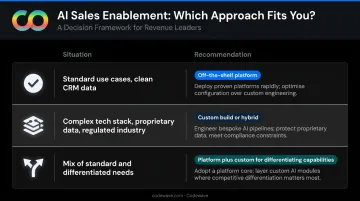
The hybrid approach works well for many mid-market teams: use a platform for coaching and content management, build custom for proprietary scoring models or industry-specific AI agents.
Frequently Asked Questions
What is the difference between AI sales enablement and traditional sales enablement?
Traditional enablement relies on reps proactively seeking out content and training — the pull model. AI sales enablement proactively surfaces the right asset, coaching, or insight at the right moment based on deal context. The practical difference shows up in rep ramp time, quota attainment, and selling hours reclaimed from administrative tasks.
How does AI improve sales coaching when teams are large or distributed?
AI removes the manager bandwidth bottleneck by analyzing call recordings, scoring rep performance, and delivering personalized feedback at scale. Role-play tools let reps practice objection handling and discovery calls repeatedly, with immediate feedback after each session, without waiting for scheduled 1:1 time.
Which AI sales enablement use cases deliver the fastest ROI?
Conversation intelligence and AI-powered coaching tend to show measurable impact fastest — often within weeks of deployment — because they directly address rep performance gaps with existing call data. Content recommendation and lead scoring typically deliver ROI over a longer window as the AI learns from more data.
What data does a team need to make AI sales enablement effective?
AI is only as good as the data it's trained on. Clean CRM records, call transcripts, content engagement history, and deal outcome data form the foundation. Teams with poor data hygiene should fix this first: bad data generates bad recommendations, and that erodes rep trust quickly.
How long does it take to implement an AI sales enablement platform?
Simpler platforms with native CRM integrations can be operational within a few weeks. Enterprise deployments with complex integrations and content migration can take several months. Starting with a structured 2-week pilot on real accounts is the most reliable way to surface integration issues before committing to full deployment.
Should companies build custom AI sales tools or buy off-the-shelf platforms?
Off-the-shelf platforms work well for standard use cases with clean CRM integrations and conventional sales workflows. Custom solutions make more sense for organizations with unique processes, proprietary data, or compliance requirements that generic platforms don't address — and a hybrid approach often fits when both conditions apply. Evaluate integration depth and long-term flexibility before committing.