Introduction: Why Business Decisions Need Better Forecasting
Picture a regional retailer who ordered Q4 inventory based on last year's trend data—only to discover that demand shifted by region, season, and SKU in ways a quarterly spreadsheet never captured. The result: $2M in markdowns and empty shelves in three zip codes. This scenario plays out across industries where planning cycles lag behind market reality.
The tools are the problem, not the effort behind them. Traditional forecasting methods were built for slower, more predictable environments. Today's businesses operate with volatile demand, multi-source data, and compressed decision windows that expose the limits of manual trend analysis.
AI forecasting shifts organizations from reactive analysis to proactive, continuously updated prediction. This guide covers exactly what you need to know: what AI forecasting is, how it works mechanically, where it delivers measurable value, and how to get started without building an overly complex system from scratch.
Key Takeaways
- AI forecasting uses machine learning to identify patterns in historical data and generates predictions that update as new data arrives.
- AI outperforms statistical models by handling multi-source data at scale and capturing non-linear relationships that traditional methods miss.
- Business value is highest where demand fluctuates, margins are tight, or resource allocation carries significant financial risk.
- Successful implementation depends as much on data readiness and process alignment as on the technology itself.
- The right implementation partner gets you to working forecasts faster — no need to build from scratch.
What Is AI Forecasting and How Does It Work?
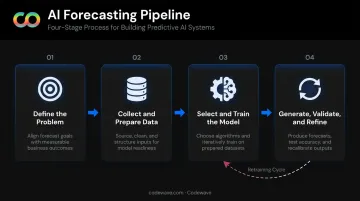
AI forecasting uses machine learning algorithms to analyze historical and real-time data, identify patterns, and generate forward-looking predictions. The key distinction from standard reporting: AI forecasting predicts what will happen, not just what has happened. Getting there requires four well-defined steps.
Defining the Forecasting Problem
Before any model is trained, organizations must define three things:
- What they're forecasting (revenue, demand volume, patient admissions, energy consumption)
- Over what horizon (daily, weekly, quarterly)
- At what granularity (by product, region, customer segment)
A poorly scoped forecasting problem produces irrelevant outputs regardless of model sophistication. Specificity here is the foundation of everything downstream.
Collecting and Preparing Data
AI forecasting models draw from three data categories:
- Internal historical data: sales records, inventory logs, financial transactions
- External data: weather, economic indicators, market signals, seasonal trends
- Behavioral data: customer activity, engagement patterns
Data preparation (cleaning duplicates, handling missing values, standardizing formats) is where most forecasting projects win or lose. A 2025 peer-reviewed study in Information Systems found that when missing values exceeded 40%, average ML model performance degraded by more than 25 percentage points across classification, regression, and clustering tasks. Bad data doesn't just reduce accuracy — it corrupts it systematically.
Selecting and Training the Model
Model selection depends on data type, forecast horizon, and business complexity — not on choosing the most technically advanced option. Common approaches in plain terms:
- Time series models (ARIMA): For sequential data with clear trend and seasonality patterns
- Regression models: For understanding how variables relate to outcomes
- Machine learning models (gradient boosting, neural networks): For complex, multi-variable environments where patterns aren't linear
Generating, Validating, and Refining Forecasts
Trained models generate probabilistic forecasts — typically with confidence intervals, not single-point estimates. Validation follows a repeatable sequence:
- Backtest against past periods to measure how closely predictions matched reality
- Monitor live outputs for drift as market or operational conditions shift
- Retrain periodically — or trigger retraining automatically when accuracy falls below a defined threshold
Most production forecasting systems run on a 30–90 day retraining cycle, though high-volatility domains like retail demand or energy pricing often require weekly updates.
AI Forecasting vs. Traditional Forecasting Methods
Traditional forecasting relies on statistical models—moving averages, linear regression, manual trend analysis—applied to structured historical data and updated on monthly or quarterly cycles. These methods aren't worthless. They offer transparency and predictability. But they break down when data volumes grow, variables multiply, or market conditions shift faster than the update cycle.
Where AI Forecasting Differs
| Dimension | Traditional Methods | AI Forecasting |
|---|---|---|
| Data sources | Structured, internal | Multi-source, structured + unstructured |
| Pattern detection | Linear relationships | Non-linear, complex interactions |
| Update cadence | Manual, periodic | Continuous as new data arrives |
| Scale | Dozens of variables | Thousands of products, locations, segments |
| Accuracy in volatile conditions | Degrades rapidly | Maintains performance with retraining |
The performance gap is documented. In the M5 Accuracy competition—a peer-reviewed benchmark using 42,840 hierarchical Walmart retail time series across a 28-day forecast horizon—the winning ML submission outperformed the best statistical benchmark by 22.4%, with the top five teams all exceeding 20% improvement.
AI Augments Human Judgment, It Doesn't Replace It
AI forecasting handles data processing at scale — pattern detection, variable interaction, continuous updates — but it doesn't make decisions. The people responsible for outcomes still do.
In practice, that division looks like this:
- AI: ingests multi-source data, generates probabilistic forecasts, flags anomalies
- Finance, supply chain, and operations teams: interpret outputs, apply business context, and make the final call
- The result: faster, better-informed decisions — not automated ones
The workflow is collaborative by design. AI narrows the range of uncertainty; human judgment determines the response.
Where AI Forecasting Delivers Real Business Impact
AI forecasting creates the most measurable value when small accuracy improvements translate directly into cost savings, revenue gains, or risk reduction. Codewave has seen this pattern repeat across 400+ engagements spanning 15+ industries — the sectors below show where the ROI is clearest.
Retail and E-Commerce: Smarter Inventory and Demand Planning
Retailers use AI forecasting to predict demand at the product-location level—reducing both overstock (which drives markdowns) and stockouts (which lose sales). A practical example: forecasting higher seasonal demand for specific SKUs in specific regions and pre-positioning inventory three weeks before the peak rather than reacting after the fact.
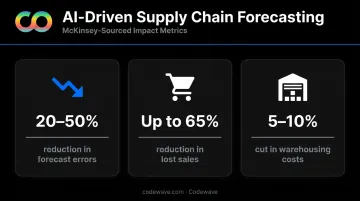
The financial stakes are significant. According to McKinsey, applying AI-driven forecasting to supply chain management can reduce forecast errors by 20–50%, reduce lost sales by up to 65%, and cut warehousing costs by 5–10%.
Healthcare: Anticipating Patient Volume and Resource Needs
Hospitals use AI forecasting to predict patient admissions, emergency room volumes, and staffing requirements, enabling proactive bed capacity planning and nurse scheduling adjustments before demand spikes hit. One key distinction from other sectors: accuracy here directly affects patient outcomes, not just operational costs. HIPAA compliance is non-negotiable, and any forecasting system must be built with data governance as a first-class requirement rather than an afterthought.
Financial Services and Fintech: Risk, Revenue, and Cash Flow
In regulated industries, forecast transparency matters as much as accuracy. Decision-makers must explain why the model predicted what it did — not just what it predicted. Codewave's approach embeds SHAP and LIME explainability frameworks directly into financial AI systems to meet FINRA and SOX requirements.
Common forecasting applications across banks, insurers, and fintech companies include:
- Loan default risk scoring ahead of credit decisions
- Cash flow fluctuation modeling for liquidity planning
- Claims volume prediction for underwriting and staffing
- Customer churn forecasting tied to retention triggers
Energy and Utilities: Balancing Supply and Demand
Energy companies forecast electricity demand using weather data, historical consumption patterns, and economic indicators to optimize grid management and plan renewable integration. Transportation and logistics companies use similar approaches for route demand and fleet utilization, particularly where supply-demand imbalances carry hard, immediate operational costs.
Agriculture: Yield Prediction and Supply Chain Optimization
AI forecasting helps agricultural businesses predict crop yields based on weather patterns, soil data, and market demand — enabling better procurement planning and reducing supply chain waste. Accurate agricultural forecasts ripple downstream into food retail and distribution, reducing waste across the entire supply chain.
The Business Benefits of AI Forecasting
AI forecasting models improve as they receive more data—meaning the accuracy and speed of your planning cycles compound over time, not plateau.
Improved Forecast Accuracy
AI models process far more signals simultaneously than any human analyst or statistical model. The result: predictions that respond to real-world complexity rather than lagging behind it. In Codewave's aircraft predictive maintenance engagement, the AI forecasting solution achieved 95% forecast accuracy, directly reducing aircraft downtime by 40%.
Faster Planning Cycles and Real-Time Responsiveness
AI forecasting automates the data refresh and model update cycle. Finance and operations teams shift from monthly or quarterly planning cycles to continuous rolling forecasts. Consider the practical difference: a supply chain team that detects an emerging supplier delay in near real-time can adjust procurement plans before a stockout occurs—rather than discovering the problem after the fact. McKinsey notes that AI forecasting engines can automate up to 50% of workforce-management tasks and reduce related costs by 10–15%.
Better Resource Allocation
When demand, revenue, and operational forecasts are more reliable, organizations can align staffing, inventory, capital expenditure, and marketing budgets more precisely to expected outcomes. That precision translates directly into leadership confidence—whether committing to a new market expansion or tightening cost reduction targets.
Scenario Planning Under Uncertainty
AI forecasting enables "what-if" scenario modeling—simulating multiple possible futures (a 10% demand drop, a new competitor entering the market, a raw material price spike) and testing how each would affect key metrics. This is fundamentally different from traditional single-point estimates. Codewave applies this approach through its QuantumAgile™ methodology, helping clients simulate multiple futures and ship strategies that are already validated against likely scenarios—before committing budget or headcount.

Common Challenges and How to Address Them
Data Quality and Availability
AI forecasting models are only as reliable as the data they train on. Organizations with siloed, incomplete, or inconsistently formatted historical data will see degraded performance—sometimes severely. The fix is clear: invest in data pipeline hygiene and governance before model development begins.
Codewave addresses this through a dedicated data assessment phase that evaluates data quality, identifies gaps, and builds cleaning and validation processes into the implementation plan. Organizations with limited historical data can supplement with external datasets (weather, economic indicators, market signals), though this requires careful integration to avoid introducing bias.
Model Drift and Ongoing Monitoring
Model drift occurs when a forecasting model's accuracy deteriorates as real-world patterns diverge from training patterns: post-pandemic demand shifts, new market entrants, regulatory changes. The NIST AI Risk Management Framework explicitly identifies data, model, and concept drift as requiring continuous monitoring and corrective triggers.
Teams must monitor forecast accuracy continuously against actual outcomes and retrain models when performance degrades. AI forecasting is an ongoing operational process, not a one-time deployment. Teams that treat it that way consistently outperform those that don't.
Organizational Adoption
Technical challenges are only half the equation. One of the most common — and underreported — failure modes is human. Decision-makers who don't trust AI-generated forecasts override them with gut instinct, negating the investment entirely.
Three interventions work consistently:
- Present model outputs with explainability—which variables drove the forecast and by how much
- Integrate forecasts into existing planning workflows and dashboards rather than requiring teams to consult a separate system
- Start with a high-impact, lower-risk use case to demonstrate value early and build internal credibility
How to Get Started with AI Forecasting: A Practical Roadmap
Step 1: Define the Business Decision First
Identify one specific business decision that would improve materially with better predictive accuracy—quarterly inventory orders, annual budget allocation, monthly staffing plans. Scoping around a concrete decision prevents AI forecasting projects from becoming unfocused analytics exercises.
Step 2: Assess Your Data Readiness
Audit historical data relevant to that decision across four dimensions:
- Volume: How many periods of history are available?
- Completeness: Where are the gaps and missing values?
- Consistency: Are formats standardized across sources?
- Accessibility: Does data live in silos or a unified system?
Most business forecasting models benefit from at least 2–3 years of consistent historical data. Organizations with less can supplement with external datasets or start with simpler models before moving to more complex approaches. Limited data is not a reason to wait. It determines where you start, not whether you start.
Step 3: Choose Your Implementation Approach
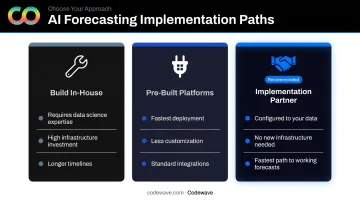
Three paths exist:
- Build in-house: Requires data science expertise, infrastructure investment, and longer timelines
- Pre-built platforms: Faster deployment, less customization for unique business contexts
- Implementation partner: Configures models to your specific data and business context without rebuilding infrastructure from scratch
For organizations choosing the implementation partner path, Codewave's analytics stack covers the full pipeline: TensorFlow for model training, Snowflake for data warehousing, Apache Kafka for real-time data streaming, and Power BI for visualization. This means forecasting capabilities can be configured to your data environment without building new infrastructure from the ground up.
Step 4: Start Small, Validate Fast, Then Scale
Launch a focused pilot on one forecast type. Measure accuracy against actual outcomes, then refine the model before expanding scope. Speed of validation matters here: tie the pilot to a live business decision so results are immediately testable, not theoretical. That connection is what moves a proof of concept into production.
Frequently Asked Questions
What is the difference between AI forecasting and traditional statistical forecasting?
Traditional statistical forecasting uses fixed mathematical models (moving averages, ARIMA) on structured historical data. AI forecasting uses machine learning to detect complex, non-linear patterns across large, multi-source datasets and continuously updates as new data arrives—without requiring manual reconfiguration as conditions change.
How much historical data does a business need to start AI forecasting?
Most business forecasting models benefit from at least 2–3 years of consistent historical data. Organizations with less can supplement with external datasets or start with simpler models, then scale up as more data accumulates.
How accurate is AI forecasting compared to traditional methods?
Accuracy gains vary by use case, but AI forecasting consistently outperforms traditional methods in volatile, multi-variable environments. In a peer-reviewed Walmart retail benchmark covering 42,840 time series, the winning ML method improved forecast accuracy by 22.4% over the best statistical benchmark. McKinsey reports forecast error reductions of 20–50% in supply chain applications.
Can small and mid-sized businesses realistically implement AI forecasting?
Yes. AI forecasting is increasingly accessible to SMBs through pre-built platforms and implementation partners. The key requirement isn't company size—it's data readiness and a clearly defined business problem to solve. Starting with a focused, high-value use case is more important than organizational scale.
What are the most common reasons AI forecasting projects fail?
The top three failure modes are poor data quality feeding into the model, lack of organizational adoption (teams not trusting or using outputs), and failing to monitor and retrain models after initial deployment. All three are preventable with deliberate planning.
How long does it take to implement an AI forecasting solution?
Timelines range from weeks for a focused pilot using pre-built tooling to several months for enterprise-wide custom implementations. Starting with a single high-impact use case is the fastest path to real ROI, and the most reliable way to build the internal credibility needed for broader rollout.