The shift is here. Agentic AI doesn't just automate tasks — it reasons, plans, and executes multi-step procurement workflows autonomously. This article covers what agentic AI in procurement means, which workflows it transforms, the ROI it delivers, and how to implement it without replacing your existing tech stack.
Key Takeaways
- Agentic AI acts autonomously across sourcing, contracts, and supplier management — not just chatbots or analytics
- Transformed workflows include intake orchestration, strategic sourcing, contract lifecycle management, and invoice processing
- Organizations report faster cycle times, lower costs, and reduced fraud risk (measurable outcomes in months, not years)
- Success depends on clean data foundations, phased rollouts, and governance built before deployment begins
- Best solutions integrate natively with your existing ERP and P2P systems rather than layering on top of legacy infrastructure
What Is Agentic AI in Procurement?
Agentic AI represents a fundamental departure from earlier procurement technology. Traditional AI delivers predictive analytics, spend classification, or rule-based automation that surfaces recommendations. Agentic AI deploys autonomous agents that perceive context, make decisions, execute multi-step tasks, and adapt based on outcomes — without constant human direction for each step.
McKinsey defines agentic AI as systems that "don't just generate text or code. They take action." Key characteristics include autonomy, reasoning, planning, tool use, and multi-agent collaboration. PwC emphasizes that agentic systems possess autonomous decision-making capabilities, data analytics capabilities, and the ability to execute tasks independently.
How Agentic Procurement AI Works
AI agents operate within a defined goal — for example, completing supplier onboarding end-to-end. Each agent follows a repeatable sequence:
- Perceives context by pulling data from ERP integrations, document parsers, and search tools
- Reasons through sub-tasks and dependencies without manual prompting
- Executes actions across connected systems
- Hands off to human reviewers only at critical decision points
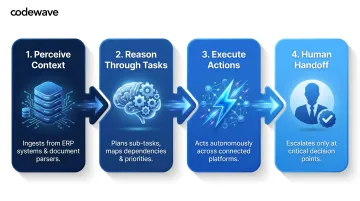
This marks a practical shift: from AI that assists humans to AI that executes while humans oversee.
Where It Fits in Your Tech Stack
Agentic AI doesn't replace ERP or S2P platforms. It acts as an intelligent orchestration layer on top — pulling data from existing systems, triggering actions, and closing process loops.
Custom-built implementations integrate directly into existing ERP, CLM, and P2P infrastructure rather than forcing migration to standalone SaaS tools. Codewave builds these integrations to enforce organization-specific procurement policy while adapting to existing workflows — no rip-and-replace required.
The Adoption Gap
49% of procurement teams piloted generative AI in 2024, but only 4% achieved large-scale deployment. The technology exists. What separates pilots from production is implementation discipline, data readiness, and change management.
Key Procurement Workflows Agentic AI Transforms
McKinsey projects that agentic AI could make procurement functions 25-40% more efficient while repositioning teams as strategic drivers of growth. Autonomous category agents capture 15-30% efficiency improvements by automating non-value-added activities. The highest-impact workflows include intake orchestration, strategic sourcing, contract lifecycle management, and invoice processing.
Intake and Request Orchestration
An intake agent translates a purchase request into a structured intake, checks it against procurement policy and approval thresholds, then routes it to the correct buying channel — catalog, sourcing event, or contract reuse. It pre-populates requisition data across systems, leaving humans to review only the final approval. Email chains and spreadsheet approvals are cut out entirely.
Business impact:
- Faster cycle times (Digital World Class teams achieve 58% shorter requisition-to-PO cycles)
- Reduced maverick spend (companies lose 10-20% of targeted savings to off-contract buying)
- Consistent policy enforcement without requiring procurement staff involvement in routine requests
Digital World Class procurement teams experience 60% less savings lost from maverick buying and contract noncompliance compared to peers.
Strategic Sourcing and Supplier Discovery
Sourcing agents autonomously gather historical spend data, benchmark pricing, scan markets for new suppliers, and assess concentration risk. They draft RFx documents from prior templates, distribute them, and analyze responses — delivering negotiation guidance directly to the sourcing manager. The result: sourcing managers spend their time on strategy, not execution.
A McKinsey case study found a chemicals company piloting autonomous sourcing in consumables delivered a 1-3% increase in value capture and 20-30% efficiency improvement across tenders, prequalification, and bid analysis. Separately, a tech company's sourcing agents identified 12-20% savings in contact center operations and 20-29% in BPO/financial services spend.
Why this matters in healthcare, retail, and energy:
These industries face high supplier risk and pricing volatility. 74% of CPOs identify "maintaining active alternative sources" as the most effective risk mitigation strategy. Agentic sourcing continuously monitors concentration risk and supplier performance, flagging issues before they disrupt operations.
Contract Lifecycle Management
Contract agents monitor expiring agreements, flag outdated terms, draft renewals using updated clause libraries, and analyze supplier redlines. They also suggest fallback negotiation language and track SLA compliance continuously, flagging deviations the moment they appear post-signature.
Compounding value:
Faster contract cycles mean earlier savings realization. Continuous monitoring reduces contract leakage and non-compliance risk. Organizations lose an average of 11% of contracted value through missed renewals, unmanaged price escalations, and poor post-award monitoring.
In another McKinsey example, a pharmaceutical company's AI-based invoice-to-contract reconciliation identified $10 million+ in value leakage, cutting leakage by 4 percentage points.
Only 15% of organizations operate with shared contracting technology between Legal and Procurement, creating manual handoffs and communication breakdowns. Agentic CLM closes that gap — and its impact carries directly into how invoices are processed downstream.
Invoice Processing and Spend Analytics
Agentic AI handles invoice matching, exception flagging, and fraud detection autonomously, connecting invoice data to contract terms and purchase orders in real time.
Performance benchmarks:
| Metric | Average | Best-in-Class | Difference |
|---|---|---|---|
| Invoice processing cost | $9.40 | ~$2.56 | 78% lower |
| Processing time | 17.4 days | — | 82% faster |
| Exception rate | — | — | 59% lower |
| Straight-through processing | — | 69% | 2.4x more likely |
Source: Ardent Partners 2025 benchmarks
Organizations lose an estimated 5% of revenue to occupational fraud, with 50% of cases involving corruption such as invoice kickbacks and purchasing schemes. AI-driven fraud detection identifies patterns manual reviews miss.
Spend analytics agents continuously classify spend across categories, surface anomalies, and generate savings opportunity reports without manual data extraction — cutting reporting time by up to 40%.
Measurable Business Outcomes: What to Expect from Agentic AI in Procurement
Cost and Efficiency Outcomes
Sourcing cycle time reduction:
Digital World Class procurement teams achieve 24% shorter sourcing cycles compared to peers. A telco player using AI agents reduced negotiating team time spent on analysis and emails by up to 90%, achieving 10-15% savings across vendors for long-tail spend.
Processing cost reduction:
Best-in-class AP departments reduce invoice processing costs from $9.40 average to approximately $2.56 through automation — a 78% reduction. Accuracy improves with each cycle as agents refine their pattern recognition across procurement data.
Risk Reduction Outcomes
Agentic AI catches issues that static analytics tools consistently miss. Core capabilities include:
- Supplier risk monitoring in real time, surfacing problems before they escalate
- Compliance gap detection that flags contract deviations as they occur
- Invoice validation against contract terms, preventing the 11% contract value leakage typical organizations experience
Productivity Reallocation
When routine execution is automated, procurement teams shift capacity toward category strategy, supplier relationship management, and cross-functional innovation. The workforce impact is measurable:
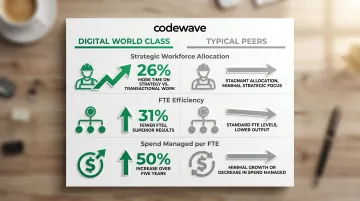
- Digital World Class teams dedicate 26% more of their workforce to strategic tasks — spend analysis, supplier relationships, stakeholder collaboration — versus transactional work
- These organizations operate with 31% fewer FTEs while achieving superior results
- Spending managed per FTE has increased 50% over five years, with no headcount growth required
ROI Timeline and Speed-to-Value
Speed-to-value depends on three factors: data readiness, integration complexity, and the scope of the initial deployment.
Organizations with clean ERP and spend data and a focused starting use case — invoice automation or tail-spend sourcing, for example — typically see measurable results in months. McKinsey reports organizations can move from prototype to pilot in "weeks" with the right data foundation, then from pilot to full-scale in "under a year." One global pharmaceutical company developed a successful AI-based proof of concept in just 4 weeks.
How to Build and Implement Agentic AI for Procurement
Step 1 — Identify the Highest-Value Starting Workflow
Start narrow and deliberate. Select one procurement workflow where repetitive work volume is highest and data is most available. Common starting points:
- Intake orchestration (high volume, policy-driven)
- Invoice processing (structured data, clear validation rules)
- Tail-spend sourcing (repetitive RFx processes)
A focused pilot generates the quick win needed to build organizational buy-in.
Step 2 — Audit and Prepare Your Data Foundation
Agentic AI is only as effective as the data it reasons over. 74% of procurement leaders state their data is "not AI-ready". Organizations still use less than 20% of available data to support procurement decision-making.
Audit these areas before deployment:
- ERP data quality and completeness
- Supplier master data accuracy
- Contract repository structure and accessibility
- Historical spend classification accuracy
Identify and address gaps before rollout — clean, structured data is what enables agents to make autonomous decisions without constant human correction.
Step 3 — Design the Human-in-the-Loop Boundaries
Define precisely which decisions remain human-owned and which are fully agent-executed:
Human-owned:
- High-value supplier awards
- Strategic supplier selection
- Contract sign-off for major agreements
- Policy exceptions
Agent-executed:
- Routine purchase request routing
- Invoice matching and exception handling
- Contract renewal drafting
- Tail-spend RFx distribution and initial analysis
Document escalation paths and oversight checkpoints to maintain accountability and auditability.
Step 4 — Build or Integrate Your Agentic AI Layer
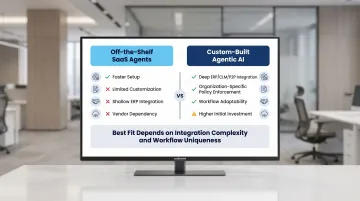
The build vs. buy decision:
Each path carries real trade-offs:
- Off-the-shelf SaaS agents: Faster initial setup, but limited customization and often shallow ERP integration
- Custom-built agentic solutions: Integrate with existing ERP, CLM, and P2P systems; enforce organization-specific procurement policy; adapt to unique workflows
For teams choosing the custom route, Codewave's QuantumAgile™ methodology compresses the path from workflow definition to validated agent prototype into days. Teams can test agent behaviors against real procurement scenarios before committing to full deployment, reducing implementation risk significantly.
Step 5 — Scale Through Iteration
After the initial deployment delivers measurable results, use the same underlying agent architecture to expand into adjacent workflows. Because the foundation (data pipelines, agent orchestration, ERP integrations) is reusable, each subsequent deployment is faster and cheaper than the first. each subsequent deployment is faster and cheaper than the last — and the organizational confidence to move quickly grows with it.
Governance, Risk, and Change Management
Data Security and Compliance Requirements
Agents that access supplier data, pricing, and contract terms must operate within strict access controls, audit logging, and data residency requirements.
Baseline compliance frameworks:
- SOC 2 Type II — Controls for security, availability, processing integrity, confidentiality, and privacy of data
- GDPR — Protection of personal data (supplier contacts, employee data) processed by AI systems
- ISO 27001 — Information security management systems
- ISO/IEC 42001 — AI-specific management system standard covering AI policy, objectives, risk management, and data governance (first international standard specifically designed for AI)
- NIST AI RMF — Framework for managing risks associated with AI systems
For procurement specifically, ISO/IEC 42001 is the most directly applicable standard — it requires documented AI policies, defined risk thresholds, and evidence of human oversight, all of which map directly to autonomous procurement agent deployments.
The Explainability Imperative
Procurement decisions must be defensible — especially in regulated industries (healthcare, energy, financial services). Agentic AI systems deployed in procurement should produce traceable reasoning, confidence indicators, and complete audit trails so human reviewers can validate and explain any AI-influenced decision.
Minimum explainability requirements for procurement AI include:
- Decision audit trails that log what data the agent accessed and when
- Confidence scores on recommendations (flagging low-certainty outputs for human review)
- Plain-language reasoning summaries for supplier selection, pricing approvals, and contract flags
- Role-based access to audit logs for compliance, procurement, and finance teams
Change Management as the Most Underestimated Implementation Risk
Procurement teams and suppliers may resist AI-driven workflows due to fear of displacement or distrust of automated decisions. Change management statistics reveal the challenge:
- 65% of employees report being excited about using AI at work, yet 37% do not use AI even when they have access — primarily because co-workers aren't using it
- 86% of managers face challenges driving effective use of AI across their teams
- 88% of HR leaders report their organizations have not yet realized significant business value from AI tools
- Only 7% of organizations provide guidelines to employees on how to use time saved by AI
Recommended change strategy:
- Show teams exactly which tasks agents handle and which decisions still require human sign-off
- Demonstrate early wins — time saved on PO processing, fewer approval bottlenecks — before rolling out broader automation
- Reposition affected roles toward supplier strategy, exception handling, and relationship management
- Issue explicit guidelines on how to use time freed by automation (the 93% of organizations that skip this step see adoption stall)
These adoption gaps aren't unique to AI — they reflect deeper organizational friction. Deloitte's 2025 CPO Survey identifies 57% siloed ways of working, 46% competing priorities, and 40% lack of organizational capability as the primary barriers to procurement value delivery. A change management plan that addresses these structural blockers is as important as the technology itself.
Frequently Asked Questions
What is agentic AI in procurement?
Agentic AI in procurement refers to autonomous AI agents that independently execute multi-step procurement tasks — processing supplier requests, drafting RFx documents, or monitoring contract compliance — by reasoning through context and connected systems, requiring human oversight only for approvals and high-stakes calls.
Which AI is best for procurement?
The "best" AI depends on your specific procurement workflows and existing tech stack. Off-the-shelf platforms (Coupa, SAP Ariba, Zycus) suit general S2P needs, while custom-built agentic AI solutions are better for organizations with complex, unique procurement processes or deep integration requirements.
How does agentic AI differ from traditional AI in procurement?
Traditional AI analyzes data and surfaces recommendations — humans still do the acting. Agentic AI independently executes sequences of tasks (intake routing, supplier outreach, contract drafting) and loops humans in only for oversight and high-stakes decisions.
What procurement processes can be fully automated with agentic AI?
The most automation-ready workflows include:
- Purchase request intake and routing
- Invoice matching and exception handling
- Tail-spend sourcing events
- Contract renewal drafting
- Supplier risk monitoring
Strategic decisions — major supplier awards and contract sign-offs — should retain human oversight.
How long does it take to implement agentic AI for procurement?
A focused initial deployment (invoice processing or intake automation) on a clean data foundation can deliver measurable results in months rather than years. Broader multi-workflow implementations typically take 3–6 months depending on integration complexity and data readiness.