Most discussions about AI for yield optimization stay theoretical. This article focuses on what AI for yield optimization actually changes in daily operations and why the advantages compound over time rather than plateau.
Key Takeaways
- AI for yield optimization uses machine learning to forecast outputs, allocate resources dynamically, and flag risk before it causes loss
- Measurable advantages include lower input costs, higher throughput, fewer errors, and faster responses to changing conditions
- Industries seeing the highest impact: agriculture, manufacturing, energy, retail, and healthcare
- AI sharpens human judgment, giving decision-makers data precision to act on facts rather than guesswork
- Delaying adoption means falling behind on cost, quality, and speed — gaps that widen over time
What Is AI for Yield Optimization
AI for yield optimization is the use of machine learning, predictive analytics, and real-time data processing to maximize useful output from available inputs—whether those inputs are seeds, raw materials, energy, inventory, or workforce capacity.
It operates wherever output quality or quantity is tied to variable, controllable inputs:
- Precision agriculture: Soil, water, climate variables
- Manufacturing: Throughput, defect rates, process control
- Energy: Generation and distribution efficiency
- Retail: Demand forecasting, inventory turnover
- Healthcare: Patient flow, resource utilization
At its practice level, yield optimization functions as a decision-support discipline: it converts raw operational data into specific guidance for planning, resource allocation, and risk response. The technology is the mechanism; the value is in the decisions it enables.
Peer-reviewed research reinforces this framing, positioning AI/ML models integrated with optimization as a modeling and decision discipline rooted in operations research—not a vendor-driven product category.
Key Advantages of AI for Yield Optimization
The three advantages below focus on measurable, operational impact — mapping directly to what finance, operations, and leadership teams track: cost per unit of output, quality rates, risk exposure, and productivity per resource. They apply across sectors wherever yield variability creates a business problem, not just in agriculture.
Advantage 1: Predictive Precision That Converts Data Into Accurate Output Forecasts
AI aggregates multimodal data—historical performance, environmental variables, input quality, market signals—and identifies non-linear patterns that no manual analysis could reliably detect. The result is yield forecasts with far higher accuracy than industry averages or historical-only models.
The Real-World Process Change:
Instead of relying on fixed seasonal averages or gut-informed projections, teams get:
- Field-level or SKU-level forecasts that account for current conditions
- Adaptive models that update as new data arrives
- Scenario simulations that show how different input decisions change projected outputs
Why This Is an Advantage:
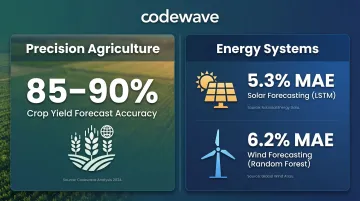
Research shows AI-based prediction models achieving 85–90% accuracy for crop yield forecasts. In energy systems, solar generation forecasting with LSTM networks achieves mean absolute error of just 5.3%, while wind generation forecasting with Random Forest models reaches 6.2% MAE.
Better forecasts reduce the cost of being wrong. When teams know which zones, lines, or segments will underperform before it happens, they can redirect resources rather than recover from shortfalls. This precision translates to:
- Fewer over-inputs that waste capital
- Less waste from overproduction
- Better procurement timing
- More reliable supply chain commitments
KPIs Impacted:
- Forecast accuracy
- Input cost per unit of output
- Waste and spoilage rates
- Planning cycle time
- On-time delivery performance
When This Advantage Matters Most:
Most valuable when output variability is large — weather-dependent agriculture, seasonal retail, fluctuating energy demand — when input costs are a significant share of margin, and when lead times for corrective action are long.
Advantage 2: Dynamic Resource Allocation That Reduces Input Waste While Protecting Output
AI continuously adjusts how resources—fertilizer, energy, labor, inventory, raw materials—are distributed across operations based on predicted need, not uniform standards. This prevents over-application in low-yield zones and under-supply in high-yield areas.
How This Works in Practice:
Variable-rate application in agriculture, predictive scheduling in manufacturing, demand-signal-driven inventory replenishment in retail, and load-balancing in energy grids all follow the same AI-driven logic—resources flow to where they generate the most output per unit spent.
Why This Is an Advantage:
Resource efficiency gains from AI-driven optimization are substantial and documented:
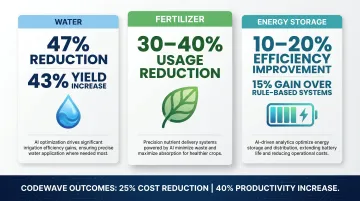
- IoT-driven smart irrigation reduced water consumption by 47% and increased lettuce yield by 43% versus traditional irrigation
- Precision fertilization systems achieved 30–40% reduction in fertilizer usage in surveyed studies
- Battery storage optimization improved efficiency by 10–20%, with reinforcement learning outperforming rule-based management by approximately 15%
These gains connect directly to cost, quality, and sustainability. Fewer wasted inputs lower cost per unit of output and shrink environmental footprint — two pressures regulators and customers are applying with increasing force.
Codewave's implementations have produced 25% cost reduction and 40% productivity increase across client engagements. The ImpactIndex™ model holds these outcomes to account — productivity and cost metrics are tracked and verified against baselines, not projected and forgotten.
KPIs Impacted:
- Input cost per unit
- Resource utilization rate
- Energy efficiency ratio
- Inventory turnover
- Waste and scrap rate
- Sustainability metrics (carbon per unit of output)
When This Advantage Matters Most:
Greatest impact comes when operations run across heterogeneous conditions — multiple fields, facilities, SKUs, or markets with different performance profiles — when input costs are volatile, and when regulatory pressure on waste or emissions is rising.
Advantage 3: Proactive Risk Detection That Shifts Operations From Reactive to Preventive
AI monitors real-time operational signals—soil stress, equipment vibration, weather trajectories, demand anomalies, quality deviation trends—and surfaces early warnings of yield-threatening conditions before they escalate into loss events.
What Changes Operationally:
Teams receive alerts for specific high-risk zones or processes, with AI-ranked priority and recommended interventions. This replaces broad-spectrum reactive responses (mass pesticide application, unplanned maintenance, emergency restocking) with targeted, timed actions.
Why This Is an Advantage:
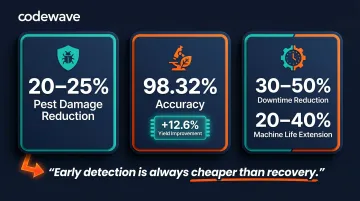
Early detection is always cheaper than recovery:
- AI-based prediction models achieved **20–25% reduction in pest damage** in reviewed studies
- CNN-based plant disease diagnosis delivered 98.32% accuracy with real-time inference and 12.6% yield improvement versus standard visual inspection
- Predictive maintenance typically reduces machine downtime by 30–50% and increases machine life by 20–40%
When AI narrows the problem from "something might go wrong" to "zone C shows moisture stress patterns consistent with a 30% yield reduction in the next 14 days," decision-makers can act with precision rather than caution. The cost savings are dramatic—in oil and gas, platform downtime costs $1–2 million per day; case examples show reductions from 14 days to 6 days with predictive models.
KPIs Impacted:
- Defect and quality deviation rates
- Unplanned downtime
- Spoilage and loss rates
- Response time to operational anomalies
- Cost of quality interventions
- Risk-adjusted output
When This Advantage Matters Most:
Applies most directly when operations face frequent or unpredictable disruption risk — weather-sensitive agriculture, high-volume manufacturing with tight tolerances, supply chains with long lead times — and when reactive intervention costs materially more than prevention.
What Happens When AI for Yield Optimization Is Missing or Ignored
Without AI for yield optimization, operations default to treating every condition the same—systematically over-resourcing low-performing areas while starving high-potential ones. That imbalance doesn't stay isolated. It compounds into chronic inefficiency that gets locked into every planning cycle.
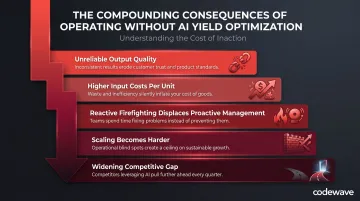
The compounding consequences:
- Unreliable output quality and volume that erode confidence in supply commitments
- Higher input costs per unit as resources are spread by average rather than allocated by actual need
- Reactive firefighting displaces proactive management, pushing up both the cost and time of every operational response
- Scaling becomes harder with each new facility, field, or market—each one adds variability that human oversight alone cannot manage consistently
- Growing competitive exposure as peers who adopt AI yield optimization compound efficiency gains year over year, widening the cost and quality gap
Organizations that delay adoption don't simply miss efficiency gains. They actively cede ground to competitors who are compounding structural cost advantages and quality consistency every year those gaps remain unaddressed.
How to Get the Most Value from AI for Yield Optimization
AI for yield optimization produces its strongest results when deployed as a continuous operational practice, not a one-time project. Three conditions determine whether the advantage compounds or stalls.
Apply It Consistently Across the Operation
Selective deployment (one facility, one field, one product line) limits the comparative insight AI needs to allocate resources intelligently. Broader data coverage produces more accurate models and more precise interventions.
Research confirms that hybrid approaches combining satellite imagery, UAV data, and ground sensors improve accuracy for crop yield prediction and growth parameter estimation. The same principle applies across industries—multimodal data from multiple operational contexts makes models smarter.
Review Outcomes Against a Defined Measurement Framework
AI models improve with feedback. Teams should:
- Track KPIs before and after AI-driven decisions
- Feed performance data back into the model
- Adjust thresholds for intervention triggers as operational conditions evolve
Data quality and contextual calibration are critical—research warns that simplistic models or timing errors can amplify risks like nutrient runoff. Regular in-season data collection and model refinement ensure the system stays aligned with real-world conditions.
Act on Insights Rather Than Archive Them
The advantage of AI yield optimization disappears if alerts and recommendations aren't translated into operational decisions. Building clear ownership and escalation paths for AI-generated recommendations is what separates teams that capture the ROI from those that don't. Assign a decision owner for each alert category before deployment — not after the first missed intervention.
Conclusion
AI for yield optimization ties together three capabilities that individually move metrics, but compound when combined: accurate forecasting reduces waste upstream, dynamic resource allocation captures those savings in real time, and proactive risk detection keeps both from unraveling.
Each capability reinforces the others. Accurate forecasts enable smarter resource allocation; smarter allocation reduces the operational noise that obscures early risk signals; better risk detection feeds more reliable data back into forecasting models. The result is a self-reinforcing loop — gains accumulate instead of flattening out.
Businesses that treat AI for yield optimization as an ongoing operational discipline, rather than a one-time deployment, accumulate the biggest gains. Organizations working with implementation partners like Codewave have documented 40% productivity increases and 25% cost reductions by doing exactly that — building AI into continuous operations rather than treating it as a standalone project. The faster you move from pilot to production, the sooner those compounding gains show up in your numbers.
Frequently Asked Questions
What is the purpose of AI in yield optimization?
AI in yield optimization converts fragmented operational data into accurate output forecasts and adaptive resource decisions, allowing businesses to maximize useful output from available inputs while minimizing waste, cost, and loss exposure.
Which industries benefit most from AI-driven yield optimization?
Agriculture (crop forecasting, precision inputs), manufacturing (throughput and defect reduction), energy (generation and grid efficiency), retail (inventory and demand optimization), and healthcare (resource utilization and patient throughput). Any sector where inputs and outputs vary is a strong candidate.
How does AI improve productivity beyond what traditional methods offer?
Traditional methods apply uniform standards to heterogeneous conditions. AI identifies which specific zones, lines, or segments deviate from expected performance and adjusts resource allocation at that granularity. That level of precision is simply out of reach for broad averages.
What data does AI need to optimize yield effectively?
AI needs historical output data, real-time operational signals (sensors, IoT, imagery), input records (materials, energy, labor), and relevant environmental or market variables. Data quality and consistency matter more than volume.
How long does it take to see measurable results from AI yield optimization?
Early indicators like forecast accuracy and anomaly detection rates are visible within weeks of deployment. Operational KPIs — input cost reduction, output quality — typically improve within one to three production cycles. That's when the model has enough real-world data to calibrate effectively.
What are the main risks of implementing AI for yield optimization?
Poor data quality is the most common barrier. Over-reliance on model outputs without human oversight and weak integration with existing workflows are close behind. A phased deployment approach with clearly defined benchmarks keeps these risks manageable.