Introduction
Finance teams lose significant hours each month to manual reporting tasks. According to a bluQube survey of 700 finance and business leaders, 40% of businesses still manage up to half of their financial data manually, with 26% handling the majority manually. The biggest time drains they identified:
- 31% — reconciling accounts between entities
- 26% — month-end close
- 20% — audit and compliance reporting
AI agents are changing this. Unlike basic RPA tools or chatbots, they autonomously analyze financial reports, detect anomalies, generate narratives, and surface insights—without waiting for manual prompts. This article explores what AI agents for financial report analysis are, how they work, key use cases, and how teams can start deploying them.
TLDR:
- AI agents autonomously analyze financial reports, detect anomalies, and generate insights without constant human intervention
- They compress close cycles, accelerate variance analysis, streamline audit prep, and enable continuous forecasting
- McKinsey research shows finance professionals save 20-30% of their time where AI has been robustly adopted
- Success requires clean data, human-in-the-loop approval, and strong governance frameworks
- Codewave has helped 400+ businesses achieve 40% less reporting time and 90% fewer data errors with custom AI solutions
What Are AI Agents for Financial Report Analysis?
Unlike traditional automation tools that follow fixed rules, AI agents combine large language models (LLMs), retrieval-augmented generation (RAG), and multi-step reasoning to interpret both structured data—spreadsheets, ERP outputs—and unstructured data like management commentary, contracts, and audit notes. Where a rules-based tool stops at extraction, an AI agent reasons over what it finds and acts on it.
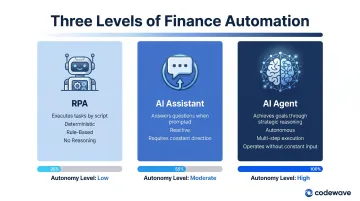
How AI Agents Differ From Assistants and RPA
IBM distinguishes the technologies clearly:
- RPA executes tasks by script — deterministic, rule-based bots that mimic repetitive human tasks
- AI assistants answer questions when prompted — respond to user queries but require constant direction
- AI agents achieve goals through strategic reasoning — autonomous systems that perceive, plan, execute multi-step analysis, and produce outputs without constant human intervention
McKinsey defines agentic AI in finance as tools "capable of orchestrating time-consuming workflows like the accounting close process with limited human input," distinguishing it from basic gen AI assistants by its ability to chain multiple steps, use tools, and operate autonomously across workflows.
What Makes Financial Report Analysis "Agentic"
Financial report analysis by AI agents means ingesting reports—income statements, balance sheets, cash flow statements, variance reports—identifying patterns and anomalies, cross-referencing with supporting documents, and generating human-readable explanations or flagging items for review.
Key agentic characteristics:
- Retain context across multi-step analysis without losing the thread
- Connect directly to ERPs, databases, and APIs to pull live data
- Enforce role-based access controls and compliance rules throughout
- Critique and iterate on their own outputs before surfacing results
Together, these characteristics let a single agent move from raw report ingestion to a flagged, explainable output — work that previously required multiple analysts and several handoffs.
Key Applications of AI Agents in Financial Reporting and Analysis
Organizations typically start with one high-value use case before expanding. Here are the most impactful deployment areas.
Automated Variance Analysis
AI agents continuously monitor actuals versus budgets across entities and periods, catching detect anomalies as they emerge rather than waiting for month-end.
FP&A Trends research found that 39% of FP&A teams still rely on manual reviews to find anomalies, 34% use Excel-based models, and only 6-7% currently use AI or ML-based solutions. The most common undetected errors: 44% cited missed or incorrect provisions, 21% cited incorrect cost center or project allocation.
Agents handle the heavy lifting that eats analyst time:
- Generate contextual narratives explaining what drove the variance (vendor timing, payroll increases, contract changes)
- Flag unusual patterns before they compound
- Free analysts from hours of manual reconciliation
McKinsey documented a global consumer goods company using a gen AI assistant to provide insights on budget variances, replacing manual number crunching and saving 30% of finance professionals' time.
Financial Close and Reconciliation
Agents ingest data from multiple ERPs and sub-ledgers, normalize account codes, match transactions, identify missing entries or intercompany mismatches, and surface only exceptions for human review. The result: a compressed close cycle with fewer last-minute surprises.
Current state of the close:
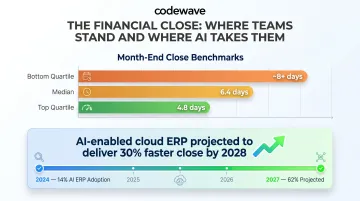
- APQC benchmarking shows median month-end close is 6.4 business days
- Only 53% of businesses complete their close in six days or less
- Top-quartile teams close in approximately 4.8 days
Gartner predicts finance organizations using cloud ERP applications with embedded AI assistants will achieve a 30% faster financial close by 2028. That shift is already underway: cloud ERP spending on AI-enabled solutions is projected to climb from 14% in 2024 to 62% in 2027.
Audit Preparation and Documentation
Agents organize supporting evidence, cross-reference journal entries against contract terms and accounting standards, draft audit documentation, and maintain continuous audit trails. Audit prep becomes an ongoing process rather than a stressful sprint at year-end.
Johnson Lambert, a CPA and consulting firm, cut manual insurance report audits by 50% in time after implementing generative AI to extract and validate financial insights — reports that previously consumed 60-80 hours each.
Deloitte's Q4 2025 CFO Signals Survey found 54% of CFOs cite integration of AI agents as a top transformation priority, with 87% expecting AI to be extremely or very important to their finance department's operations in 2026.
Narrative Report Generation
Agents analyze transaction-level movements, connect them to business events (new customers driving revenue growth, headcount changes driving labor cost increases), and produce draft management commentary ready for review, replacing hours of manual writing.
Workiva AI, launched in 2025, provides narrative generation capabilities for financial reporting: analyzing and summarizing tables, drafting commentary from tabular data, and reviewing MD&A commentary. Cognizant reported saving 40% of time using Workiva AI for sustainability governance work.
McKinsey documented a North American financial institution using gen AI to generate first drafts of internal risk model reports and market-specific risk models, combining internal data with public sources automatically.
Financial Forecasting and Scenario Analysis
Agents pull real-time data from internal systems and external feeds, update financial models dynamically as conditions change, and run "what if" scenarios across raw material cost spikes, demand shifts, and other variables. Forecasting shifts from a quarterly exercise into an always-on capability.
McKinsey research shows machine learning can achieve up to 50% reduction in average forecasting errors compared to traditional methods. That gap matters: traditional budgets built on data from six months ago often become obsolete three months into the new year.
Gartner predicts 70% of large-scale organizations will adopt AI-based forecasting to predict future demand by 2030, enabling "touchless forecasting" that eliminates frequent manual inputs and interventions.
How AI Agents Analyze Financial Reports: Under the Hood
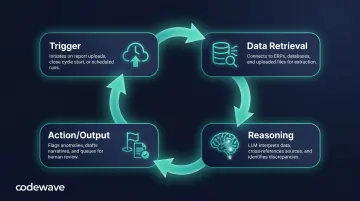
Understanding what happens inside an AI agent during financial analysis helps teams know where to trust it, where to verify it, and where human judgment still leads. The core workflow follows a practical loop:
1. Trigger — Report uploaded, close initiated, or scheduled analysis runs 2. Data Retrieval — Agent pulls from ERPs, databases, or uploaded files 3. Reasoning — LLM interprets figures, cross-references supporting data, identifies discrepancies 4. Action/Output — Flags anomalies, drafts narrative, queues items for human review
The Role of RAG in Grounding Analysis
Retrieval-Augmented Generation (RAG) is critical for trust in financial contexts. Microsoft describes RAG as an approach that integrates information retrieval with text generation, allowing LLMs to access external, authoritative knowledge bases in real-time before generating responses.
Why this matters for finance:
- Agents don't hallucinate figures because they retrieve actual data from governed sources rather than generating numbers from training data
- Transparent source attribution creates an audit trail
- No retraining needed when data updates
- Data privacy preserved
The Human-in-the-Loop Model
Agents don't post journal entries or finalize reports autonomously. Instead, they surface recommendations, suggested adjustments, and flagged exceptions into an approval queue, with full documentation of the logic used—giving finance teams oversight without manual execution.
FCA guidance requires "robust oversight from both human judgment and automated tools" for validating LLM outputs. Firms must understand and justify how AI models reach their conclusions. Key regulatory themes include:
- Explainability
- Bias mitigation
- Data quality
- Operational resilience
- Contestability
Multi-Agent Orchestration
That governance structure scales naturally when multiple agents work together. Complex tasks like multi-entity consolidation can be distributed across specialized agents — one per entity or function — running in parallel. Each feeds results to an orchestrator, cutting processing time that would otherwise stretch across sequential manual steps.
Measurable Benefits for Finance Teams
Operational Outcomes
McKinsey research reveals that in functions where AI has been robustly adopted, finance professionals spend 20-30% less time crunching data. 44% of CFOs used gen AI for over five use cases in 2025, up from just 7% the previous year.
Documented results from Codewave implementations:
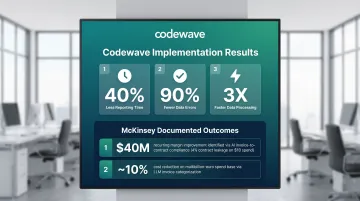
- 40% less reporting time
- 90% fewer data errors
- 3X faster data processing
Additional McKinsey case studies:
- A global biotech company identified contract leakage equal to 4% of total spend using agentic AI for invoice-to-contract compliance—representing $40M recurring margin improvement on $1B spend
- A large European financial institution reduced costs by approximately 10% of a multibillion-euro spend base using LLMs to categorize invoice-level data
Strategic Benefits Beyond Efficiency
Finance leaders gain earlier visibility into issues and spend less time on data reconciliation. That shift frees capacity for analysis and strategic decisions — moving teams from firefighting mode into forward-looking planning.
Scalability
AI agents handle growing data volumes and entity complexity without proportional headcount increases, making them most valuable during business expansion, mergers, or audit cycles.
Deloitte research shows 84% of organizations investing in AI and GenAI report gaining ROI; 70% of those investing in agentic AI reported gains. Among those same organizations, over 95% reported that their broader digital initiatives lifted market capitalization or return on equity — a sign that AI investment compounds beyond its immediate use cases.
Risks and Governance Considerations
The Explainability Challenge
Many financial institutions require transparent, auditable decision trails. Well-designed agents log every step—data source, logic applied, output produced—and flag edge cases for human review rather than acting as black boxes.
Data Quality and Integration Risks
Agents amplify poor data. IBM research citing Forrester found over 25% of organizations estimate they lose more than $5M annually due to poor data quality; 7% report losses of $25M or more. Separately, 45% of business leaders cite data accuracy and bias concerns as a top barrier to expanding AI programs.
Critical prerequisite: Organizations need clean, unified data sources before deploying agents. Prioritize ERP integration and data governance as a foundational step.
Regulatory and Compliance Considerations
Role-based access controls, permission-aware data indexing, and human approval workflows are required in regulated finance environments.
The Financial Services AI Risk Management Framework (FS AI RMF) was developed by the Cyber Risk Institute with input from 100+ financial institutions and NIST. It contains 230 Control Objectives covering bias, opacity, cybersecurity exposures, and systemic interdependencies, structurally aligned with the NIST AI RMF.
Regulators increasingly expect formal agent governance frameworks that include:
- Documented agent inventories tracking what each agent does and accesses
- Risk classifications tied to output sensitivity and decision authority
- Model lifecycle controls covering updates, retraining, and retirement
Building these controls in from the start is far less costly than retrofitting them after deployment.
How to Get Started with AI Agents for Financial Report Analysis
Start Narrow, Not Broad
Identify one high-impact, well-documented, and currently manual process as the pilot—monthly variance reporting or bank reconciliation work well.
Why narrow pilots work better:
A Deloitte report drawing on MIT research found only 5% of Generative AI pilots deliver sustained value at scale. The recommendation: shift from isolated pilots to "learning-capable systems" integrated into core workflows.
McKinsey reinforces this. Their research found 59% of executives taking a tech-first approach fail to meet transformation goals, while 78% still plan to increase AI spending. The problem isn't investment — it's implementation strategy.
Practical Implementation Approach
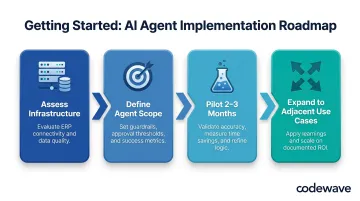
Step 1: Assess Current Infrastructure Evaluate data infrastructure and ERP connectivity. Identify data quality issues and integration gaps.
Step 2: Define Agent Scope Set clear guardrails, approval thresholds, and success metrics. Document what the agent should and shouldn't do.
Step 3: Pilot for 2-3 Months Validate accuracy and measure time savings. Track exceptions and refine logic.
Step 4: Expand to Adjacent Use Cases Apply learnings to related processes. Scale based on documented ROI.
Working with an experienced AI development firm cuts time-to-value considerably. Codewave has helped 400+ businesses across fintech and related industries design and deploy custom AI solutions with documented ROI.
The Build vs. Buy Decision
For organizations with complex or proprietary workflows, custom-built agents trained on internal data and integrated with existing ERP systems consistently outperform off-the-shelf tools. That said, they require a partner with both financial domain knowledge and AI engineering depth.
McKinsey's guidance on scaling AI in finance reinforces this approach:
- Pursue domain-by-domain transformation rather than "big bang" rollouts
- Don't wait for perfect data — deliver use cases that work with current data while strengthening the foundation
- Standardize processes before applying AI
- Pilots launched without a roadmap tied to business priorities rarely scale
Frequently Asked Questions
Can I use AI to help with my finances?
Yes, AI agents can assist with financial analysis tasks like report generation, anomaly detection, and reconciliation at the enterprise level. Consumer-facing AI tools also exist for personal finance. Business finance teams benefit most from purpose-built agents integrated with their data systems.
Which AI agent is best for finance?
There is no single "best" agent—the right choice depends on your specific workflow, existing ERP infrastructure, and governance requirements. Purpose-built agents with financial domain training consistently outperform generic LLM tools for enterprise finance use cases.
How are AI agents used in finance?
Common use cases include:
- Financial report analysis and variance explanation
- Reconciliation and close acceleration
- Audit preparation and compliance monitoring
- Fraud detection and financial forecasting
Agents handle the high-volume, repetitive analytical work so finance teams can focus on judgment-intensive decisions.
What types of financial reports can AI agents analyze?
AI agents can analyze income statements, balance sheets, cash flow statements, budget vs. actual variance reports, multi-entity consolidated reports, and audit documentation. Agents handle both structured data and unstructured commentary within these reports.
How do AI agents ensure accuracy in financial reporting?
Accuracy is maintained through several layered controls: RAG grounds outputs in retrieved source data rather than generated figures, continuous validation checks against live systems catch discrepancies, and human-in-the-loop approval workflows log every decision for audit purposes. Together, these prevent hallucination and ensure full transparency.