Introduction
Most organizations aren't short on data. They're short on the ability to act on it before the moment passes.
The average enterprise pulls data from dozens of disconnected systems — CRM, ERP, IoT sensors, transactional platforms, third-party feeds — yet strategic decisions still lean on last quarter's reports. That lag has a price: missed revenue, excess inventory, fraud losses, and equipment failures that "nobody saw coming."
Except AI can see them coming. That's the operational gap predictive analytics closes.
AI predictive analytics shifts the question from "what happened?" to "what's likely to happen next — and what should we do about it?" For organizations that execute it well, the effect compounds: sharper forecasts inform better decisions, which produce cleaner data, which improve the next forecast. The advantage builds on itself.
This article breaks down how AI predictive analytics works, where it delivers measurable business value — in healthcare, finance, retail, manufacturing, and beyond — what consistently derails implementation, and how to build a practical starting point.
Key Takeaways
- AI predictive analytics uses machine learning, statistical modeling, and historical data to forecast future outcomes with proven accuracy
- Unlike traditional reporting, AI processes millions of data points continuously, enabling faster and higher-confidence decisions
- Healthcare, financial services, retail, insurance, and manufacturing see the strongest ROI from predictive AI
- Data quality is the single biggest determinant of model accuracy — not algorithm sophistication
- Organizations that treat predictive analytics as an ongoing capability — not a one-time project — see compounding returns over time
What Is AI Predictive Analytics?
Predictive analytics, as defined by SAS, uses "data, statistical algorithms and machine learning techniques" to identify the likelihood of future outcomes based on historical data. That definition is technically correct — but it undersells what changes when machine learning enters the picture.
Traditional methods (regression models, rule-based forecasting) can handle hundreds of variables with skilled analysts. AI-powered systems process millions of variables simultaneously, surface non-linear relationships statistical models miss, and retrain automatically as new data arrives.
Understanding the Analytics Spectrum
Predictive analytics sits between two related disciplines — understanding where it falls clarifies what it actually does:
- Descriptive analytics — answers "what happened?" through historical reporting and dashboards
- Predictive analytics — answers "what is likely to happen?" through statistical and ML models applied to historical and real-time data
- Prescriptive analytics — answers "what should we do about it?" by recommending specific actions based on predictive outputs
Most organizations have mature descriptive capabilities. Predictive analytics is where competitive advantage starts to diverge. Machine learning is what makes modern predictive analytics viable at enterprise scale — it handles the volume, speed, and complexity that manual methods simply cannot.
How AI Powers the Predictive Analytics Engine
The Five-Stage Workflow
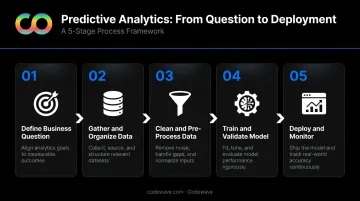
A predictive analytics initiative follows a consistent sequence regardless of industry or use case:
- Define the business question — Frame a specific, measurable problem (e.g., "Which customers are likely to churn in the next 60 days?")
- Gather and organize data — Pull from relevant sources: transactional systems, CRM, IoT sensors, third-party feeds
- Clean and pre-process data — Remove duplicates, fill gaps, standardize formats, eliminate noise
- Train and validate the model — Select the appropriate algorithm, train on historical data, test against held-out data
- Deploy and monitor — Put the model into production and track performance continuously
Key Algorithms and When to Use Them
Algorithm selection depends on the nature of the prediction:
- Regression analysis — Best for continuous outcomes like sales revenue, demand volume, or price forecasting
- Decision trees — Well-suited to classification tasks like churn prediction, credit risk scoring, or fraud triage
- Neural networks — Most effective for complex pattern recognition in large, multi-variable datasets such as fraud detection, health risk modeling, or sensor anomaly detection
Why Data Quality Determines Everything
The most common misconception about AI predictive models is that better algorithms compensate for poor data. They don't. AI amplifies both good data and bad data — a model trained on inconsistent or incomplete records produces confident, wrong predictions.
Gartner reports that poor data quality costs organizations at least $12.9 million per year on average, and 63% of organizations either don't have, or are unsure if they have, the right data management practices for AI. This isn't a technical problem. It's a governance problem that must be addressed before any model selection discussion begins.
Even a well-governed, cleanly trained model has a shelf life. That's the problem model drift introduces.
Model Drift: The Silent Accuracy Killer
Predictive models degrade as the world around them changes. IBM defines model drift as the degradation of ML performance caused by changes in real-world data or the relationship between inputs and outputs. A fraud detection model trained on 2022 transaction patterns may perform poorly against 2025 fraud tactics. A demand forecasting model built before a supply chain disruption will produce systematically biased outputs after it.
Continuous monitoring and scheduled retraining are prerequisites for sustained accuracy, not afterthoughts.
Predictive AI Meets Generative AI
Organizations are increasingly connecting predictive outputs to generative AI systems — and the operational impact is tangible. According to MIT Sloan Management Review, LLMs can reframe complex model outputs into plain-language recommendations, giving non-technical stakeholders the context they need to act. The progression moves from "what will happen?" (predictive) to "here's what to do about it" (generative acting on predictive signals). For organizations serious about closing the gap between insight and action, this convergence is the architecture worth building toward now.
Where AI Predictive Analytics Delivers Real Business Value
Healthcare
AI predictive models analyze patient history, lab results, and population data to enable earlier, more accurate clinical decisions. In a prospective multicenter evaluation, a machine-learning sepsis prediction algorithm was associated with 39.5% lower in-hospital mortality and 32.3% shorter hospital stays compared to control groups.
Beyond individual patient care, predictive models support hospital operations: forecasting admission volumes, optimizing staffing schedules, and identifying patients at elevated readmission risk before discharge. Codewave's healthcare analytics work uses TensorFlow and Azure Machine Learning to analyze patient data for outcome prediction — including early complication flagging — as part of its broader healthcare IT practice.
Financial Services and Fintech
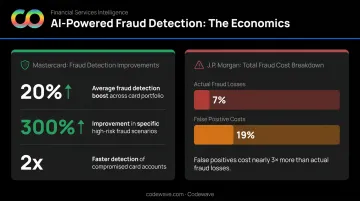
Fraud detection offers one of the clearest ROI cases for predictive AI. Mastercard reported that AI enhancements boost fraud detection rates by 20% on average and up to 300% in specific scenarios, while also doubling compromised-card detection speed.
The economics extend beyond detection rates. According to J.P. Morgan, actual fraud losses represent only 7% of total fraud cost — false positives account for 19%. Better predictive models reduce both, cutting losses while eliminating the overhead of investigating flagged legitimate transactions.
Credit risk modeling follows similar logic: more accurate scoring reduces default rates and improves capital allocation across lending portfolios.
Retail and E-commerce
McKinsey reports that AI can reduce inventory levels by 20%-30% by improving demand forecasting, alongside logistics cost reductions of 5%-20%. Better predictions of what customers will want, when, and where, means less capital tied up in the wrong inventory.
Personalization compounds the effect. According to Harvard Business Review, Amazon's recommendation engine influences roughly 50% of the 4,000 products it sells every minute. That's predictive modeling driving conversion and loyalty at scale.
Codewave's retail analytics work uses Python-based predictive models combined with Power BI dashboards to forecast demand shifts, prioritize restocking, and reduce holding costs — with practical applications like anticipating regional demand surges for seasonal products ahead of peak periods.
Insurance
Insurers apply predictive AI across claims fraud detection, underwriting risk assessment, and loss forecasting. A 2025 peer-reviewed study on insurance claims fraud detection reported its deep learning model achieved 92% accuracy in identifying fraudulent claims — a meaningful improvement over rule-based systems prone to both false positives and missed fraud.
Codewave's insurance work includes AI-powered claims flagging systems that analyze claim history, detect document discrepancies, and trigger automated reviews when anomalies appear — reducing fraudulent payouts through pattern recognition rather than manual audits.
Manufacturing, Energy, and Transportation
Deloitte reports that predictive maintenance delivers measurable gains across operations:
- Reduces unplanned downtime by 20%-50%
- Cuts maintenance costs by 10%-40%
- Targets one of manufacturing's largest cost drivers — NIST estimates maintenance represents 15%-70% of cost of goods produced
These systems use IoT sensor data — vibration, temperature, pressure — to identify equipment failure signatures before breakdowns occur. Codewave's energy sector implementations have delivered a 40% reduction in unplanned downtime through real-time equipment monitoring using platforms including Siemens MindSphere and AWS IoT Analytics.
The Business Benefits You Can Actually Measure
Faster, Higher-Confidence Decisions
Forrester found that firms with advanced analytics capabilities are nearly 3x more likely to report double-digit year-over-year revenue growth than less mature peers. The performance gap extends further: an HBR Analytic Services survey summarized by Google Cloud found that 57% of data leaders have an enterprise strategy for AI-augmented decision-making — versus just 17% of late adopters. Those leaders outperform on both operational efficiency (81% vs. 58%) and customer retention (77% vs. 45%).
The advantage isn't just having better predictions. It's the speed at which those predictions reach decision-makers. Traditional analytics cycles produce insights that are stale by the time they're reviewed. Real-time predictive models surface signals as conditions change.
Cost Reduction and Operational Efficiency
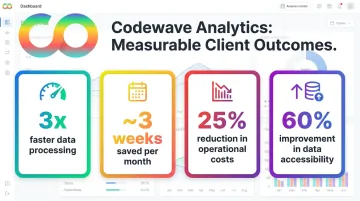
Codewave's analytics implementations have produced consistent benchmarks across AI and data engagements:
- 3x faster data processing
- ~3 weeks saved per month in manual data work
- 25% reduction in operational costs
- 60% improvement in data accessibility
McKinsey separately reports that AI forecasting engines can automate up to 50% of workforce management tasks, producing 10%-15% cost reductions in those functions.
Proactive Risk Management
Fraud, equipment failures, customer churn, and supply chain disruptions all have detectable precursors in data — patterns that surface before losses materialize. Predictive analytics turns those signals into early warnings rather than after-the-fact reports.
Organizations that build models around these signals shift from damage control to prevention, redirecting resources toward growth instead of recovery.
Common Challenges and How to Navigate Them
Data Readiness Gaps
Gartner predicts that through 2026, organizations will abandon 60% of AI projects unsupported by AI-ready data. The failure point is rarely algorithm complexity — it's fragmented pipelines, inconsistent data formats, and missing historical records that make model training impossible or unreliable.
The practical fix: conduct a data audit before selecting any tool or platform. Identify what data exists, where it lives, how clean it is, and what's missing. This step alone saves months of rework.
Model Bias and Explainability
AI models trained on biased historical data can produce predictions that are systematically wrong for specific populations — a serious concern in healthcare and financial services where errors carry regulatory and ethical consequences. Regulators are responding: the FDA's 2025 draft guidance for AI-enabled medical devices specifically addresses bias-related risks, and the OCC has updated model risk management guidance for banking models.
Addressing these risks requires a layered approach:
- Diverse training datasets that reflect the actual populations the model will serve
- Explainable AI (XAI) techniques that make model logic auditable by non-technical stakeholders
- Governance frameworks aligned with NIST's AI Risk Management Framework
Organizational Adoption
Accurate predictions create zero value if stakeholders don't act on them. McKinsey reports that 74% of organizations cite inaccuracy as a top AI risk concern — meaning even well-performing models face trust barriers.
Closing that trust gap means embedding predictive outputs into the workflows people already use — not delivering them as standalone data science reports. Effective implementation includes:
- User training so teams understand what the model predicts and what it doesn't
- Clear communication of model logic, confidence levels, and known limitations
- Workflow integration that surfaces predictions inside existing tools rather than requiring a separate platform
A model that sits outside daily workflows rarely changes behavior — and behavior change is where the actual value is captured.
How to Implement AI Predictive Analytics in Your Organization
Start With One Focused Business Problem
Pick one specific, measurable question: "Which customers are likely to churn in the next 90 days?" or "Which equipment is most likely to fail this quarter?" A focused scope produces faster results, builds internal proof points, and creates momentum for broader adoption.
Assess Your Data Infrastructure
Before choosing any platform or algorithm, evaluate:
- Which data sources exist and where they live
- Data quality, completeness, and historical depth
- What architecture is needed for model training and real-time inference
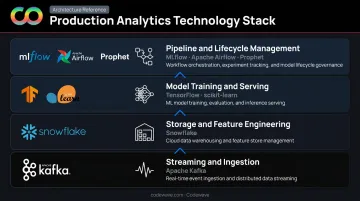
A production-ready analytics stack typically includes tools across four layers:
- Streaming & ingestion: Apache Kafka for real-time event streaming
- Storage & feature engineering: Snowflake for data warehousing
- Model training & serving: TensorFlow, scikit-learn
- Pipeline & lifecycle management: MLflow, Apache Airflow, Prophet for time-series forecasting
Choose Between Building, Buying, or Partnering
Three paths exist, each with distinct trade-offs:
| Approach | Pros | Cons |
|---|---|---|
| Build in-house | Maximum control, customization | High resource requirement, long timelines |
| Buy off-the-shelf | Faster deployment | Less customizable, may not fit specific use cases |
| Partner with a specialist | Domain expertise + technical depth | Requires vendor alignment |
Each path has its place, but for most organizations running their first predictive analytics initiative, the trade-offs favor partnership. Combining industry-specific context with hands-on implementation experience shortens time-to-value — a model that accounts for your vertical's data patterns from day one needs far less iteration than one built generic and tuned later. Codewave's QuantumAgile™ approach addresses this directly, running parallel scenario testing rather than sequential waterfall cycles to reach validated outcomes faster.
Establish Measurement Frameworks Before Launch
Define success metrics before deployment — not after. Without a baseline, it's impossible to demonstrate ROI or know when a model needs retraining.
Track two categories simultaneously once deployed:
- Business KPIs: fraud rate, churn rate, inventory carrying cost, equipment uptime
- Model performance metrics: accuracy, precision, recall, and drift signals
Build monitoring dashboards that surface both in a single view, so operational teams and data teams stay aligned on what's working.
Frequently Asked Questions
What is the difference between AI and predictive analytics?
Predictive analytics is a discipline focused on forecasting future outcomes from historical data. AI — specifically machine learning — is the technology that makes modern predictive analytics faster, more scalable, and more accurate than earlier statistical methods. They're complementary: ML is the engine, predictive analytics is the application.
Which industries benefit most from AI predictive analytics?
Healthcare, financial services, retail, insurance, manufacturing, and logistics consistently see the strongest ROI. These industries share two characteristics: large historical datasets and high-stakes decisions where accurate forecasting translates directly into cost savings or revenue protection.
What data is needed to implement AI predictive analytics?
Models require historical data relevant to the prediction target — past transactions for fraud detection, patient records for health risk modeling, sensor readings for predictive maintenance. Data quality, completeness, and volume all directly impact accuracy. Fragmented or inconsistent data is typically what slows or derails implementation.
How accurate is AI predictive analytics?
Accuracy varies based on data quality, algorithm choice, and problem complexity. Well-designed models with clean, representative data can perform at high levels — but regular monitoring and retraining are essential as real-world conditions change.
What are the biggest challenges in AI predictive analytics implementation?
Most implementations run into the same three roadblocks:
- Poor data quality and fragmented infrastructure
- Model bias and explainability gaps in regulated industries
- Organizational resistance to acting on AI-generated predictions
How long does it take to implement an AI predictive analytics solution?
A focused, single-use-case deployment can produce initial results in weeks. Enterprise-wide transformations typically take several months, with ongoing iteration as models are refined — and organizations with clean, centralized data move much faster.