According to Salesforce research, only 3% of marketing teams have fully implemented AI — meaning the vast majority are still leaving significant analytical capability on the table. Traditional analytics tells you what happened last month. AI marketing analytics tells you what's happening now and what will happen next.
This guide covers what AI marketing analytics actually is, why it matters for growth, how it works step by step, and how to get started — without the hype.
Key Takeaways
- AI marketing analytics combines ML, NLP, and predictive models to surface forward-looking insights faster than any manual process
- Teams shift from reactive reporting to proactive decisions, with measurable gains in targeting accuracy and budget efficiency
- Core use cases: customer segmentation, lead scoring, sentiment analysis, campaign optimization, and anomaly detection
- Clean, unified data and clear business objectives are prerequisites for any model to deliver reliable outputs
- Codewave builds custom AI marketing analytics solutions with a documented track record of 3X faster data processing and 40% less reporting time
What Is AI Marketing Analytics?
AI marketing analytics applies machine learning, natural language processing, and predictive modeling to marketing data. The result is faster, more granular insight than any human analyst team can produce at scale — including pattern detection across channels, predictive scoring, and automated recommendations.
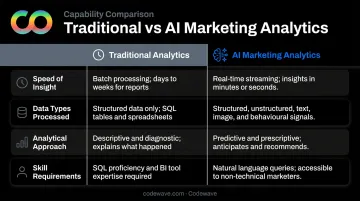
The gap between traditional and AI-powered analytics is wider than most marketing teams expect — and the table below shows exactly where that gap shows up.
Traditional vs. AI Marketing Analytics
| Dimension | Traditional Analytics | AI Marketing Analytics |
|---|---|---|
| Speed of insight | Batch reporting (daily/weekly) | Near real-time |
| Data types processed | Structured data only | Structured + unstructured (text, social, voice) |
| Approach | Descriptive (what happened?) | Predictive + prescriptive (what will happen, what should we do?) |
| Skill requirements | SQL, spreadsheets | ML expertise or a capable technology partner |
Three technologies power everything under the hood:
- Machine learning — identifies patterns in historical data and makes predictions (segmentation, lead scoring, churn risk)
- Natural language processing — analyzes unstructured content like social posts, reviews, and support transcripts
- Predictive modeling — forecasts future campaign performance, conversion rates, or customer behavior before they materialize
IDC research cited by Box found that only 26% of companies use mostly automated methods to analyze unstructured content — meaning the majority of marketing signal from social media, reviews, and email replies goes largely unread.
Why AI Marketing Analytics Is Critical for Business Growth
From Reactive Reporting to Predictive Decisions
Traditional marketing teams react. They pull last month's campaign report, spot a performance drop, investigate, and course-correct — by which point the budget has already been misallocated for weeks.
AI changes that sequence: instead of flagging a problem after it compounds, predictive models identify leading indicators of a performance shift before it becomes expensive — so budget reallocation happens in days, not the following quarter.
Personalization at Scale
Modern customers expect experiences that feel tailored to them. The challenge is that manual segmentation — grouping customers by age, geography, or broad behavior — produces segments that are too coarse to drive meaningful personalization.
AI analyzes individual behavioral signals across every channel and maps them to the right message, at the right time, on the right platform. Salesforce's State of Marketing data reports that 61% of marketers are already using hyperpersonalization — a capability that depends entirely on AI-driven analytics to execute at scale.
Team Productivity Gains
Deloitte Digital reports that generative AI users saved an average of 11.4 hours per week. For marketing teams, those hours typically come from eliminating manual data extraction, report generation, and dashboard maintenance — tasks that AI automates entirely.
That shift frees analysts to focus on interpretation and strategy rather than data wrangling.
Additional Business Benefits
Productivity gains are only part of the picture. AI marketing analytics also delivers:
- Sharper ROI through precise targeting and reduced wasted spend
- Real-time anomaly detection that catches campaign issues before they escalate
- Richer customer understanding through cross-channel behavioral analysis
- Faster, more confident decisions that build competitive advantage over time
How AI Marketing Analytics Works – Step by Step
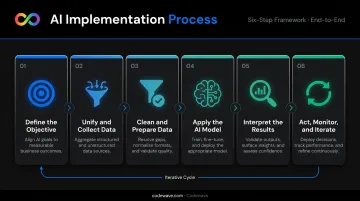
This is the sequence of decisions that determines whether AI analytics delivers accurate, actionable outputs — or produces expensive noise.
Three failure modes kill most implementations before they start:
- Skipping data quality validation
- Defining goals too vaguely to measure
- Treating the process as a one-time event rather than an ongoing cycle
Step 1 – Define the Objective
Specify the exact marketing question the analysis will answer: reducing churn, improving lead quality, or optimizing ad spend across channels. Vague goals produce unfocused models.
A useful test: can you articulate the success metric before you build anything? If not, the objective isn't defined enough.
Step 2 – Unify and Collect Data
Aggregate data from every relevant source — paid ads, CRM, web analytics, email platforms, social channels — into a single, accessible data layer.
Siloed data is the leading cause of inaccurate AI outputs. When Google Ads data lives separately from CRM data and email engagement data, the model only sees a fraction of the picture.
Step 3 – Clean and Prepare the Data
Normalize naming conventions, remove duplicates, resolve nulls, and validate quality before any model runs. AI models amplify data quality problems — a dirty dataset doesn't just produce wrong answers, it produces confidently wrong answers that are harder to catch.
Common issues at this stage: duplicate leads with different email formats, inconsistent campaign naming across platforms, and mismatched date ranges between data sources.
Step 4 – Apply the AI Model
Match the tool to the problem:
- ML models for segmentation or lead scoring
- NLP for sentiment analysis and social listening
- Predictive models for forecasting campaign outcomes
- Anomaly detection algorithms for real-time monitoring
Step 5 – Interpret the Results
AI surfaces patterns. Human expertise provides context: explaining why a trend matters and what it means for campaign decisions. Skipping this interpretation layer is where teams misread outputs and make costly pivots based on statistical noise.
Step 6 – Act, Monitor, and Iterate
Apply insights to actual campaign changes:
- Reallocate budget toward higher-performing channels
- Adjust audience segments based on predicted behavior
- Personalize content for distinct cohorts
- Shift bid strategies in response to real-time signals
Then monitor against the original KPIs defined in Step 1. If results diverge from predictions, that gap is itself a data point — feed it back into the model and refine.
AI Marketing Analytics in Action – A Case Walkthrough
A mid-sized B2B software company runs paid and email campaigns across multiple channels. They can't identify which audiences convert, why certain campaigns underperform, or how to allocate budget effectively. All data lives in separate platforms.
The team starts by defining a clear objective — improve lead-to-conversion rate by 20% — then connects Google Ads, HubSpot CRM, their email platform, and website analytics into a unified data layer. After cleaning the data (resolving duplicate leads, standardizing campaign naming conventions), an ML model surfaces a standout behavioral pattern: IT decision-makers who engage with technical content on Tuesday afternoons convert at significantly higher rates than any other segment.
That insight drives immediate action: shifted ad scheduling, personalized email send times, and content tailored by audience segment.
Two mistakes teams commonly make at this stage:
- Acting on a single data point rather than a sustained pattern
- Failing to set up monitoring dashboards to verify whether the changes actually moved the needle
Conversion rates improve, reporting time drops, and the AI model keeps refining its predictions as new campaign data flows in. Each iteration makes the next recommendation sharper — which is why AI marketing analytics delivers compounding returns, not diminishing ones.
How Codewave Can Help You Build AI-Driven Marketing Analytics
Codewave is an Austin-based enterprise technology consulting firm that designs and builds custom AI marketing analytics solutions for businesses that need more than an off-the-shelf platform.
Their analytics tech stack covers the full pipeline: TensorFlow for ML model development, Apache Kafka for real-time data streams across multi-channel marketing stacks, Snowflake for scalable data warehousing, and Power BI for visualization and automated reporting.
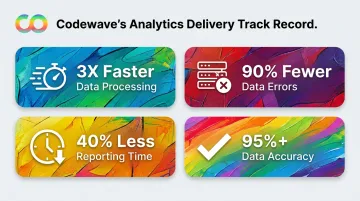
Across 400+ client engagements spanning 15+ industries, Codewave's documented outcomes include:
- 3X faster data processing
- 90% fewer data errors
- 40% less reporting time
- 95%+ data accuracy across analytics deployments
For marketing teams, Codewave builds explainability directly into model outputs. Using SHAP and LIME, they translate complex model decisions into plain-language reasoning that non-technical stakeholders can understand and act on — closing the trust gap that stalls AI adoption.
Engagements typically cover:
- Unifying fragmented marketing data across channels into a governed, single source of truth
- Building custom ML models for segmentation, lead scoring, or campaign performance prediction
- Automating reporting and anomaly detection to reduce manual data work
- Ongoing model optimization as campaign data and market conditions evolve
Codewave's ImpactIndex™ model ties engagements to measurable business outcomes — not just implementation hours — and post-launch support includes continuous model monitoring and iterative refinement as new data patterns emerge.
Conclusion
AI marketing analytics changes what marketing teams can do with data — not just how quickly they can report on it. The real shift is from describing past performance to anticipating what comes next, then acting on that before the window closes. Teams that operate this way move from reactive to deliberate, making decisions grounded in evidence rather than instinct.
The organizations that build lasting advantages treat AI analytics as an ongoing discipline: refining models as market conditions shift, closing the loop between insight and execution, and building internal trust in data-driven decisions. Those that deploy it once and move on will find model accuracy eroding as data assumptions drift and consumer behavior changes around them.
That durability starts small. Define one clear objective, get the data quality right, and run a focused pilot. What compounds over time isn't the technology — it's the organizational muscle for using it well.
Frequently Asked Questions
What is AI marketing analytics?
AI marketing analytics applies machine learning, NLP, and predictive models to marketing data to uncover patterns and generate actionable insights at a speed no human analyst can match. Traditional analytics describes what already happened. AI analytics is predictive and prescriptive — it tells teams what's likely to happen next and what to do about it.
How is AI used in marketing analytics?
Primary applications include automating data collection and normalization, segmenting audiences with ML, predicting campaign outcomes before they occur, detecting performance anomalies in real time, scoring leads by conversion likelihood, and enabling natural-language querying of marketing data without SQL expertise.
Is there an AI tool for marketing analytics?
Yes — multiple platforms exist, from embedded analytics within CRM and ad tools to purpose-built ML and NLP platforms. The right choice depends on business size, data complexity, and whether your team needs an off-the-shelf solution or a custom-built system integrated into your existing stack.
What are the biggest benefits of AI marketing analytics?
The core benefits: shifting from reactive to predictive decision-making, enabling hyper-personalization across large, diverse audiences, automating reporting to reclaim analyst hours, and improving ROI through more precise budget allocation and targeting.
How do I get started with AI marketing analytics?
Define a specific business objective first, then unify and clean your marketing data sources. Start with a focused pilot — lead scoring or campaign forecasting work well — measure results, and scale from there. Data quality and goal clarity are prerequisites; no model delivers reliable outputs without both.
What are the most common implementation challenges?
Three barriers come up repeatedly: poor data quality (siloed or inconsistent data undermines model accuracy), lack of internal AI expertise, and the "black box" problem, where AI outputs are difficult to explain to stakeholders without explainability features or human interpretation layers in your reporting.