The adoption numbers reflect this shift. Salesforce's 2024 State of Marketing survey of nearly 4,500 marketing leaders found 45% actively use generative AI in their marketing workflows, with another 43% experimenting with it. Meanwhile, B2B websites typically convert at just 2% to 3% of visitors — meaning the overwhelming majority of inbound traffic leaves without any meaningful engagement.
The gap isn't traffic. It's response. Most teams deploy bots only for basic lead capture — a name, an email, a form submission. That's a fraction of what these systems can do. This guide breaks down the full operational sequence: how AI marketing bots detect intent, initiate conversations, qualify prospects, and route them toward conversion.
Key Takeaways
- AI marketing bots use NLP and behavioral signals to detect, engage, and qualify visitors automatically
- They operate in a defined sequence: detect intent → initiate conversation → qualify → route or convert
- Bot types range from simple lead-capture widgets to full-cycle AI agents that handle objections and book meetings
- 41% of meetings booked via conversational AI happen outside business hours — a direct pipeline advantage
- CRM-integrated bots create measurable gains in lead response time, conversion rates, and pipeline quality
What Is an AI Marketing Bot?
An AI marketing bot is software that uses artificial intelligence — specifically NLP, machine learning, and behavioral data — to engage website visitors, qualify prospects, and guide them toward a conversion action without manual intervention.
The operational problem they solve is concrete: most marketing teams generate inbound traffic that never gets engaged in real time. Visitors land on a pricing page, spend two minutes reading, and leave — no conversation started, no lead captured. AI marketing bots step in at that moment, before the session ends.
What an AI Marketing Bot Is Not
Two distinctions matter here:
- Rule-based chatbots follow scripted decision trees, responding to predefined triggers with predefined answers. When a visitor goes off-script, the conversation breaks down.
- General-purpose AI assistants (like ChatGPT used internally by a marketing team) are tools for content creation and research — not visitor engagement systems embedded in live conversion flows.
IBM distinguishes these clearly: rule-based systems operate on predefined scripts, while AI chatbots have genuine learning potential for more complex interactions. Gartner's definition of conversational AI platforms emphasizes the ability to build, deploy, and scale virtual assistants that simulate human conversation — not just respond to fixed menu choices.
Types of AI Marketing Bots
| Bot Type | Scope | Key Capability |
|---|---|---|
| Lead-capture chatbot | Top of funnel only | Collects contact fields; limited qualification |
| Conversational AI widget | Top + mid funnel | NLP-driven conversation; handles open-ended input |
| AI SDR tool | Mid + bottom funnel | Qualifies against ICP criteria; books meetings |
| Full-cycle AI agent | Entire buyer journey | Maintains context across touchpoints; handles objections; routes autonomously |
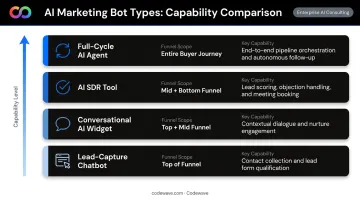
The distinction matters operationally. A basic chatbot follows rigid scripts. A full-cycle AI agent maintains conversation context, personalizes responses based on prior interactions and firmographic data, and takes action — scheduling meetings, updating CRM records, triggering follow-up sequences — without human intervention.
How AI Marketing Bots Capture and Convert Leads
AI marketing bots operate through a defined sequence of stages. Each stage builds on the previous one, and where a bot stops in that sequence determines whether it produces activity metrics or actual pipeline.
Lead Detection and Engagement Initiation
The bot doesn't wait to be clicked. It triggers based on behavioral signals:
- Time on page — a visitor spending 90+ seconds on a pricing page signals higher intent than a 10-second bounce
- Scroll depth — reaching the bottom of a features page suggests active evaluation
- Page type — pricing and demo pages warrant different bot logic than blog posts
- Referral source — a visitor arriving from a competitor comparison site is further along the buying journey
- Return visits — a second or third visit to the same page is a meaningful intent signal
- Firmographic data — tools like Qualified use known data points to identify target accounts before a conversation starts
The opening message is where most bots fail. Generic openers — "Hi! How can I help you today?" — ignore all the context the bot just collected. A better initiation references the visitor's behavior: "Looks like you're evaluating our enterprise plan — want to see how teams your size typically get started?"
Qualification Through Conversation
Once engaged, the bot moves into qualification. This is where AI marketing bots genuinely separate from scripted chatbots.
The NLP layer interprets visitor responses — including open-ended, unstructured answers — and maps them against qualification criteria: company size, role, use case, urgency, and budget fit. Follow-up questions adapt based on prior answers rather than following a fixed script.
Real-time lead scoring runs in parallel. As the conversation progresses, the bot categorizes the visitor as a target account, unqualified, or needs-nurture — and adjusts its behavior accordingly. A visitor who identifies as a VP of Sales at a 500-person company evaluating enterprise software gets a different path than someone who lists "just browsing" as their intent.
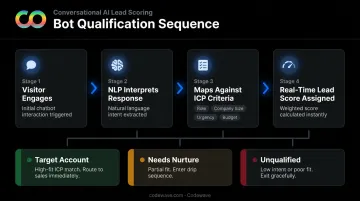
Bots that can only collect contact fields produce lead volume. Bots that interpret complex responses and qualify against ICP criteria produce qualified lead volume. Those aren't the same metric.
Personalization at this stage sharpens accuracy further. Referencing the page the visitor came from, the company they work for (via IP or cookie data), or a prior conversation significantly improves qualification precision — and reduces the number of unqualified leads passed to sales.
Routing, Scoring, and Conversion
Once a lead clears qualification, routing logic determines what happens next. There are three possible destinations:
- Live rep handoff — with full conversation context passed, so the rep doesn't restart the conversation from scratch
- Automated meeting booking — the bot presents calendar availability and confirms a time without human involvement
- Nurture sequence — triggered email or content flow for leads who showed interest but aren't ready for a sales conversation
The output the bot produces matters as much as the conversation it had. A booked meeting with a completed CRM record and full conversation log is a materially different pipeline asset than a raw email address with no context.
Salesloft's 2024 Conversational AI Marketing Trends Report, analyzing over 30 million Drift conversations, found that high-intent playbooks booked 2x as many meetings and sourced 3x more opportunities than generic playbooks. The difference wasn't the bot itself — it was the depth of the qualification and routing logic deployed.
Where AI Marketing Bots Fit in the Marketing Funnel
Bots serve different purposes depending on where in the funnel they're deployed:
- Top of funnel (blog pages, gated content) — capture contact information, assess initial intent, route to nurture or product content
- Mid funnel (product and feature pages) — qualify against ICP criteria, surface relevant case studies, identify purchase timeline
- Bottom of funnel (pricing and demo pages) — convert high-intent visitors directly into booked meetings or trial starts
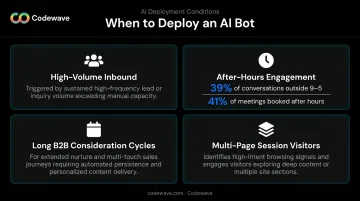
The deployment conditions where bots perform best:
- High-volume inbound traffic — where human reps can't respond to every visitor in real time
- After-hours engagement — a Salesloft/Drift report found 39% of website conversations happened outside 9-to-5 hours, and 41% of meetings were booked outside standard business hours
- Long consideration-cycle B2B products — where multiple visits across days or weeks require consistent, contextual engagement
- Multi-page session visitors who've viewed three or more pages in a single session and shown clear intent signals
The right deployment conditions depend heavily on the vertical — and so does the conversion goal. For teams like Codewave's clients, the target outcome shifts by industry:
- Fintech — pre-qualify leads for regulated products before a compliance-sensitive conversation with a human rep
- Healthcare — handle appointment scheduling at scale without overwhelming front-desk staff
- Retail and B2B commerce — surface product fit and route prospects to account-specific pricing conversations
Key Metrics That Prove AI Marketing Bot Performance
Activity metrics — sessions started, messages sent, conversations initiated — tell you the bot is running. They don't tell you it's working.
The metrics that actually matter:
| Metric | What It Measures |
|---|---|
| Inbound conversion rate | Visitors converted to qualified opportunities |
| Speed-to-lead | Time from first visit to first human contact |
| Meeting booking rate | Bot-initiated conversations resulting in scheduled demos or calls |
| Opportunities sourced | Pipeline created directly from bot-qualified leads |
| Pipeline quality | Close rate and deal size of bot-sourced leads vs. other channels |
Harvard Business Review research found that firms contacting prospects within one hour were nearly 7x more likely to qualify the lead than firms that waited — a gap that AI marketing bots, with always-on engagement, are built to close.
Vendor-reported case studies show meaningful outcomes. Cin7 reported a 7x increase in sales meetings after deploying Qualified's AI SDR agent. Intercom's Ringostat case study documented 76% lead conversion through bot-assisted qualification. Both figures are vendor-reported — useful as directional signals, not universal benchmarks.
Custom vs. Off-the-Shelf: Why Implementation Depth Matters
Those outcome gaps — 7x meetings for one company, 76% conversion for another — often trace back to how the bot was built, not which platform was chosen. Off-the-shelf tools follow generic qualification flows, standard CRM field mappings, and routing logic that isn't calibrated to any specific pipeline.
Custom-built bots map logic directly to a client's ICP criteria, sales stages, and routing rules. In Codewave's conversational AI and AI agent engagements, this means:
- Qualification questions reflect what the sales team actually needs to know
- Scoring thresholds match how that business defines a qualified lead
- Handoff logic passes the exact context a rep needs to move the deal forward
The result is measurable in pipeline terms, not engagement volume. Codewave's automation implementations have delivered outcomes including 60% time saved in manual marketing work, 3x faster lead conversions, and 40% faster response times — metrics tied to how the bot logic was built, not just which platform was deployed.
Frequently Asked Questions
Which AI chatbot is best for marketing?
It depends on your use case. Evaluate bots on pipeline metrics — conversion rate, meetings booked, opportunities sourced — not feature lists alone. The right choice is the one calibrated to your ICP and built into your sales workflow.
Are AI chatbots legal?
AI marketing bots are legal in most jurisdictions, but data privacy regulations apply. GDPR requires transparency about automated profiling; CCPA mandates notice at collection for California residents; SB-1001 restricts undisclosed bots used to influence purchases. Disclosure requirements vary by market.
How do AI marketing bots qualify leads automatically?
Bots qualify leads through NLP-driven conversation: they interpret visitor responses, map them against ICP criteria (role, company size, intent, urgency), and score leads in real time. High-fit prospects route to sales or a booking flow; lower-fit visitors enter nurture sequences.
What is the difference between an AI marketing bot and a traditional chatbot?
Traditional chatbots follow scripted decision trees and fail when visitors respond outside the script. AI marketing bots use machine learning and NLP to handle natural language, adapt responses based on context, and improve over time. The functional gap shows up most clearly when visitors give open-ended or unexpected answers.
How do AI marketing bots integrate with CRM systems?
Most platforms connect to HubSpot and Salesforce via native integrations or APIs. Synced data typically includes lead records, conversation transcripts, qualification scores, meeting bookings, and campaign activity. Setup requires mapping bot output fields to your CRM schema, which most major platforms handle through guided configuration.
Can AI marketing bots replace human sales representatives?
No, and that's not the design intent. Bots handle volume-heavy, repetitive top- and mid-funnel tasks at scale. Complex deal conversations, relationship development, and strategic negotiations still require human judgment. Codewave builds AI engagement systems around this division: the bot qualifies and books; the rep closes.