The concept is widely discussed. The real business impact shows up in the metrics: how fast leads are contacted, how consistently they are qualified, and how much manual effort disappears from the front of the funnel. According to an HBR audit of 2,245 US companies, 23% never responded to online sales leads at all — and firms that contacted leads within an hour were nearly 7x more likely to have a meaningful conversation than those that waited longer.
This article covers why chatbots for lead generation create measurable advantages in practice — across conversion quality, qualification consistency, and sales enablement — not just what they claim to do.
TL;DR
- Chatbots for lead generation engage website visitors in real time, ask qualifying questions, and route high-intent prospects to sales workflows automatically
- Unlike static forms, chatbots respond instantly and consistently — no matter the time zone or team availability
- Businesses using chatbots typically see higher conversion rates, cleaner lead data, and stronger sales productivity across industries
- CRM integration unlocks automatic lead scoring, segmentation, and handoff — compounding value without manual input
- Chatbots act as a qualification layer, not a sales replacement, so reps focus only on leads most likely to convert
What Is a Lead Generation Chatbot?
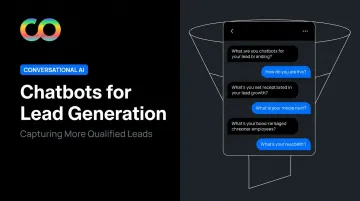
A lead generation chatbot is a conversational AI tool deployed on a website, landing page, or messaging channel that initiates dialogue with visitors, gathers qualifying information, and routes or stores that data for sales follow-up — without a human agent.
These tools are typically deployed on:
- Website homepages and pricing pages — where intent is highest
- High-converting landing pages tied to paid campaigns
- Messaging channels like WhatsApp or embedded chat widgets
- Ad-linked flows where the bot continues the conversation started by the ad
A lead generation chatbot is a dynamic qualification engine — its purpose is to determine whether a visitor fits your ideal customer profile and, if they do, move them efficiently toward the next step in your sales process. That distinction separates it from a static form with a chat wrapper.
Modern chatbots operate across multiple channels simultaneously, so a single qualification logic can run on your pricing page and your WhatsApp line at once — with all data flowing into the same CRM.
Key Advantages of Chatbots for Lead Generation
The three advantages below are focused on operational and commercial outcomes — the kind that appear in pipeline reports, sales productivity metrics, and marketing ROI, not engagement dashboards.
Instant Engagement That Prevents Lead Decay
Lead decay is one of the most documented problems in digital lead generation. The MIT/InsideSales study analyzing over 15,000 leads and 100,000 call attempts found that the odds of contacting a lead at the 30-minute mark were 100x lower than at 5 minutes — and qualification odds dropped 21x.
Chatbots eliminate this window entirely. When a visitor lands on a pricing or product page showing high intent, the bot opens a conversation, captures intent, and begins qualification before the visitor considers leaving.
Why this matters commercially:
- If paid traffic drives visitors to a page and no one responds within the visit window, acquisition spend converts at a fraction of its potential — the cost per lead rises with no corresponding gain
- Salesloft's conversational AI report found that 39% of chatbot conversations and 41% of meetings booked occurred outside business hours — time when no sales rep would have been available
- The chatbot doesn't replace the human conversation; it preserves the lead long enough for a sales rep to take over with full context
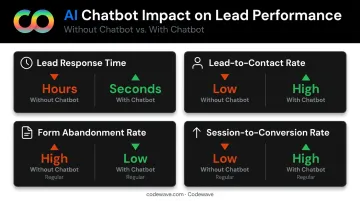
KPIs directly impacted:
| Metric | How chatbots move it |
|---|---|
| Lead response time | Drops from hours to seconds |
| Lead-to-contact rate | Increases as fewer leads go cold |
| Form abandonment rate | Decreases with conversational engagement |
| Session-to-conversion rate | Increases by capturing intent before exit |
For Fintech, Insurance, and SaaS — where visitors compare multiple providers in a single session — response speed isn't a nice-to-have. It's the difference between a captured lead and a lost one.
Consistent Lead Qualification That Improves Pipeline Quality
Inconsistent qualification is one of the most common causes of wasted sales time. When different reps ask different questions — or skip qualification entirely under volume pressure — the CRM fills with low-fit leads that consume follow-up resources without converting.
Chatbots solve this structurally. Every visitor goes through the same qualification flow regardless of time of day, traffic volume, or team bandwidth. Budget, company size, use case, decision timeline, and contact details are captured the same way, every time.
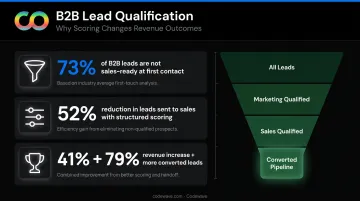
MarketingSherpa's B2B benchmark research found that 73% of B2B leads are not sales-ready at the point of initial contact. A structured lead scoring approach reduced leads sent to sales by 52% while increasing revenue 41% and converted leads 79%.
What consistent qualification actually delivers:
- A cleaner signal-to-noise ratio in the CRM — sales teams receive structured data, not partial form submissions or vague inquiries
- Automated lead scoring so reps prioritize by fit rather than guesswork
- Shorter sales cycles because disqualification happens at the front of the funnel, not after three follow-up calls
KPIs directly impacted:
- Lead quality score
- Sales-accepted lead rate
- CRM data completeness
- Cost per qualified lead
- Average sales cycle length
This matters most at scale and in B2B contexts — Healthcare, Fintech, Transportation — where qualification criteria are complex and a single missed question can route the wrong lead into a sales cycle it was never going to close.
Richer Lead Intelligence That Enables Personalized Follow-Up
A chatbot interaction captures more than a name and email. Through branching conversational logic, it collects behavioral signals, stated pain points, use-case context, and decision-stage information that a static form cannot gather without overwhelming the visitor.
Each answer a visitor gives triggers a context-specific follow-up question. By the end of a 3-minute conversation, the chatbot has built a lead profile that would take a form ten fields — and a sharp drop in completion rate — to replicate.
Gong's analysis of 30,000 prospecting emails from 250+ companies found that individual-based personalization more than doubled reply rates for non-manager personas, and company-based personalization tripled reply rates from executive buyers.
How this plays out in practice:
- The sales rep enters the first call knowing the prospect's specific problem, decision timeline, and budget range — not just their email address
- When chatbot-captured data syncs automatically to the CRM with structured fields and lead scores, manual data entry disappears and handoff from marketing to sales accelerates
- Personalized outreach sequences built on conversation data consistently outperform generic email follow-ups
KPIs directly impacted:
- Lead-to-opportunity conversion rate
- CRM data accuracy
- First-call conversion rate
- Email response rate from personalized outreach sequences
In Healthcare, Insurance, and enterprise SaaS — where high-consideration purchases mean longer cycles — what gets captured in the first conversation often determines whether a deal progresses or stalls at discovery.
What Happens When Chatbots Are Missing from Lead Generation
Businesses relying solely on static forms and manual follow-up face the same pattern of breakdowns:
- Leads go cold during off-hours, weekends, and peak traffic periods — and the decay curve is steep
- Qualification becomes inconsistent, leaving the CRM full of incomplete or low-fit records
- Sales teams spend time manually triaging leads that should have been filtered automatically
- Cost per qualified lead rises as conversion friction eats into marketing spend
- More traffic compounds the problem — without automation, scale just means more missed opportunities
Harvard Business Review research found that 23% of companies never respond to inbound leads at all — meaning nearly one in four potential customers disappear before a sales rep ever gets involved. That's not a follow-up problem. It's a structural gap that manual processes can't close.
How to Get the Most Value from Chatbots for Lead Generation
A chatbot performs best when it is aligned to a specific qualification goal. The questions it asks should reflect the signals that actually predict whether a visitor will become a good customer — not generic contact collection that could have come from any form.
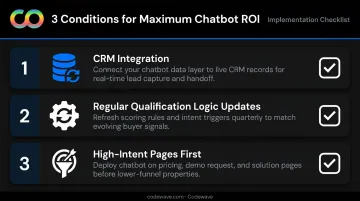
Three conditions where chatbots deliver the highest ROI:
- CRM is integrated so lead data flows in automatically and scores update without manual export
- Qualification logic is updated regularly based on direct sales team feedback on lead quality
- High-intent pages come first — pricing pages, demo requests, and campaign landing pages before rolling out site-wide
For businesses in regulated or complex-sale industries — Healthcare, Fintech, Insurance — a standard off-the-shelf chatbot typically can't handle nuanced qualification logic, compliance requirements, or multi-step ICP criteria.
Codewave builds custom conversational AI systems for exactly these situations. Working with 400+ businesses across Fintech, Healthcare, and Insurance, the team designs qualification workflows around specific ICP criteria and compliance requirements — HIPAA, GDPR, CCPA, and PCI-DSS included.
Codewave's approach uses NLP frameworks — including GPT-4 and context-aware conversation management — to run dynamic, multi-turn qualification flows that off-the-shelf tools can't replicate at the same depth.
Conclusion
The core value of chatbots for lead generation comes down to three things: control, consistency, and speed. Every visitor gets an immediate, structured response. Qualified leads enter the CRM with complete data, and sales reps start follow-ups with actual context — not just a name and an email address.
These advantages compound. As the chatbot accumulates conversation data, qualification logic sharpens, lead scoring grows more accurate, and cost per qualified lead falls — often significantly within the first few months.
The businesses seeing the strongest results treat their chatbot as an active part of their sales process, not a set-it-and-forget-it tool. They iterate on questions, test conversation flows, and review lead quality metrics on a regular cadence. The chatbots that keep improving share one trait: someone is paying attention to the data they generate.
Frequently Asked Questions
What are the best chatbots for lead generation?
The best option depends on your team's needs. Rule-based tools like Landbot suit simple, linear qualification flows. AI-powered platforms handle more complex, open-ended conversations. Custom-built solutions are the right fit for businesses with specific ICP criteria, industry compliance requirements, or multi-step qualification logic that generic tools cannot accommodate.
What are the main types of chatbots used for lead generation?
The three main types are rule-based chatbots (scripted decision trees), AI/NLP-powered chatbots (conversational and adaptive), and hybrid models that combine both. Rule-based bots are predictable but rigid; AI-powered bots handle open-ended questions and dynamic qualification more effectively.
Can ChatGPT be used for lead generation?
ChatGPT's underlying models can power lead generation chatbots, but only when integrated into a platform or custom application with qualification logic, CRM connections, and deployment configuration. Additional engineering is required to make it function as a structured qualification system.
How do chatbots qualify leads automatically?
Chatbots qualify leads by asking branching questions aligned to the ideal customer profile — company size, budget, use case, and decision timeline — scoring responses against preset criteria, and routing high-fit leads to the CRM or directly to a sales rep. The entire process runs in real time without human involvement.
How do I measure the ROI of a lead generation chatbot?
Track lead response time, lead-to-qualified conversion rate, cost per qualified lead, CRM data completeness, and pipeline contribution from chatbot-sourced leads. Comparing pre- and post-deployment performance on these metrics is the most direct measure of ROI.
Is lead generation illegal?
Lead generation is legal when conducted transparently and in compliance with applicable data privacy regulations — GDPR, CCPA, or HIPAA depending on industry and geography. Chatbots must collect consent and disclose data use practices at the point of capture.