The pressure is real. According to AHLA's 2025 survey, **65% of hotels report staffing shortages**, with 26% specifically lacking front desk staff. Meanwhile, guest expectations keep rising. The result: front desk teams stretched thin across interactions that range from "what's the Wi-Fi password?" to genuinely complex service recovery situations.
Chatbots address this gap — not as a novelty, but as a practical capacity tool. This article explains exactly how they improve guest experience in practice, tied to the KPIs hospitality operators actually track.
Key Takeaways
- 77% of travelers want automated messaging or chatbots for customer service — guest acceptance is already there
- Chatbots eliminate response gaps at midnight, peak check-in, and high-occupancy periods without adding headcount
- AI-powered bots consistently surface personalized upsell offers at the right moment, driving revenue staff interactions often miss
- Every guest interaction generates structured data that surfaces service gaps before they turn into negative reviews
- Chatbot ROI compounds over time — performance improves with continuous training, not a single deployment
What Is a Hotel Chatbot?
A hotel chatbot is software that communicates with guests in real time across channels — websites, SMS, WhatsApp, messaging apps — automating responses to inquiries, service requests, and bookings without a human agent in the loop.
Three types exist, with meaningfully different capabilities:
| Type | How It Works | Best For | Limitation |
|---|---|---|---|
| Rule-based | Predefined decision trees and scripted flows | Fixed FAQs: check-in times, parking, Wi-Fi | Breaks when guests phrase questions unexpectedly |
| AI/NLP-based | Natural language processing understands intent, learns over time | Multilingual, unstructured, personalized queries | Requires training, monitoring, and escalation paths |
| Hybrid | Structured control + AI flexibility | Most independent hotels and groups | Needs governance to prevent the AI from inventing property details |
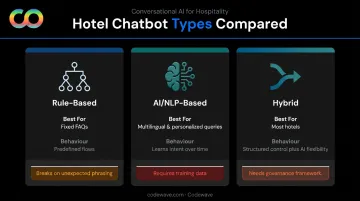
AI-based and hybrid systems dominate current hotel deployments because they handle unpredictable phrasing and multilingual requests that rule-based flows consistently fumble. The practical role: chatbots absorb high-volume, repetitive interactions so human staff can concentrate on the complex, high-touch moments that actually define a guest's stay.
Key Advantages of Hotel Chatbots for Guest Experience
The three advantages below focus on outcomes hotels can measure — response time, revenue, and operational intelligence — not abstract improvements.
24/7 Availability and Faster Response Across Every Touchpoint
Chatbots eliminate the downtime gaps that frustrate guests and overwhelm front desk teams. They respond in seconds, on any channel, at any hour.
In practice, this looks like:
- A guest arriving at midnight confirms check-in details via SMS — no call required
- A guest requests extra towels through webchat; a service ticket routes automatically to housekeeping
- Pre-arrival questions about parking, breakfast, and amenities are answered before the guest even arrives
Why it matters: Oracle's AI-enabled guest communication research found that AI-powered systems can reach average response times of 5 seconds, automatically handle roughly 70% of guest requests, and reduce calls to human concierge desks by 35% or more. Beyond speed, J.D. Power's 2025 hotel study found that guest satisfaction drops 217 points when problems occur — and that many guests never report issues mid-stay because there's no fast, easy way to do so. A chatbot removes that barrier.
KPIs impacted:
- Average response time
- Call volume to front desk
- Guest satisfaction (CSAT/NPS)
- Front desk escalation rate
When it matters most: Peak check-in and check-out windows, overnight hours, and high-occupancy periods — precisely when staffing is thinnest relative to demand.
Personalized Upselling and Revenue Generation Throughout the Stay
AI-based chatbots use guest data — booking history, stay type, preferences — to surface relevant upgrade offers and add-ons at the right moment, without staff involvement.
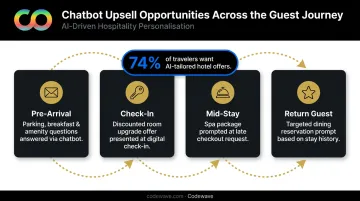
Here's what that looks like across a typical stay:
- A check-in confirmation message includes a discounted room upgrade offer
- A guest requesting late checkout gets prompted with a spa package during those extra hours
- A returning guest with prior dining purchases receives a targeted restaurant reservation prompt
Why it matters: Oracle Hospitality's 2022 consumer research found 74% of travelers are interested in hotels using AI to better tailor services and offers — room pricing, dining suggestions, and discounts. Guest appetite for personalized recommendations is high. Human agents often skip upselling during busy periods or feel uncomfortable making offers. Chatbots apply upsell logic consistently to every interaction, regardless of how busy the shift gets.
Chatbots also protect direct booking revenue. When a guest lands on your website with a pre-booking question and no one responds immediately, many abandon to book through an OTA instead. A chatbot answers that question in real time and can present direct-only incentives on the spot.
KPIs impacted:
- Revenue per available room (RevPAR)
- Upsell conversion rate
- Direct booking rate
- Average spend per guest
When it matters most: Pre-arrival and check-in windows, when guests are actively deciding how to spend during their stay. Hotels with diverse add-ons — spa, dining, experiences — see the clearest gains, since staff can't consistently promote every offering across every interaction.
Operational Data Collection and Continuous Service Improvement
Every chatbot conversation generates structured data: what guests asked, when, how quickly it was resolved, and what went unanswered. This creates a feedback loop that most hotels currently lack.
In practice:
- Repeated queries about breakfast location may indicate a wayfinding problem
- Frequent noise complaints routed to the bot can flag a recurring room allocation issue
- Unresolved intents reveal gaps in staff knowledge or policy communication
Why it matters: Most hotels rely on post-stay surveys and review monitoring to identify service gaps — a lagging signal that arrives after the damage is done. Chatbot data provides an in-stay, real-time view of what's actually bothering guests before they write about it publicly. Revinate's 2025 analysis of 147,000+ hotels across 200+ countries found a global average review response rate of just 33% — meaning most hotels are reacting to a fraction of guest feedback. In-stay chatbot data catches what post-stay surveys miss.
KPIs impacted:
- Issue resolution time
- Repeat complaint rate
- Review sentiment scores
- Staff allocation efficiency
When it matters most: The data value builds over time — by month three or four of deployment, pattern detection becomes actionable. Multi-property groups and high-volume hotels benefit most, since manually tracking service patterns across hundreds of daily interactions isn't feasible at scale.
What Happens When Hotels Skip Chatbots
Hotels without chatbots don't just miss a convenience feature — they face compounding service gaps:
- Answers to the same question vary by shift, experience level, and desk volume — that inconsistency erodes brand trust over time.
- Upgrade and add-on opportunities get left to staff discretion and routinely go unmentioned during peak check-in queues, where upsell prompts never happen.
- Headcount absorbs inquiry volume that automation could handle at lower cost, keeping cost-per-interaction high for tasks that require no human judgment.
- A guest who can't get a quick answer at 2 AM doesn't wait — they leave a review about poor service. Oracle's 2022 survey found 34% of guests cite slow service caused by labor shortages as their top deterrent to rebooking.
How to Get the Most Value from a Hotel Chatbot
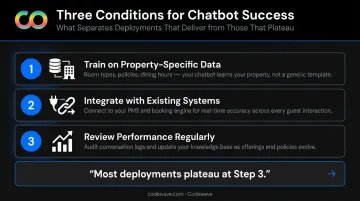
A chatbot delivers its full value only when three conditions are consistently met:
1. Train it on property-specific data. Generic out-of-the-box responses erode guest trust faster than no chatbot at all. The bot needs to know your room types, policies, dining hours, local recommendations, and service offerings — not just industry-standard FAQs.
2. Integrate it with your existing systems. A chatbot that can't pull real-time room availability or booking data will direct guests to "call the front desk" anyway — defeating the purpose. PMS and booking engine integration is what makes personalized, accurate responses possible.
3. Review performance regularly. Conversation logs reveal unresolved queries, frequent escalations, and new question types the bot wasn't built to handle. Without regular review, the knowledge base goes stale and upsell logic stops converting. This is where most chatbot deployments plateau.
Getting past that plateau typically requires deeper technical groundwork than most off-the-shelf tools can support. For hotels pursuing a custom-built path, Codewave builds conversational AI systems designed around property-specific data sources and existing hotel management infrastructure — so responses stay accurate and guest interactions don't dead-end at "please call the front desk." Their QuantumAgile™ delivery model allows hospitality teams to test working conversation flows early, reducing the risk of committing to a full build before validating real-world performance.
Conclusion
The value of hotel chatbots comes from three compounding strengths: consistent 24/7 availability that protects satisfaction scores, personalized upselling that grows per-stay revenue, and real-time data that continuously improves service quality. None of these work in isolation. Higher satisfaction scores create more upsell opportunities; better upsell data sharpens future personalization — each layer compounds the one before it.
A chatbot that's well-integrated, regularly updated, and monitored creates a compounding feedback loop. One that's installed and forgotten becomes a liability. The hotels seeing lasting gains are those that staff, review, and iterate on their chatbot the same way they would any other guest-facing service channel.
Frequently Asked Questions
What types of guest requests can a hotel chatbot handle automatically?
Common examples include FAQ responses (check-in times, parking, Wi-Fi), booking modifications, room service routing, upsell prompts, and local recommendations. AI-based bots handle more nuanced, multi-intent requests than rule-based systems, which are limited to predefined scripts.
Do hotel chatbots replace front desk staff?
No. The goal is augmentation, not replacement. Chatbots absorb high-volume, repetitive inquiries so staff can focus on complex, in-person interactions. Hospitality ultimately depends on human connection, and Mews' research found 59% of hoteliers believe front-desk welcome should remain human-led.
How do hotel chatbots improve guest satisfaction scores?
Faster response times, consistent answers across channels, and 24/7 availability directly reduce the friction points most cited in negative reviews. Instant resolution of routine requests translates to measurable CSAT and NPS improvements, particularly during overnight hours when staff coverage is minimal.
Can a hotel chatbot work across multiple channels — website, SMS, WhatsApp?
Yes. Modern hotel chatbots are designed for multichannel deployment and maintain conversation context when a guest switches channels — from webchat to SMS, for example — so guests don't have to repeat themselves.
How long does it take to implement a hotel chatbot?
A basic rule-based bot can go live in days. An AI-based bot trained on property-specific data and integrated with PMS/CRS systems typically requires several weeks of setup, integration work, and testing. Complexity of existing systems is the primary variable.
How do hotels measure the ROI of a chatbot investment?
Key metrics to track include call volume reduction, upsell conversion rate, average response time, and changes in guest satisfaction scores and review sentiment. ROI is property-specific, so establish baselines before deployment to measure impact accurately.