Introduction
Roughly 1 in 7 mobile users switched providers in the past 12 months, according to GSMA Intelligence's 2025 mobile churn research. Telecom support teams are buried under millions of repetitive queries every month while customers expect instant answers at any hour, on any channel. Churn at this scale isn't a retention program problem — it's an infrastructure one.
Traditional support models weren't built for this volume. Hiring more agents to handle demand spikes from outages or product launches is neither scalable nor cost-effective. And when customers can't get quick answers, they leave.
AI chatbots close this gap directly. Deployed across web, app, and messaging channels, they handle billing questions, plan inquiries, troubleshooting flows, and upsell conversations at scale — no additional headcount required. What follows covers the top use cases, measurable benefits, real-world carrier examples, and what a successful implementation actually requires.
Key Takeaways:
- Leading telecom operators automate 70%+ of customer interactions using AI chatbots
- Difficult issue resolution correlates with 41% switching intent vs. 5% for easy resolution
- Use cases span billing, troubleshooting, fraud alerts, plan recommendations, and sales
- Effective deployments start with the top 10–15 most common intents, not full automation from day one
- Verizon's AI assistant produced a nearly 40% increase in sales among its service team
Why Telecom Companies Are Turning to AI Chatbots
The Repetition Problem
The majority of inbound telecom support contacts aren't complex. Customers want to know their data balance, understand a charge on their bill, check service availability in a new area, or ask about an upgrade. These queries require no skilled judgment — but they consume the same agent capacity as difficult problems.
LivePerson's analysis of millions of telecom conversations identified the top intents by volume:
- Plan information — 8.45% of all interactions
- Product upgrades — 5.33%
- Connectivity issues — 5.2%
- Promotions, discounts, and cancellations — rounding out the top five
Every hour an agent spends answering "What's included in my plan?" is an hour not spent on escalations that actually require human judgment. All five of these intent categories are well-defined enough to automate reliably.
The Scale and Cost Problem
Telecom demand isn't consistent. Outages, new product launches, and billing cycles all create sharp spikes. Hiring to cover peak volume means overstaffing during normal periods — a budget problem that grows quickly at scale.
AI chatbots don't have this constraint. There's no ramp-up time when demand spikes overnight — they handle hundreds of simultaneous conversations without performance degradation, and cost per interaction stays flat regardless of volume.
The Churn Connection
Slow or difficult service resolution isn't just a support inconvenience — it's a direct churn driver. J.D. Power data shows that customers who found issue resolution difficult had a 41% stated switching intent, compared to just 5% among those who found it easy. Those difficult-resolution customers also waited more than twice as long on hold and saw first-contact resolution drop from 85% to 31%.
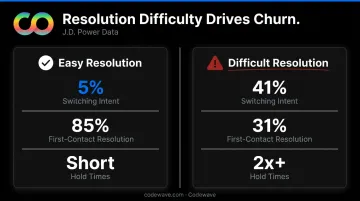
For telecom operators, that gap — from 85% to 31% first-contact resolution — represents real subscriber loss. Speed and accuracy in support delivery are, in measurable terms, retention tools.
Top Use Cases for Chatbots in Telecom
Customer Support and Self-Service
This is where chatbots deliver the most immediate volume relief. Plan details, service availability checks, account status, SIM activation, and basic troubleshooting are all high-frequency, well-structured intents that chatbots handle autonomously.
Vodafone UK's TOBi processes roughly 1 million interactions per month, with 70% resolved at the first point of contact. In Portugal, the upgraded SuperTOBi lifted first-time resolution from 15% to 60% and pushed online NPS up 14 points to 64.
The escalation design matters as much as the automation rate. When a query exceeds the chatbot's scope, the handoff to a live agent should carry full conversation context — so customers don't have to repeat themselves. Codewave's conversational AI implementations incorporate sentiment analysis to detect frustration in real time and trigger escalation proactively, rather than waiting for the customer to request it.
Billing Inquiries and Payment Assistance
Billing queries are high-frequency and high-frustration — the combination that makes them ideal for automation. A well-trained chatbot handles:
- Explaining line-item charges
- Processing one-time payments
- Setting up auto-pay
- Flagging billing discrepancies
- Sending proactive payment reminders before due dates
The proactive piece is where AI adds the most value. Rather than waiting for a frustrated customer to call about a surprise charge, an AI system detects the anomaly and alerts them first — turning a potential complaint into a trust-building interaction.
Personalized Plan Recommendations and Upselling
Generic promotional messages convert poorly. AI-driven recommendations convert better because they're grounded in individual behavior, not demographic assumptions. The signals that drive this include:
Generic promotional messages convert poorly. AI-driven recommendations convert better because they're grounded in individual behavior, not demographic assumptions. The signals that drive this include:
- Actual data consumption trends
- Roaming frequency and destinations
- Call volume and peak usage windows
- Device type and plan tier
When a customer checks their data balance and is 90% through with a week left in the cycle, that's the moment to surface a relevant upgrade offer. A chatbot handles this in-conversation — no outbound campaign needed — at exactly the moment the customer is already thinking about usage.
Fraud Detection and Proactive Security Alerts
Chatbots integrated with backend security systems flag suspicious activity in real time — unusual usage spikes, SIM swap attempts, or billing anomalies — and push alerts to customers immediately for verification. This compresses the response window from hours to minutes and reduces financial exposure on both sides.
For customers, receiving a proactive "did you authorize this?" message before a fraudulent charge clears is far better than discovering the problem on a statement weeks later — when the dispute window may already be closing.
Technical Troubleshooting and Network Support
Structured troubleshooting flows guide customers through router resets, device configuration, connectivity checks, and signal diagnostics without requiring agent involvement. McKinsey noted that at one telecom operator, roughly 40% of fixed-broadband technician appointments were booked entirely through automation — illustrating the scope of what structured AI flows can handle in the technical support domain.
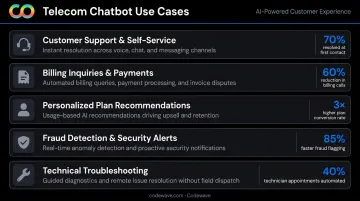
The chatbot resolves what it can, captures structured diagnostic data, and hands off with full context when escalation is needed — meaning the agent who takes the call already knows what's been tried.
Sales Enablement and Lead Capture After Hours
High-intent visitors who land on a telecom website at 11 PM are lost without a chatbot. They have questions about plans, coverage, or device compatibility — and if no one answers, they leave. A chatbot captures contact details, qualifies interest, explains plan options, and routes them to the right next step, whether that's a quote, a callback request, or direct conversion.
For business accounts, where deal cycles run longer, a single after-hours inquiry captured — rather than lost — can represent a six-figure contract opportunity.
Key Benefits of Telecom Chatbots
24/7 Availability and Instant Response
Chatbots eliminate wait times entirely. A customer dealing with a network outage at 2 AM gets immediate acknowledgment and status information, not a hold queue. This matters most during the moments when customers are most frustrated and most likely to decide they're switching providers.
Scalability Without Headcount Growth
A chatbot that handles 500 simultaneous conversations costs the same as one handling 50. During demand spikes — a major outage, a new iPhone launch, a billing cycle peak — the system absorbs the volume without degradation. Human teams can't do this economically.
Reduced Customer Churn Through Better Experience
The data makes the case clearly. Vodafone Portugal's SuperTOBi improved first-time resolution from 15% to 60%, directly addressing the friction J.D. Power identified as the primary driver of switching intent. Faster, more consistent service delivery at scale is a retention strategy, not just a support efficiency play.
Actionable Customer Insights
Every chatbot conversation generates structured data. Operations and product teams can mine this for patterns that are otherwise invisible:
- Which intents appear most frequently across customer sessions
- Which conversation flows cause drop-off before resolution
- Which questions escalate repeatedly, signaling a product or plan gap
- Where self-service succeeds versus where human handoff is unavoidable
Support teams see exactly where friction lives. Product teams learn which features or pricing structures are generating the most confusion. The result is a feedback channel that improves both service and product decisions simultaneously.
Codewave's conversational AI implementations connect this data to integrated analytics dashboards, so teams can act on customer behavior patterns without waiting for quarterly reports.
Real-World Examples of Telecom Chatbots in Action
Vodafone's TOBi and SuperTOBi
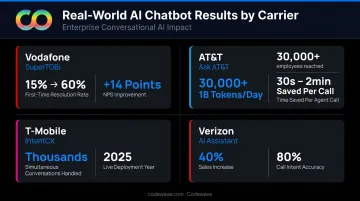
TOBi operates across 13 countries in 11 languages, handling approximately 1 million interactions per month in the UK alone. The upgrade to SuperTOBi — powered by generative AI — produced measurable improvements in Portugal (15% to 60% first-time resolution, NPS up 14 points) and is now rolling out across Germany and Turkey. That kind of resolution rate jump, achieved at scale, sets a concrete benchmark for what enterprise GenAI can deliver in telecom customer experience.
AT&T's Ask AT&T
Ask AT&T is an internal GenAI platform — not customer-facing. By September 2023, more than 30,000 employees were using it for network engineering queries, financial analysis, software development, and supply chain operations. By 2024, it was processing roughly 1 billion tokens per day, with automated call summaries saving agents 30 seconds to several minutes per inbound call. The internal productivity case is as significant as the customer-facing one.
T-Mobile and Verizon
T-Mobile announced IntentCX in partnership with OpenAI in September 2024, designed to handle thousands of simultaneous conversations while drawing on real-time customer data and sentiment. Full production deployment was scheduled for 2025.
Verizon's results are already public. Its AI assistant supporting a 28,000-person service team was associated with a nearly 40% increase in sales by April 2025. Verizon's GenAI system also correctly identified why a customer was calling 80% of the time, enabling more precise routing and faster resolution.
SK Telecom's "A." Super App
SK Telecom launched "A." in September 2023 as an AI personal assistant that extends well beyond traditional support. The app integrates music streaming, e-commerce, personalized daily recommendations, and proactive information delivery. By late 2025, it had surpassed 10 million monthly active users. That trajectory signals a meaningful shift: telecom AI is no longer just a support channel — it's becoming infrastructure for daily customer engagement.
How to Implement a Telecom Chatbot Successfully
Start With High-Volume, Well-Defined Intents
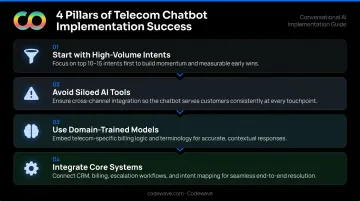
The most effective deployments don't try to automate everything on day one. They identify the top 10–15 most common customer intents — plan information, billing questions, connectivity troubleshooting, upgrade requests, payment processing — and build deep, accurate handling for those first.
LivePerson's data confirms this: plan information (8.45%), product upgrades (5.33%), and connectivity issues (5.2%) already represent a significant share of total volume. Getting these right delivers immediate ROI and provides a foundation to expand from.
Avoid Common Implementation Pitfalls
Two patterns consistently undermine telecom chatbot deployments:
- Siloed AI tools — when different departments adopt separate chatbot solutions without coordination, customers encounter inconsistent experiences across channels. Billing support says one thing; technical support says another. The integration layer matters as much as the AI layer.
- Generic LLMs without domain training — off-the-shelf models frequently mishandle telecom-specific billing logic, plan structures, and network terminology. A chatbot that can't correctly explain proration on a mid-cycle upgrade, or doesn't understand the difference between a soft credit and a promotional discount, creates more confusion than it resolves.
Telecom-specific training — through fine-tuning, retrieval-augmented generation, or structured knowledge bases — is what separates a chatbot that handles real interactions from one that erodes customer trust with every wrong answer.
Choose an Outcome-Focused Development Partner
Building a telecom chatbot requires a partner who understands both the AI architecture and the operational workflows it needs to support. Codewave uses its QuantumAgile™ methodology to simulate multiple implementation scenarios before any build begins — giving telecom teams a validated path forward rather than a costly course correction mid-project.
For telecom clients, the discovery phase addresses the four areas that most often determine deployment success:
- CRM integration — ensuring the chatbot surfaces accurate, real-time account data
- Billing system connectivity — so the bot can read, explain, and act on billing records
- Escalation workflow design — defining exactly when and how handoffs to live agents occur
- Intent mapping — aligning the chatbot's scope to actual customer query volume before build begins
Frequently Asked Questions
How can AI be used in telecom?
AI in telecom powers customer-facing chatbots, billing automation, fraud detection, personalized plan recommendations, and predictive network maintenance. It also supports internal use cases like agent assist tools, call summarization, and employee-facing knowledge platforms — as AT&T's Ask AT&T demonstrates.
What is a telecom chatbot?
A telecom chatbot is an AI-powered conversational tool deployed on websites, apps, or messaging channels to handle customer queries, automate support tasks, and assist with sales, available 24/7 without human intervention. More advanced deployments extend into proactive outreach: billing alerts, usage notifications, and plan upgrade suggestions.
How do chatbots reduce customer churn in telecom?
Instant, accurate responses remove the friction that drives switching intent. J.D. Power data shows that customers who resolve issues easily have an 8x lower switching intent than those who find resolution difficult. Proactive outreach (billing alerts, usage notifications, relevant upgrade offers) builds loyalty before problems escalate.
What percentage of telecom interactions can a chatbot handle automatically?
Leading telecom operators achieve automation rates of 70% or higher for routine interactions. LivePerson reports that 70% of its telecom clients automate 70% of their customer interactions , though actual rates vary based on trained intents and backend integrations.
How long does it take to deploy a telecom chatbot?
Simple FAQ bots can go live in days. Fully integrated solutions with CRM connectivity, billing system integration, and escalation workflows typically take several weeks, with scoping and integration planning often driving the timeline more than the build itself.