Introduction
Insurance companies are under pressure from multiple directions simultaneously. Customers now expect instant answers at any hour, through whatever channel they prefer — and 47% of auto insurance shoppers purchased through digital channels in 2025, according to J.D. Power, compared to just 35% who went through agents. That shift is accelerating.
Traditional call centers weren't built for this volume. High-frequency, repetitive interactions consume agent capacity that's better spent on complex cases:
- Claims status checks
- Coverage and policy questions
- Payment reminders and processing
- ID verification and document requests
The result: slower response times, higher costs, and customers who switch.
Chatbots are a practical answer — the measurable outcomes are real: faster FNOL intake, lower cost per interaction, and higher satisfaction when digital experiences actually work.
This article covers what insurance chatbots are, what they deliver, the highest-impact use cases, and what insurers risk by waiting.
TL;DR
- An insurance chatbot is an AI-powered virtual assistant that automates customer interactions — claims, queries, and onboarding — across digital channels without routing every request to a human agent.
- The biggest benefits are 24/7 availability, faster claims processing, lower operational costs, and improved agent productivity.
- Key use cases include FNOL intake, policy Q&A, ID verification, lead qualification, and fraud flagging.
- Insurers that delay adoption lose ground on resolution speed, cost efficiency, and customer retention to faster-moving competitors.
- Effective implementation requires backend integration, clear automation boundaries, and ongoing tuning from real interaction data.
What Is an Insurance Chatbot?
An insurance chatbot is an AI-driven virtual assistant built to handle insurance-specific customer interactions — answering coverage questions, guiding claim submissions, verifying identities, and surfacing policy information without routing every request to a live agent.
Older rule-based bots follow rigid scripts: if the customer says X, respond with Y. Any question outside that predefined flow hits a dead end. Modern AI chatbots understand intent, context, and sentiment — so a customer describing a car accident in their own words gets routed correctly, not abandoned in a menu loop.
Where Insurance Chatbots Operate
These systems don't live in one place. They're deployed across:
- Insurer websites — for policy queries, quotes, and self-service account management
- Mobile apps — for claims status, document uploads, and payment support
- WhatsApp and SMS — meeting customers on the channels they already use
- Voice channels — handling inbound calls with conversational AI before or instead of routing to an agent
Think of the chatbot as the first layer of response. It absorbs routine volume so agents stay focused on cases that genuinely require human judgment — complex claims, sensitive situations, coverage disputes.
Key Benefits of Insurance Chatbots
The benefits below reflect operational outcomes insurers actually track: cost, speed, accuracy, customer satisfaction, and agent workload.
24/7 Omnichannel Availability
Modern insurance customers don't file claims on a schedule. A car accident happens at 11pm. A water leak starts on a Sunday. A policy question occurs during a lunch break.
An AI chatbot handles these moments across web, mobile, WhatsApp, and voice simultaneously, without staffing increases. The data supports why this matters: 92% of customers who had an excellent digital experience said they would use digital channels again, compared to just 40% with poor digital experiences, per J.D. Power. Digital quality directly determines future digital adoption.
KPIs impacted:
- Customer satisfaction score (CSAT)
- First response time
- Channel deflection rate
- After-hours inquiry resolution rate
The value compounds during weather-driven claim surges and peak renewal periods. Insurers serving multilingual or multi-timezone customers feel it most acutely, where off-hours coverage would otherwise mean significant staffing cost.
Faster, More Accurate Claims Processing
Claims processing is one of the most friction-heavy touchpoints in insurance. Customers are stressed, and delays compound dissatisfaction. According to the 2025 J.D. Power Property Claims Satisfaction Study, average property claim final payment takes 44 days after FNOL , with repair cycle time averaging 32.4 days.
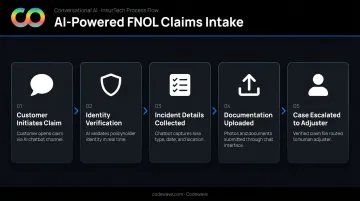
AI chatbots compress that timeline by handling the front end of claims. They guide customers through FNOL submission, collect documentation (photos, police reports), validate information against backend systems, and deliver real-time status updates — with no agent involvement in the early stages.
Digital claims channels are already outperforming traditional ones. J.D. Power's 2024 Claims Digital Experience Study found digital claims satisfaction reached 871 out of 1,000, up 17 points from 2023. Digital channels have surpassed phone as the most satisfying way to submit a new claim.
KPIs impacted:
- Average handling time (AHT)
- Claims cycle time
- Cost per claim
- Customer effort score
Cost Reduction and Agent Productivity
A significant share of insurance call center volume is repetitive: policy lookups, payment reminders, ID verification, coverage FAQs. Chatbots absorb this volume, and the productivity benefit compounds in both directions.
Agents freed from low-complexity calls handle cases that actually require their expertise. Gartner predicts that agentic AI will autonomously resolve **80% of common customer service issues** by 2029, reducing operational costs by 30%. That's a cross-industry figure, but a relevant benchmark for insurers evaluating automation investments.
Agents handling higher-value, more varied work also tend to report greater job satisfaction and lower turnover. In contact centers with historically high attrition, that's a meaningful operational gain.
KPIs impacted:
- Cost per interaction
- Agent utilization rate
- Escalation rate
- Average resolution time
Top Use Cases of Insurance Chatbots
The following use cases reflect where chatbot automation has the clearest, most documented impact across the insurance customer lifecycle.
Claims Filing and First Notice of Loss (FNOL)
FNOL is the most time-sensitive and emotionally charged touchpoint in insurance. When a customer reports a loss, they're often stressed — and the quality of that first interaction shapes their perception of the entire claims experience.
An AI chatbot serves as the immediate first contact: it verifies the customer, collects incident details, requests supporting documentation, and summarizes the case before escalating to an adjuster.
Picture what that looks like in practice: a customer involved in a car accident at 11 PM initiates a claim via WhatsApp, uploads photos of the damage, answers structured questions about the incident, and receives a case reference number — without a single human agent involved.
Frontline Insurance deployed voice AI for FNOL with a documented outcome of 70% autonomous FNOL call resolution, according to Insurance Journal research. Travelers launched an agentic AI Claim Assistant in February 2026, developed with OpenAI, capable of providing policy information, answering claim-related questions, and helping customers decide whether to file.
The operational payoff is structured, complete data collection at intake — which speeds downstream adjudication and reduces rejected or delayed claims.
Policy Information and Coverage Queries
Customers regularly contact insurers to ask whether specific situations are covered. Is my rental car included? Does my homeowner's policy cover flood damage? These queries are high-volume but low-complexity.
A chatbot integrated with policy databases delivers accurate, personalized answers instantly — in conversational language, without routing through a call queue. Customers get real answers instead of a PDF link, and agents stop fielding the same questions repeatedly.
Identity Verification and Customer Onboarding
ID verification is a mandatory step in nearly every insurance interaction. Traditionally, it consumes agent time before the actual customer need is even addressed.
An AI chatbot handles the entire verification sequence — collecting personal details, matching against backend records, confirming identity — and delivers the customer to a human agent (if needed) with full context already captured. Codewave's chatbot implementations incorporate authentication controls, data protection, and audit trails into this layer, keeping verification secure without adding friction.
Lead Qualification and Policy Recommendations
A chatbot on an insurer's website doesn't have to wait for a customer to ask a question. It can proactively engage visitors, ask targeted qualifying questions (coverage type, household composition, existing policies), and surface the most relevant plans.
Pre-qualifying leads before human follow-up produces measurable results:
- Improves conversion rates by surfacing high-intent prospects first
- Reduces time sales teams spend on unqualified inquiries
- Ensures agents engage only with prospects ready to buy
Fraud Detection Support
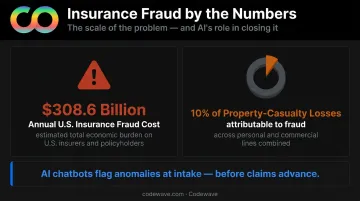
AI chatbots configured for fraud flagging cross-reference claim details against policy records and historical patterns during intake — escalating inconsistencies for human review before payouts are triggered.
The stakes are substantial. Insurance fraud costs the U.S. $308.6 billion annually, according to the Insurance Information Institute citing Coalition Against Insurance Fraud data, with fraud occurring in approximately 10% of property-casualty losses. Catching anomalies at the intake stage — before a claim advances — is significantly more cost-effective than detecting fraud downstream.
What Happens When Insurance Companies Delay Chatbot Adoption
Every month without chatbot automation, low-complexity queries keep consuming agent capacity — driving up cost per interaction and stretching resolution times. That strain is most visible during peak periods:
- Claim surges following weather events
- Annual renewal cycles with concentrated inbound volume
- Seasonal demand spikes that staffing can't scale fast enough to absorb
The customer experience risk is real. J.D. Power found that 57% of auto insurance customers shopped for a new policy in the prior year — the highest switching rate on record. Poor digital experiences accelerate that behavior: customers who encounter slow response times or inaccessible support don't wait for improvement.
The competitive pressure compounds this. As more insurers deploy AI-driven customer service, laggards face a widening perception gap. 32% of auto insurance shoppers used AI tools during their search, and those AI users were 1.3x more likely to switch insurers — meaning customers are already choosing insurers based on the quality of AI-assisted channels.
Scaling customer service without automation requires proportional headcount growth — eroding margins while leaving the core experience problems unsolved.
How to Get the Most from Your Insurance Chatbot
Chatbot value compounds over time — but only when implementation is strategic.
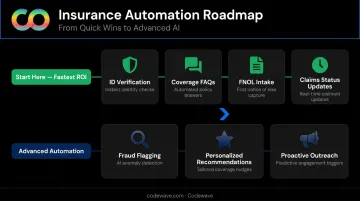
Start with the highest-volume, lowest-complexity journeys:
- ID verification
- Coverage and policy FAQs
- FNOL intake
- Claims status updates
These deliver the fastest ROI and build the operational foundation for more nuanced automation later — fraud flagging, personalized recommendations, and proactive outreach.
Integration depth determines everything. A chatbot that can't access policy systems, CRM records, or claims databases in real time defaults to generic responses — frustrating customers and undermining trust. Define integration requirements before selecting a platform or development partner.
Codewave's insurance AI development practice spans claims management systems, policy administration platforms, and CRM integration, using RAG architectures and vector databases that produce accurate, policy-grounded responses rather than hallucinated or off-policy answers.
Ongoing performance review is how chatbots improve. Analyze escalation patterns (where the bot hands off to humans), failed resolution rates, and interaction-level CSAT scores to identify where automation breaks down.
Codewave includes post-deployment analytics dashboards that track engagement rates, satisfaction metrics, and conversation flow anomalies — with continuous optimization cycles built into every engagement. Codewave's ImpactIndex™ model ties fees to measurable outcomes rather than deployment milestones, so the incentive to improve post-launch is structural, not contractual.
Frequently Asked Questions
Can AI do insurance claims?
Yes. AI chatbots handle the early stages of claims processing — collecting incident details, verifying customer identity, requesting documentation, and providing status updates. Complex claim decisions are still reviewed by human specialists, but the intake layer can be fully automated.
What is the role of chatbots in the insurance industry?
Insurance chatbots act as always-on digital assistants that handle customer queries, guide claim submissions, verify identities, recommend policies, and flag potential fraud. This cuts operational costs while delivering faster, more consistent customer support.
Which AI is best for insurance?
The best fit depends on the insurer's use cases, system landscape, and compliance requirements. Custom-built solutions with deep integration into CRM and claims systems typically outperform generic off-the-shelf platforms for the complex, multi-step workflows insurance requires.
Can insurance chatbots handle complex queries or only simple FAQs?
Modern AI chatbots go well beyond FAQs, handling multi-step processes like FNOL, ID verification, and policy comparisons. Genuinely complex cases — disputed claims, legal inquiries — should have a clear escalation path to a human agent built in from the start.
How do insurance chatbots handle data privacy and compliance?
Well-implemented insurance chatbots are built with data encryption, role-based access controls, and audit trails. They can be configured to comply with HIPAA, NAIC data security model law requirements, and state-level regulations.