
Introduction
Telecom operators are under pressure from every direction. Network traffic surges 40-50% every 12-16 months, driven by 5G expansion, IoT proliferation, and edge computing workloads—and costs aren't keeping pace.
According to TM Forum data, total expenses for communication service providers (CSPs) run between 48% and 79% of revenues, with operating expenditures 2.5 to 3 times higher than capital costs. Much of that burden traces back to the same source: repetitive, manual processes that drain resources and introduce costly errors.
This article covers what robotic process automation (RPA) looks like in telecom, which use cases are generating real ROI, and what companies are actually gaining by deploying bots across billing, order management, network monitoring, and customer service.
Key Takeaways
- RPA deploys software bots to automate repetitive, rule-based tasks without replacing legacy systems or building custom APIs
- Key use cases span billing automation, order management, network fault monitoring, compliance reporting, and fraud detection
- Expect lower operational costs, faster processing, fewer errors, and measurable gains in customer satisfaction
- AI-augmented RPA moves beyond task execution into intelligent, adaptive automation
- Start by identifying high-volume, error-prone, rule-based processes causing bottlenecks today
What Is RPA in Telecom?
Robotic process automation (RPA) is software that mimics human actions—clicking, copying, pasting, entering data—across existing systems without requiring backend integration or custom APIs. For telecom operators running a patchwork of legacy OSS/BSS platforms, third-party billing systems, and CRM tools, that distinction matters.
Up to 60% of telecom applications are legacy technology, and up to 80% of IT budgets can go toward maintaining these outdated systems. RPA works on top of these systems at the user interface level — no rip-and-replace required.
What RPA Is Designed For: RPA handles structured, rule-based, high-volume, repetitive processes—tasks where the steps are predictable and the inputs are consistent. Complex judgment calls, unstructured inputs, and exception-heavy workflows still need human oversight.
Three Types of RPA in Telecom
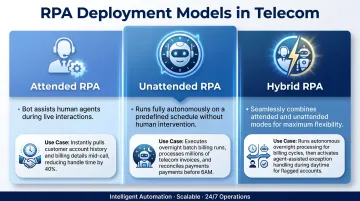
| Type | How It Works | Telecom Example |
|---|---|---|
| Attended RPA | Bots assist human agents during live interactions | Pulls account history and pre-populates upgrade forms while an agent handles the customer call |
| Unattended RPA | Bots run autonomously on a schedule, no human involvement needed | Overnight billing runs — extracts invoice data, validates it, enters it into accounting systems, and flags discrepancies |
| Hybrid RPA | Combines attended and unattended modes | Bot processes invoices overnight unattended, then hands exceptions to an attended bot for agent review during business hours |
Key RPA Use Cases in Telecom
Telecom runs on repetitive, data-heavy workflows — and most of them are still manual. This section maps the highest-impact automation opportunities by function, from billing to fraud prevention.
Billing, Invoicing, and Payment Processing
Telecom billing is notoriously complex—and error-prone. Gartner estimates that 80% of telecom invoices contain billing errors, and TM Forum estimates these errors cost the industry approximately $50 billion per year. Additionally, 30% of all telecom complaints are related to billing.
RPA addresses this directly:
- Extracts invoice data from multiple systems automatically
- Validates charges against service agreements and usage records
- Enters validated data into accounting software
- Flags discrepancies for human review
- Routes invoices for approval based on predefined rules
At subscriber scale, even a partial automation of this workflow produces measurable cost and accuracy gains — fast.
Order Management and Service Provisioning
The "swivel-chair" problem is pervasive in telecom order management: agents manually switch between CRM, inventory, dispatch, and provisioning systems to complete a single customer request. Each handoff introduces delay and the risk of data entry errors.
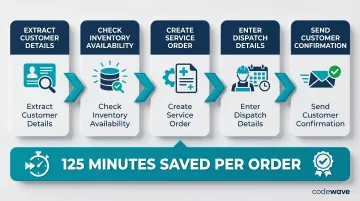
When a customer calls to set up new internet service, an RPA bot can:
- Extract customer details from the CRM
- Check inventory availability in real time
- Create the service order in the provisioning system
- Enter dispatch details for technician scheduling
- Send confirmation to the customer—all while the agent remains on the call
The agent handles the conversation; the bot handles the data movement. One telecom provider saved 125 minutes per order and reduced service cycle time to 29 days using this approach — with no changes to the agent's workflow.
Network Monitoring and Fault Management
Network issues degrade customer experience quickly. Average issue resolution in telecom takes approximately 4.1 days, and customer satisfaction drops by 30% if resolution takes more than one day. Additionally, more than 60% of outages result in losses exceeding $100,000.
RPA combined with AI/ML compresses that 4.1-day window:
- Monitors network performance metrics continuously
- Detects anomalies against baseline thresholds
- Triggers predefined remediation workflows automatically
- Sends structured fault reports to network technicians
- Logs incident data for trend analysis
The result: faster mean time to resolution (MTTR) and fewer minor issues that spiral into major outages.
Customer Service and First Call Resolution (FCR)
51% of customers try to fix issues themselves before calling support, and nearly 70% attempt self-service first. When they do escalate to an agent, they expect answers immediately — not after three system lookups.
Unattended RPA bots handle this end-to-end:
- Run on scheduled intervals to collect compliance data automatically
- Compile reports from disparate systems without manual intervention
- Flag anomalies or missing data for human review
- Submit reports to regulatory portals on time
Unlike manual compilation, bots don't introduce transcription errors — which matters when a filing mistake can trigger regulatory scrutiny.
Fraud Detection and Cybersecurity
Telecom operators are prime targets for fraud and cyberattacks. Telecom fraud losses totaled $38.95 billion in 2023, rising to $41.82 billion in 2025. The global average cost of a data breach is $4.44 million.
RPA keeps security operations running continuously:
- Automates privileged access management
- Detects unauthorized system access attempts
- Schedules and executes security patch downloads
- Runs threat scans on defined schedules
- Flags suspicious activity for human investigation
With fraud losses climbing year over year, automated detection is no longer optional — it's the baseline for managing exposure at scale.
Key Benefits of RPA for Telecom Companies
For every use case above, there are measurable operational outcomes that directly impact revenue and costs. Here's what well-implemented RPA actually delivers.
Cost Reduction and Operational Efficiency
By replacing manual labor on repetitive tasks, telecom companies significantly reduce operational overhead. Bots work 24/7, don't make transcription errors, and scale instantly without additional headcount.
Real-world results:
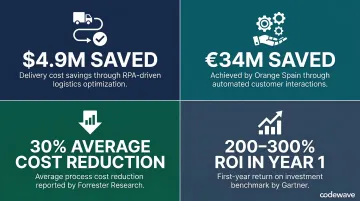
- One telecom provider saved $4.9 million through delivery cost optimization and reduced their BPO team by more than 50%
- Orange Spain achieved EUR 34 million in savings through RPA, with more than 2 million automated interactions within six months
- DNA Plc in Finland returned 25 FTEs' worth of hours to the business every month
Forrester reports an average 30% process cost reduction from RPA, while Gartner cites 200-300% ROI within the first year.
Faster Processing and Time-to-Market
Automation sharply cuts cycle times. Order processing that took multiple days can be completed same-day or even in hours.
Documented improvements:
- 125 minutes saved per order; service cycle time reduced to 29 days; 14% decrease in complaints cycle time
- One global telco reduced processing time from 25 minutes (90 steps) to 53 seconds—a 67% improvement
Faster processing means faster revenue recognition and a direct improvement in cash flow—both of which show up quickly on the bottom line.
Improved Accuracy and Data Quality
RPA bots execute each process identically, every run—eliminating transcription errors, duplicate records, and compliance gaps.
Expected outcomes:
- 90% reduction in data errors
- 95%+ data accuracy rates
- Fewer billing disputes and compliance violations
These improvements translate directly into reduced rework, fewer customer complaints, and lower regulatory risk.
Enhanced Customer Experience
Automation improves customer-facing outcomes in measurable ways:
- Faster order fulfillment
- 24/7 self-service availability
- Higher first-call resolution rates
- Reduced complaint cycle times
NTT Docomo slashed customer churn by 60% using AI and automation, while Vodafone Turkey reduced average handling time for billing complaints by 80%. Given that 51% of telecom customers would consider switching providers if connectivity issues weren't resolved quickly, faster resolution directly reduces churn.
Employee Productivity and Higher-Value Work
RPA doesn't eliminate jobs—it reallocates human effort. When bots handle data entry, billing, and reporting, employees shift to work that actually requires judgment: complex problem-solving, customer relationships, and innovation. The net result is a measurable productivity gain—typically around 40%—without adding headcount.
RPA + AI: Elevating Telecom Automation
Basic RPA handles rule-based, structured tasks. When you layer machine learning, natural language processing, or computer vision onto RPA, bots can handle unstructured data—emails, call transcripts, scanned documents—and make adaptive decisions rather than just follow scripts.
Two use cases show what that looks like in practice:
- Personalized Upsell Offers: An ML model analyzes customer usage patterns and flags upgrade opportunities. During a live call, the RPA bot surfaces a tailored offer to the agent, who can accept or adjust it based on the conversation.
- Intelligent Fault Management: AI anomaly detection spots unusual network behavior and triggers an RPA bot to pull performance data, generate a fault report, and route it to the right technician—no human intervention needed until the fix stage.
These aren't edge cases—they're a preview of where the industry is heading. As 5G and IoT push network event volumes and customer interactions to new scales, AI-augmented RPA becomes less optional and more foundational. Analysys Mason forecasts telecoms operators will invest $77 billion cumulatively in AI cloud infrastructure between 2025 and 2030, with annual spending rising from $6.5 billion in 2024 to $16.6 billion by 2030.
How to Implement RPA in Telecom: Where to Start
The most common mistake: trying to automate everything at once. Start by identifying the highest-volume, most rule-based, error-prone processes first—billing, order entry, compliance reporting—then build from there with clear success metrics defined before deployment.
Key implementation considerations:
- Standardize processes before automating them. Bots need consistent, well-documented rules—if workflows vary significantly by agent, fix that first.
- Confirm system stability before deployment. RPA works with existing UIs without APIs, but frequent interface changes will break bot workflows.
- Define bot ownership upfront. Assign clear roles for monitoring, exception handling, and escalation paths before go-live.
- Pilot before scaling. Validate the approach with one or two bots, measure results, then expand—don't deploy 50 bots simultaneously.
Getting these foundations right—documentation, governance, and a phased rollout—is what separates successful RPA programs from stalled ones. Codewave has helped 400+ businesses across industries work through exactly this kind of implementation planning, reducing costs and cutting processing times on automation projects. Learn more at codewave.com.
Frequently Asked Questions
What is robotic process automation (RPA) in telecom?
RPA is the use of software bots to automate repetitive, rule-based tasks such as billing, order entry, and compliance reporting across telecom systems—without replacing those systems or requiring custom API development. Bots mimic human actions at the user interface level.
What are the three types of RPA?
The three types are attended, unattended, and hybrid. Attended bots assist agents during live interactions (e.g., pulling customer data mid-call). Unattended bots run autonomously on a schedule, handling tasks like overnight billing. Hybrid RPA combines both, routing bulk processing to unattended bots and exceptions to attended bots for human resolution.
What is the difference between RPA and APIs?
RPA works at the user interface level, mimicking human actions without requiring backend access or development effort. APIs enable direct system-to-system integration but require development and backend access. RPA is faster to deploy in legacy-heavy environments like telecom, where building APIs isn't feasible.
Which is better for telecom automation: RPA or Selenium?
Selenium is a browser testing tool, not a process automation platform. RPA is purpose-built for business process automation with governance, scalability, and enterprise integrations, making it the appropriate choice for telecom operations automation.
What are the top RPA software platforms for telecom?
Commonly used platforms include UiPath, Automation Anywhere, Blue Prism, and IBM RPA. Platform selection should depend on your existing tech stack, scalability needs, and whether AI-augmented features are required. Notably, 67% of telecom operators already use RPA for customer service, which gives these platforms a proven track record in the industry.