
Introduction
Manufacturing operations today face a straightforward but costly problem: skilled workers spend hours each day on digital busywork—data entry, inventory updates, compliance reporting, purchase order processing—that pulls them away from actual production work.
The labor math makes this worse. According to the Manufacturing Institute and Deloitte, the U.S. manufacturing sector could need up to 3.8 million workers over the next decade, with only 1 qualified applicant for every 20 job openings. Every hour a technician spends on manual data entry is an hour lost to higher-value work—and those skilled workers are increasingly hard to replace.
Robotic Process Automation (RPA) addresses this directly. Software bots handle the rule-based, high-volume digital tasks that drain skilled workers' time—without displacing the ERP, MES, or CRM systems already in place. What follows covers where RPA delivers the most value in manufacturing, how AI amplifies its capabilities, and what a practical implementation looks like.
TLDR:
- RPA uses software bots to automate repetitive digital tasks like data entry, invoice processing, and compliance reporting—reducing errors and freeing skilled workers
- Proven applications include quality control reporting, maintenance scheduling, inventory management, and BOM generation
- Combined with AI and ML, RPA handles unstructured data, predicts equipment failures, and inspects products in real time
- Forrester studies show 248-330% ROI with payback periods under six months
- Success depends on choosing the right processes first—high-volume, rule-based workflows with costly errors are ideal entry points
What Is RPA in Manufacturing?
RPA stands for Robotic Process Automation—software bots that mimic human interactions with digital systems. These bots log into applications, extract data, enter records, and trigger actions to complete repetitive, rule-based tasks faster and without fatigue. RPA is distinct from physical industrial robots. While factory automation moves products on assembly lines, RPA works in the digital layer, handling processes like scheduling, data reconciliation, document processing, and reporting.
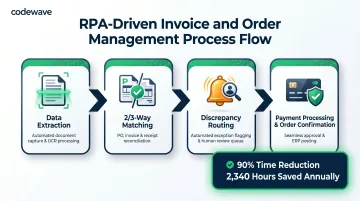
When an invoice arrives, an RPA bot extracts the vendor name, amount, and purchase order number, matches them against the procurement system, flags discrepancies for human review, and routes approved invoices for payment—no human input required.
How RPA Differs from Traditional Automation
Traditional factory automation handles physical tasks via machinery—robotic arms, conveyors, CNC machines. RPA handles process tasks via software. It integrates with existing tools—ERP, MES, and CRM platforms—without requiring system overhauls.
This is the practical appeal: you don't replace your core systems. RPA sits on top of them, automating the clicks, keystrokes, and data transfers your team currently handles by hand.
The global RPA market reflects this growing adoption. According to Mordor Intelligence, the market reached approximately $8.12 billion in 2026 and is projected to grow at a 28.64% CAGR toward $28.60 billion by 2031. Manufacturing is among the fastest-growing verticals, driven by the need to automate administrative overhead while addressing workforce shortages.

Key Use Cases: Where RPA Is Transforming the Factory Floor
RPA applications in manufacturing span two main areas: production and operations on the floor itself, and back-office and supply chain functions. Both deliver measurable time and cost savings.
Quality Control and Defect Detection
RPA bots handle the full inspection data loop — collecting, flagging, reporting, and routing — without manual intervention:
- Collect inspection data from QMS and MES platforms
- Flag anomalies against predefined quality thresholds
- Generate inspection reports automatically
- Route exceptions to QA teams for review
The result is a complete audit trail, fewer missed defects, and real-time escalation of non-conformances before they compound.
Equipment Maintenance and Scheduling
Bots process data from Computerized Maintenance Management Systems (CMMS) to keep equipment running on schedule:
- Schedule preventive maintenance based on usage and condition data
- Send reminders and alerts to technicians
- Auto-generate repair work orders when a machine signals a fault
- Produce maintenance reports without manual data entry
An Automation Anywhere customer story documents a global construction and mining equipment manufacturer that achieved 3X greater efficiency and a 29% productivity increase after a six-month RPA pilot — with zero errors across automated supply chain processes. When maintenance notifications are automated, critical information stops falling through the cracks.
Production Tracking and Bill of Materials (BOM)
RPA extracts component and quantity data from product specs, design documents, and inventory records to auto-generate BOMs. When design changes are detected, bots update the BOM automatically. Bots also provide real-time production status visibility by pulling data from MES and ERP systems, consolidating it into dashboards, and flagging delays or material shortages before they cascade.
Inventory Management and Procurement
Inventory management is one of the highest-impact RPA use cases in manufacturing. Bots handle the full procurement loop continuously:
- Monitor stock levels and trigger reorders when thresholds are breached
- Auto-generate purchase orders and purchase requisitions
- Validate delivery notes via OCR (Optical Character Recognition)
- Reconcile inventory data across disparate systems
Manufacturers using automated inventory workflows have reported up to 90% fewer data errors and 95%+ data accuracy — eliminating the stockouts and overordering that manual tracking cycles routinely produce.
Invoice Processing and Order Management
On the finance side, RPA bots handle the entire invoice and order cycle:
- Extract data from electronic and scanned invoices
- Perform two- and three-way matching against purchase orders and delivery notes
- Route discrepancies for human review and process approved payments
- Monitor incoming orders, send confirmations, and update downstream systems
Arçelik, one of the world's top three household appliance manufacturers, cut invoice entry and validation time by 90% — saving 2,340 working hours per year on invoicing alone and $1.1 million annually across 85+ automated processes.
When RPA Meets AI: The Rise of Intelligent Automation
Basic RPA handles rule-based tasks—if this, then that. But when combined with AI and machine learning (ML), bots gain the ability to process unstructured data, learn from patterns, and make contextual decisions. This evolution is called intelligent automation (IA), and it moves RPA from rigid scripts to adaptive workflows.
Three areas show this shift most clearly on the factory floor.
Predictive Maintenance Powered by IoT and ML
AI-driven ML models analyze real-time sensor data from IoT devices to predict equipment failures before they happen. RPA bots then act on those predictions automatically:
- Trigger maintenance requests in the CMMS
- Optimize technician schedules around predicted failure windows
- Update equipment records to reflect current risk status
This eliminates reactive downtime and converts maintenance from a reactive cost center into a proactive reliability function. McKinsey Global Institute projects that manufacturing will have the highest automation adoption rate at 31% of work hours by 2030, exceeding the 27% economy-wide average.
Computer Vision for Quality Inspection
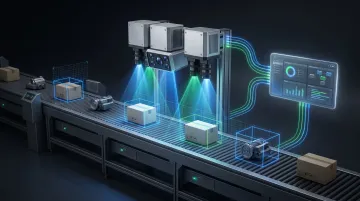
AI-powered image recognition integrates with RPA to inspect products on assembly lines in real time. Computer vision models detect defects, identify components, and classify parts automatically—while RPA bots update quality records in QMS and ERP systems. This combination delivers faster, more consistent inspection than manual visual checks, especially for high-volume production runs.
Intelligent Document Processing and NLP
AI-based OCR extracts data from scanned invoices, shipping documents, and forms, with ML models improving accuracy as they process more examples over time. Natural Language Processing (NLP) takes this further—enabling bots to read and respond to emails or work orders in natural language, expanding automation well beyond structured inputs. Platforms like UiPath and Automation Anywhere now embed generative AI natively, letting teams automate unstructured documents and conversational workflows without custom model training.
Benefits of RPA in Manufacturing
Increased Operational Speed and Throughput
Bots complete tasks in seconds that take humans hours—data entry, report generation, purchase order creation. This reduces cycle times across procurement, invoicing, and compliance. For example, Forrester's Total Economic Impact study for Microsoft Power Automate found that high-impact RPA use cases saved approximately 200 hours per year per employee, with total time savings valued at $13.2 million over three years for a 30,000-employee organization.
Dramatically Reduced Errors and Improved Data Accuracy
By removing manual data entry from critical workflows like vendor reconciliation, tax reporting, and BOM management, RPA eliminates costly human errors. Manufacturers working with experienced implementation partners have reported achieving 90% fewer data errors and 95%+ data accuracy across automated workflows. One Forrester study found that 61% of respondents reported error reduction and data quality benefits from intelligent automation.
Cost Savings and Better Resource Allocation
RPA frees up human workers from low-value tasks so teams can focus on strategic work: demand forecasting, supplier negotiation, and product innovation. Client outcomes tracked by Codewave show a 25% reduction in operational costs and a 40% increase in productivity across automated workflows. Those numbers reflect more than labor savings — they include eliminated rework, fewer compliance penalties, and sharper decisions driven by cleaner data.
24/7 Availability and Operational Scalability
RPA bots operate around the clock without fatigue, enabling continuous processing—overnight inventory updates, batch invoicing, compliance report generation. When demand spikes, you scale bot capacity without adding headcount. For seasonal manufacturers or operations hit by sudden order surges, that flexibility can be the difference between meeting commitments and falling behind.
Compliance, Auditability, and Risk Reduction
In regulated manufacturing environments — medical devices, aerospace, food and beverage — documentation gaps are costly. RPA addresses this directly:
- Generates complete audit trails for every automated action
- Standardizes compliance documentation across workflows
- Triggers alerts before regulatory deadlines are missed
- Produces repeatable, inspectable processes that hold up under audit
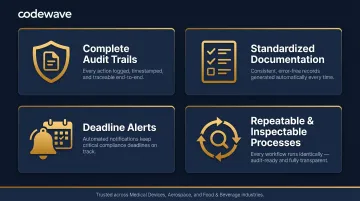
Non-compliance penalties and audit failures become far less likely when the process itself enforces the rules.
How to Choose the Right Processes to Automate First
Not every process is a good candidate for RPA. The characteristics of an RPA-ready process include:
- Rule-based and repetitive with low exception rates
- High transaction volume (hundreds or thousands of iterations per month)
- Structured digital data (forms, spreadsheets, system records)
- Reliance on two or more existing software systems that need data transferred between them
Processes requiring complex judgment, creativity, or high human interaction are poor RPA candidates. Tasks like strategic supplier negotiations, product design reviews, or customer relationship management don't fit the RPA model.
Prioritization Approach
Start with processes that have the highest volume and the clearest rules, where errors are costly and frequent. Invoice processing, inventory reordering, and compliance reporting are typically the best entry points. A phased rollout—pilot one or two processes before scaling—reduces disruption risk and lets teams validate ROI before expanding.
According to Deloitte's Global Intelligent Automation survey, organizations using process mining report significantly better outcomes: 80% agree it enables identification of high-value processes, and 82% agree it drives better outcomes than selecting processes without it.
The Role of Process Discovery Tools and Expert Assessment
Organizations use process mining or RPA consulting assessments to objectively identify high-ROI automation candidates before committing resources. This prevents misalignment between what's technically automatable and what actually drives business value. When selecting an implementation partner, look for outcome-based engagement models rather than time-and-materials billing. Codewave's ImpactIndex™, for example, ties client fees to measurable results — so manufacturers can connect automation spend directly to business outcomes rather than project hours.
Common Implementation Challenges and How to Navigate Them
Employee Resistance and Change Management
Fear of job displacement is a common barrier. A recent survey found that 51% of American workers worry that AI will replace their jobs. Address this with clear communication about augmentation, not replacement. Show how automation takes over tedious parts of roles—data entry, manual reconciliation—while freeing employees for higher-value work like analysis, strategy, and innovation. Invest in upskilling staff for new responsibilities. Deloitte found that 57% of organizations implementing citizen-led development programs report improved talent retention.
High Initial Costs and the Phased Investment Approach
Upfront software, integration, and training costs can feel prohibitive. Per-bot licensing typically ranges from $5,000 to $15,000 annually, though licensing accounts for only 25-30% of total RPA cost. A phased approach limits your downside: start with one or two high-impact use cases, prove ROI, then scale. Forrester research documents 248-330% ROI with payback periods under six months for organizations that identify the right initial processes.
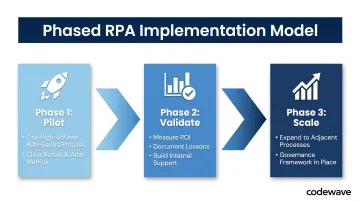
The three-phase model most implementation teams follow:
- Pilot: One high-volume, rule-based process with clear before/after metrics
- Validate: Measure ROI, document lessons learned, build internal support
- Scale: Expand to adjacent processes with governance already in place
Ongoing Maintenance and Scalability Planning
Bots break when the systems or processes underneath them change — and that happens more often than most teams expect. Building a governance framework before you scale is what separates sustainable RPA programs from ones that quietly collapse under their own weight.
Your maintenance plan should cover:
- Bot performance monitoring and alerting
- Change management protocols when source systems update
- A clear owner (bot controller or CoE team) for each automated process
- A roadmap for stepping up to intelligent automation as complexity grows
Platform selection matters here. The 2024 Gartner Magic Quadrant for Robotic Process Automation identifies UiPath and Automation Anywhere as Leaders — both offer centralized orchestration and are integrating generative AI features for agentic automation. Microsoft Power Automate and SS&C Blue Prism round out the enterprise-grade options worth evaluating.
Frequently Asked Questions
What is RPA in manufacturing?
RPA in manufacturing uses software bots to automate repetitive, rule-based digital tasks—data entry, inventory updates, compliance reporting—by integrating with existing systems like ERP and MES to handle the clicks and data transfers your team currently does by hand.
What are the uses of RPA in manufacturing?
Key applications include inventory management, invoice processing, procurement automation, quality control reporting, equipment maintenance scheduling, BOM generation, compliance documentation, and order management. RPA handles high-volume, rules-based workflows across production and supply chain operations.
What are the top RPA tools for manufacturing?
Leading platforms include UiPath, Microsoft Power Automate, Automation Anywhere (Automation 360), and SS&C Blue Prism—each with ERP integrations and manufacturing-specific use case support. The 2024 Gartner Magic Quadrant identifies UiPath and Automation Anywhere as Leaders.
What are the three types of RPA in manufacturing?
The three types are attended RPA (triggered manually, works alongside humans), unattended RPA (runs autonomously on a schedule), and hybrid RPA (combines both for workflows requiring automation and human input at different stages).
Which is better, RPA or Selenium?
These serve different purposes. Selenium is a web browser testing tool for developers, while RPA is a business process automation platform built for enterprise workflows. For manufacturing operations—invoice processing, inventory management, compliance reporting—RPA is the right choice.