Introduction
Most RPA implementations fail before they deliver value — and the number one cause isn't bad technology. It's a fundamental misunderstanding of what RPA actually costs. Businesses across healthcare, finance, insurance, and manufacturing are deploying bots to eliminate repetitive, error-prone work, yet many programs stall or overspend within the first year.
Most organizations budget for software licenses and assume they're covered. In reality, licensing accounts for only 25–30% of total RPA cost.
The remaining 70–75% goes into development, infrastructure, legacy system integration, training, and ongoing maintenance. That gap between perceived cost and actual investment is what drives budget overruns, abandoned programs, and executive skepticism about automation's ROI.
This guide breaks down the real cost components beyond licensing, explains what drives costs up or down, shows how to calculate ROI accurately, and gives you a framework to budget for an implementation that delivers measurable results — not just deployed bots.
Key Takeaways
- Total RPA costs range from $5,000 for a single-bot pilot to $500,000+ for enterprise multi-process deployments
- Licensing is only 25–30% of total cost—the other 70% goes to development, infrastructure, training, and maintenance
- AI-augmented and unattended automation workflows can push costs 3–5x higher than basic attended-bot deployments
- ROI typically lands within 6–18 months—but only when total cost of ownership is budgeted upfront, not just licensing fees
How Much Does RPA Cost?
RPA has no fixed price. Total cost depends on process complexity, the number and type of bots you deploy, which vendor you choose, whether you host on-premises or in the cloud, and the scale of your rollout. Misunderstanding this leads to three predictable failures: underbudgeting by 2–3x, choosing the wrong platform for your needs, or getting blindsided by maintenance costs once bots are live.
Vendor pricing models vary dramatically:
- Per-bot pricing: $5,000–$15,000 per bot per year
- Subscription-based: $20,000–$100,000 annually for multi-bot access
- Consumption-based: Fractions of a cent per transaction, scaled to volume
- Enterprise flat-rate licensing: $500,000–$1,000,000+ per year for unlimited bots
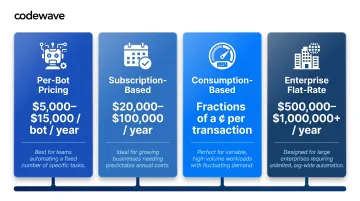
The right model depends on your usage patterns and scale. A small finance team automating month-end reconciliation doesn't need enterprise licensing; a global insurer automating claims processing across 50 countries does.
Entry-Level RPA Setup
Entry-level RPA covers one or two simple, rule-based processes using a single attended bot or a small number of unattended bots. Common use cases: data entry from PDFs to spreadsheets, automated report generation, or invoice data extraction. Platforms at this tier include UiPath Basic, Microsoft Power Automate Premium, or open-source tooling like Robot Framework.
This tier typically covers:
- Basic bot development and configuration
- Minimal integration with existing systems
- Limited end-user training—typically documentation or a single workshop
Total cost range: $5,000–$15,000 per bot, including licensing, development, and initial setup.
Best For:
- SMEs testing RPA for the first time
- Departments with clear, high-volume, low-exception processes (e.g., employee onboarding paperwork, daily report generation)
- Teams needing to prove ROI before committing budget to a broader rollout
Mid-Range RPA Setup
Mid-range implementations deploy multiple unattended bots handling several interconnected processes across one or more departments. You'll typically work with professional services teams from vendors or third-party implementation partners to ensure bots are production-ready.
This tier includes:
- Deeper integration with CRMs, ERPs, or legacy platforms
- Upfront process analysis to identify automation opportunities
- Custom bot development and exception handling logic
- Infrastructure setup (cloud or on-premises)
- Structured employee training programs
Total cost range: $50,000–$150,000, depending on process count and system complexity.
Best For:
- Growth-stage businesses scaling automation beyond a single use case
- Organizations in regulated industries (fintech, insurance, healthcare) needing compliance and security measures baked in
- Teams running higher-volume, semi-complex workflows where exceptions need intelligent routing
- Companies ready to move from pilot to a repeatable deployment model
Enterprise RPA Deployment
Enterprise deployments involve dozens of bots running across multiple departments, often augmented with AI/ML capabilities to handle unstructured data—invoices, emails, scanned documents—or decision-heavy tasks.
This tier includes:
- A dedicated Center of Excellence (CoE) to govern bot development and manage the bot lifecycle
- Advanced analytics dashboards for monitoring bot performance
- Custom integrations with industry-specific platforms
- Ongoing vendor support contracts with SLA guarantees
Infrastructure costs rise significantly at this scale due to server capacity, orchestration platforms, and redundancy requirements.
Total cost range: $150,000–$500,000+ depending on deployment complexity and bot count.
Best For:
- Large enterprises with complex, high-volume operations across logistics, banking, telecom, or manufacturing
- Businesses pursuing company-wide automation at scale rather than point-solution fixes
- Organizations ready to establish governance frameworks and long-term automation roadmaps
Key Factors That Affect the Cost of RPA
RPA pricing is shaped by where you're automating, what you're automating, and who you're buying from. No two implementations cost the same — understanding these variables upfront helps you scope smarter and avoid budget surprises later.
Process Complexity and Volume
Simple, rule-based, linear processes—like invoice matching, data entry, or report generation—cost far less to automate than multi-step workflows with conditional logic, exception handling, or human decision points.
For example:
- Simple bot (PDF data extraction): $2,000–$8,000 per process
- Complex bot (multi-system workflow with AI validation): $15,000–$40,000 per process
Execution frequency also drives ROI. A process running thousands of times daily delivers payback in weeks; one running weekly takes months.
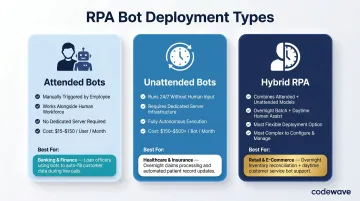
Bot Type: Attended vs. Unattended
The bot deployment model you choose has a direct impact on both cost structure and infrastructure needs:
- Attended bots — Triggered manually, work alongside employees. No dedicated server required. Cost: $15–$150 per user/month depending on platform.
- Unattended bots — Run 24/7 on dedicated infrastructure without human intervention. Higher cost due to server and orchestration requirements: $150–$500+ per bot/month.
- Hybrid RPA — Unattended bots handle overnight batch processing; attended bots assist staff during business hours. Common in fintech and healthcare where human-in-the-loop oversight is required for certain tasks. Most flexible, but also the most complex and costly to manage.
Vendor and Licensing Model
Vendor choice directly shapes both upfront and ongoing costs. Here's how major platforms compare:
| Vendor | Entry Tier | Enterprise Tier | Pricing Model |
|---|---|---|---|
| Microsoft Power Automate | $15/user/month (attended) | $215/bot/month (hosted unattended) | Per-user + per-bot |
| UiPath | $25/month (Basic) | Contact sales | Subscription + per-bot hybrid |
| Automation Anywhere | Free (Community) | $20,000/year per production bot | Subscription + per-bot |
| IBM RPA | $981/month (SaaS) | Custom pricing | Subscription |
| Open-source (Robot Framework) | $0 license | $0 license | Free (development costs only) |
Licensing alone can range from $0 (open source) to $50,000+ per year per bot for enterprise platforms. Switching vendors mid-project is expensive—migration requires redevelopment, testing, and retraining.
Integration with Existing Systems
Beyond licensing, integration is where RPA budgets most often balloon. Connecting bots to legacy systems, ERPs, or third-party APIs introduces hidden complexity that vendor quotes rarely capture upfront. Custom connectors, middleware, and data mapping for poorly documented systems can add $20,000–$200,000 to a project's cost. The more systems involved, the more complex—and expensive—the build.
Healthcare organizations integrating with HL7/FHIR-compliant EHR systems, manufacturers connecting to legacy MES platforms, or insurers syncing with decades-old policy management systems face the highest integration costs.
Deployment Environment and Ongoing Maintenance
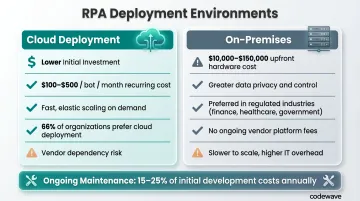
Where you run your bots affects both your upfront spend and long-term cost structure:
- Cloud — Lower initial investment (no server hardware), with recurring subscription fees of $100–$500/bot/month. Scales quickly and suits teams prioritizing speed. Over 66% of organizations now use cloud for some or all automations.
- On-premises — Higher upfront hardware costs ($10,000–$150,000) but greater data control. The standard choice for heavily regulated industries like healthcare and financial services.
- Ongoing maintenance — Unavoidable regardless of deployment model. Bots break when applications update their UI or restructure workflows. Budget 15–25% of initial development costs annually for maintenance.
RPA Cost Breakdown: What You're Actually Paying For
The total cost of RPA goes well beyond the software purchase. Licensing accounts for only 25–30% of total cost—a critical insight most budget plans miss. Here's where the rest goes.
Software Licensing and Renewals
Licensing fees renew annually and tend to climb as your bot count or user count grows. Open-source alternatives eliminate this cost entirely but require stronger internal technical capability to develop and maintain bots.
Microsoft Power Automate charges $15/user/month for attended bots and $150/bot/month for unattended. UiPath's Pro plan runs $1,380/month for one attended and one unattended bot. Automation Anywhere charges approximately $20,000/year per production bot license.
Development, Configuration, and Testing
Development costs cover bot design, programming, exception handling logic, and testing—paid once, with periodic updates as processes change. Simple bots automating single-application tasks (for example, copying data from one system to another) cost $2,000–$8,000 to build. Complex, multi-system automations with AI-augmented decision logic cost $15,000–$40,000 or more.
Testing is consistently underestimated. Bots must be validated across every failure mode, including:
- Missing required fields in source data
- Target systems going offline mid-process
- Unexpected changes to data formats or UI layouts
- Edge cases in exception-handling logic
Infrastructure and Hosting
Infrastructure costs are a mix of one-time setup and ongoing operating expenses—often overlooked because teams focus on bot count rather than the compute and orchestration platforms needed to run them reliably.
Cloud hosting costs $100–$500 per month per bot. Microsoft's Hosted Process plan (which includes an Azure VM) costs $215/bot/month.
On-premises infrastructure requires server purchase, configuration, and maintenance—typically $10,000–$150,000 upfront depending on scale.
Training, Change Management, and Support
End-user training, IT workshops, and change management are one-time investments that recur whenever new bots or processes roll out—and they're chronically underfunded. Poor change management is one of the top reasons RPA rollouts stall: 52% of organizations cite inability to change business processes as a key scaling barrier.
The cost adds up fast. Comprehensive training runs $3,000–$4,000 per participant. Across multiple departments, mid-sized deployments routinely exceed $50,000 in training spend alone.
Low-Cost vs High-Cost RPA—What's the Difference?
The difference between low-cost and high-cost RPA is not just the price tag—it reflects scope, reliability, scalability, and long-term value. Choosing the cheapest option without evaluating these dimensions is a common and costly mistake.
How the Two Tiers Actually Differ
Process coverage is the most visible gap. Low-cost bots handle narrow, stable tasks with minimal variation—copying invoice data from email attachments to spreadsheets, for example. High-cost bots manage exceptions, adapt to UI changes, integrate AI to interpret unstructured data, and orchestrate workflows across multiple systems.
Maintenance burden is where the real cost gap hides. Cheaper bots break more often when underlying applications update. A $5,000 bot requiring $10,000 in annual break-fix work delivers worse ROI than a $15,000 bot with reliable exception handling that needs minimal upkeep.
Scalability is the third dimension organizations underestimate. Low-cost setups hit limits quickly as automation ambitions grow. Once an initial implementation can't scale past a handful of bots, teams face expensive rework or full vendor migrations.
Understanding these tradeoffs makes the decision clearer. Here's when each tier makes sense:
When spending more is justified:
- High transaction volume (thousands of processes daily)
- Regulated industries requiring audit trails and compliance controls
- Multi-department rollout requiring centralized governance
- AI augmentation needs for handling unstructured data
When a lean setup delivers better ROI:
- Single department pilot with clear, stable processes
- Well-documented systems with minimal exceptions
- Internal technical team available for bot maintenance
- Need to prove ROI before committing larger budgets
How to Estimate the Right Budget for Your RPA Project
The best RPA budget is built around fit, not just price. Define what you want to automate, who will manage it, what systems it touches, and what success looks like before comparing vendor quotes.
Step 1: Map the target process and calculate savings baseline
Document the process end-to-end. Count hours saved per week and multiply by fully-loaded labor cost (salary + benefits + overhead). Example: If a process takes 20 hours/week and the fully-loaded cost is $50/hour, you're spending $52,000/year on that process.
Step 2: Add all cost components—not just software
Include licensing, development, infrastructure, training, and maintenance. Don't just budget for Year 1 licenses.
Step 3: Apply the ROI formula
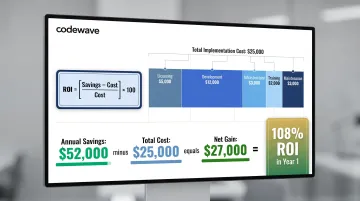
ROI = [(Total Annual Savings − Total Implementation Cost) / Total Implementation Cost] × 100
Example calculation:
- Annual savings: $52,000 (20 hours/week × $50/hour × 52 weeks)
- Total implementation cost: $25,000 (licensing $5,000 + development $12,000 + infrastructure $3,000 + training $2,000 + first-year maintenance $3,000)
- ROI: [($52,000 − $25,000) / $25,000] × 100 = 108% ROI in Year 1
Step 4: Build in a scaling buffer
Once early results come in, demand for automation usually grows fast. Budget 20–30% contingency for expanding to adjacent processes or departments.
The implementation partner you choose shapes how quickly these numbers materialize. Codewave's ImpactIndex™ model ties delivery to measurable outcomes — the 40% productivity gains and 25% cost reductions that clients report aren't targets set at kickoff and forgotten; they're the conditions under which the engagement is considered complete.
What Most Businesses Get Wrong About RPA Costs
Focusing Only on Licensing Costs
Treating RPA like a software purchase—comparing license prices and picking the cheapest—ignores the 70–75% of total cost that comes from development, integration, training, and maintenance. This leads to severe underbudgeting and failed rollouts. Between 30–50% of all RPA initiatives fail, and underestimating total cost is a leading cause.
Ignoring Ongoing and Scaling Costs
RPA is not set-it-and-forget-it. As your deployment grows, so do the hidden costs:
- Bot maintenance: Every application update can break existing automations, requiring rework
- Governance overhead: Managing 20 bots costs more than twice what managing 10 does — it doesn't scale linearly
- Year 2+ surprise expenses: Organizations that budget only for Year 1 licensing typically face additional costs of 15–25% of initial development costs annually
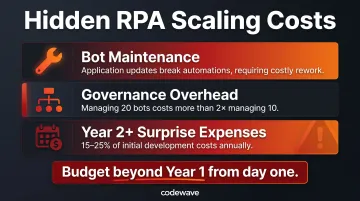
Planning for these from the start separates successful programs from ones that stall after the pilot.
Automating the Wrong Processes First
Starting with complex, exception-heavy, or unstable processes dramatically increases both development cost and maintenance burden. A process that changes frequently or has dozens of edge cases will cost far more to automate and maintain than a stable, high-volume workflow.
The highest ROI comes from automating simple, rule-based, well-documented processes first—and using those wins to fund more complex automation later. Deloitte's 2022 survey found that 52% of organizations cite inability to change business processes as their primary scaling barrier. Pick the wrong process to automate first, and no amount of tooling fixes it.
Conclusion
RPA costs vary significantly—from a few thousand dollars for a focused pilot to hundreds of thousands for enterprise-scale deployment. Understanding every component of total cost of ownership separates successful automation programs from those that stall or fail.
The right cost is the one that delivers measurable, sustainable business value. Before committing budget, make sure you've addressed the fundamentals:
- Start with process clarity before selecting a platform
- Budget for all five cost components: licensing, development, infrastructure, training, and maintenance
- Build in scaling room from day one
- Measure ROI against concrete outcomes—not just implementation completion
Organizations that plan this way consistently see ROI within 6–18 months. That timeline makes expanding automation across the enterprise a straightforward business case, not a gamble.
Frequently Asked Questions
How much does robotic process automation (RPA) cost to implement?
Total RPA implementation costs range from $5,000–$15,000 for entry-level single-bot setups to $150,000–$500,000+ for enterprise-scale deployments. Licensing accounts for only 25–30% of total cost—the remainder comes from development, infrastructure, integration, training, and ongoing maintenance.
How much does an RPA developer cost?
In-house RPA developers in the US earn an average of $112,937 annually. Outsourced or offshore RPA consultants typically charge $15–$60/hour. Project-based engagements with implementation partners range from $20,000–$100,000 depending on scope and complexity.
What is a typical ROI timeline for RPA?
Simple, high-volume processes often generate positive ROI within 3–6 months. More complex deployments typically see payback within 12–18 months. Process selection and realistic cost planning have the biggest impact on that timeline.
What are the hidden costs of RPA that companies often overlook?
The most commonly missed costs are:
- Change management and employee training
- Exception handling when bots encounter unexpected scenarios
- Bot maintenance after underlying applications update
- Governance and monitoring overhead as bot fleets grow
- Infrastructure scaling costs beyond the initial deployment
Which is better: RPA or Python?
These serve different use cases. Commercial RPA platforms offer low-code accessibility, pre-built connectors, and faster deployment for non-technical users. Python-based automation offers more flexibility, zero licensing costs, but requires developer expertise. The right choice depends on your team's technical capability, process complexity, and budget.
What does RPA stand for?
RPA stands for Robotic Process Automation—software-based automation of repetitive, rule-based digital tasks. "Robotic" refers to software bots, not physical robots.