AI chatbots get talked about mostly as a customer service tool — but that framing misses the bigger story. When a chatbot connects directly to your CRM, it becomes something fundamentally different: an active participant in the sales process that qualifies leads, personalizes outreach, and keeps your data current around the clock.
This article focuses on the practical, measurable case for AI chatbot-CRM integration — specifically what it does for sales performance, and where the value compounds over time.
Key Takeaways
- A CRM chatbot qualifies leads instantly, routes high-intent prospects automatically, and eliminates manual data entry.
- Personalization at scale — driven by real CRM history — moves prospects through the funnel faster than generic outreach.
- Every chatbot interaction enriches your CRM, making forecasts, targeting, and sales decisions progressively more accurate.
- Without CRM-chatbot integration, slower response times and qualification gaps quietly erode pipeline revenue.
- Full value comes from consistent cross-channel deployment, regular performance review, and acting on what the data reveals.
What Is a CRM Chatbot?
A CRM chatbot is an AI-powered conversational interface connected directly to your CRM system. That connection is what separates it from a standard chatbot. With CRM access, it can retrieve customer records, update lead data, qualify prospects, and engage contacts using real-time context — not scripted, one-size-fits-all responses.
Without CRM integration, a chatbot is just a FAQ machine. It can answer common questions, but it has no idea who it's talking to, where that person is in the pipeline, or what the right next action should be.
With CRM integration, the chatbot becomes an AI sales agent that knows:
- Whether this is a new lead or a returning customer
- What deals, tickets, or purchases are already on record
- Which stage of the funnel this contact is in
- What the next logical action is — schedule a call, send a resource, flag for rep follow-up
That intelligence extends across the full sales funnel — from initial lead capture on a website or landing page, through qualification and nurturing, to post-sale support. CRM chatbots also work across channels: web chat, WhatsApp, email workflows, and internal sales tools. Codewave designs these multi-channel integrations so every conversation, regardless of where it happens, writes back to a single CRM data source — keeping records clean and context intact.
Three Core Advantages of AI Chatbot-CRM Integration
Advantage 1: Automated Lead Qualification and Sales Acceleration
Manual lead triage is one of the biggest drains on sales productivity. According to Salesforce's 2024 research, sales reps spend 70% of their time on non-selling tasks — and a significant portion of that goes to lead screening that AI can handle faster and more consistently.
The chatbot takes over the front end of qualification: it engages inbound leads the moment they arrive, runs a qualification conversation aligned to your CRM criteria, scores leads based on their responses and behavioral signals, and routes high-intent prospects to the right rep — with a full context summary already attached.
Here's what this looks like in practice: a prospect fills out a form after clicking a paid ad. The chatbot pulls their available CRM data (industry, firmographics, any prior interactions), asks three to five qualifying questions, updates the lead score in real time, and either books a meeting or flags the lead for rep follow-up — all before the rep even opens their laptop.
Why response speed is a bigger factor than most teams account for:
Harvard Business Review research found that firms contacting prospects within one hour were nearly 7x more likely to qualify the lead than those contacting even an hour later — and more than 60x more likely than firms waiting 24 hours or longer. The problem is that most teams aren't anywhere close to that benchmark. Only 0.1% of inbound leads are engaged within five minutes, and 57.1% of first contact attempts happen after more than a week.
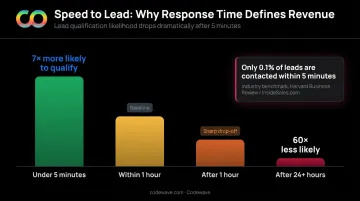
A CRM-integrated chatbot responds in seconds, not hours. That speed advantage directly lifts lead-to-opportunity conversion rates — and the data shows the drop-off is steep once you miss the first hour.
KPIs this advantage moves:
- Lead response time
- Lead-to-opportunity conversion rate
- Pipeline velocity
- Cost per qualified lead
- Sales rep hours spent on qualification vs. active selling
When it matters most: High inbound lead volumes, multiple lead sources, lean sales teams, and compliance-sensitive industries like fintech, insurance, and healthcare — where qualifying information must be gathered before a human conversation can begin.
Advantage 2: Real-Time Personalization at Scale
Generic outreach erodes trust. McKinsey research found that 76% of consumers get frustrated when personalization doesn't happen, and 78% are more likely to repurchase from companies that do personalize. Faster-growing companies also drive 40% more revenue from personalization than their slower-growing peers.
CRM-integrated chatbots make this kind of personalization possible at any volume — because they draw on the full customer history already in the CRM.
Two concrete examples of what this looks like:
- A returning customer asks about an upgrade. The chatbot pulls their purchase history, sees their contract renewal is due in 30 days, and responds with a tailored offer — not a link to the product page.
- In a B2B deal, the chatbot recognizes an inbound contact as an existing stakeholder in a multi-stakeholder opportunity and adjusts its messaging to match where that deal stands.
This isn't just a better experience — it's a direct revenue driver. McKinsey reports that personalization can reduce customer acquisition costs by up to 50%, lift revenues by up to 15%, and increase marketing ROI by 10% to 30%.
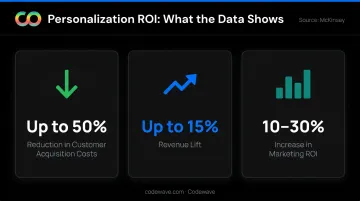
Once a customer base grows past what any rep can track individually, personalization degrades — interactions become generic, renewal signals get missed, and upsell timing slips. CRM-integrated chatbots maintain that contextual awareness across every account, without adding headcount.
KPIs this advantage moves:
- Customer satisfaction score (CSAT)
- Repeat purchase rate
- Upsell and cross-sell revenue
- Customer lifetime value (CLV)
- Churn rate
- Email and message engagement rates
When it matters most: E-commerce, SaaS, and retail businesses managing large customer bases, and healthcare or insurance companies where follow-up timing and relevance directly affect outcomes.
Advantage 3: Continuous Data Enrichment and Actionable Sales Intelligence
Every chatbot conversation generates data: intent signals, objections raised, topics explored, competitor mentions, specific feature requests. Without CRM integration, that data disappears when the conversation ends. With integration, it flows automatically into the CRM — structured, searchable, and immediately useful.
Here's what that feedback loop looks like in practice:
A chatbot conversation surfaces that a prospect is evaluating two competitors and needs a specific compliance feature. That's automatically logged in the CRM. The sales manager sees the same pattern across 40 similar conversations, adjusts the pitch, and flags it to marketing. The collateral gets updated within a week. A manual review process operating on weekly call notes couldn't surface that pattern until the opportunity was already lost.
The underlying problem this solves is real. Dun & Bradstreet estimates that contact data accuracy erodes by roughly 2.5% per month — about 30% per year — when it isn't actively maintained. And only 35% of sales professionals completely trust the accuracy of their organization's data, according to Salesforce. Reps forget to log calls. Notes are incomplete. Patterns go undetected.
AI chatbots capture interaction data with 100% consistency. Every conversation enriches the CRM rather than degrading it — which means forecasting gets more accurate, segmentation gets sharper, and reps go into calls with fuller context over time.
KPIs this advantage moves:
- CRM data completeness rate
- Forecast accuracy
- Time spent on manual data entry
- Data error rates
- Sales cycle length (richer data enables faster decisions)
When it matters most: Large sales organizations where data consistency is hard to enforce, businesses relying on CRM data for revenue forecasting, and any company using data-driven segmentation or campaign targeting as a growth lever.
What Happens Without AI-CRM Integration
The risks of skipping integration aren't dramatic — they compound gradually until reversing course becomes expensive.
| Problem | Consequence |
|---|---|
| Lead response gaps | Prospects wait hours or days, lose intent, and convert with a competitor |
| Inconsistent qualification | Reps apply different criteria; high-value leads get missed, low-value ones consume resources |
| Data blind spots | Cross-channel interactions go unlogged; the CRM becomes increasingly stale |
| No elastic capacity | As lead volumes grow, the team either burns out or misses opportunities |
| Compounding cost | Each problem compounds the others — rising cost per acquisition, declining retention |
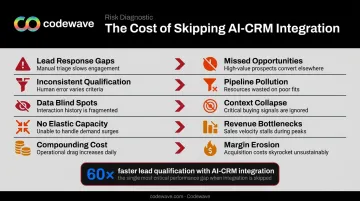
Companies that respond within one hour are more than 60x as likely to qualify a lead as those waiting 24 hours. Yet the average first contact attempt happens more than a week after inquiry — meaning most businesses without automation are already losing pipeline before they realize it's gone.
How to Get the Most From AI Chatbot-CRM Integration
Chatbot-CRM integration requires active management to hold its value. Configure it once and leave it alone, and performance erodes. Review it regularly — conversation flows, qualification rates, CRM data quality — and the system compounds what it learns.
Three practices that separate strong implementations from weak ones:
Deploy across all touchpoints, not just one. A website chatbot that doesn't share CRM data with your email automation and sales tools negates the enrichment advantage. Fragmented deployment recreates the same blind spots you built this to eliminate.
Review KPIs monthly and act on what you find. Track qualification rates, drop-off points, and conversation completion rates. When flows underperform, update the logic — don't wait for the next quarterly review.
Move insights out of dashboards. Chatbot interaction data that never reaches a sales pitch, a product roadmap, or a marketing brief is dead intelligence. The integration is only as useful as the decisions it informs.
For businesses building or upgrading AI chatbot-CRM integration across complex customer journeys — particularly in healthcare, fintech, retail, or insurance — Codewave's outcome-based development model (ImpactIndex™) structures engagements around measurable business results, not just technical delivery.
The integration stack spans the full chain: LLM and NLP layer, API orchestration, and CRM connectivity, with compliance architecture (HIPAA, SOX, FINRA) built in from the start rather than retrofitted.
Conclusion
The value of AI chatbot-CRM integration comes from three things working together: faster lead qualification that shortens the sales cycle, personalization that deepens customer relationships and drives retention, and a continuously enriched CRM that makes every future sales decision more accurate.
These advantages grow stronger over time. The system processes more interactions, the data becomes richer, and the gap between integrated and non-integrated teams widens each quarter. Teams that start sooner accumulate a structural advantage that's difficult for late movers to close.
Treat the integration as an ongoing sales asset — one that compounds in value as your pipeline grows, your data deepens, and your team learns what the system surfaces.
Frequently Asked Questions
What is a CRM chatbot?
A CRM chatbot is an AI-powered conversational tool connected to your CRM system, giving it access to customer records, deal history, and pipeline data. Unlike a standalone chatbot, it engages prospects and customers with real-time context rather than generic, scripted responses.
How does a CRM chatbot improve sales performance?
It shortens the sales cycle by qualifying leads instantly, improves conversion rates through personalized follow-ups, and keeps CRM data complete and accurate — all of which directly improve pipeline velocity and reduce the time reps spend on non-selling tasks.
Which AI is best for CRM?
Your CRM platform (Salesforce, HubSpot, Zoho), workflow complexity, and customization needs all shape the right choice. Businesses with complex or cross-industry requirements typically get more value from custom-built integrations than off-the-shelf tools.
What are the risks of integrating AI chatbots with CRM?
The main risks are data security and compliance exposure, poor chatbot logic degrading customer experience, and data quality issues — all of which require ongoing performance review to protect pipeline integrity and customer trust.
Can AI build a CRM system?
AI is best used to enhance existing CRM platforms through integrations, automation layers, and intelligent features. It can assist with building or customizing components, but it doesn't replace the core CRM infrastructure.
How long does it take to integrate an AI chatbot with a CRM?
Simple integrations can be functional within a few weeks. Enterprise-grade deployments — spanning multiple channels, custom workflows, and compliance requirements — typically take several months and are best delivered in phased sprints.