



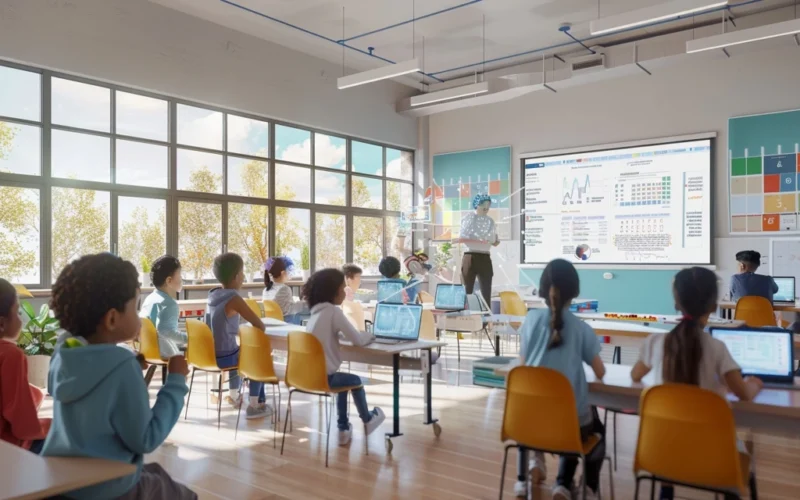
AI entered classrooms faster than policies, training, or assessment rules could catch up, and now schools are dealing with learning gains in one place and integrity concerns in another.
Students are already using AI to draft assignments, teachers are redesigning grading systems mid-semester, and institutions are trying to decide what should be automated before trust erodes.
85% of teachers and 86%of students are already using AI in learning environments, making AI in education a structural change rather than a pilot initiative. Yet adoption alone does not explain impact. Institutions now need clarity on where AI improves outcomes, where it introduces risk, and which applications are worth scaling.
This blog examines where AI in education is delivering measurable results today and how schools and universities are applying it across teaching, assessment, and operations.
Key Takeaways
- AI in education is shifting from experimental tools to fully integrated systems that improve learning, teaching, and decision-making.
- Personalized learning through AI helps adjust pacing, difficulty, and subject focus based on student behavior and performance.
- Teachers are using AI to automate grading, lesson planning, and provide instant feedback, reducing administrative workload.
- AI-driven student retention tools help institutions predict and address dropout risk earlier, improving student success rates.
- AI in education is most effective when connected systems work together, integrating learning management, assessment, and academic advising platforms.
Where AI Personalizes Learning for Every Student
Personalization used to depend on smaller class sizes or additional teaching staff. AI now enables personalization across large cohorts without increasing instructional load.
Adaptive learning systems track how students interact with content and automatically adjust instruction paths. Instead of assigning identical material to entire classes, platforms modify pacing, complexity, and revision cycles based on performance signals.
Research shows adaptive learning systems produce measurable improvements in cognitive outcomes compared with non-adaptive instruction across multiple subject areas.
Real-time adjustment of learning pace and difficulty
AI platforms detect hesitation patterns, repeated mistakes, skipped sections, and timing of answers. These signals help systems determine whether a student needs reinforcement or progression.
Example:
A middle-school math platform can slow down algebraic progress for one learner while accelerating geometry modules for another in the same classroom session.
This reduces silent learning gaps that often remain hidden until exam periods.
Identifying knowledge gaps before exams
Traditional assessment models detect problems only after performance has dropped. AI systems detect weak concept clusters weeks earlier.
Institutions now deploy:
- Concept-level mastery dashboards
- Topic-wise probability scoring
- Error pattern clustering
- Predictive revision sequencing
Students receive targeted revision lists instead of full-chapter repetition. This shortens remediation cycles significantly during semester transitions.
Adaptive learning paths across subjects and grade levels
Cross-disciplinary adaptation is becoming standard in advanced platforms.
Example:
A learner struggling with reading comprehension in history may automatically receive vocabulary reinforcement tasks aligned with the English curriculum.
This reduces fragmentation between subjects and improves retention continuity.
AI support for multilingual and special-needs learners
Accessibility improvements are among the strongest drivers of adoption.
Institutions now deploy AI for:
- Speech-to-text classroom capture
- Real-time translation layers
- Dyslexia-friendly formatting
- Audio explanation alternatives
- Captioned lecture playback
These systems allow learners to access identical academic content without requiring separate curriculum tracks.
Personalized career and skills recommendations
Higher education platforms increasingly combine academic performance data with labor-market trend models.
Students now receive:
- Skill gap forecasts
- Internship readiness indicators
- Certification suggestions
- Course sequence optimization
This shifts advising from reactive consultation to continuous planning support.
Looking to improve your education platform?With Codewave’s GenAI Development, we help schools and universities streamline operations, personalize learning, and automate administrative tasks, all while ensuring data security. Contact Codewave todayto explore how we can help make your educational systems more efficient and responsive.
Also Read: Can AI Work with Legacy Systems? Practical Integration Strategies for Enterprises
How Teachers Are Using AI to Reduce Workload
Faculty adoption has accelerated faster than institutional governance frameworks. Teachers now rely on AI for lesson preparation, assessment review, and interpretation of student performance.
1. Automating grading across assignments and quizzes
Assessment automation has moved beyond multiple-choice evaluation.
Modern grading assistants now support:
- Short-answer scoring
- Rubric alignment
- Language feedback suggestions
- Code evaluation
- Reasoning-step validation
Example:
Computer science departments increasingly deploy AI debugging assistants that explain errors instead of simply marking submissions incorrect.
Students correct mistakes earlier, and instructors review fewer repetitive errors manually.
2. Generating lesson plans and classroom activities faster
AI lesson planners now produce structured teaching sequences aligned with curriculum standards.
Faculty typically use them for:
- Discussion prompts
- Practice worksheets
- Formative assessment questions
- Revision session outlines
3. Creating differentiated instruction for mixed-ability classes
Mixed-ability classrooms traditionally required manual grouping strategies. AI now automatically recommends differentiated activity layers.
Teachers can assign:
- Extension exercises for advanced learners.
- Reinforcement tasks for struggling students.
- Alternate explanation formats within the same lesson window.
This supports inclusion without fragmenting classroom pacing.
4. Summarizing student performance trends instantly
Instead of manually reviewing individual submissions, teachers now receive structured performance summaries.
Dashboards typically include:
- Concept-level mastery scores
- Participation heatmaps
- Assignment completion probability
- Predicted assessment readiness
These insights help instructors adjust teaching priorities before performance drops become visible in grades.
5. Supporting continuous assessment instead of periodic testing
Semester-end evaluation models often mask learning volatility.
AI systems enable:
- Micro-assessment tracking
- Weekly comprehension signals
- Revision sequencing recommendations
- Intervention triggers
This supports ongoing feedback loops rather than single high-stakes evaluation points.
Where AI Improves Student Assessment and Feedback
Assessment is shifting from end-of-term measurement to continuous evidence tracking. Institutions are replacing static grading checkpoints with systems that analyze performance signals across assignments, interactions, and revision behavior.
1. Instant formative feedback after assignments
Delayed feedback weakens retention cycles. AI assessment engines now return concept-level corrections immediately after submission.
These systems typically support instructors through:
- Identifying misconception clusters instead of marking answers wrong
- Highlighting reasoning gaps inside multi-step responses
- Suggesting revision sequences based on attempt history
- Generating alternative explanation formats for difficult concepts
- Detecting repeated error signatures across cohorts
Students correct misunderstandings within the same learning window instead of waiting until the next evaluation cycle.
2. AI-driven adaptive testing frameworks
Traditional testing assumes identical difficulty levels for all learners. Adaptive testing replaces fixed sequencing with responsive progression.
The system adjusts questions based on performance signals such as:
- Response accuracy
- Time per attempt
- Revision frequency
- Confidence indicators
This improves measurement precision without extending test duration.
| Traditional assessment model | Adaptive assessment model |
| Fixed question order | Dynamic sequencing |
| Same difficulty for all students | Difficulty adjusts continuously |
| End-stage evaluation | Continuous measurement |
| Delayed correction cycles | Immediate intervention signals |
Adaptive testing improves the reliability of performance interpretation across large cohorts.
3. Detecting learning behavior patterns from performance data
Assessment platforms now evaluate behavior patterns rather than isolated answers.
Examples include:
- Sudden accuracy drops after concept transitions
- Skipped explanation steps in structured responses
- Repeated correction attempts without improvement
- Late-stage completion spikes before deadlines
These signals help institutions distinguish between effort and comprehension problems. This distinction improves intervention accuracy significantly.
4. Supporting competency-based evaluation models
Competency frameworks require tracking mastery rather than completion.
AI systems support this transition by mapping performance to skill benchmarks rather than assignment totals.
Institutions implementing competency evaluation typically monitor:
- Skill acquisition progression
- Concept reinforcement frequency
- Transfer learning capability across topics
- Retention stability after revision cycles
This produces clearer readiness signals for graduation and certification pathways.
5.Monitoring engagement signals during digital learning sessions
Digital classrooms generate interaction data continuously. AI systems convert those signals into engagement indicators that instructors can act on immediately.
Typical engagement metrics include:
- Interaction frequency with the course material.
- Attention consistency during lecture playback.
- Revision behavior after incorrect answers.
- Participation timing patterns across sessions.
Engagement dashboards now serve as early indicators of academic stability rather than passive reporting tools.
Ready to turn your data into action? Codewave’s AI/ML Consulting Services help education institutions optimize student success, improve curriculum delivery, and automate processes. We integrate custom solutions that protect data security and provide measurable outcomes.
Reach out to Codewave to see how we can transform your data into impactful decisions, improving both learning experiences and operational efficiency.
Also Read: How to Keep Your AI as a Service Solution Secure: Key Strategies for 2026
How Schools Use AI to Predict Student Risk Early
Retention prediction is one of the most measurable institutional uses of AI in education. Instead of reacting after performance declines, institutions now detect disengagement trajectories weeks earlier.
Survey data shows that 66 percent of teachers already use AI tools in school environments, with reduced administrative workload and performance monitoring among the primary drivers of adoption.
Early prediction systems combine academic, behavioral, and attendance signals into intervention alerts.
Early warning systems for dropout prevention
Dropout risk rarely appears suddenly. It develops through small changes in engagement over time.
AI platforms monitor patterns such as:
- Assignment completion decline
- Attendance irregularity
- Reduced platform interaction frequency
- Late submission clustering
- Topic-level comprehension instability
These indicators allow counselors to intervene before disengagement becomes irreversible.
Institutions that deploy predictive retention analytics report higher persistence rates across transition semesters.
Attendance and engagement analytics dashboards
Attendance alone no longer accurately predicts academic success. Institutions now combine attendance with behavioral engagement metrics.
Typical dashboards track:
- Login consistency
- Resource access frequency
- Session duration trends
- Participation timing variability
- Revision interval patterns
This produces a layered view of student commitment levels.
Identifying mental health and support intervention signals
Behavioral shifts often precede academic decline, becoming visible.
AI systems detect patterns such as:
- Sudden participation withdrawal
- Missed milestone clustering
- Communication silence across learning platforms
- Late-night submission spikes
These signals help support teams prioritize outreach earlier.
Institutions increasingly integrate academic analytics with student well-being frameworks to reduce attrition risk.
Forecasting academic performance trajectories
Predictive analytics platforms estimate expected grade ranges weeks before exams.
Forecast models evaluate:
- Concept mastery progression
- Assignment consistency
- Interaction frequency
- Revision response speed
Students receive performance probability ranges instead of waiting for final results.
This improves planning for remediation support.
Targeting counseling resources more effectively
Support teams often operate with limited capacity. AI systems help allocate intervention resources where impact probability is highest.
Examples include:
- Prioritizing first-generation students with declining engagement
- Supporting transition-year cohorts earlier
- Identifying course-switch recommendation candidates
- Detecting early specialization misalignment
Resource targeting improves retention efficiency across departments.
Also Read: SaaS or AI as a Service: Which Is Right for Your Business?
Where Universities Apply AI Beyond the Classroom
Most adoption discussions stop at tutoring systems and grading assistants. The larger impact is seen in admissions pipelines, advising systems, scheduling engines, and workforce alignment programs.
Universities now treat AI as an operational decision layer rather than a teaching supplement. Predictive analytics platforms already support retention improvement, resource allocation planning, and enrollment forecasting across departments.
A recent multi-campus study across 22 California State University institutions involving 94,000 students and stafffound that AI tools were influencing academic choices themselves, with many students reconsidering majors in light of expected labor-market changes.
This shift signals that AI is shaping not only the delivery of learning but also academic direction.
Admissions screening and application analytics
Admissions teams increasingly rely on pattern recognition models to identify applicants who are likely to persist through degree completion rather than only those with strong entrance scores.
Typical analytics layers evaluate:
- Academic consistency across semesters
- Course difficulty progression
- Recommendation letter sentiment clusters
- Extracurricular depth indicators
- Application timing signals
Institutions using predictive admission modeling improve cohort stability without increasing rejection rates.
Example:
Public universities in the United States now combine socioeconomic indicators with prior achievement signals to identify applicants who benefit most from early advising programs after enrollment. This improves first-year transition outcomes.
AI-supported academic advising systems
Traditional advising often depends on fixed appointment cycles. AI advising systems operate continuously.
Students now receive alerts such as:
- Credit misalignment with graduation timelines
- Skill gaps affecting internship eligibility
- Course sequencing risks delaying specialization entry
- Certification opportunities aligned with labor demand
Instead of scheduling reactive meetings, advisors intervene earlier in the semester.
Campus operations and scheduling automation
Course scheduling used to depend on historical enrollment averages. AI systems now simulate demand shifts before semester registration opens.
These platforms optimize:
| Planning variable | Traditional method | AI-supported method |
| Course allocation | Previous enrollment trends | Predictive enrollment modeling |
| Classroom usage | Fixed semester blocks | Dynamic utilization optimization |
| Faculty load | Static department planning | Cross-department balancing |
| Lab scheduling | Manual coordination | Conflict prediction engines |
Operational planning improves without increasing administrative staffing.
Career placement intelligence platforms
Career centers now integrate employment trend modeling with student performance signals.
Platforms recommend:
- Internship timing windows
- Industry readiness benchmarks
- Portfolio improvement priorities
- Certification alignment suggestions
Labor-market awareness becomes embedded in degree pathways instead of appearing only at the graduation stage.
Example:
Several engineering programs now flag automation-exposed entry-level roles and redirect students toward hybrid technical skill clusters earlier in their degree progression.
Institutional planning using enrollment prediction models
Universities increasingly use predictive modeling to estimate:
- Program popularity shifts
- Cross-disciplinary migration trends
- Financial aid demand changes
- Housing occupancy fluctuations
These forecasts influence budgeting decisions before application cycles close.
A recent policy shift at Purdue University illustrates how institutions now treat AI as infrastructure rather than an optional skill area. Beginning in 2026, all undergraduates must demonstrate AI competency across programs, reflecting alignment between workforce preparation and curriculum planning.
This signals a structural transition from elective exposure to mandatory literacy.
Why AI Works Better When Education Systems Are Connected
Many institutions deploy isolated tools for tutoring, grading, or analytics. Impact increases when those tools exchange signals across platforms.
Research shows AI improves engagement most effectively when embedded inside interactive learning frameworks rather than deployed as standalone assistants.
System connectivity determines whether AI supports individual tasks or institutional outcomes.
Linking LMS platforms with analytics engines
Learning management systems already store behavioral interaction data. Analytics layers convert that data into intervention signals.
Connected systems detect:
- Topic-level disengagement sequences
- Revision timing inefficiencies
- Assignment avoidance cycles
- Participation decline trajectories
This creates actionable insights rather than passive reporting dashboards.
Example:
A university LMS integrated with retention analytics can trigger advisor alerts after two consecutive missed milestone submissions, rather than waiting until midterm grades.
Connecting assessment data with curriculum improvements
Assessment platforms generate concept-level mastery signals across cohorts. Curriculum teams increasingly use this data to redesign modules annually.
Instead of relying on instructor observation alone, departments now evaluate:
- Concept failure concentration areas
- Topic sequencing friction points
- Instruction pacing mismatches
Curriculum updates become evidence-driven rather than intuition-driven.
Integrating tutoring systems with retention strategies
Tutoring assistants typically operate at the course level. When connected to advising systems, they influence persistence outcomes.
Integrated platforms support:
- Early tutoring recommendations
- Automatic intervention escalation
- Learning pathway adjustments
Predictive analytics research confirms AI tutoring systems contribute to improved retention through earlier intervention sequencing.
Retention support shifts from semester checkpoints to weekly monitoring cycles.
Building unified student intelligence layers
Student performance signals often remain distributed across departments. Institutions increasingly aggregate them into unified dashboards.
Unified layers combine:
- Assessment outcomes
- Attendance signals
- Advising interactions
- Engagement metrics
This allows support teams to evaluate student stability across academic and behavioral dimensions simultaneously.
Example:
Universities using unified dashboards identify transition-year attrition clusters earlier than those relying solely on course-level reporting.
Moving from isolated tools to institution-wide learning ecosystems
Fragmented deployments create duplication. Integrated deployments create continuity.
Connected systems allow institutions to:
| Capability | Fragmented deployment outcome | Integrated deployment outcome |
| Risk detection | Late alerts | Early intervention signals |
| Curriculum planning | Instructor-level adjustments | Department-level redesign |
| Advising support | Appointment-based guidance | Continuous recommendation engines |
| Retention strategy | Reactive outreach | Predictive support sequencing |
This shift explains why institutions that move beyond pilot deployments see measurable improvements in academic stability.
Case Study: AI-Supported Student Performance Gains at Macquarie University
Macquarie University introduced an AI academic support chatbot to assist students with coursework clarification and revision planning.
After deployment:
- Average exam scores increased by nearly 10 percent
- Students reported faster access to concept explanations
- Faculty observed reduced repetition in support queries
The system functioned as a structured learning assistant rather than a replacement for instructors, showing how targeted AI integration improves measurable academic outcomes when aligned with curriculum workflows.
This example illustrates a broader pattern. Institutions that deploy AI to address specific academic bottlenecks achieve stronger results than those adopting general-purpose assistants without integration planning.
How Codewave Supports Scalable AI in Education Platforms
Many institutions experiment with AI through isolated pilots that never connect to learning analytics, curriculum workflows, or student success systems.Codewave works as an AI orchestrator that helps education organizations move beyond tool adoption and build connected learning intelligence platforms with strong data security foundations and measurable outcomes.
Instead of deploying generic solutions, Codewave designs custom AI architectures aligned with institutional priorities, such as improving retention, adaptive learning delivery, and predictive academic planning.
Core services supporting AI in education include:
- Custom AI platform engineering for adaptive learning, assessment automation, and intelligent tutoring systems.
- Learning analytics pipelines that convert engagement signals into retention and performance insights.
- Agentic AI assistants that support advising workflows, faculty productivity, and student queries.
- Generative AI integrations that automate content creation, reporting, and academic support interactions.
- Cloud infrastructure modernization using scalable architectures such as Kubernetes and serverless environments.
- UX redesign of LMS and digital portals to improve adoption across students and instructors.
- Rapid AI audits and prototype validation before large institutional rollouts.
Explore Codewave’s portfolioto see how connected AI platforms and secure data systems have delivered measurable outcomes across education and other complex digital environments.
Conclusion
In 2026, education systems are beginning to treat AI as part of how they teach, assess, and plan learning rather than as a set of isolated tools. Modern platforms are now built to adapt learning paths, help teachers work more efficiently, and alert institutions to student needs earlier than ever before.
Responsible use also means strong policies and skills training for educators to guide students safely as systems evolve. Future classrooms will reflect both technology and sound teaching practice, not one without the other.
Contact Codewave to start building education platforms that deliver measurable results and prepare your institution for what comes next.
FAQs
Q: How can AI help improve student engagement in hybrid learning environments?
A: AI tools can track student participation across both in-person and virtual settings, offering real-time insights into engagement levels. By adapting content delivery based on engagement signals, AI can ensure students remain focused and actively involved in hybrid classrooms.
Q: How does AI contribute to curriculum design and optimization?
A: AI analyzes student performance data to identify which topics or teaching methods work best, enabling curriculum designers to refine course content. This continuous feedback loop ensures that the curriculum evolves based on student needs and learning outcomes.
Q: Can AI replace traditional educational assessments like exams?
A: While AI can enhance assessment processes, it doesn’t fully replace exams. Instead, it supplements traditional methods by providing continuous, formative assessments and instant feedback. This approach allows students to track their progress and improve in real time, complementing traditional exams.
Q: How does AI support inclusive education for students with disabilities?
A: AI tools can provide specialized learning tools such as speech-to-text, real-time captioning, and customizable content for students with disabilities. By adapting materials to suit diverse needs, AI ensures equitable access to education for all students, including those with visual or auditory impairments.
Q: What are the privacy concerns with AI in education?
A: AI systems collect vast amounts of student data, raising concerns about data security and privacy. Educational institutions must implement robust data protection measures, ensure compliance with regulations such as GDPR, and maintain transparency about data use to address these concerns effectively.

Pruthviraj Karur S is a Software Engineer at Codewave who specialises in building robust digital solutions across web, mobile, and cloud platforms. His writing covers software engineering best practices, technology architecture, and digital transformation—drawn from real-world experience delivering custom applications for global clients.