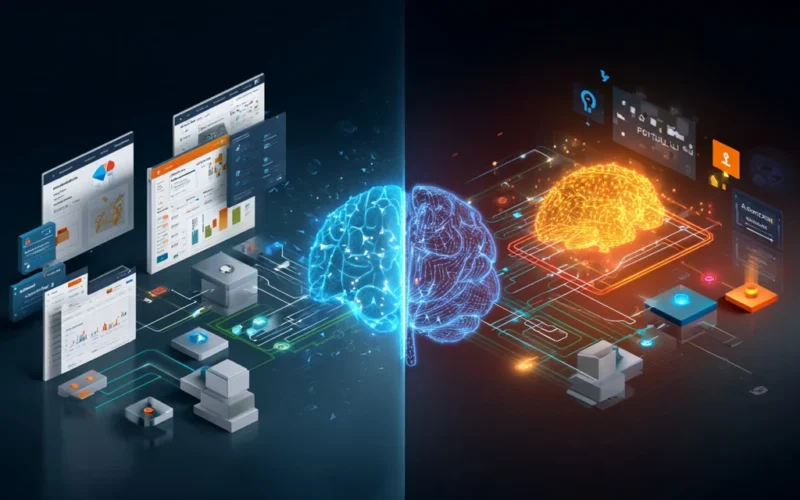



Your core systems still keep the business running. Orders move through ERP platforms, years of customer data sit in long-standing databases, and many essential workflows depend on software built long before AI became part of enterprise strategy. The challenge begins when companies try to layer modern AI capabilities onto these environments.
Legacy architectures were not built for real-time data access, flexible APIs, or machine-learning pipelines, which often makes AI adoption slower and riskier than expected.
Yet the opportunity is significant. McKinsey reports that applying generative AI to technology modernization can accelerate timelines by 40–50%and reduce technology-debt costs by around 40%, while improving output quality.
This blog explores why integrating AI with legacy systems is difficult and how leaders can introduce AI capabilities without replacing mission-critical infrastructure.
Key Takeaways
- Legacy systems still run critical business operations, which makes full replacement risky and expensive.
- AI can be added through integration layers such as APIs, middleware, and data pipelines, rather than rebuilding systems.
- The biggest barriers to AI integration are data silos, monolithic architectures, and limited real-time data access.
- Incremental approaches such as AI overlays and microservices allow businesses to modernize without disrupting operations.
- Leaders must decide whether to integrate, modernize, or replace systems based on scalability, cost, and operational risk.
Why Are Legacy Systems Still Critical to Enterprise Operations?
Many enterprises operate technology environments that have evolved over decades. Core platforms such as billing systems, transaction engines, inventory systems, and regulatory reporting platforms were often designed long before cloud computing or AI became mainstream.
These systems persist because they still execute mission-critical operations reliably.
What Qualifies as a Legacy System Today
Legacy status is not determined solely by age. A system becomes legacy when its architecture limits integration, scalability, or modernization.
Typical characteristics include:
| Indicator | What it means in practice |
| Outdated technology stack | Systems written in COBOL, older Java frameworks, or proprietary enterprise platforms |
| Monolithic architecture | All functionality is deployed as one large application |
| Limited API exposure | Integration depends on batch exports or custom connectors |
| Infrastructure constraints | Systems designed for fixed capacity rather than cloud scalability |
Legacy systems often store large volumes of operational data and contain highly customized workflows developed over years of production use.
Example:
A logistics company may run routing, billing, and warehouse management through a single monolithic platform built years ago. The platform still works, but integrating real-time optimization or predictive analytics requires additional layers.
Why Enterprises Still Rely On Them
Organizations rarely retain legacy systems out of convenience. In many cases, replacing them introduces operational risk.
Four structural reasons explain their continued use.
Operational stability: Platforms running financial transactions or supply chains must maintain uninterrupted availability.
Embedded business logic: Enterprise software often contains years of operational rules encoded into the system.
Complex integration networks: Legacy applications frequently connect to dozens of other internal systems.
Regulatory validation: Systems used in healthcare, banking, and insurance often pass compliance audits that are costly to repeat.
Because of these factors, modernization initiatives typically move slowly and require staged migration rather than complete replacement.
Also Read: AI Website Builders vs Traditional Web Development: Cost and Comparison
What Makes AI Integration with Legacy Systems Difficult?
AI systems depend on high-quality data pipelines, modular software components, and scalable infrastructure. Legacy environments often lack these capabilities, which introduces integration barriers across several layers of enterprise architecture.
The challenge is rarely a single technical limitation. Instead, it emerges from multiple structural constraints across data management, system architecture, governance frameworks, and organizational readiness.
1. Data Silos and Incompatible Formats
Legacy systems often store information in isolated databases designed for specific business units.
This creates data silos, where information cannot easily move between systems.
Typical issues include:
- Separate databases for customer records, transactions, and operations
- Proprietary storage formats
- Inconsistent data definitions across departments
When AI models attempt to analyze such data, they often encounter incomplete datasets or inconsistent structures.
Example:
An insurance provider may store policy data in one system, claims data in another, and customer communication in a third. AI models trained on only one dataset cannot produce accurate risk predictions.
2. Monolithic Architectures
Many legacy enterprise applications follow monolithic design principles.
In monolithic architecture:
- All application components run within one codebase
- Updates require redeploying the entire system
- Scaling individual services is difficult
AI systems operate differently. They often rely on distributed components that process large volumes of data simultaneously.
The architectural mismatch creates integration friction. Monolithic systems can handle predictable workloads but struggle to integrate with distributed AI environments designed for scalability.
3. Security and Compliance Concerns
Enterprise AI requires access to sensitive operational data. Connecting AI tools to legacy platforms increases data governance complexity.
Organizations must manage:
- Data access permissions
- Encryption across systems
- Compliance with industry regulations
Highly regulated industries must maintain traceability and auditability of both data and AI outputs.
Example:
Healthcare systems integrating AI into patient record analysis must maintain strict privacy and data protection standards.
4. Integration Complexity with Modern AI Platforms
Modern AI systems depend on standardized integration interfaces such as APIs and real-time data pipelines.
Legacy systems often expose limited interfaces.
Common integration obstacles include:
- SOAP or XML-based interfaces instead of REST APIs
- batch processing instead of real-time event streams
- proprietary communication protocols
Connecting these systems often requires middleware layers that transform legacy data formats into structures that AI platforms can process.
5. Organizational Resistance and Operational Risk
Technical integration is only one part of the challenge.
Enterprises often hesitate to modify legacy systems because these systems support critical operations.
Common organizational barriers include:
- Fear of disrupting production systems
- Lack of engineers familiar with legacy technologies
- Uncertainty about modernization timelines
Many AI initiatives stall during the transition from experimentation to operational deployment because organizations cannot modify the underlying infrastructure quickly enough.
Are legacy systems slowing down product launches and daily operations? Codewave redesigns them using microservices and AI-powered platforms, helping businesses achieve 3X faster go-to-market and 50% fewer security issues and downtimes.
With our Impact Index model, success is evaluated by measurable business improvements, not just software delivery.
Also Read: Steps for Secure Software Development and AI Integration
Can AI Work with Legacy Systems Without Replacing Them?
Full system replacement is rarely required to introduce AI capabilities. Many enterprises now deploy AI alongside legacy systems using layered architectures that allow both environments to coexist.
This approach allows organizations to extract value from existing infrastructure while gradually modernizing their technology stack.
AI Augmentation vs Full System Replacement
AI augmentation introduces machine learning capabilities into existing workflows rather than rebuilding entire systems.
In this model:
- Legacy platforms continue managing operational tasks
- AI systems analyze data and provide decision support
Example implementations include:
| Legacy workflow | AI augmentation |
| Fraud monitoring in banking | Machine learning models detect anomalies in transaction patterns |
| Inventory planning | AI forecasts demand based on historical sales |
| Customer service systems | AI analyzes support interactions to recommend responses |
This approach reduces operational risk while still introducing intelligent capabilities.
API Wrapping and Middleware Integration
Many legacy systems cannot directly communicate with modern AI platforms. API wrapping solves this limitation by exposing legacy functionality through standardized interfaces.
A typical integration architecture includes:
- API gateway: Provides a modern interface to legacy systems.
- Middleware layer: Converts data formats and manages communication.
- AI services: Analyze data and generate predictions.
This architecture allows AI models to access legacy data without modifying the core application.
AI as an Intelligent Overlay on Existing Systems
Another strategy is to deploy AI as an external analytical layer.
In this model:
- Legacy systems continue processing transactions
- AI analyzes the operational data produced by those systems
Common use cases include:
- Predictive maintenance in manufacturing
- Anomaly detection in financial transactions
- Document processing in administrative workflows
The legacy platform remains unchanged while AI delivers insights that improve decision-making.
Microservices Strategy for Gradual Modernization
Microservices architectures allow organizations to modernize applications in smaller increments.
Instead of rewriting a large system, teams extract specific functions into independent services.
Example architecture transformation
Legacy system
- Order processing
- Billing
- Customer records
Modern services
- AI recommendation engine
- Predictive analytics service
- Forecasting models
Microservices gradually reduce dependence on monolithic platforms while allowing AI systems to operate independently.
Practical Business Solutions for AI Integration with Legacy Systems
Most organizations do not integrate AI into legacy environments through a single technical change. Instead, they combine architectural patterns that allow older systems and new AI capabilities to work together without destabilizing operational infrastructure.
These integration approaches focus on one objective: extracting value from legacy data while minimizing risk to existing systems.
API Layers To Expose Legacy Capabilities
Many legacy platforms were built before standardized APIs became common. Direct integration with AI services is therefore difficult.
A common solution is API wrapping, where a modern interface is built around the legacy system.
This architecture introduces a controlled access layer.
| Component | Role |
| Legacy application | Executes operational processes |
| API gateway | Exposes functions such as data retrieval or transactions |
| AI services | Consume data and generate predictions |
This design allows AI systems to interact with older software without modifying the original codebase. Wrapping systems behind APIs acts as a translation layer between legacy environments and modern AI tools.
Example: A financial institution may expose transaction data through an API so fraud detection models can analyze activity in real time.
Middleware Platforms That Connect Old And New Systems
In complex enterprise environments, direct system-to-system integration can create fragile point-to-point connections.
Middleware platforms solve this by acting as a central communication layer.
Middleware platforms perform tasks such as:
- Routing data between systems
- Transforming data formats
- Enforcing integration rules
Enterprise integration platforms such as IBM App Connect Enterprise operate as service buses, enabling applications across different systems and platforms to exchange data reliably.
Example workflow:
- The legacy system generates transaction data
- Middleware transforms data into a standardized format
- AI platform processes the data
- Results are returned to operational systems
This model allows organizations to introduce AI services without modifying core applications.
Data Integration Pipelines For AI Readiness
AI models depend on high-quality, accessible data. Legacy systems often store information across multiple databases, limiting analytical capabilities.
Organizations address this by building data integration pipelines that consolidate operational data.
Common approaches include:
- Change Data Capture (CDC): Replicates data from legacy systems into analytics environments without altering the original database.
- Data virtualization: Creates a unified view of data across systems without physically moving the data.
- Data lakes or warehouses: Centralize historical data for machine learning models.
These techniques allow AI models to access legacy data while leaving operational databases unchanged.
Example:
A retail organization may replicate sales data from multiple POS systems into a centralized data lake where demand forecasting models run.
Modular Services That Introduce AI Incrementally
Rather than modifying large legacy applications, many enterprises introduce AI through independent services. This approach builds small AI services that integrate with existing workflows.
Typical architecture:
Legacy system → Integration layer → AI microservice → Operational system
Examples include:
- Recommendation engines for ecommerce
- Predictive maintenance for industrial equipment
- Automated document classification for administrative workflows
Modular services reduce operational risk because they can be deployed, tested, and scaled independently.
APIs and microservices provide flexibility that allows legacy platforms to integrate with newer applications without major rewrites.
What if your legacy systems could generate insights, automate reports, and assist customers on their own? Codewave integrates GenAI, conversational bots, and intelligent automation into existing systems, enabling 30% higher customer engagement and lifetime value while keeping data secure and operations scalable.
How Leaders Decide Between Integration, Modernization, Or Replacement
Integrating AI with legacy systems is not purely a technical decision. Leaders must evaluate whether integration alone is sufficient or whether deeper modernization is required.
The decision usually depends on three factors: system stability, modernization cost, and future scalability requirements.
When Integration Is The Right Choice
Integration is often the preferred strategy when the legacy system continues to perform its core functions effectively.
Integration is suitable when:
- The system is stable and well-maintained
- Operational risk from replacement is high
- AI capabilities can be added externally
Typical examples include:
| Industry | Legacy system | AI capability |
| Banking | Transaction processing system | Fraud detection models |
| Retail | Inventory management system | Demand forecasting |
| Healthcare | Patient record platform | Clinical decision support |
In these cases, AI operates as a decision layer above the operational system rather than replacing it.
When Partial Modernization Becomes Necessary
Some systems cannot support modern workloads even with integration layers.
Indicators that modernization is required include:
- Unsupported software platforms
- Inability to scale with growing workloads
- Lack of documentation or maintainability
In these cases, organizations often adopt incremental modernization strategies such as:
- Containerizing legacy applications
- Migrating selected modules into microservices
- Moving data infrastructure to cloud platforms
Software modernization aims to extend the value of legacy investments by updating architecture or platforms while preserving core functionality.
Certain legacy systems eventually reach a point where integration becomes more expensive than replacement.
Replacement becomes necessary when:
- The technology stack is no longer supported
- Skilled engineers are unavailable
- Security or compliance requirements cannot be met
At this stage, organizations typically build new systems while maintaining the legacy platform during a transition period.
Example:
A telecommunications provider may build a modern customer platform while gradually migrating customers from the legacy billing system.
A Structured Decision Framework For Technology Leaders
Leaders evaluating AI integration should assess legacy systems across four dimensions.
| Dimension | Key question |
| Operational criticality | Does the system support core business operations |
| Integration capability | Can it expose APIs or data interfaces |
| Technical sustainability | Are skills and tools still available |
| Future scalability | Can it support future workloads |
This framework helps organizations avoid premature system replacement while still enabling AI innovation.
Architecture Patterns That Enable AI and Legacy Systems to Work Together
Integrating AI with older enterprise systems rarely happens through a single architecture model. Organizations typically use layered architectures that allow legacy platforms to remain operational while modern analytics and AI services operate alongside them.
These patterns focus on controlled data access, modular integration, and scalable computing environments.
API gateway architecture
An API gateway acts as a controlled entry point between legacy systems and modern applications.
In this model, legacy systems remain unchanged while an API layer exposes specific functions such as data retrieval or transaction processing.
Typical architecture flow
| Layer | Role |
| Legacy system | Executes core operational logic |
| API gateway | Exposes functions through secure APIs |
| AI service | Processes data and generates predictions |
| Application layer | Uses insights to guide business actions |
API gateways reduce integration complexity by standardizing how external systems interact with legacy applications.
Example: A financial services company may expose account activity through APIs so fraud detection algorithms can analyze transactions without modifying the underlying banking platform.
Data pipeline architecture for AI
AI models require continuous access to operational data. Legacy systems often store data in transactional databases optimized for reliability rather than analytics.
Organizations address this by creating data pipelines that replicate operational data into AI environments.
Typical pipeline structure:
- Source system exports data through replication or change data capture
- Data pipeline transforms records into standardized formats
- Data storage platform holds historical and real-time datasets
- AI models analyze the data and produce predictions
Example applications:
- Predictive maintenance using equipment sensor data
- Demand forecasting using historical sales records
- Customer churn analysis using CRM activity data
This architecture separates operational systems from analytical workloads, which prevents AI processes from interfering with production systems.
Event-driven integration
Some enterprise environments require real-time responses to operational events. Event-driven architecture enables systems to react immediately when specific conditions occur.
In this model, legacy systems publish events when transactions happen.
Examples of events include:
- Order created
- Payment processed
- Equipment sensor alert
AI services subscribe to these events and analyze them.
Example scenario:
- A transaction occurs in a payment platform
- The system publishes a transaction event
- An AI fraud detection service analyzes the event
- Suspicious activity triggers a security alert
Event-driven integration enables AI to operate in real time without modifying the legacy platform itself.
Hybrid cloud integration architecture
Many organizations now combine on-premise systems with cloud AI services.
Hybrid environments typically include:
| Component | Purpose |
| On-premise legacy system | Executes operational transactions |
| Cloud data platform | Stores aggregated operational data |
| AI services | Train and deploy machine learning models |
| Integration layer | Synchronizes data between environments |
Hybrid architecture allows enterprises to adopt scalable AI infrastructure without migrating every legacy application immediately.
How Codewave Helps Enterprises Add AI to Legacy Systems
Legacy modernization is rarely about replacing everything at once. At Codewave, we combine design, engineering, AI, and modernization strategy to turn rigid systems into scalable, connected platforms that deliver faster speed, greater efficiency, and better business performance.
We do not sell one-size-fits-all software. We build custom solutions that align with how your systems, workflows, and data already operate, so AI adoption becomes practical, secure, and tied to measurable outcomes.
Our approach also supports outcome-based billing, where our success is linked to measurable business improvement, not just project delivery.
Key services include:
- Digital Core Modernization: Codewave upgrades legacy environments with hybrid and multi-cloud architectures that improve scale, stability, and system performance.
- Application Modernization Services: We take complex legacy applications and reshape them into cloud-native systems through phased modernization paths that minimize disruption.
- AI Solutions Development: Our team introduces AI where it solves a clear operational problem, from automation to decision support, without pushing unnecessary rebuilds.
- Cloud Software and Infrastructure Services: Codewave establishes the cloud backbone for AI workloads, machine learning models, and real-time data processing.
- Product Engineering and Custom Software Development: When legacy applications require significant change, we design and develop secure software products tailored to current business needs and future growth.
Explore our portfolioto see how Codewave applies AI, cloud, and modernization strategies across enterprise products and digital platforms.
Conclusion
Legacy systems are not barriers to AI. They are often the foundation that holds the most valuable operational data inside an organization. The real opportunity lies in connecting intelligence to these systems in a controlled and scalable way rather than replacing everything at once.
Through approaches such as API layers, middleware integration, data pipelines, and modular services, businesses can introduce AI capabilities while maintaining operational stability. The companies that succeed with AI are those that modernize strategically, not those that rebuild blindly.
If you are exploring practical ways to connect AI with existing systems, Codewavecan help you design and implement a modernization path that delivers measurable business outcomes.
FAQs
Q: Do companies need AI engineers who understand legacy programming languages?
A: Yes. Many successful AI integration projects involve engineers who understand both modern AI frameworks and legacy technologies such as COBOL, Java, or C++.
This cross-skilled set helps teams connect AI models with older systems without rewriting the entire platform.
Q: Can AI act as middleware between enterprise systems?
A: Increasingly, yes. Some organizations use AI models as orchestration layers that analyze data from multiple systems and trigger automated actions across applications.
In this setup, AI functions similarly to middleware by coordinating workflows and improving decision speed across systems that were never originally connected.
Q: Why do many AI projects stall at the pilot stage in legacy environments?
A: The most common reason is infrastructure limitations. Legacy systems were built for batch processing rather than for real-time analytics, making it difficult to scale AI models beyond testing.
When systems cannot support fast data access or large compute workloads, projects often remain in proof-of-concept stages rather than move to full production.
Q: How do organizations avoid disrupting operations during AI integration?
A: Many enterprises use phased deployment strategies. Teams begin with a small use case, such as predictive analytics or document automation, validate results, and then expand integration across other systems.
This staged approach reduces operational risk and allows organizations to prove business value before scaling.
Q: What is the most overlooked requirement for AI integration with legacy systems?
A: Data quality and governance are often underestimated. Legacy environments frequently contain inconsistent data structures and fragmented datasets.
Without data cleansing, normalization, and governance frameworks, AI models struggle to produce reliable insights even when the integration architecture is technically successful.

Keerthikumar M Acharya is a Senior Software Engineer at Codewave with a track record of delivering complex digital transformation projects. He writes on software architecture, development best practices, and technology innovation—covering system design and engineering patterns for enterprise-scale applications.