Introduction
A Cisco survey found that 60% of IoT initiatives stalled at proof of concept, with only 26% of companies considering their efforts a complete success. This is happening despite a market that shows no signs of slowing: according to IoT Analytics, connected IoT devices reached 18.5 billion in 2024, growing 12% year over year, with forecasts reaching 39 billion by 2030.
The gap between pilot and production isn't a shortage of ambition or budget.
Most IoT projects fail because of architecture decisions, platform mismatches, and security gaps that compound early and become expensive to unwind later.
This guide covers the tools, platform decisions, and development practices that separate proof-of-concept from production-ready IoT applications.
Key Takeaways
- IoT app development follows six phases — from scoping and platform selection through deployment and ongoing maintenance.
- Platform choice directly impacts latency, scalability, and cost — evaluate against requirements, not brand familiarity.
- Security must be designed in from day one, covering encryption, per-device authentication, and OTA firmware updates.
- Protocol selection matters: MQTT, CoAP, and HTTP each suit different use cases, and a mismatch degrades performance and drives up cost.
- Most IoT projects fail for the same reasons: vague requirements, underestimated scale, and security testing that comes too late to fix cheaply.
How to Build an IoT Application: A Step-by-Step Process
Step 1: Define Objectives and Scope
Before any technical work begins, identify the specific business problem the application will solve — including target devices, user types, data inputs required, and what decisions or actions the app must enable.
Define these constraints explicitly in the requirements phase:
- Connectivity requirements — range, bandwidth, and battery constraints
- Data frequency expectations — how often devices report, and what happens when they miss a cycle
- Compliance obligations — HIPAA for healthcare, NERC CIP for energy infrastructure, GDPR for EU-adjacent deployments
- Latency tolerance — whether sub-second responses are required or hourly batch analytics suffice
Teams that skip this step frequently discover mid-development that their chosen hardware cannot support the required data frequency, range, or processing load. Starting from the problem and working outward — rather than starting with a preferred device — is what separates projects that reach production from the 60% that don't.
Step 2: Select Your IoT Platform and Architecture
Platform selection is one of the highest-stakes decisions in IoT development. The three major enterprise options each have distinct strengths:
| Platform | Best For |
|---|---|
| AWS IoT Core | Granular device management, deep AWS ecosystem integration (DynamoDB, Kinesis, Lambda) |
| Azure IoT Hub | Microsoft-stack enterprises; supports MQTT, AMQP, HTTPS; tiered pricing from Free to S3 |
| Google Cloud IoT | Data-intensive applications requiring BigQuery or Vertex AI; note that Google Cloud IoT Core was retired in 2023 — current guidance points to third-party MQTT brokers with Pub/Sub and Dataflow backends |
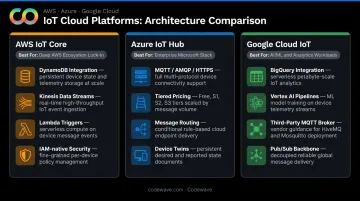
On architecture patterns, three approaches are common in production:
- Three-tier architecture (presentation, logic, data) — straightforward, well-understood, suits most mid-scale deployments
- Microservices architecture — independently deployable services; ideal for large teams with distinct domain ownership
- Edge/hybrid architecture — processing on-device or at gateway for low-latency scenarios; cloud handles analytics and storage
Hybrid architectures are the norm in serious production deployments, not the exception. Pure cloud-only designs frequently hit latency limits in industrial, healthcare, and fleet management contexts.
Step 3: Select Hardware and Define Connectivity Protocols
Hardware selection should follow requirements, not vendor relationships. Common platforms serve different fidelity needs:
- Arduino — prototyping, education, rapid iteration; extensive community support
- ESP32/ESP8266 — wireless sensor nodes with built-in Wi-Fi; cost-effective for high-volume deployments
- Raspberry Pi — IoT gateway and edge processing; runs full Linux-based OS, aggregates data from multiple sensors
- NVIDIA Jetson — edge AI and computer vision; enables ML inference on-device without cloud dependency
Connectivity protocol selection is equally critical. Match protocol to use case:
- MQTT — lightweight publish/subscribe; the default for constrained devices and intermittent networks
- CoAP — for deeply resource-limited devices where even MQTT's footprint is too heavy
- HTTP/HTTPS — cloud-to-cloud integrations and environments where simplicity outweighs overhead
- LoRaWAN — long-range, low-power wide-area deployments (agricultural monitoring, remote infrastructure, power grid sensors)
- Zigbee — mesh networking for building automation, smart lighting, HVAC
- BLE — wearables and personal area networks requiring extended battery life
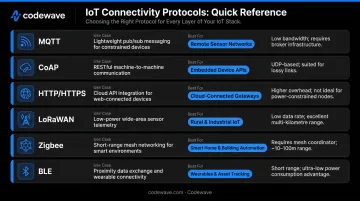
Choosing HTTP out of familiarity, without evaluating MQTT or CoAP, adds unnecessary data overhead, accelerates battery drain, and degrades field performance at scale.
Step 4: Develop Firmware and Application Software
Language selection is driven by layer-specific constraints, not preference.
At the firmware layer:
- C — the dominant choice for resource-constrained devices; used by 55% of constrained-device developers per the Eclipse Foundation's 2024 IoT Developer Survey
- C++ — 36% adoption at constrained device layer; useful when object-oriented abstractions provide value without excessive overhead
- Assembly — bootloaders, interrupt service routines, timing-critical operations
At the application and backend layer:
- Python — 39% of gateway/edge-node developers; data pipelines, ML integration, rapid prototyping
- Java — enterprise-grade backend services requiring robustness and long-term maintainability
- JavaScript/Node.js — event-driven backends handling high-concurrency device streams; real-time dashboards via WebSocket
The application logic layer must cover:
- Data ingestion pipelines and processing rules
- Alerting and automation workflows
- A user-facing interface that presents sensor data in formats actionable for operations teams, not just developers
Step 5: Test, Deploy, and Maintain
A layered testing strategy covers four distinct layers:
- Unit tests — validate individual firmware and application components in isolation
- Integration tests — verify end-to-end device-to-cloud data flow across protocols and middleware
- Security penetration testing — follow the OWASP IoT Security Testing Guide for firmware and communication channels
- Performance/load testing — simulate peak device connection volumes before production; tools like k6 or JMeter work for application layers
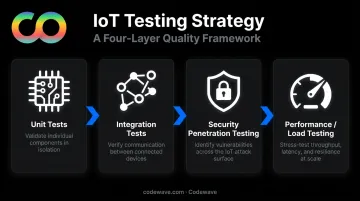
On deployment model selection:
- Cloud-based — centralized scalability; suited for non-latency-sensitive analytics workloads
- Edge-based — local processing for offline-capable or latency-critical scenarios
- On-premises — regulated industries with data residency requirements or private infrastructure mandates
Device lifecycle management must be treated as a product feature from day one: automated provisioning, remote OTA firmware updates, health monitoring, and a clear decommissioning and credential revocation process. Skipping it doesn't delay the problem — it guarantees an operational crisis within the first year.
Tools Every IoT Development Team Needs
Effective tooling spans four categories: IoT cloud platforms, hardware development tools, connectivity and protocol tooling, and data analytics infrastructure. A weak link in any category tends to surface late — usually during integration, when it's most expensive to fix.
IoT Cloud Platforms
AWS IoT Core, Azure IoT Hub, and Google Cloud's current recommended architecture (third-party MQTT brokers + Pub/Sub + BigQuery) each carry distinct trade-offs in pricing model, regional availability, and native integrations. Review current pricing and quota documentation before committing — both AWS IoT Core and Azure IoT Hub publish detailed throttling limits that directly affect architecture decisions.
For teams with limited engineering bandwidth, managed low-code platforms (Mendix, Zoho Creator) can reduce time-to-value but carry real trade-offs in customization depth and long-term extensibility.
Hardware Development and Prototyping Tools
Simulating before hardware procurement catches problems before they become expensive. Tools like Wokwi (embedded systems simulation) and AWS IoT Device Simulator let teams validate firmware behavior and device-to-cloud data flow before committing to physical hardware. Catching protocol incompatibilities or latency issues at prototype stage is far cheaper than at production scale.
Verify that chosen microcontrollers have SDKs compatible with your target cloud platform before procurement. That compatibility decision also shapes what your data pipeline needs to support.
Data Pipeline and Analytics Tools
IoT systems generate continuous, high-volume data streams that standard application databases are not built to handle.
- Apache Kafka — real-time event streaming at scale; widely used for IoT telemetry pipelines in logistics, energy monitoring, and industrial deployments
- Snowflake — historical storage and batch analytics for IoT time-series data, with Snowpipe Streaming supporting low-latency row ingestion
- Power BI / Grafana / Tableau — visualization layers for operations teams; tool choice should follow where end users actually work, not engineering preference
Confirm that the data pipeline architecture can scale to the projected device count without reengineering. Azure IoT Hub's published quotas (up to 300M messages/day on S3 units) and AWS IoT Core's component-based pricing both reward early architecture decisions.
Best Practices for IoT Application Development
The following practices reduce the most common sources of failure in IoT projects — security gaps, scale surprises, integration delays, and invisible outages.
Build Security In, Not On
IoT attacks increased 45% year over year according to Zscaler ThreatLabz 2024 data, with manufacturing accounting for 36% of all IoT malware blocks. Retrofitting security after launch is far more costly than embedding it from the start.
Core requirements at minimum:
- Implement TLS/SSL for all device-to-cloud communication
- Enforce per-device certificate or token-based authentication (never shared credentials)
- Build OTA firmware update capability in from day one
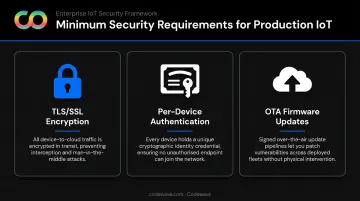
Both ETSI EN 303 645 and NIST SP 800-213 treat secure software updates as baseline requirements, not optional features.
Design for Scale Before You Need It
IoT deployments routinely start as pilots with hundreds of devices and grow to tens of thousands within 18–24 months. Architectures that skip scalability planning require expensive re-platforming at the worst possible time: during rapid adoption.
Use cloud-native auto-scaling groups, stateless application components, and message queues (Kafka, AWS SQS) to decouple data ingestion from processing. Stateless design alone eliminates most bottlenecks that appear at scale.
Validate Hardware-Software Integration Early
A physical prototype proving the sensor-to-cloud data path is worth more than weeks of design-only iteration. Protocol incompatibilities discovered at prototype stage cost a fraction of what they cost at production scale.
Instrument for Observability Before Go-Live
Implement logging, alerting, and anomaly detection at the device, gateway, and application layers before launch — not after the first outage. IoT failures are difficult to reproduce in staging environments, and teams without built-in observability spend disproportionate time debugging production issues with incomplete information.
Common Mistakes to Avoid
Hardware chosen before requirements are defined. Teams that start with a preferred device — rather than the problem — often discover mid-development that their hardware cannot support the required data frequency, range, or processing load.
Deferring security until QA. Security cannot be retrofitted into IoT systems. Teams that postpone it ship applications with hardcoded credentials, unencrypted channels, and no firmware update path — vulnerabilities that have caused real-world breaches in industrial and consumer IoT deployments alike.
Underestimating device management at scale. Manual provisioning works fine for a pilot. At 10,000 devices, it becomes an operational crisis waiting to happen. Teams without automated provisioning, remote update mechanisms, and health monitoring infrastructure embed that crisis directly into their launch timelines.
Choosing protocols based on familiarity. Defaulting to HTTP when MQTT or CoAP would better serve the use case adds unnecessary overhead, drains device batteries faster, and degrades field performance — none of which surface until devices are deployed in volume.
Frequently Asked Questions
What are the 4 types of IoT applications?
The four common types are: consumer IoT (smart homes, wearables), industrial IoT/IIoT (manufacturing, predictive maintenance), commercial IoT (retail, logistics, smart buildings), and infrastructure IoT (smart cities, utilities). Scale and security requirements differ significantly — IIoT and infrastructure IoT carry the strictest compliance and uptime demands.
What are the 4 pillars of IoT?
The four foundational pillars are: devices/sensors (the physical data-collection layer), connectivity (protocols and networks enabling data transmission), data processing (cloud or edge platforms that analyze data), and applications/user interfaces (where business value is realized for end users and operators).
What programming languages are used in IoT development?
C and C++ dominate firmware and embedded development due to hardware access and memory constraints. Python leads at the gateway and analytics layer for data processing and ML integration. Java serves enterprise backend services, while JavaScript/Node.js handles real-time application and dashboard layers — selection depends on device capabilities and application complexity.
What are the biggest security challenges in IoT app development?
Each connected device adds attack surface, while limited processing power on constrained devices restricts advanced encryption options. Patching firmware post-deployment is operationally difficult without OTA mechanisms built in. Weak or shared credentials across device fleets remain one of the most common and exploitable vulnerabilities in production IoT systems.
How long does it take to build an IoT application?
Timelines vary by complexity. A basic single-device application may take 2–4 months; a multi-device enterprise deployment with custom hardware and compliance requirements commonly runs 9–18 months. Requirements definition and platform selection have the greatest influence on timeline — unclear scope in either area typically adds months to delivery.
What is the difference between cloud and edge computing in IoT?
Cloud computing centralizes data processing on remote servers — suited for non-time-sensitive analytics, cost efficiency, and scalability. Edge computing processes data locally on the device or gateway — suited for low-latency requirements, offline operation, or bandwidth-constrained environments. Hybrid approaches combining both are the most common pattern in production deployments.