






AI is no longer a fringe experiment for forward‑looking teams. It’s rapidly becoming a core part of business operations and competitive strategy. In 2026, Gartner forecasts that more than 80 % of enterprises will haveused generative AI APIs or deployed generative AI‑enabled applications in production environments, up sharply from less than 5 % just a few years ago. This underscores how quickly meaningful AI adoption is spreading across industries.
Yet simply having AI isn’t enough. The real value lies in organizations successfully weaving intelligent systems into existing workflows, decision platforms, and customer experiences. This task often requires specialized expertise beyond in‑house teams.
This post walks through what AI integration really means, the criteria for selecting a partner, and a curated list of leading companies to consider in 2026.
Key Takeaways
- Business Outcome Alignment: Choose an AI integration partner that aligns solutions with your business goals, focusing on measurable results such as cost reduction and efficiency.
- Companies like Codewave, RTS Labs, and LeewayHertz excel at mapping AI capabilities directly to business KPIs.
- Security & Compliance: Ensure the partner adheres to industry security standards (e.g., GDPR, CCPA) and provides robust data protection.
- Cross-System Integration: The right partner should have experience in seamlessly integrating AI with your existing systems, such as CRM, ERP, and business intelligence tools.
- Cloud and Data Strategy: Assess whether the partner supports a scalable cloud infrastructure and can effectively manage structured and unstructured data for AI.
- Post-Deployment Support: Ongoing model monitoring, maintenance, and updates are crucial for long-term success in AI integration.
How to Evaluate an AI Integration Partner in 2026
When evaluating an AI integration partner, businesses must consider a variety of factors to ensure they choose a firm that delivers technical expertise and drives meaningful business outcomes.
The following criteria will guide your evaluation process, ensuring you select a partner who can integrate AI seamlessly into your operations, scale effectively, and drive measurable success.
1. Business Outcome Alignment
Start by clarifying your business goals and ensuring your AI partner is focused on delivering value, not just technical innovation. A credible AI integration partner will map their AI capabilities directly to your specific business use cases and KPIs.
Key Considerations:
- How does the AI solution tie back to your business objectives (e.g., increasing efficiency, reducing costs, improving customer experience)?
- Can the partner provide clear, measurable outcomes tied to business performance, such as increased sales or improved customer retention?
- Do they explain how AI integration impacts your bottom line, with metrics like cost savings, revenue growth, or efficiency improvements?
Examples of Alignment:
- Cost Reduction: Automating routine tasks such as data entry or inventory management.
- Customer Retention: Using AI chatbots to improve customer service response times and reduce churn.
- Decision Making: Implementing predictive analytics for more informed financial and operational decisions.
2. Security and Compliance Capabilities
AI systems often handle sensitive data, so it’s critical that the integration partner follows best practices in security and compliance. This helps protect against data leaks, fraud, and legal issues, particularly in highly regulated industries.
Key Considerations:
- Does the partner adhere to recognized security standards (e.g., ISO 27001, NIST)?
- Are they GDPR, CCPA, and HIPAA compliant?
- Does the partner conduct regular security audits and have a track record of maintaining data privacy during AI deployments?
- How do they ensure secure model deployment and data encryption during the AI integration process?
Security Checklist:
- Data access controls
- Regular security audits and penetration testing
- Data encryption (in transit and at rest)
- User authentication mechanisms
3. Cross-System Integration Experience
AI solutions do not exist in a vacuum; they need to integrate seamlessly with your existing enterprise systems. A strong AI integration partner should have a proven ability to connect AI models with your CRM, ERP, business intelligence tools, and other critical systems.
Key Considerations:
- Can the partner integrate AI into existing systems like CRM, ERP, data warehouses, and analytics platforms?
- Do they have experience working across both modern cloud-based platforms and legacy systems?
- Can they ensure minimal disruption to current workflows while incorporating AI functionality?
Integration Requirements:
- Legacy systems integration: Ensure the partner understands how to connect AI with old technologies without requiring a complete system overhaul.
- Real-time data flows: AI solutions often need real-time data to be effective. Can the partner ensure seamless data transfer and processing?
4. Cloud and Data Strategy Support
AI is most effective when it has access to the right data architecture and compute resources. This is where your partner’s cloud strategy and data pipeline expertise come into play.
Key Considerations:
- Can the partner design and implement a scalable data strategy that supports AI at enterprise scale?
- Do they provide expertise in cloud architecture (e.g., AWS, Azure, Google Cloud)?
- Can they manage unstructured data, such as images or text, and convert it into useful AI inputs?
- Will they ensure data is clean, structured, and ready for AI model consumption?
- Do they use automated data pipelines to ensure smooth data flow between systems and AI models?
Cloud and Data Strategy Checklist:
- Cloud integration expertise (AWS, Azure, GCP)
- Support for Big Data environments (Hadoop, Spark, etc.)
- Data governance and data lakes for storing raw, unprocessed data
- Real‑time analytics and data orchestration tools
5. Post-Deployment Governance and Support
AI models evolve, and their performance can degrade over time. A good partner will offer comprehensive post-deployment support and model monitoring to ensure that AI solutions continue to deliver value long after the initial launch.
Key Considerations:
- What ongoing maintenance does the partner provide for the AI system after integration?
- Do they offer model monitoring to detect performance drift or changes in data patterns?
- How do they handle model updates, error correction, and continuous learning?
- Do they provide training and documentation for internal teams to maintain and improve the models?
Post-Deployment Support Checklist:
- Continuous monitoring of model performance
- Model updates and retraining processes
- Error handling and anomaly detection
- Technical support and troubleshooting channels
Ready to Transform Your Business with AI? AtCodewave, we position ourselves as your AI orchestrator, creating custom AI/ML solutions that directly impact your business goals.
With our Impact Index billing model, you only pay when measurable results are delivered. From automated workflows to GenAI tools, we ensure seamless integration and high ROI, all while prioritizing data security.
Also Read: AI as a Service (AIaaS): A Strategic Guide for Enterprise Adoption
Top 11 AI Integration Companies Worth Shortlisting in 2026
For enterprise buyers evaluating AI integration firms in 2026, the emphasis is on partners who can connect AI models with core business systems (CRM, ERP, data platforms), embed automation into workflows, and ensure scalable deployment across environments.
The companies below appear in multiple industry lists and market research because they offer proven integration capabilities, along with consulting and engineering execution
1. Codewave
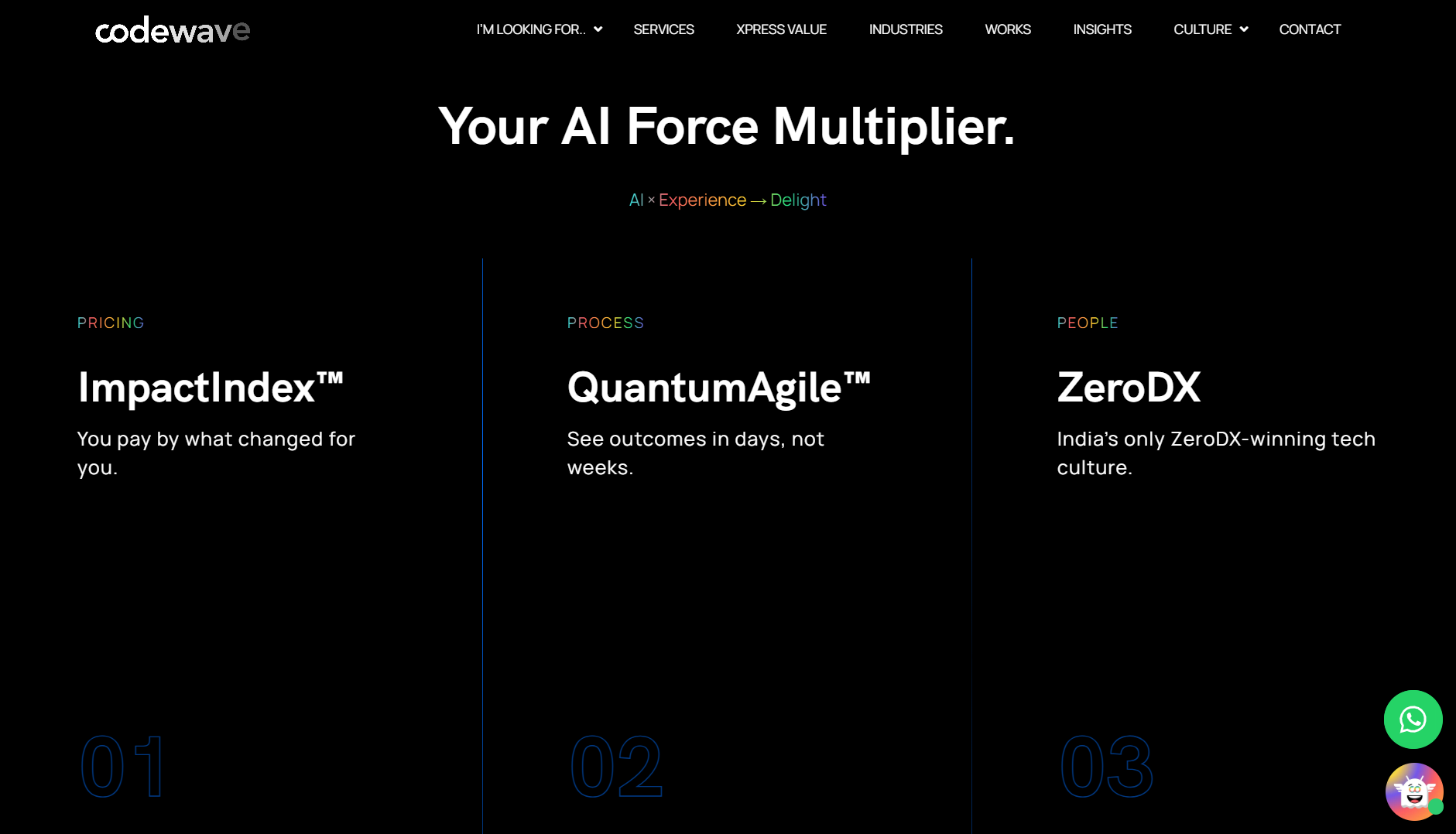
Codewave is a design-thinking-led digital transformation and engineering company with a strong focus on integrating AI into enterprise systems.
The firm brings product strategy, UX‑oriented design, and secure engineering practices together to help clients operationalize AI beyond experimentation. It also applies structured integration approaches, from API connectivity to governance, rather than simply delivering isolated AI modules.
Best for: Mid-market and enterprise teams implementing agentic AI inside operational workflows
Key AI integration features
- Agentic AI workflow orchestration across CRM, ERP, and internal platforms.
- Secure API-based integration with legacy systems.
- Outcome-linked delivery through the ImpactIndex engagement model.
- Multimodal LLM system deployment across business functions.
- Governance controls at the inference endpoints and the pipeline level.
Pros
- Strong UX-first engineering approach improves adoption rates.
- Outcome-based pricing structure aligns incentives with business impact.
- Effective for enterprise modernization programs involving legacy stacks.
- Recognized in Clutch Global Leader awards for AI and digital engineering delivery.
Cons
- Smaller delivery footprint than Tier-1 consulting integrators.
- Requires internal alignment on transformation KPIs for outcome-based engagements.
Pricing snapshot
- Minimum project size: $25,000+
- Hourly rate: $25–$49/hr. Currently, Codewave believes in ImpactIndex- You pay by what changed for you.
Why shortlist
Strong choice for organizations moving from pilot-stage GenAI experiments into production workflow automation.
2. RTS Labs
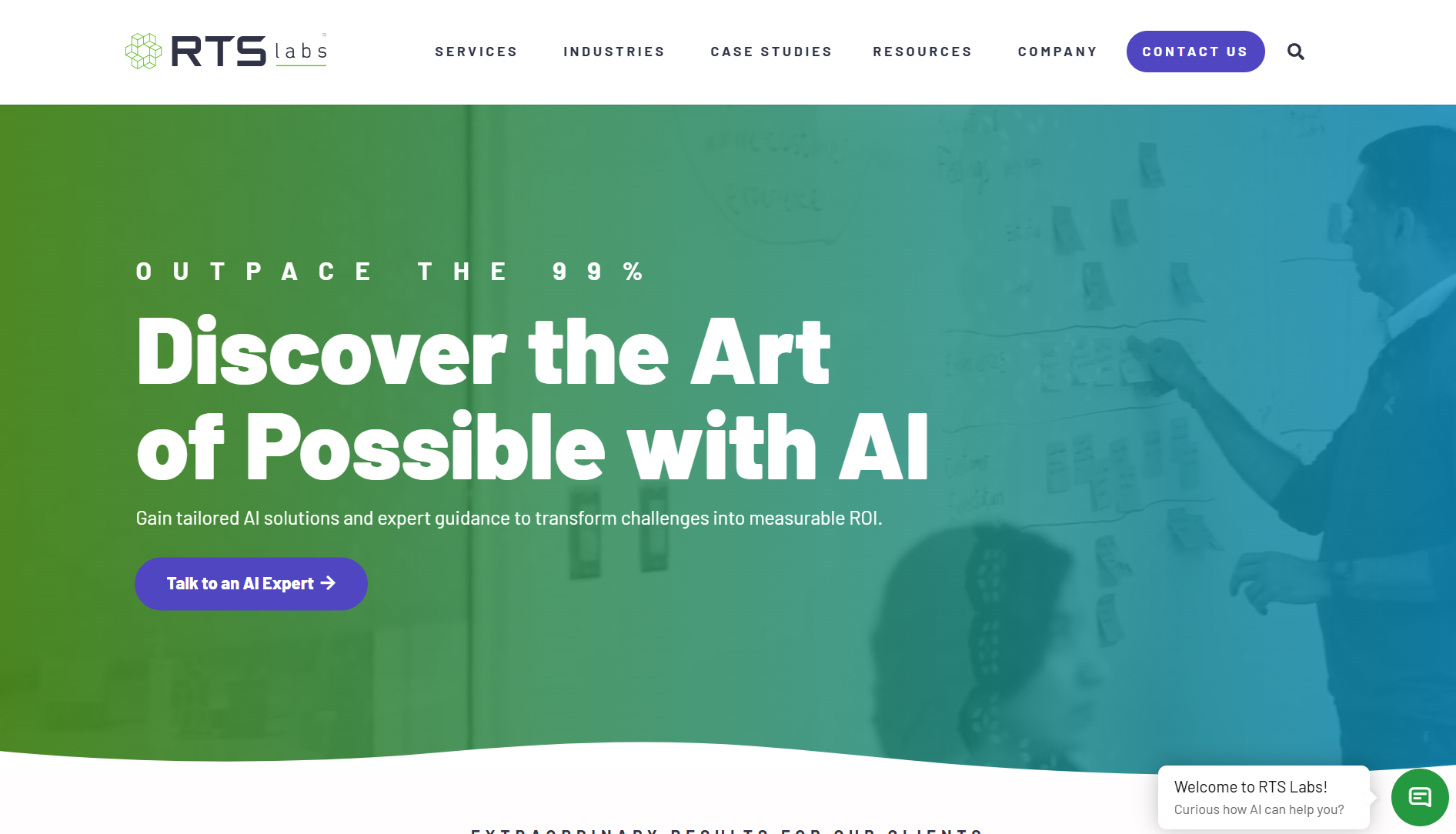
RTS Labs focuses on taking AI from concept to production deployments that operate across systems like ERPs, CRMs, and data platforms, ensuring AI is consistently actionable at enterprise scale. Key offerings include AI strategy, data engineering, ML consulting, and scaled deployment.
Best for: Enterprises operationalizing predictive AI across multiple systems
Key AI integration features
- Cross-platform model deployment across ERP and analytics stacks
- Data consolidation pipelines for enterprise ML readiness
- Lifecycle governance with monitoring and drift detection
- Hybrid cloud deployment support
Pros
- Strong MLOps orientation
- Reliable enterprise rollout frameworks
- Effective at scaling analytics into decision systems
Cons
- Less emphasis on GenAI-native product embedding
- Longer implementation cycles compared with boutique firms
Pricing snapshot
- Custom enterprise engagements
Why shortlist
Ideal for analytics-driven transformation rather than conversational AI deployments.
3. LeewayHertz
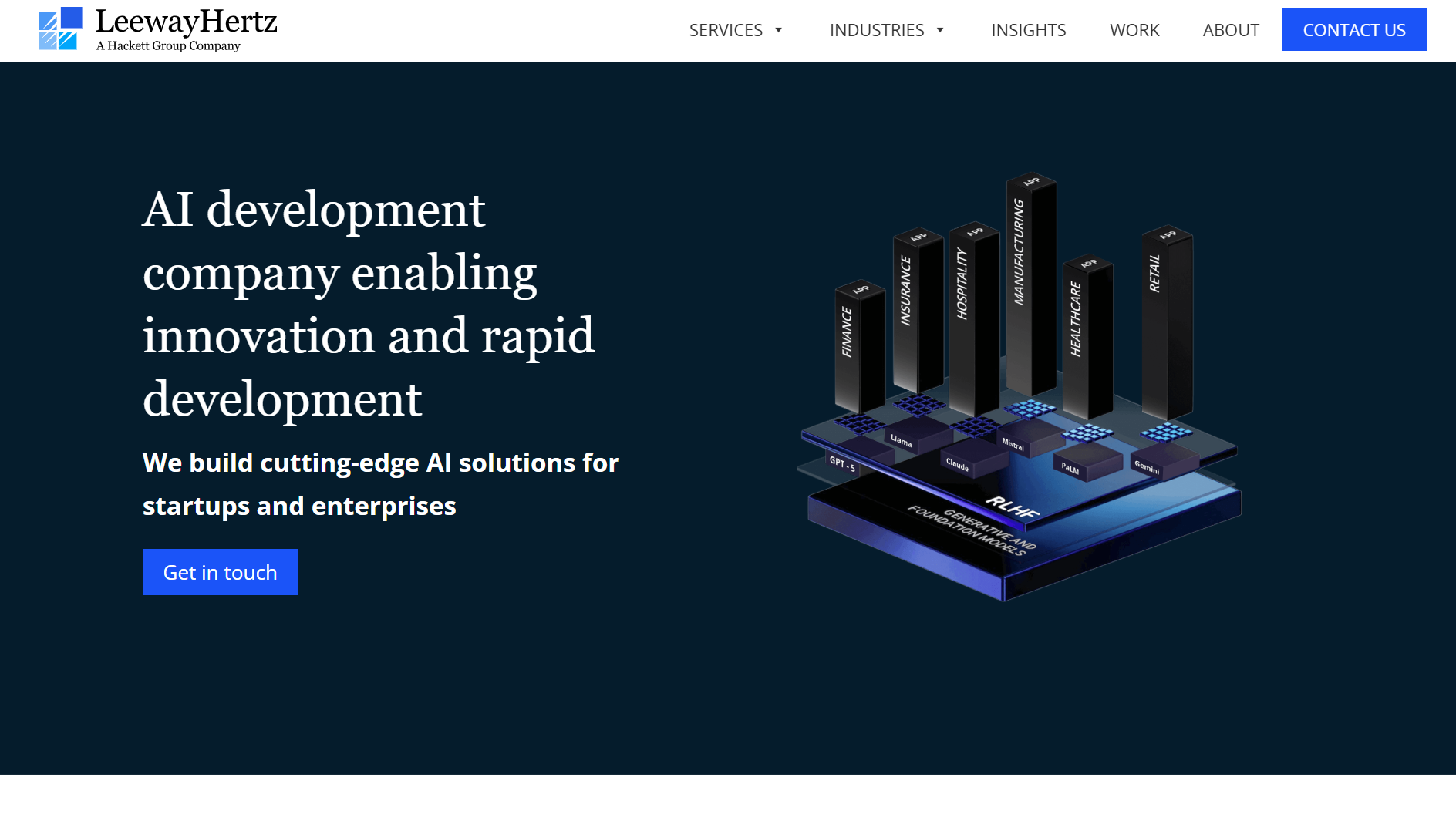
LeewayHertz is a full‑stack AI consulting and development firm with robust capabilities in generative AI, LLM integration, and agentic AI embedding into workflows. It supports enterprise clients by integrating custom solutions directly into existing operational tech stacks.
Best for: Companies integrating LLM features into digital products
Key AI integration features
- Retrieval-augmented generation pipelines
- Prompt orchestration layers
- API-first microservices integration
- Cloud deployment across AWS, Azure, and GCP
- Conversational assistants and copilots
Pros
- Deep specialization in GenAI architecture
- Strong support for MVP-to-production transitions
- Effective product-centric integration workflows
Cons
- Smaller governance footprint than enterprise SI partners
- Less suited for compliance-heavy environments
Pricing snapshot
- Typical engagement range: mid-tier custom builds
Why shortlist
Best suited for product teams embedding AI into SaaS platforms.
4. InData Labs
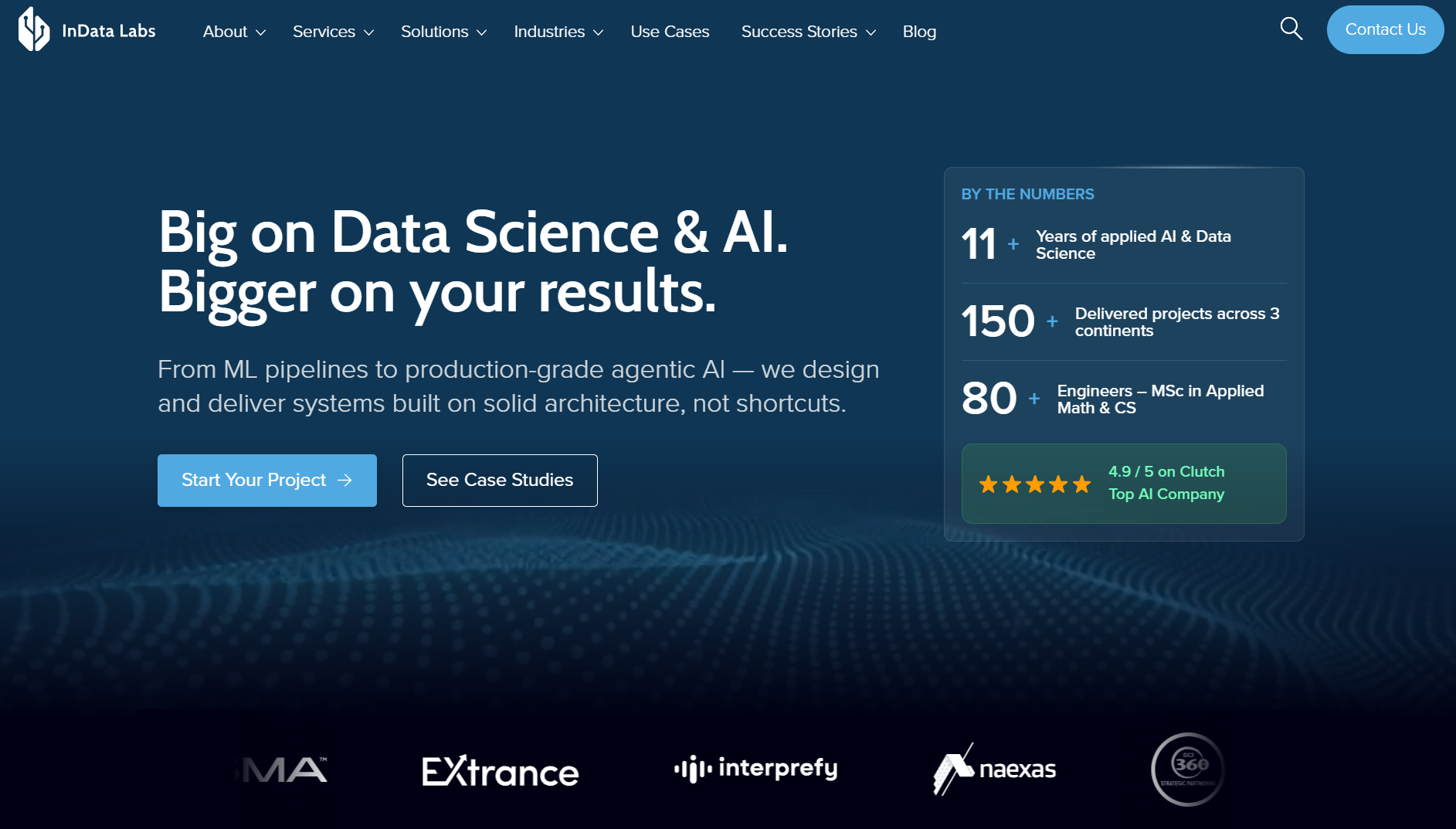
InData Labs focuses on data engineering and analytics as the foundation for AI integration. By preparing structured data pipelines and ensuring data readiness, they help organizations embed predictive models into business systems.
Best for: Data-centric organizations preparing infrastructure for predictive AI
Key AI integration features
- Data warehouse architecture for AI pipelines
- Predictive analytics integration into BI platforms
- Model deployment across hybrid environments
- Structured feature engineering pipelines
Pros
- Strong analytics engineering foundation
- Reliable pipeline architecture delivery
- Suitable for KPI-driven decision automation
Cons
- Less specialization in conversational AI systems
- Requires a mature data environment for best results
Pricing snapshot
- Typical hourly rate: $50–$99/hr
Why shortlist
Strong option for enterprises building forecasting and analytics platforms
5. Addepto
Addepto is a data‑science‑centric AI partner that constructs custom machine learning models and deploys them into enterprise environments using structured MLOps processes. This makes their work especially relevant for analytics and decision-support systems.
Best for: Custom machine-learning integrations inside enterprise analytics stacks
Key AI integration features
- Custom predictive model deployment
- Automated retraining pipelines
- Explainability tooling for regulated environments
- Microservice wrappers around ML services
Pros
- Strong experimentation and prototyping capabilities
- Effective domain-specific modeling expertise
- Flexible engagement structures
Cons
- Smaller GenAI portfolio compared with LLM-focused integrators
Pricing snapshot
- Scope-based delivery pricing
Why shortlist
Best suited for organizations integrating decision-support models.
6. SoluLab
SoluLab provides AI integration and development systems that help turn raw data and model outputs into operational business intelligence and workflow automation. It has delivered over 40+ AI projects across industries, including healthcare, education, and logistics.
Best for: Mid-market firms deploying workflow automation using LLM systems
Key AI integration features
- ChatGPT-based workflow assistants
- Enterprise automation planning frameworks
- Cross-industry AI deployments
- Post-deployment optimization support
Pros
- Broad industry coverage
- Strong consulting-to-deployment continuity
- Useful for automation-first integration initiatives
Cons
- Limited specialization in large-scale enterprise governance frameworks
Pricing snapshot
- Custom project-based engagement models
Why shortlist
Effective partner for automation-driven transformation programs.
7. Miquido
Miquido has expertise in embedding AI into both front‑end applications and backend systems, often working closely with product teams to ensure integrated AI aligns with business objectives and end‑user needs.
Best for: Product-led companies embedding AI into user-facing platforms
Key AI integration features
- AI-augmented mobile and web application embedding
- Continuous monitoring and model iteration workflows
- UX-aligned AI architecture integration
- Recommendation and personalization systems
Pros
- Strong product engineering alignment
- Reliable front-end AI deployment capability
- Effective collaboration with internal product teams
Cons
- Less enterprise-scale transformation coverage
Pricing snapshot
- Mid-range engineering delivery pricing
Why shortlist
Best suited for digital product teams integrating personalization systems.
8. Ekimetrics
Ekimetrics brings advanced analytics together with integration support, helping firms embed data‑driven models into operational decision systems and measure impact across KPIs.
Best for: Organizations linking analytics performance directly to business KPIs
Key AI integration features
- Decision-flow analytics integration
- KPI attribution modeling
- Governance frameworks for model oversight
- Marketing and commercial analytics automation
Pros
- Strong measurement frameworks
- Commercial outcome-focused deployment
- Effective governance integration
Cons
- Less focus on conversational AI systems
Pricing snapshot
- Enterprise consulting engagement structures
Why shortlist
Ideal for ROI-linked analytics transformation programs.
9. Binariks
Binariks emphasizes robust software engineering and integration of AI components via APIs and scalable architectures. It supports enterprises in healthcare, fintech, and other data‑intensive sectors.
Best for: Healthcare and fintech platforms requiring API-centric AI embedding
Key AI integration features
- API-driven architecture integration
- Hybrid cloud deployment support
- Scalable engineering frameworks
- Compliance-aware healthcare integrations
Pros
- Strong engineering discipline
- Effective regulated-industry experience
- Reliable backend integration capability
Cons
- Smaller GenAI productization footprint
Pricing snapshot
- Mid-tier custom engineering engagements
Why shortlist
Strong option for compliance-heavy integration environments.
10. Cognizant
Cognizant is a global professional services firm with deep experience delivering enterprise AI integration at scale. It’s often chosen for regulated environments requiring strong governance and compliance.
Best for: Large enterprises requiring governance-heavy AI deployment
Key AI integration features
- Enterprise-scale AI transformation frameworks
- Regulated-industry deployment support
- Global delivery infrastructure
- Lifecycle governance tooling
Pros
- Strong compliance expertise
- Global delivery capacity
- Suitable for multi-region rollouts
Cons
- Higher engagement cost structures
- Longer delivery timelines than boutique firms
Pricing snapshot
- Enterprise consulting pricing tiers
Why shortlist
Best suited for regulated industries and global deployments.
11. Scale AI
Scale AI is known for operationalizing data and model workflows, especially in data‑heavy sectors. It supports structured pipelines and integrations that ensure models operate effectively within fast‑moving enterprise processes.
Best for: Data-intensive organizations operationalizing large-scale model pipelines
Key AI integration features
- Data pipeline orchestration
- Model training dataset infrastructure
- Annotation lifecycle tooling
- Deployment scaling support
Pros
- Strong dataset infrastructure capabilities
- Effective for autonomous-system pipelines
- Reliable model lifecycle support
Cons
- Less suited for workflow-level business automation use cases.
Why shortlist
Ideal partner for organizations scaling model training pipelines across environments.
Also Read: Understanding AI vs. Generative AI for Enterprises
How Leading AI Integration Projects Deliver Measurable Results
Enterprises that integrate AI with clear business targets are seeing quantifiable impacts on operations, customer experience, and decision effectiveness.
In fact, recent industry evidence suggests that AI workflow automation and integrated AI agents are becoming central to scaled adoption, with about one‑third of high‑performing organizations formally embedding AI into business processes.
1. AI‑Powered Customer Service Automation
Integrations of AI into customer support systems, such as generative agents or automated ticket routing, reduce manual handling and speed responses.
For example, large contact center implementations that combine real‑time transcription, intent and sentiment detection, and automated task routing show improvements in agent efficiency and customer satisfaction as AI assists in high‑volume interactions.
- Outcome metric: Up to 80% reduction in repetitive workload, enabling service teams to focus on complex issues.
- Measurement focus: Reduction in average handling time (AHT), first‑contact resolution rates, and CSAT scores.
2. AI Integration with Enterprise Planning Systems (CRM/ERP)
When AI agents are connected to systems like Microsoft Dynamics 365 or enterprise ERPs, they automate data workflows, forecast demand, and proactively assist sales or support teams. CRM automation reduces manual data entry and repetitive follow‑up tasks, increasing productivity.
- Outcome metric: Predictive lead scoring and automation can shorten sales cycles and improve forecast accuracy.
- Example: AI agents integrated with CRM auto‑categorize tickets and suggest next actions without human input, boosting team throughput.
3. Predictive Insights Injected into Existing BI Systems
Embedding predictive models into BI dashboards turns static reports into action drivers. AI models that analyze past trends and forecast future scenarios help decision teams identify opportunities and risks in advance.
- Outcome metric: Faster, data‑backed decisions with measurable improvements in planning accuracy and delivery timelines.
4. Workflow Pipelines That Reduce Manual Process Costs
AI integration with process automation tools (e.g., intelligent document processing plus generative automation) can cut cycle times drastically. Studies of automated business tasks show significant reductions in processing time and error rates, resulting in improved compliance and lower labor costs.
- Outcome metric: Shortened throughput times, lower operational costs, and reduced error variance.
Why settle for generic solutions when you can have custom software designed specifically for your business needs? At Codewave, we focus on the features that deliver the most value, using Code Accelerate to build scalable solutions 3x faster. Every system we create is tailored, secure, and designed for growth.
Ready for software that fits? Contact Codewave today!
Integration Risks and How to Mitigate Them
Many vendor lists highlight capabilities without addressing the practical risks that enterprise buyers face during and after integration. Understanding these risks helps organizations avoid costly execution pitfalls and ensure sustainable value from AI investments.
1. Data Security, Privacy, and Regulatory Compliance
AI systems are often tied to sensitive customer and internal data. Without strict security frameworks and compliance adherence, AI integrations can expose organizations to data breaches or regulatory penalties.
Focus on encryption at rest, strict access controls, and compliance checks for frameworks like GDPR, CCPA, or HIPAA during integration planning.
2. Model Governance and Audit Trails
Lack of transparent governance around models increases risk over time. Ensure that AI outputs are traceable, decisions are auditable, and models include mechanisms for explainability.
Audit logs should record input sources, transformation steps, and output usage for regulatory review or internal validation.
3. Technical Debt from Poor Integration Design
Integrations that ignore architecture constraints or legacy system compatibility increase technical debt. Build modular connectors and decoupled APIs to reduce dependencies on monolithic systems.
Prioritize adaptable infrastructure that supports incremental updates without rework.
4. Expectations vs Operational Realities
High expectations without clear benchmarks lead to disappointment. Define baseline performance metrics before integration and track delta improvements post‑deployment. Establish phased rollouts with early KPI checkpoints to validate assumptions.
5. Ongoing Model Maintenance and Drift Control
AI models degrade as data patterns change. Plan for regular retraining schedules, drift detection monitoring, and alerts for performance degradation. Governance frameworks must include maintenance budgets and skilled oversight to sustain long‑term ROI.
Practical Steps to Start Your AI Integration Project in 2026
Getting started with AI integration requires clear objectives and a practical project structure. The following checklist helps enterprise teams prepare effectively for evaluation and execution.
Define Clear Business Outcomes
Outline specific goals such as reducing cost per transaction, increasing first‑contact resolutions, or improving forecast accuracy. Attach quantitative targets to each objective.
Assess Current System Architecture
Review your existing CRM, ERP, data warehouses, and middleware. Identify integration points and any legacy constraints that might require adjustments. Replace or wrap outdated components if necessary.
Build a Cross‑Functional Governance Team
Include stakeholders from IT, security, business operations, and data teams. A unified governance team ensures alignment on priorities, risk policies, and shared success metrics.
Select an AI Integration Partner Aligned with Your Maturity and Goals
Choose a partner with proven experience in systems similar to your stack and documented case results tied to measurable performance. Ensure they provide governance frameworks, security checks, and ongoing support.
Set KPIs & Monitoring Frameworks
Define key performance indicators upfront and install dashboards or alerts for continuous tracking. Examples include cycle time reduction, error rates, cost savings, and predictive accuracy improvements.
Why Choose Codewave for AI Integration?
Codewave is your design-thinking-led partner for digital transformation and AI integration. We combine strategic insight, engineering expertise, and secure execution to turn your AI use cases into production‑grade solutions.
From the cloud to CRM/ERP systems, we help integrate AI into your existing technology stack, delivering measurable business outcomes at every step.
Key Services
- AI Orchestration & Integration: Embed AI agents and models into existing enterprise systems via secure APIs and process connectors.
- Predictive Analytics & Automation: Build machine learning models that forecast trends and automate decision tasks tied to performance outcomes.
- Secure Data Pipelines: Ensure safe handling of sensitive data throughout ingestion, processing, and inference stages with continuous validation.
- Cloud‑Native Solutions: Align AI systems with cloud strategies on platforms such as AWS, Azure, or hybrid deployments for scalable compute and storage.
- Impact‑Based Billing: Use the Impact Index model so clients pay based on business performance improvements rather than just delivery milestones.
Codewave has executed 300+ projects globally across industries, including healthcare, retail, and energy. Explore our portfolio to learn more.
Conclusion
Companies that treat integration as a strategic capability rather than a one‑off task tend to get stronger business value from their technology investments. A well‑defined integration strategy connects disparate systems such as CRM, ERP, and data platforms into a single source of truth, enabling smoother workflows and faster decision-making.
Clear KPIs tied to integration, such as reduced manual re‑entry, fewer data errors, shorter quote‑to‑cash cycles, and improved renewal or upsell rates, help justify investment and measure ROI over time.
If your goal is lasting impact and measurable outcomes,partner with Codewave to build secure, performance‑aligned integration solutions that move beyond experimentation. Explore how a tailored approach can accelerate your business transformation.
FAQs
Q: How can I tell if my organization is actually ready for AI integration?
A: Readiness goes beyond enthusiasm. Leaders should assess if they have clean, governed data, clearly defined use cases, and alignment across business and IT teams before starting. A readiness assessment helps surface gaps in infrastructure, data quality, and governance that could derail integration projects.
Q: Should my internal team develop AI models, or should we rely on external partners?
A: Internal teams may be strong in domain knowledge but often lack the breadth of integration experience needed to deploy and maintain systems at scale. External partners with proven integration expertise can help bridge this gap and reduce risk. Look for partners who can work with your team to transfer knowledge rather than replace it.
Q: How does industry expertise influence the success of an AI integration project?
A: Different sectors come with unique regulatory and data challenges. Partners with vertical experience understand compliance nuances such as healthcare‑specific controls or finance‑grade governance. This reduces risks associated with misaligned assumptions and accelerates implementation timelines.
Q: What happens if my organization’s use case changes mid‑project?
A: Agile integration approaches help here. Leading partners build modular architectures that support iterative adjustments without reworking the entire system. A partner who plans for flexible integration and iterative delivery avoids lock‑in to rigid solutions that can’t adapt to shifting business needs.
Q: How do I avoid vendor lock‑in when selecting an AI integration partner?
A: Ask about portability and interoperability standards upfront. Good partners design for open APIs and data portability, so your AI components can work with multiple platforms and tools. This avoids costly migrations or dependencies on a single vendor’s stack over time.

Codewave is a UX first design thinking & digital transformation services company, designing & engineering innovative mobile apps, cloud, & edge solutions.