




Smart contracts execute automatically once deployed. There is no rollback, no quiet patching, and no tolerance for overlooked vulnerabilities. If your contract logic fails in production, the financial and reputational impact is immediate.
As a CTO or Web3 engineering lead, your tooling decisions define your security posture and deployment confidence. Smart contract development is not just about writing Solidity. It requires a structured stack of frameworks, testing environments, security libraries, node providers, and monitoring tools.
The right toolchain reduces exploit risk and audit complexity. The wrong one introduces exposure and operational friction. This guide breaks down the essential smart contract development tools and how to evaluate them for secure, scalable Web3 delivery.
Key Takeaways
- Smart contracts cannot be patched after deployment, which means your tooling decisions determine security, reliability, and scalability from day one.
- A production-ready Web3 stack goes far beyond Solidity; it requires coordinated frameworks, testing layers, security validation, infrastructure, and data integrations working together.
- The difference between a resilient protocol and an exploitable one often comes down to how well your tools simulate real-world conditions before launch.
- Choosing the right stack early can prevent costly exploits, gas inefficiencies, and architectural constraints that are difficult to fix later.
Why Smart Contract Development Tools Are Critical for Production Web3 Systems
As a Web3 engineering lead, you are not choosing tools for convenience. You are designing the foundation that determines whether your contracts are secure, auditable, scalable, and upgrade-ready.
Smart contracts are immutable once deployed. This changes how you approach development compared to traditional backend systems.
Here is why tooling becomes critical.
1. Security Cannot Be an Afterthought
Smart contracts manage value directly. A single unchecked vulnerability can lead to irreversible loss. Development frameworks, static analyzers, and audited libraries reduce the probability of exploitable logic flaws before deployment.
Without structured tooling, you rely heavily on manual review, which increases risk and audit complexity.
2. Deployment Infrastructure Impacts Reliability
Node providers and automation scripts influence:
- Transaction reliability
- Network latency
- Multi-chain support
- Failover resilience
Poor infrastructure decisions introduce operational bottlenecks even if the contract logic is sound.
3. Testing Must Simulate Real Network Conditions
Mainnet failures are expensive. Local blockchain simulators and automated testing frameworks allow you to:
- Validate edge cases
- Stress-test gas consumption
- Simulate multi-contract interactions
- Reproduce attack scenarios
This reduces deployment uncertainty and improves audit readiness.
4. Scalability Depends on Ecosystem Integration
Oracles, indexing layers, and storage systems determine how well your application scales beyond core contract logic.
If these integrations are poorly selected, your product may face:
- Slow data retrieval
- Limited composability
- Inefficient event tracking
- Frontend performance bottlenecks
Tooling decisions affect long-term architectural flexibility.
Also Read: Introduction to DApp Development Tools and Frameworks
If you are evaluating whether your current smart contract stack can support your roadmap, it may help to review it from an architecture-first perspective. Codewave works with Web3 teams to assess tooling gaps, strengthen security validation layers, and align smart contract frameworks with long-term scalability goals.
Key Features to Evaluate in Smart Contract Development Tools
When selecting smart contract development tools, popularity should not drive your decision. Your evaluation criteria must reflect production risk, audit complexity, scalability requirements, and long-term maintainability.
Below are the core feature sets you should assess before standardizing your stack.
1. Development Framework Capabilities
Your framework defines how contracts are built, configured, and deployed across environments. Weak framework capabilities introduce operational friction and increase deployment risk.
You should evaluate whether the framework provides:
- Automated task execution and scripting support
Deployment, migration, and contract verification should be scriptable and repeatable across networks. - Plugin architecture and extensibility
A modular ecosystem allows you to integrate gas reporting, security scanning, test coverage, and CI/CD pipelines without restructuring your stack. - Flexible network configuration
Multi-network support with environment isolation ensures consistent deployment across testnets, staging, and mainnet. - Gas usage analysis tools
Gas inefficiencies directly affect user adoption and transaction costs in production environments. - Advanced debugging and stack tracing
Detailed error traces accelerate remediation and reduce debugging cycles before audits.
If your framework cannot support automation, extensibility, and multi-network management, scaling becomes operationally fragile.
2. Testing and Simulation Depth
Testing is not about validating functionality alone. It is about stress-testing logic under adversarial and production-like conditions.
Critical testing capabilities include:
- Deterministic local blockchain environments
Consistent testing conditions eliminate unpredictable execution differences. - Automated unit and integration testing
Every contract interaction should be validated systematically, not manually. - Mainnet forking and realistic simulation
Forked network simulation allows you to test against real liquidity pools, token states, and contract dependencies. - Fuzz testing support
Randomized input testing exposes edge cases traditional testing may miss. - Coverage reporting and performance benchmarking
Visibility into untested code paths and gas-heavy operations improves exploit resistance.
Testing depth directly influences audit outcomes and post-deployment stability.
3. Security Tooling and Validation Layers
Security tooling should not be optional. It should be integrated into your development lifecycle.
You should assess whether your security stack includes:
- Static code analysis for vulnerability detection
Early identification of reentrancy risks, overflow issues, and access control flaws reduces exploit probability. - Dependency and library validation
External contract dependencies introduce hidden risk if not audited and version-controlled. - Upgradeable contract validation
If using proxy patterns, tooling should verify safe upgrade implementation. - Role-based access control verification
Misconfigured permissions are a frequent source of exploits. - Automated security scans within CI pipelines
Validation should occur continuously, not only before external audits.
Strong security tooling shortens audit cycles and reduces remediation cost.
4. Infrastructure and Node Provider Reliability
Node infrastructure directly affects user experience and transaction reliability. Infrastructure decisions must align with scale expectations.
Evaluate providers based on:
- High availability and uptime guarantees
Downtime translates into failed transactions and lost trust. - HTTP and WebSocket endpoint performance
Real-time event subscriptions depend on low-latency connections. - Multi-network and multi-chain support
If expansion is part of your roadmap, infrastructure flexibility becomes critical. - Usage analytics and monitoring visibility
Observability helps diagnose transaction failures and performance bottlenecks. - Rate limit transparency and scaling tiers
Unexpected throttling can disrupt high-volume applications.
Infrastructure resilience determines whether your contracts remain accessible during peak demand.
5. Oracle and External Data Integrity
If your contracts rely on off-chain data, oracle architecture becomes part of your security model.
You should evaluate:
- Level of decentralization in the oracle network
Centralized feeds introduce manipulation risk. - Diversity of data sources
Single-source feeds increase vulnerability. - Latency and update frequency
Delayed data updates can distort financial logic. - Tamper resistance and cryptographic guarantees
Integrity mechanisms must be transparent and verifiable. - Service-level commitments
Enterprise-grade deployments require reliability assurances.
Oracle selection directly affects trust assumptions in DeFi and insurance platforms.
6. Indexing and Query Performance
Smart contracts store data on-chain, but querying blockchain state directly is inefficient for complex applications.
Indexing tools should provide:
- Event-based indexing for contract events
Enables efficient data retrieval for dashboards and analytics. - Flexible query frameworks (e.g., GraphQL-based systems)
Simplifies frontend integration and analytics pipelines. - Real-time synchronization capabilities
Ensures UI reflects current contract state. - Multi-chain indexing support
Required for cross-chain or Layer 2 strategies.
Efficient indexing improves application responsiveness and operational visibility.
Also Read: Cryptocurrency Development Services and Solutions
Top Smart Contract Development Tools for Production Web3 Stacks
Production-grade Web3 applications rely on more than a single framework. Below are the core smart contract development tools commonly used to build, test, secure, and scale blockchain systems.
1. Hardhat
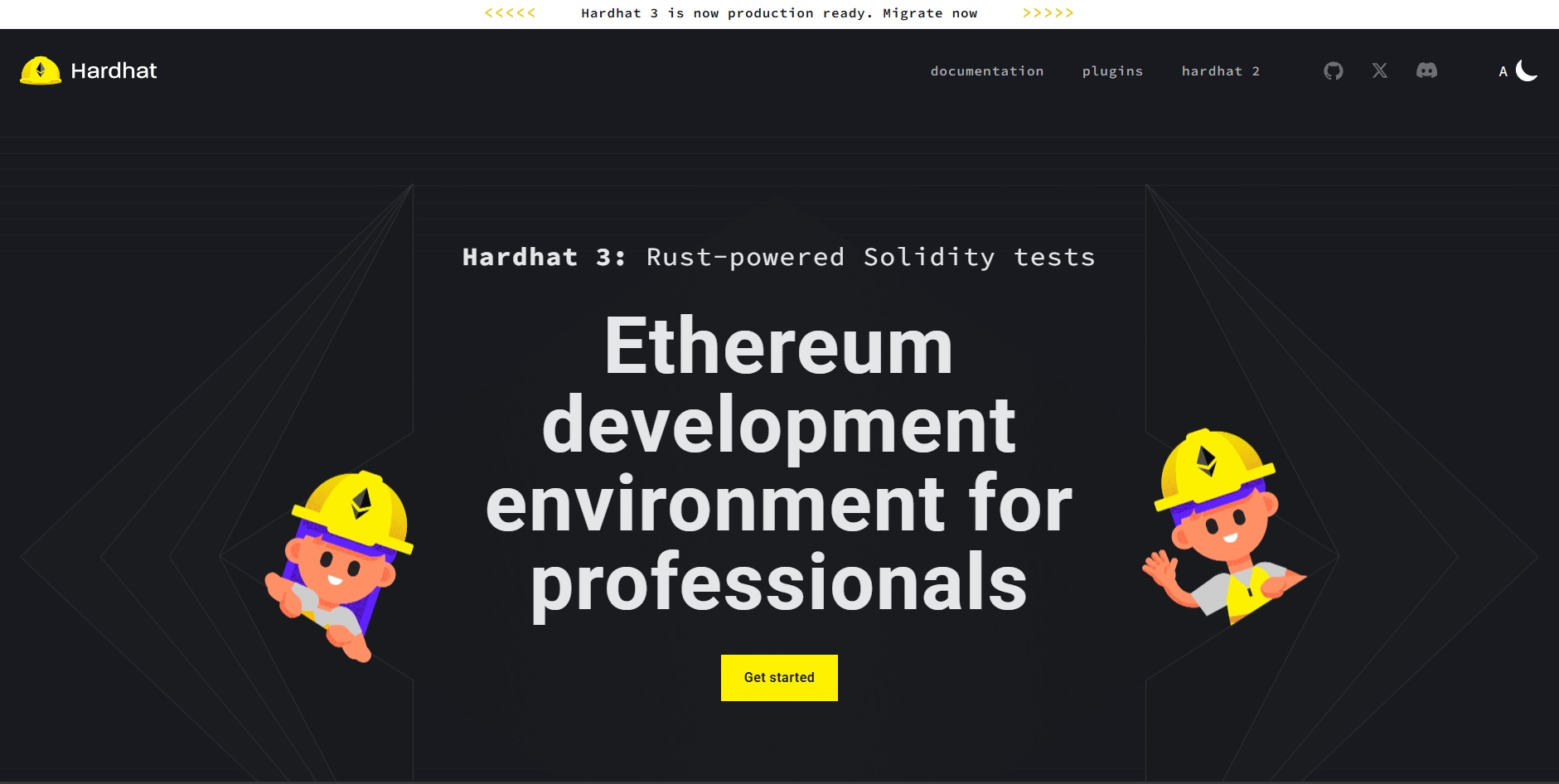
Hardhat is one of the most widely adopted development environments for Ethereum-based smart contracts. It provides a flexible framework for compiling, testing, debugging, and deploying contracts. For engineering leads, Hardhat stands out because of its extensible plugin ecosystem and strong debugging capabilities, which support production-grade workflows.
Key Features
- Local Ethereum network for development
- Built-in task runner and scripting system
- Detailed stack traces and console debugging
- Plugin ecosystem (Ethers.js, gas reporting, coverage)
- Network forking for mainnet simulation
Pros
- Strong debugging and developer experience
- Highly extensible through plugins
- Active ecosystem and community support
Cons
- It can become complex with many plugins
- Primarily optimized for Ethereum-based chains
Best For
Teams building Ethereum or EVM-compatible DeFi, NFT, or tokenization platforms requiring flexible scripting and advanced debugging.
2. Foundry

Foundry is a Rust-based smart contract toolkit designed for speed and performance. It has gained popularity among advanced Web3 teams because of its fast compilation and testing capabilities. For CTOs managing performance-sensitive applications, Foundry offers a streamlined alternative to heavier frameworks.
Key Features
- Fast compilation and execution
- Built-in testing framework written in Solidity
- Fuzz testing support
- Gas snapshotting
- Minimal dependency structure
Pros
- High-speed testing and compilation
- Lightweight architecture
Cons
- Smaller ecosystem compared to Hardhat
- Steeper learning curve for some teams
Best For
Performance-focused teams and advanced developers building complex DeFi systems or optimizing gas-intensive logic.
3. Truffle Suite
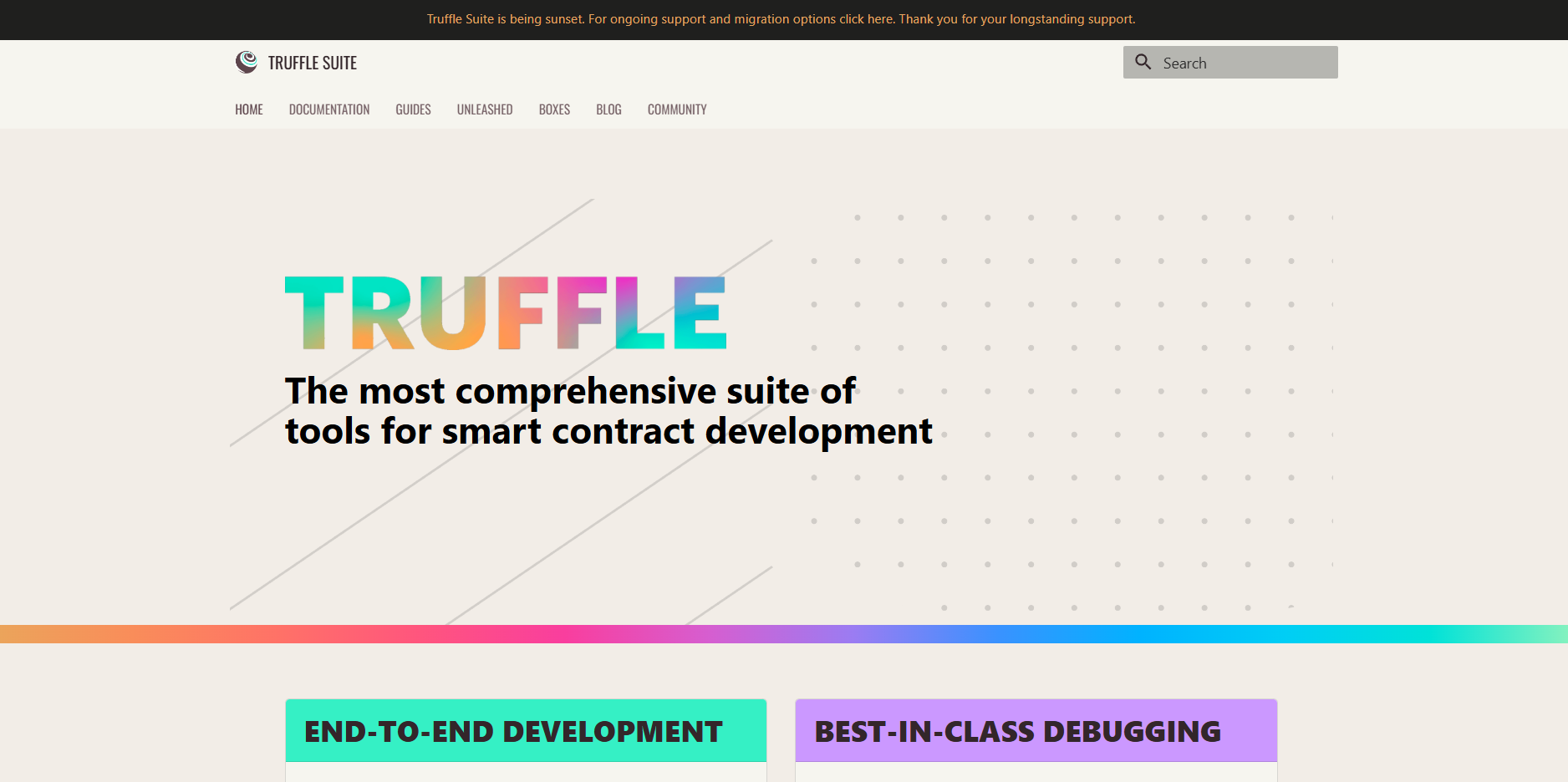
Truffle is one of the earliest smart contract development frameworks. It provides a full lifecycle toolkit for development, testing, and deployment. While newer tools have emerged, Truffle remains a stable option for structured project management.
Key Features
- Contract compilation and deployment tools
- Built-in testing support
- Network management
- Integration with Ganache
- Asset pipeline support
Pros
- Mature ecosystem
- Structured project management
- Strong integration with local testing tools
Cons
- Slower updates compared to newer frameworks
- Heavier configuration in large projects
Best For
Teams seeking a traditional, structured framework for Ethereum-based applications.
4. Ganache

Ganache is a personal blockchain for Ethereum development. It allows teams to simulate blockchain interactions locally before deploying to public networks. For engineering leaders, it reduces the risk of costly mainnet mistakes.
Key Features
- Local blockchain simulation
- Customizable gas pricing
- Pre-funded test accounts
- Transaction inspection tools
Pros
- Safe environment for testing
- Easy debugging of transactions
- Rapid prototyping support
Cons
- Does not fully replicate live network congestion
- Limited scalability testing
Best For
Early-stage development and iterative contract testing before public deployment.
5. OpenZeppelin
OpenZeppelin provides audited smart contract libraries and security-focused tooling. It is widely adopted for implementing token standards and upgradeable contracts. For security-conscious engineering leads, it reduces risk by relying on battle-tested components.
Key Features
- Pre-audited contract libraries
- ERC standards implementation
- Role-based access control modules
- Upgradeable contract patterns
- Security utilities
Pros
- Reduces custom vulnerability risk
- Industry-standard implementations
- Strong documentation
Cons
- Limited customization flexibility in some modules
- Over-reliance can reduce internal understanding
Best For
Teams prioritizing security and standardized implementations in DeFi, NFT, and governance systems.
6. Infura
Infura provides scalable access to Ethereum and other blockchain networks without running your own nodes. For CTOs, this reduces infrastructure overhead while maintaining network reliability.
Key Features
- Hosted Ethereum node access
- High uptime infrastructure
- HTTP and WebSocket endpoints
- Multi-network support
Pros
- Eliminates node maintenance
- Reliable infrastructure
- Fast integration
Cons
- Centralized dependency
- Rate limits based on usage tier
Best For
Startups and SMEs need reliable node access without managing infrastructure internally.
7. Alchemy
Alchemy offers enhanced blockchain infrastructure with additional analytics and developer tooling. It provides performance insights that can help teams monitor application behavior post-deployment.
Key Features
- Blockchain node APIs
- Application performance monitoring
- Enhanced analytics
- Multi-chain support
Pros
- Advanced monitoring capabilities
- Developer-friendly dashboards
- Strong scalability support
Cons
- Usage-based pricing
- Vendor dependency
Best For
Growing Web3 applications requiring performance visibility and scalable infrastructure.
8. Chainlink
Chainlink provides decentralized oracle services that connect smart contracts to off-chain data. For DeFi and complex applications, oracle selection directly impacts trust assumptions and security.
Key Features
- Decentralized data feeds
- Tamper-resistant oracle networks
- Cross-chain compatibility
- Automation support
Pros
- Industry-standard Oracle solution
- High reliability for financial data
- Widely adopted
Cons
- Additional integration complexity
- Cost considerations for high-frequency feeds
Best For
DeFi protocols, insurance platforms, and applications require secure real-world data integration.
9. The Graph
The Graph is an indexing protocol that allows efficient querying of blockchain data. It improves frontend performance and data accessibility.
Key Features
- Event indexing
- GraphQL query interface
- Subgraph creation
- Real-time data updates
Pros
- Improves frontend scalability
- Efficient blockchain data querying
- Reduces backend complexity
Cons
- Requires setup and maintenance
- Indexing latency for large datasets
Best For
Applications with heavy on-chain data requirements and analytics-driven dashboards.
10. IPFS
IPFS is a decentralized storage protocol used to store off-chain assets such as NFT metadata and media files. It reduces reliance on centralized storage.
Key Features
- Content-addressable storage
- Distributed file system
- Decentralized hosting model
Pros
- Reduces central storage risk
- Supports NFT ecosystems
- Improves data resilience
Cons
- Requires pinning services for persistence
- Performance depends on node distribution
Best For
NFT platforms, decentralized apps, and systems require off-chain asset storage.
How to Choose the Right Stack Based on Your Web3 Architecture
As a CTO or Web3 engineering lead, your tool selection should follow architecture decisions, not trends. The right stack depends on your product type, security exposure, scalability goals, and regulatory requirements.
Below is how tooling priorities shift across different Web3 architectures.
1. DeFi Protocols
If you are building a DeFi protocol, your primary concerns are capital security, oracle reliability, and gas optimization.
Stack Priorities
- Frameworks that support advanced testing and scripting
- Security libraries with audited implementations
- Fuzz testing and static analysis tools
- Decentralized oracle integrations
- Indexing layers for analytics and transaction tracking
Why This Matters
DeFi contracts manage pooled liquidity and automated logic. You must simulate attack vectors, validate access controls, and test edge cases before deployment. Tooling should support deterministic testing and continuous validation.
2. NFT Marketplaces & Digital Asset Platforms
NFT ecosystems depend heavily on storage architecture and frontend data performance.
Stack Priorities
- Structured deployment frameworks
- Upgrade-safe contract patterns
- Decentralized storage for metadata and assets
- Reliable node infrastructure
- Efficient indexing for filtering and search
Why This Matters
Improper storage design can break asset references. Weak indexing slows marketplace performance. Your tooling should support scalable metadata handling and predictable minting workflows.
3. Enterprise Blockchain Solutions
Enterprise systems introduce governance, compliance, and integration requirements.
Stack Priorities
- Automation-friendly development frameworks
- Role-based access control modules
- Static analysis and audit tooling
- SLA-backed infrastructure providers
- Upgradeable contract patterns
Why This Matters
Enterprise deployments require maintainability and compliance alignment. Tooling should support structured deployment pipelines and integration with existing cloud and data systems.
4. Multi-Chain or Cross-Chain Applications
If your architecture targets multiple EVM-compatible networks or Layer 2 chains, flexibility becomes critical.
Stack Priorities
- Multi-network deployment configuration
- Gas reporting and cost optimization tools
- Cross-chain compatible oracle systems
- Infrastructure providers with multi-chain support
Why This Matters
Multi-chain expansion increases operational complexity. Your toolchain must simplify deployment scripts and network management without duplicating logic.
If you are planning a new Web3 product or reassessing your current smart contract stack, it may be time to validate whether your tooling aligns with your security and scalability goals.
Explore how Codewave’s blockchain development and smart contract engineering services can help you design a secure, production-ready Web3 architecture from day one.
How These Tools Work Together in a Production Web3 Stack
In a real Web3 environment, smart contract development tools function as an integrated system, not independent utilities.
You design contract architecture first, defining storage models, access controls, and upgrade strategy. Development frameworks such as Hardhat or Foundry handle compilation, scripting, and configuration. Local testing environments simulate blockchain conditions before any testnet deployment.
Security tools then validate logic using static analysis, fuzz testing, and dependency checks. Once validated, deployment scripts push contracts through node providers such as Infura or Alchemy. If your application relies on off-chain data, oracle networks like Chainlink bridge external inputs securely. Indexing layers such as The Graph support efficient frontend querying, while storage protocols like IPFS manage decentralized assets.
Each layer reduces a specific risk. Remove one, and operational exposure increases.
How Codewave Approaches Smart Contract Tooling
Smart contract stacks should be structured around risk, scalability, and maintainability, not popularity.
Codewave designs Web3 architectures that integrate development frameworks, security validation layers, oracle systems, and infrastructure planning into a cohesive deployment pipeline. This ensures contracts are audit-ready, upgrade-safe, and aligned with long-term scaling goals.
You can explore how blockchain solutions are implemented across industries.
If you are validating your current stack or planning a new Web3 build, aligning tooling with architecture from day one reduces exposure to exploits and long-term rework. Contact us to discuss how Codewave can help you design and implement a secure, production-ready smart contract architecture tailored to your Web3 goals.
FAQs
1. What are smart contract development tools?
They are frameworks, testing environments, security analyzers, node infrastructure services, and indexing layers used to build and manage blockchain-based contracts.
2. Which framework is better: Hardhat or Foundry?
Hardhat offers strong debugging and plugin flexibility. Foundry provides faster compilation and advanced testing performance. The choice depends on project complexity and team preference.
3. Do these tools prevent smart contract exploits?
They reduce risk through automated validation and structured testing, but security also depends on architecture and audit discipline.
4. What tools are required for a DeFi application?
A framework, testing environment, security libraries, oracle integration, reliable node access, and indexing tools are typically required.
5. Why are node providers important?
They ensure stable blockchain access. Poor infrastructure choices can lead to latency, failed transactions, or downtime.

Codewave is a UX first design thinking & digital transformation services company, designing & engineering innovative mobile apps, cloud, & edge solutions.