



Have you ever wondered why most products don’t succeed even when teams invest heavily in development? Research consistently shows that 80–95% of new products fail within their first year on the market, often because the product development process is rushed, unfocused, or misses critical validation steps.
This failure rate reflects how easily teams can bypass rigorous customer feedback, weak market research, or poorly structured development stages and still proceed. Without a clear, disciplined process, promising ideas rarely translate into sustainable products.
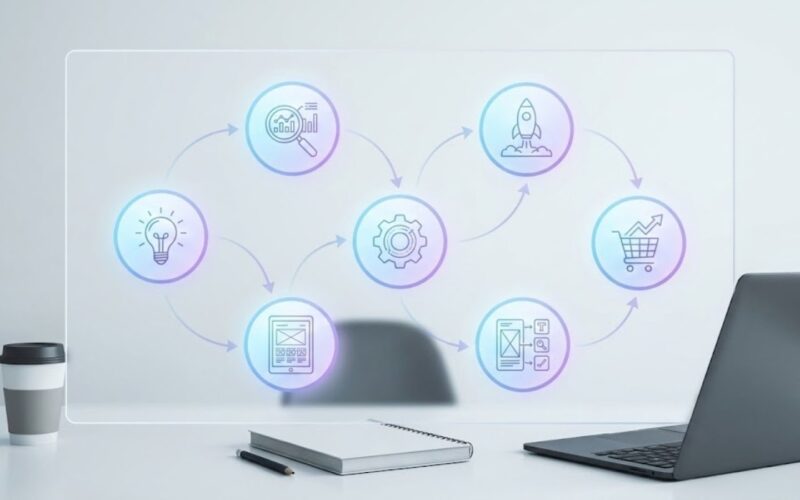
This blog breaks down the 7 stages of the product development process, what each entails, and why skipping any stage increases risk.
Key Takeaways
- Product Development Stages: The product development process comprises 7 stages, from idea generation through post-launch optimization, each focused on validating key aspects of the product.
- High Failure Rates: Up to 95% of new products fail due to a misalignment with customer needs or market timing.
- Early Validation Matters: 62% of companies that validate their products early are more likely to succeed by aligning better with user needs.
- Importance of Each Stage: Skipping key stages, such as market research or user validation, significantly increases the risk of product failure.
- Effective Product Delivery: Successful products result from clear goals, robust planning, and strong cross-functional teamwork, reducing common pitfalls such as scope creep.
What Is the Product Development Process?
The product development process is a step-by-step approach to assess whether a product idea is worth building before investing significant time and money.
Its main purpose is to catch weak ideas early, when changes are easy and inexpensive.
For example, imagine a team building a fitness app:
- If they validate user needs early and learn that users prefer simple habit tracking to complex workout plans, they can refine the idea before development begins.
- If they skip this step and build advanced features first, they may spend months engineering something users never use.
- Research on product success consistently shows that decisions made at this early stage have a greater impact on outcomes than the quality of subsequent development.
What the Product Development Process Actually Covers
Before breaking down stages, it’s important to be precise about scope. The process focuses on decisions, not just activities.
- Validating market need before building: This step directly addresses the primary cause of failure. A significant number of startups fail due to insufficient market need, indicating breakdowns in early product development.
- Testing feasibility before scale: Technical, design, and business constraints are evaluated early to avoid expensive reversals later.
- Reducing downstream costs and rework: Fixing issues late in development can cost up to 100 times more than resolving them during early design and concept stages.
Product Development vs Product Delivery
This distinction is where many teams fail.
- Product development defines what to build, why it matters, and how success is measured.
- Product delivery focuses on execution, timelines, and shipping features.
Products often fail not because they were delivered poorly, but because they were developed around the wrong assumptions.
Who Should Care About Each Stage
Each stage of the product development process answers a different risk question. Ownership must be clear.
- Founders: Early stages protect capital. Demand validation and feasibility checks prevent months of spend on products users will not adopt.
- Product managers: In the middle stages, convert research into scope, priorities, and success metrics. Process maturity here directly correlates with higher product success rates.
- Engineering and design leaders: Later stages lock usability and technical decisions only after validation, reducing redesign cycles and post-launch instability.
Also Read: Guide to Custom Web Application Development in Simple Steps
The 7 Stages of the Product Development Process
The product development process breaks down a complex journey into defined stages so teams can confirm demand, avoid costly errors, and improve launch outcomes. Data show product outcomes are far from guaranteed. Research shows that up to 95 percent of new products underperform or fail because they do not align with real customer needs or market timing.
Stage 1 – Idea Generation: Are You Solving a Real Problem?
Idea generation focuses on concepts directly tied to user problems, not on internal preferences.
- Sources of product ideas: Use customer support logs, sales feedback, usage analytics, trend reports, and competitor gap analyses. Broader idea sets increase the odds of finding high‑impact opportunities.
- Signals that an idea is worth exploring: Frequency and intensity of expressed need, early engagement on concept tests, and clear indicators of unmet demand are stronger predictors of success than internal intuition alone.
Stage 2 – Market Research and User Validation
This stage confirms whether the target market will actually adopt the product.
- Understanding user needs: Combine structured interviews and surveys to understand core pain points and desired outcomes.
- Competitive and market analysis: Analyzing competitors’ features, pricing, and market size helps ensure the product has a unique selling point (USP).
- Early validation methods: Use landing pages or MVP tests to validate interest before full-scale development. Companies that conduct early validation are 62% more likely to succeed in product launches by avoiding misalignment with user needs.
Stage 3 – Product Concept and Feasibility
At this stage, you define whether the product idea is technically feasible and aligned with business goals.
- Defining the value proposition: A strong value proposition clearly articulates measurable user benefits over competitors.
- Technical and business feasibility checks: Assessing the product’s cost, resource requirements, and regulatory hurdles ensures there are no roadblocks before engineering begins.
Stage 4 – Product Design and Prototyping
This stage focuses on the practical aspects of product design and on developing prototypes to test ideas before full-scale development.
Most product managers say prototyping and MVPs are essential for testing ideas and ensuring the product meets user needs before the final build.
- UX and UI design: Ensure your product is designed for ease of use, solving problems through thoughtful user flows and interfaces.
- Prototypes for feedback: Rapid prototypes help uncover usability issues and validate design assumptions before investing heavily in development.
Stage 5 – Product Development and Engineering
This is where validated designs are translated into products, with engineering teams focused on building functional software.
- Translating designs into working software: Engineers bring the design to life by building software that meets the functional requirements laid out in earlier stages.
- Iterative builds and scope control: Work is done in sprints, with regular reviews to ensure development stays on track and aligned with the original vision.
Stage 6 – Testing, Feedback, and Iteration
Testing ensures that the product works as expected and is ready for real-world use. Iteration based on user feedback helps refine the product.
- Functional, usability, and performance testing: These tests help catch bugs, evaluate usability, and ensure the product performs well under different conditions.
- Closing gaps before launch: Final testing, including user acceptance and stress testing, ensures the product is stable and ready for release.
Stage 7 – Launch and Post-Launch Optimization
After the product is launched, the focus shifts to monitoring its performance, gathering feedback, and making improvements based on real-world usage.
- Go-to-market readiness: Ensure all sales, marketing, and support materials are aligned with the product vision and ready for the launch.
- Measuring adoption and retention: Track key metrics such as activation rates and user engagement to assess product performance and identify areas for improvement.
- Continuous improvement: Post-launch, continually analyze user feedback and performance metrics to iterate on features and enhance the product.
Ready to turn your product idea into reality? At Codewave, we combine design thinking, user validation, and cutting-edge technology to build scalable products that drive long-term value.
Let’s build your next big success together – contact us to get started today!
Also Read: Step-by-Step Guide on Building AI Agents for Beginners
Where Products Commonly Fail Across These 7 Stages
Many product development efforts encounter predictable challenges that undermine outcomes. These stem from missteps such as unclear goals, unmanaged scope changes, poor team alignment, and insufficient user insight.
Research shows that such issues materially affect delivery timelines, team effectiveness, and the product’s fit with market needs.
Product Development Challenges:
| Challenge Category | What This Looks Like in Practice | Impact |
| Unclear goals & poor planning | Teams begin without a shared understanding of what they’re building | Leads to misaligned objectives, delays, and wasted resources. |
| Skipping validation / misreading user needs | Decisions are made on assumptions rather than evidence | Results in products that don’t meet user expectations or solve the right problems. |
| Scope creep & feature bloat | Extra features get added mid‑project without controlling the impact | Increases complexity, extends timelines, and escalates costs. |
| Poor cross‑functional cooperation | Design, development, sales, and marketing act in silos | Leads to fragmented communication, missed opportunities, and inefficient processes. |
| Technical & resource limits | Teams struggle with tooling, skills, or budget to execute plans | Causes delays, compromises on quality, and lack of scalability. |
| Misjudged market fit or viability | Product doesn’t align with customer needs or competitive landscape | Results in poor adoption, low sales, and ultimately project failure. |
Also Read: 12 Main Types of Software Development: Everything Explained!
How the Product Development Process Changes for Startups vs Enterprises
Product development looks very different depending on company size and maturity.
Startups move fast and iterate often to test ideas and find product‑market fit, while enterprises emphasize structure, alignment, and risk management across functions.
Speed vs Structure Tradeoffs
Startups and enterprises differ significantly in the speed of their development cycles and the level of structure they incorporate.
Startups:
- Timelines tend to be shorter and more compressed, with a focus on rapid development, testing, and iteration to gain early traction.
- Lean approaches like MVPs help test hypotheses quickly, but can be risky without strong early customer insight.
Enterprises:
- Development follows more formalized processes and governance, which slows execution but ensures broader alignment across strategy, compliance, and internal stakeholders.
- Roles and responsibilities are more specialized, supporting stability and long‑term planning.
Resource Constraints vs Scale Complexity
Startups often have limited resources and rely on multifunctional teams, while enterprises have larger teams that require strong cross-departmental coordination.
Startups:
- Smaller teams and limited resources encourage multifunctional roles and fast decision‑making.
- This can accelerate learning but also create gaps in documentation and strategic alignment.
Enterprises:
- Larger teams with defined specialties and budgets enable cross‑functional coordination and depth of expertise.
- Processes like stakeholder mapping and formal handoffs help manage complexity and maintain alignment.
Governance, Security, and Compliance Considerations
Enterprises and startups take different approaches to security, compliance, and governance.
Enterprises integrate these aspects early in the development process, while startups typically scale them as their product and business grow.
Enterprises:
- Security, compliance, and risk controls are embedded early in the product process, with formal reviews and validations required before release.
- This helps protect data and adhere to regulations but can slow down feature releases.
Startups:
- Early‑stage companies often prioritize speed and market entry, scaling governance and compliance practices later as the product and business mature.
- Prioritization of rapid feedback and early customer signals guides early iterations.
What Stays Constant Regardless of Company Size
Despite differences in process and structure, certain core principles remain essential in product development. These fundamentals help ensure that products solve real problems and deliver measurable value.
1. User Validation:
- Involving real users throughout design and development ensures products remain aligned with user needs and reduces the risk of building features no one uses.
- User‑centered design emphasizes continual feedback and iterative refinement across stages.
2. Clear Problem Definition:
- Explicitly defining the problem before building focuses efforts and clarifies priorities for all stakeholders.
- This reduces unnecessary work and sharpens decision‑making throughout the development process.
3. Measurable Outcomes:
- Success should be judged by outcomes such as adoption, retention, and customer satisfaction rather than activity or output volume.
- Using metrics and feedback loops informs product direction and supports iterative improvement.
Why Choose Codewave for Your Product Development?
With a design-thinking-led approach, Codewave focuses on understanding your target audience’s needs and creating solutions that drive engagement, adoption, and retention. Our commitment to innovation and precision engineering ensures your product is built to scale and stay relevant.
What Codewave Brings to Your Product Strategy
- Design Thinking Approach: Codewave starts with user empathy sessions, journey mapping, and ideation to ensure your product addresses real user needs and aligns with business goals.
- End-to-End Development: From custom software to web and mobile apps, Codewave delivers solutions that meet both functional requirements and business priorities.
- AI & Machine Learning Expertise: Codewave builds tailored AI solutions, including predictive analytics and automation, to enhance operational efficiency and user engagement.
- Scalable Software Engineering: Using modern stacks like React, Node.js, and AWS, Codewave ensures your product performs reliably at scale.
- Cross-Industry Impact: Codewave’s portfolio spans sectors like agritech, healthtech, fintech, and e-commerce, delivering tailored solutions to complex challenges.
Want to see how we’ve helped other businesses transform their ideas into successful products? Explore our portfolio to learn more about our process and the impact we’ve made across industries.
Conclusion
A structured product development process increases the odds that products meet customer needs, launch on schedule, and achieve measurable business results.
By rigorously progressing through ideation, research, prototyping, and testing, you reduce risk and avoid costly corrections later. Early user validation and metrics tracking help ensure each investment decision aligns with market demand.
If you’re ready to convert your idea into a market‑ready product with strategic planning and disciplined execution, contact Codewave for expert product development support tailored to your goals.
FAQs
Q: What are the key signs that a product idea is worth pursuing in the early stages?
A: A strong product idea typically shows frequent user demand, validated pain points, and clear gaps in the market. These indicators are often confirmed through early feedback, surveys, and MVP testing, ensuring the concept aligns with real user needs.
Q: How can enterprises ensure smooth transitions between each stage of the product development process?
A: Clear documentation, regular milestones, and cross-functional meetings help maintain alignment between stages. By ensuring all stakeholders are informed and involved, enterprises can reduce delays and ensure smooth handovers across product development phases.
Q: How do companies balance speed and structure in product development?
A: Startups often prioritize speed by using lean methods like MVPs, while enterprises focus on structure for stability and long-term planning. The key is finding a balance—using agile methods to iterate quickly without compromising quality or scope.
Q: What are the risks of skipping market research in the product development process?
A: Skipping market research often leads to developing a product that doesn’t align with customer needs or expectations. This increases the chances of failure, as businesses fail to identify critical gaps or unique value propositions in the competitive landscape.
Q: How can feedback loops be integrated into the product development process for continuous improvement?
A: Feedback loops should be built into every stage—from user validation and prototype testing to post-launch. Regular user feedback, performance analytics, and team retrospectives help refine the product and keep it aligned with evolving market demands.

Codewave is a UX first design thinking & digital transformation services company, designing & engineering innovative mobile apps, cloud, & edge solutions.